Your Brain Was Never Meant to Stay Inside Itself All Day
A rainy morning in Seattle made me realize how mentally crowded modern life has become
Your Brain Was Never Meant to Stay Inside Itself All Day
A rainy morning in Seattle made me realize how mentally crowded modern life has become
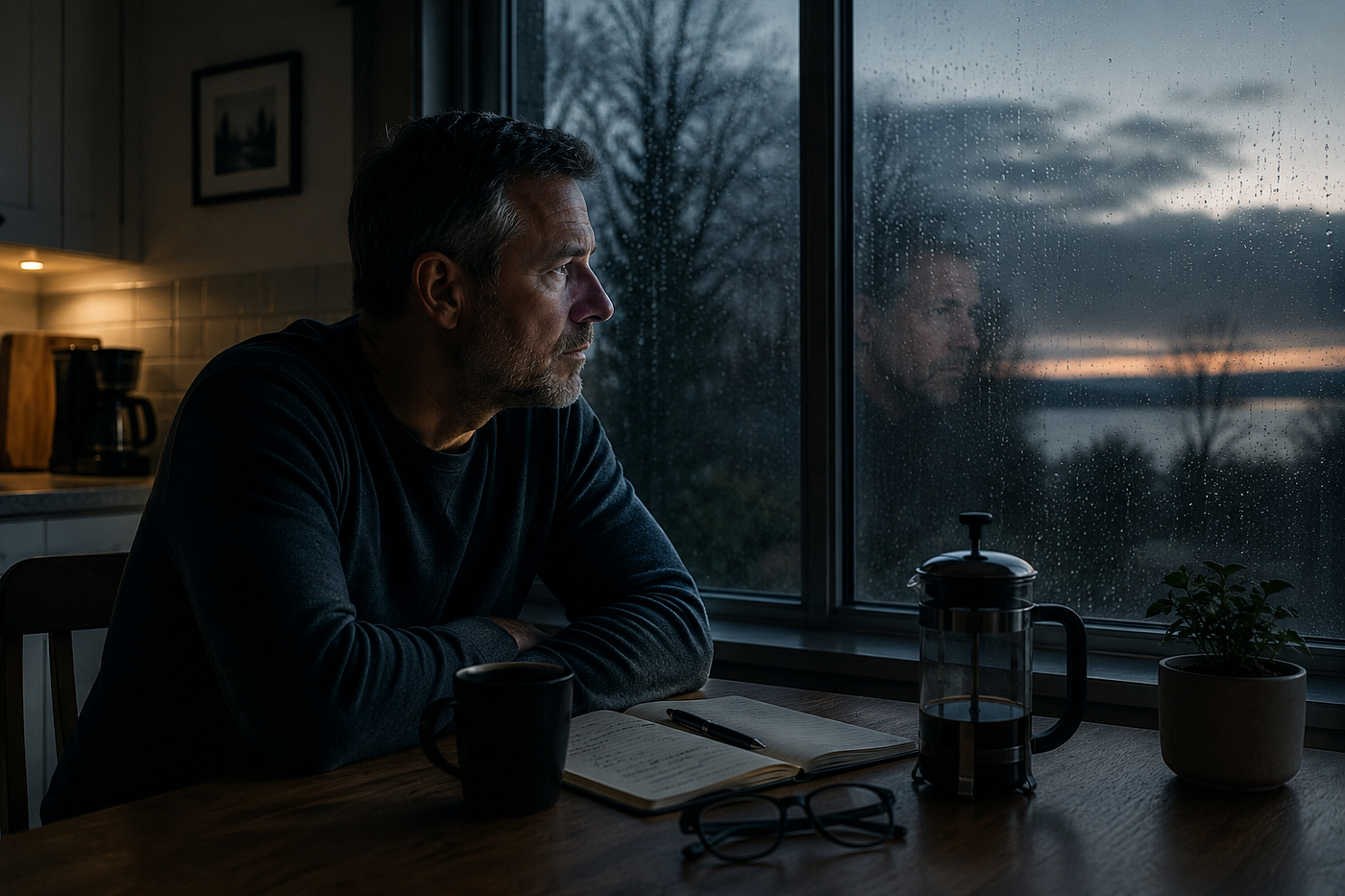
Yesterday morning, I stood in the kitchen longer than I needed to, holding a cup of coffee that had gone cold.
The rain had come back overnight after nearly a week of rare Seattle brightness. For a few days, the city had seemed briefly rearranged by sunlight. Paddleboards returned to Lake Washington. Waterfront restaurants stayed crowded later than usual. People lingered outdoors with that slightly desperate Pacific Northwest gratitude, as if trying to store light in their bones before the clouds reclaimed it.
Now the sky had settled back into gray.
Rain moved through the cedar trees behind our house while I stood there thinking about too many things at once. A patient I was worried about. An unfinished draft. A text from my daughter, I could not remember answering. The odd sense that I sometimes pass through entire mornings without quite arriving inside them.
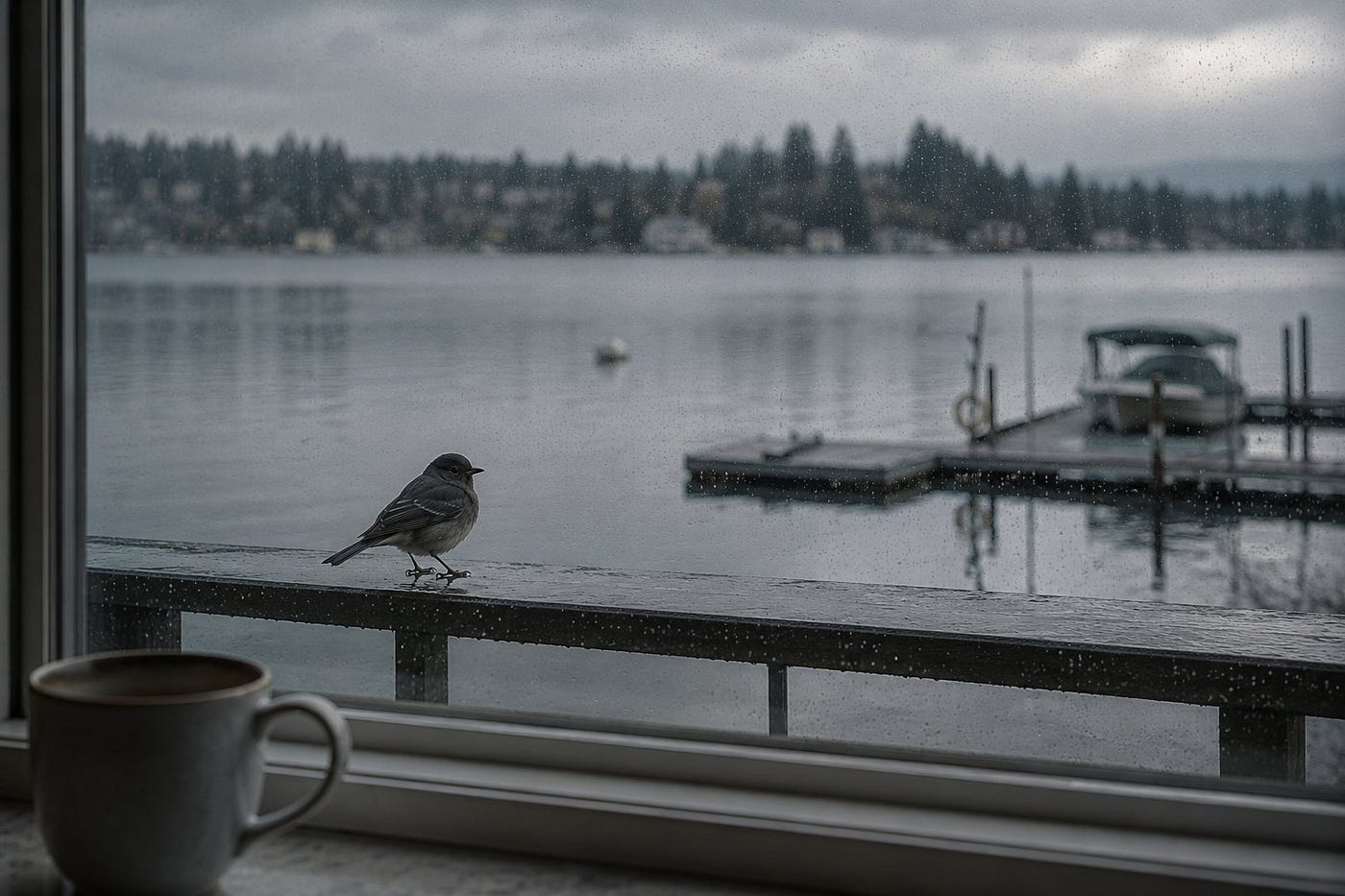
Then a small bird landed on the railing outside the window.
Dark head. Gray back. Pale underside. A junco, I thought, though bird identification still feels to me like a form of practical intelligence I somehow missed. My father would have known immediately. He noticed everything: bird calls, weather shifts, tiny changes in the water before the rest of us saw anything different. He belonged to a generation that spent long stretches of life paying attention to the world without needing to convert every observation into data.
The bird stayed longer than I expected, shifting slightly on the wet railing while the rain continued behind it.
And during those few quiet seconds, I noticed how loud my own mind had been.
Not panicked. Not miserable. Just busy. Continuously busy in the way many modern minds now seem to be. One thought slipping under the next. Plans mixed with memories. Old conversations resurfacing for no obvious purpose. The automatic urge to reach for the phone the moment silence opens a small door.
Lately, I have wondered whether many of us live this way so constantly that we no longer recognize it as a condition.
A while back, I wrote about why modern attention feels increasingly fragmented and why so many people now describe themselves as mentally overloaded despite functioning normally on the surface. The response from readers was immediate because many recognized the feeling before they fully understood it. That earlier **essay lives here**
If these reflections resonate with you, I write weekly about attention, overload, physiology, and the quieter habits that help people feel more like themselves again → **Kit newsletter**
The Mind Rarely Sits Still Anymore
One of the stranger shifts of the past decade is how completely technology has occupied moments that once belonged to simple observation.
People used to spend parts of their daily lives merely noticing things. Looking out train windows. Standing in line with nothing to do. Sitting quietly after dinner while the weather moved across the yard. Walking slowly enough to register gardens, dogs sleeping beneath trees, the changing angle of evening light against buildings.
Now, almost every empty interval gets filled immediately.
Waiting becomes scrolling. Walking becomes consumption. Exercise becomes another opportunity for input. Even rest arrives layered with podcasts, notifications, headlines, videos, messages, and background noise. The nervous system spends remarkably little uninterrupted time in direct contact with the physical world anymore, as attention is continuously occupied by language, anticipation, memory, planning, and self-monitoring.

I notice this constantly in myself.
Not long ago, I was walking along the water on Mercer Island while listening to a podcast about cognitive resilience. Halfway through, I realized I could not remember a single detail about the lake beside me. I had moved physically through the landscape without ever fully entering it mentally, which struck me afterward as sad in a way I found hard to explain.
In medicine, people often describe something similar indirectly.
They say they feel foggy. Distracted. Mentally tired in ways sleep does not fully repair. Sometimes there are clear explanations: burnout, depression, medications, sleep apnea, anxiety, hormonal changes, and post-viral syndromes. Occasionally, something more serious.
But often what people describe feels harder to quantify.
Their attention never fully settles anywhere. Thoughts continue moving beneath experience almost continuously, as though the mind has forgotten how to loosen its grip on itself for more than a few moments at a time.
Why the Bird Stayed With Me
Neuroscientists sometimes describe a system called the default mode network, involved in memory, internal narration, future planning, and self-referential thought. None of that is unhealthy by itself. Human beings need reflection. We need imagination, memory, and the ability to think ahead.
What modern life seems less capable of providing is interruption.
Something is always waiting now. Some incoming message. Some unfinished obligation sits quietly in the background while attention attempts to rest. Even during moments that are supposed to feel restorative, part of the mind often remains slightly alert, still organizing, anticipating, or monitoring something.
Which may be part of why that small bird stayed with me afterward.
Not because nature magically cures exhaustion. Not because birds possess hidden therapeutic powers. The explanation is probably more ordinary than that. For several moments, my attention moved fully away from myself.
I was not evaluating my life while watching the bird. I was not mentally revising the past or rehearsing the future. I was simply watching something alive exist quietly in the rain. The feeling was strangely relieving, disproportionate to the moment itself.
The older I get, the more I suspect many people miss this kind of outward attention without fully realizing it. So much of modern life now unfolds inside language, planning, memory, performance, and self-monitoring that even brief moments of uncomplicated observation can feel restorative.
The obligations did not disappear afterward. The emails still waited. The day ahead remained exactly the same. But for a short period of time, the constant mental narration softened, and my mind stopped circling itself quite so tightly.
Looking Outward Changes the Texture of Life
Children still know how to do this naturally. They stop to watch ants cross sidewalks. They crouch beside puddles. They follow birds with complete concentration for reasons adults no longer fully understand. Somewhere along the way, many people lose that capacity and replace it with the persistent feeling that every moment should be useful somehow.
I suspect this is partly why travel affects people so deeply.
Last year in Italy, I found myself noticing details I routinely overlook at home: laundry moving between buildings in afternoon wind, elderly couples sitting quietly in public squares, the sound of dishes drifting from restaurant kitchens late at night. People appeared less psychologically hurried there. They seemed more willing to remain where they were physically rather than mentally move several hours ahead of themselves.

The older I get, the more I suspect the nervous system experiences modern life as a form of continuous low-grade vigilance. Attention remains partially braced all day long against incoming information, unfinished responsibilities, and the next demand waiting just beyond immediate awareness.
Which may explain why certain ordinary moments now feel oddly restorative.
Rain is moving through the cedar branches outside the kitchen window. Geese crossing low over the water before sunrise. A bird is balancing quietly on a wet railing while, for several seconds at least, the mind stops trying to organize the future. None of those moments solves anything permanently. The obligations remain exactly where we left them.
But occasionally, the nervous system seems to loosen slightly when attention leaves the self long enough to encounter something beyond it fully.
Final Thoughts
Medicine understandably searches for increasingly sophisticated ways to reduce human suffering. Many of those advances are extraordinary and deeply important. At the same time, some parts of physiology still seem remarkably responsive to very old conditions: sunlight, movement, sensory variation, companionship, quiet, and periods of attention that are not continuously divided across multiple directions at once.
The modern wellness industry often frames health as a project of constant self-management. More tracking. More monitoring. More vigilance directed inward. Even self-care can begin to feel strangely effortful after a while, as though the nervous system is being asked to recover through yet another layer of cognitive work.
Yet sometimes the mind may need the opposite for a little while.
Not the elimination of thought. Not permanent calm. Just temporary relief from the exhausting habit of continuously managing the self from inside the self. A few moments in which attention settles naturally onto something beyond personal productivity, optimization, or internal narration.
Yesterday morning, I was reminded of that by a small bird standing quietly in the rain.
If you want to stay with these ideas a little longer, I write more each week about attention, overload, physiology, and the quieter habits that help people recover steadiness in modern life → **Subscribe here**
Michael Hunter, MD, is a radiation oncologist who writes about health, attention, and how small, quiet changes reduce strain before burnout. His work focuses on what actually helps people feel better in real life.
메타데이터
- post_id
- eb91d6bf25c4
- slug
- your-brain-was-never-meant-to-stay-inside-itself-all-day-eb91d6bf25c4
- url
- https://medium.com/dr-michael-hunters-wellness/your-brain-was-never-meant-to-stay-inside-itself-all-day-eb91d6bf25c4
- canonical_url
- https://medium.com/dr-michael-hunters-wellness/your-brain-was-never-meant-to-stay-inside-itself-all-day-eb91d6bf25c4
- author_url
- https://medium.com/@drmichaelhunter
- status
- ok
- fetched_at
- 2026-06-09 15:37:30