The Sneakerina Takeover: 7 Reasons Japan Just Fused the Ballet Flat With the Everyday Sneaker
I noticed it first on the Chiyoda Line, somewhere between Otemachi and Nijubashimae, in the seven-minute window when the morning train…
The Sneakerina Takeover: 7 Reasons Japan Just Fused the Ballet Flat With the Everyday Sneaker
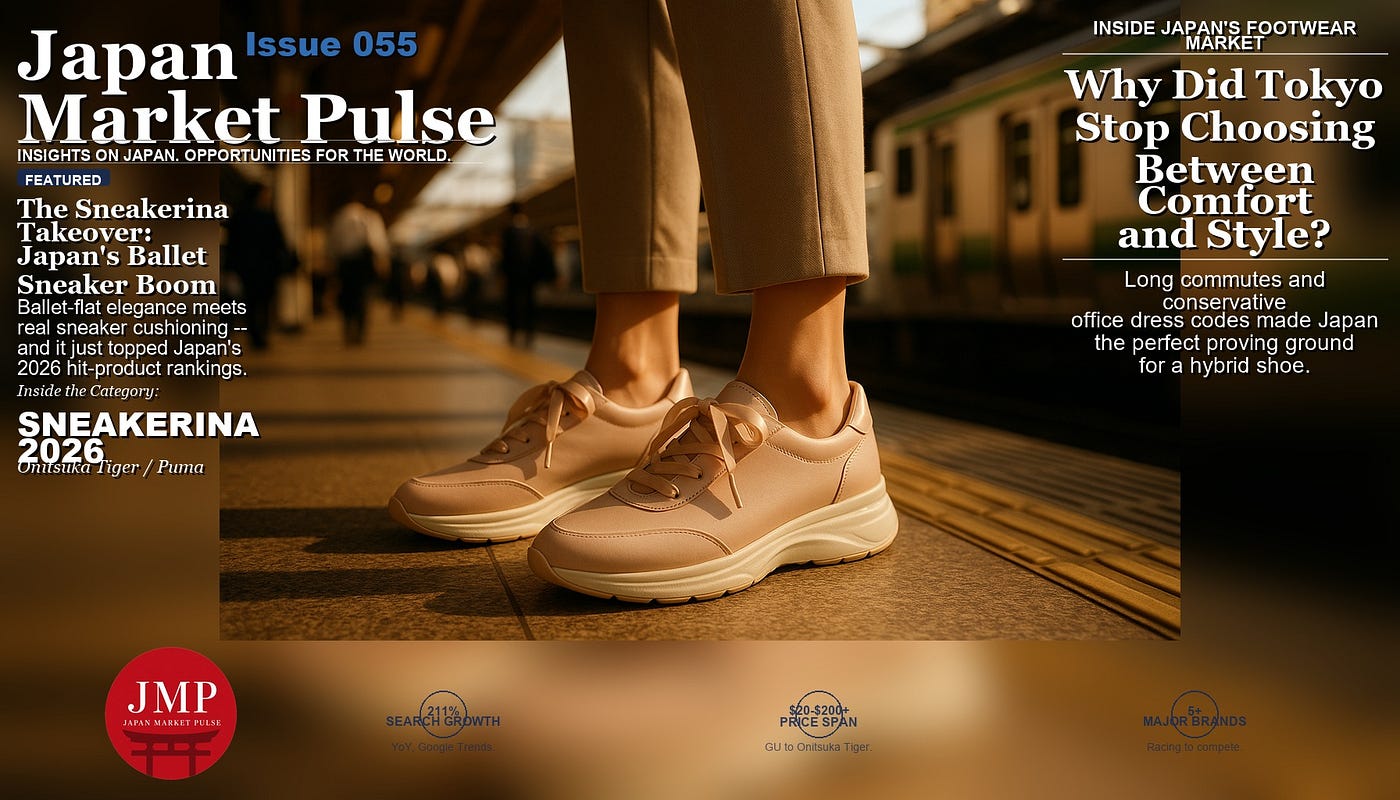
I noticed it first on the Chiyoda Line, somewhere between Otemachi and Nijubashimae, in the seven-minute window when the morning train fills with people who are dressed for meetings but walking like they have somewhere far to be. Twenty years ago, that meant white sneakers paired awkwardly with a suit, swapped out for pumps at the office. This spring, it meant something else entirely: flat, satin-trimmed shoes with the unmistakable silhouette of a ballet slipper, except they had laces, rubber soles, and — on closer inspection — the kind of cushioned midsole you’d expect on a running shoe. Nobody was carrying a second pair of heels in a tote bag. Nobody needed to.
That shoe has a name now, several names actually, depending on who you ask. In Japan it’s simply “ballet sneakers.” In the English-language fashion press it’s “sneakerina,” a portmanteau that sounds like it was coined by a committee but has stuck anyway, racking up a 211% jump in global search interest over the past year according to Google Trends data. Whatever you call it, the category — flat ballet-shoe elegance welded onto sneaker-grade comfort — was one of the defining stories of Japan’s 2026 first-half retail cycle, and it says more about where footwear is headed than any single product launch could.
I’ve spent two decades in Tokyo watching trends arrive, mutate, and either disappear or become permanent fixtures of how this city dresses. The ballet sneaker has all the signs of the latter. Here’s what’s actually happening, who’s making money from it, and why American retailers and brand managers should be paying closer attention than they probably are.
1. What Exactly Is a “Sneakerina,” and Why Is Tokyo Suddenly Full of Them?

Strip away the marketing language and the idea is almost embarrassingly simple: take the low-cut, rounded-toe elegance of a ballet flat — the shoe that has signaled “polished but comfortable” in womenswear for decades — and rebuild the sole, the lacing system, and the internal cushioning using the construction techniques of a performance sneaker. The result looks like a ballet shoe from six feet away and feels like a lifestyle sneaker from the inside.
This isn’t a completely new idea. Hybrid ballet-sneaker silhouettes have circulated in niche fashion circles since around 2024, largely thanks to the broader “balletcore” aesthetic — all that soft pink, wrap tops, and leg-warmer styling that filtered down from runway shows into everyday closets. What changed in 2026 is that the idea graduated from aesthetic trend to genuine product category, with real engineering behind it. Louis Vuitton formally named its own version “Sneakerina” in 2025, effectively planting a flag and daring the rest of the industry to follow. They did. Adidas, Puma, Nike, Salomon, and Onitsuka Tiger all put out athletic interpretations through the following twelve months, while Miu Miu and other luxury houses pushed a more delicate, satin-forward reading of the same idea.
The celebrity amplification helped, as it always does — Rihanna, Bella Hadid, Dua Lipa, Zendaya, and Hailey Bieber have all been photographed in some version of the silhouette over the past year, according to fashion press coverage, which is exactly the kind of unpaid marketing that turns a niche shoe into a category. But what’s interesting from a Japan-market perspective is that the trend didn’t need celebrity culture to take hold here. It needed something much more mundane: a commute.
2. The Verdict: How Ballet Sneakers Conquered Japan’s Hit Product Rankings

Twice a year, a closely watched national hit-products ranking takes stock of what actually moved units and captured attention in Japan over the preceding six months. It’s not a popularity contest decided by editors; it’s assembled from sales data, search volume, and retail buyer sentiment, which is why brand strategists across the industry treat it as a genuine signal rather than a puff piece.
The 2026 first-half ranking crowned “Hormuz Shock” — the supply disruption tied to Middle East tensions that rippled into daily consumer prices — as the top story on one side of its sumo-style ladder, and the 30th anniversary of Pokémon on the other. The organizing theme editors settled on for the half was, cleverly, “a storm of P’s” — Pokémon, Price, and Premium, three forces that shaped what Japanese consumers bought and why.
Footwear doesn’t usually crack the top tier of these rankings, which tend to be dominated by consumer electronics, food products, and cultural phenomena. But ballet sneakers made a real showing in the shoe and fashion sub-categories this cycle, and the reasoning tracks neatly with that “P” framework. It’s a Premium story, in the sense that the category pulled meaningfully upmarket price points into the mainstream. And it’s a Price story too, in a subtler way: in a half-year defined by import cost pressure and household budget anxiety, a shoe that lets someone retire a second pair of work pumps — one less purchase, one less thing to carry — reads as a practical win dressed up as a fashion one.
That combination, style you don’t have to apologize for and a genuine reduction in the number of shoes you need to own, is precisely why retail buyers across department stores and fast-fashion chains alike stocked up on the category through the spring.
3. Inside the Design Lab: Onitsuka Tiger’s Gymnarina and the Heritage Playbook

If you want to see how a legacy sportswear brand approaches this category with real engineering intent rather than a marketing sticker, look at Onitsuka Tiger’s Gymnarina, which launched at Onitsuka Tiger stores nationwide and on the brand’s official online store on June 26, 2026, priced at roughly $200.
What makes the Gymnarina worth studying is how deliberately it borrows from the brand’s own archive rather than inventing a silhouette from nothing. It carries over the crossed-heel detailing, the structured heel flap, and the signature side stripes from the Mexico 66 — Onitsuka Tiger’s most recognizable running shoe, originally built for the 1968 Olympic pre-trials — and reshapes them onto a lower, ballet-inspired last. The shoe ships with two separate lacing options: classic flat laces with metal aglets for a sportier read, or wide satin ribbons for the softer, more romantic balletcore look. Swap the laces, change the mood, no second pair required. Colorways range from sport-standard black, blue, and red through to metallic silver and rose gold finishes clearly aimed at the going-out crowd rather than the office commuter.
That two-in-one lacing system is a small design decision that tells a bigger story: Onitsuka Tiger isn’t treating this as a limited fashion drop. It’s positioning the Gymnarina as a piece of everyday wardrobe infrastructure, something a customer wears to the office on Monday with flat laces and to dinner on Friday with ribbons, using the exact same shoe. For a brand whose modern identity leans heavily on heritage running silhouettes, that’s a meaningful bet on a genuinely new customer occasion. American shoppers curious about the model can currently find Onitsuka Tiger’s ballet-sneaker lineup on Amazon, where inventory has been filling in gradually as the line rolls out internationally.
4. Puma’s Speedcat Ballet and the Sell-Out-in-Minutes Phenomenon

Where Onitsuka Tiger is playing a heritage-brand long game, Puma has turned its Speedcat Ballet into the trend’s fastest-moving commercial success story — and one with an origin story that has almost nothing to do with ballet at all. The original Speedcat was designed more than 25 years ago as a fireproof driving shoe for Formula 1, built for precision pedal feel rather than street style. Puma’s decision to graft that low-profile racing silhouette onto a ballet-flat shape, complete with a suede upper, an embroidered cat logo, and elastic side bands for a snug, sock-like fit, turned out to be one of the smarter mash-ups in recent sportswear memory.
In the US, the Speedcat Ballet has generally retailed in the roughly $90 range at launch, with markdowns appearing at outlets like Foot Locker once initial drops clear. In Japan, the story has looked different: drops in Harajuku and other flagship locations have reportedly sold out within minutes, with local retailers receiving smaller allocations than the US market and international collaborative colorways rarely making it to Japanese shelves at all. That scarcity dynamic — high demand chasing thin, unpredictable inventory — has done as much for the shoe’s cultural cachet in Tokyo as any advertising campaign could.
It’s worth noting that Puma isn’t selling the Speedcat Ballet as a runway curiosity. It’s positioned squarely as a lifestyle sneaker, sold alongside the brand’s core running and training lines, which signals that Puma expects this category to have staying power rather than functioning as a single-season fashion moment. If you want to see the model up close, Puma’s Speedcat Ballet is available directly through Amazon in several colorways, alongside the suede version favored by resellers tracking the Japan restock cycle.
5. The Comfort Psychology: Why Japanese Commuters Are the Ideal Customer
It’s tempting to file all of this under pure fashion trend-chasing, but that undersells what’s actually going on in the Japanese market specifically. Tokyo’s average one-way commute time regularly ranks among the longest of any major global city, and a meaningful share of that time is spent walking — to the station, through transfer corridors, and from the final stop to the office. For decades, the compromise for working women in particular was well documented and almost universally shared: wear comfortable shoes for the commute, then change into something presentable once you arrive, or simply endure the discomfort of dress shoes for eight or more hours because carrying two pairs is impractical.
Ballet sneakers collapse that trade-off. They read as appropriate for a reasonably formal Japanese office environment — flat, unfussy, closer in silhouette to a traditional pump than to a chunky trainer — while delivering the internal cushioning and structural support of genuine athletic footwear. That’s not a small thing in a culture where office dress norms remain more conservative than in much of the US, and where the unspoken rule for years has been that comfort and professionalism exist in some tension with each other.
What I’ve heard consistently from friends and colleagues here, unprompted, is a version of the same sentence: “I can wear these all day and my feet don’t hurt by the time I get home.” That’s not a fashion review. It’s a functionality review, and it’s precisely the kind of word-of-mouth endorsement that turns a seasonal trend into a wardrobe staple. Comfort-driven purchasing has quietly been one of the strongest undercurrents in Japanese retail for several years now — you can see it in the runaway popularity of orthopedic-adjacent sneaker brands and cushioned walking shoes in past seasons — and the ballet sneaker category is arguably the most elegant solution that undercurrent has produced so far.
6. The Price Ladder: From ¥2,990 Fast Fashion to $200 Heritage Leather
One of the more revealing aspects of this trend is how completely it spans the price spectrum, with almost no gap in coverage between the bottom and the top. Fast-fashion retailer GU has offered ballet-sneaker styles starting from around ¥2,990 (roughly $20), aimed squarely at the entry-level, trend-testing shopper who wants the look without the commitment. ZARA Japan sits a step up, with satin-detailed ballet-flat sneakers in the neighborhood of ¥6,290 (about $42), positioned as a slightly more considered purchase but still very much impulse-buy territory.
From there, the ladder climbs quickly into sportswear-brand territory. Puma’s Speedcat Ballet occupies the roughly $90-$100 tier, the classic “invest a little more for a recognizable name and better materials” zone that has always driven sneaker culture. Onitsuka Tiger’s Gymnarina sits meaningfully higher, at around $200, justified by its leather construction, dual-lacing system, and direct lineage to an archival running silhouette rather than a seasonal design exercise. Above that sits the luxury tier entirely — Miu Miu’s satin Plume sneakers and Louis Vuitton’s own Sneakerina line, priced well into four figures in US dollars, functioning less as everyday footwear and more as the aspirational top of the category that makes everything below it look like smart value by comparison.
That kind of full-spectrum price coverage is unusual for a footwear micro-trend, and it’s a big part of why department stores and fast-fashion chains alike found space for it on their shelves simultaneously rather than fighting over a single price tier. Everyone in the retail chain, from ¥2,990 up to $200 and beyond, found a version of the story that worked for their customer.
It also helped that this arrived at a moment when the broader Japanese footwear category was already gaining ground. Japan’s domestic shoe and footwear retail market was estimated at roughly ¥1.24 trillion for the 2024 fiscal year, essentially flat in unit terms but up slightly in value, with industry analysts attributing the growth almost entirely to rising average unit prices driven by sneaker demand and a broader shift toward higher-value purchases. Ballet sneakers, in other words, weren’t creating new footwear spending out of nothing — they were capturing a share of a market that was already primed to trade up.
7. What This Means for Footwear Brands and Retailers Watching From Abroad
For American footwear brands and retail buyers, the lesson here isn’t “launch a ballet sneaker” — plenty of companies are already doing exactly that, and the market will sort out which versions have staying power. The more useful lesson is about what made this particular hybrid category durable rather than fleeting: it solved a genuine, unglamorous daily problem — commute comfort versus office appropriateness — with a product that also happened to look good on Instagram.
That combination, functional necessity plus aesthetic upside, is a much sturdier foundation than aesthetic trend alone. Trends built purely on visual novelty tend to have a shelf life measured in a single fashion cycle. Trends that also quietly fix something people were already frustrated about tend to stick around, get iterated on, and eventually stop being treated as a “trend” at all and start being treated as a permanent shelf category, the way athleisure did roughly a decade ago.
For brands evaluating whether to bring a similar hybrid to the US market, Japan’s spring 2026 cycle offers a useful test case: watch which price tiers moved fastest (the mid-range sportswear tier, based on what retailers here have reported), which design details customers actually cared about (the dual-lacing, styling-flexibility idea from Onitsuka Tiger is worth studying closely), and which retail channels captured the most volume (fast fashion for trial purchases, sportswear specialty and department stores for the considered, longer-term purchase). None of that requires guesswork. It’s already playing out in Tokyo storefronts right now.
Frequently Asked Questions
Q. Where can I buy Onitsuka Tiger’s Gymnarina or Puma’s Speedcat Ballet in the US?
A. Both are available through official brand websites and select US retailers. Onitsuka Tiger’s ballet-sneaker styles can also be found on Amazon, and Puma’s Speedcat Ballet is sold directly through Amazon in several colorways, which tends to be the fastest way to check current US stock without waiting on a Japan-specific restock.
Q. How much do ballet sneakers typically cost?
A. The category spans an unusually wide range. Fast-fashion versions from retailers like GU start around $20, sportswear interpretations like Puma’s Speedcat Ballet run roughly $90-$100, heritage designs like Onitsuka Tiger’s Gymnarina sit near $200, and luxury versions from houses like Miu Miu or Louis Vuitton climb into four figures.
Q. Why is this trend especially strong in Japan right now?
A. Long average commute times and relatively conservative Japanese office dress norms have historically forced a trade-off between comfortable footwear and professional appearance. Ballet sneakers largely eliminate that trade-off, which is why the category has resonated as functional wardrobe solution rather than a passing aesthetic fad.
Q. Are ballet sneakers actually comfortable enough for all-day wear?
A. Based on the models built by established sportswear brands — Puma and Onitsuka Tiger among them — yes, generally. These aren’t reskinned ballet flats; they use genuine sneaker-grade midsoles and cushioning systems, which is the entire point of the hybrid engineering. Ultra-thin fast-fashion versions vary more in comfort and durability.
Q. Is the ballet sneaker trend likely to last beyond 2026?
A. Early signs point to yes. The category has moved beyond a single celebrity-driven aesthetic moment into genuine product infrastructure — multiple major brands now carry it as a permanent lifestyle line rather than a limited seasonal drop, and the underlying comfort-versus-formality problem it solves isn’t going away.
Conclusion
Standing on that Chiyoda Line platform, what struck me wasn’t really the shoes themselves — Tokyo produces footwear trends constantly, and most of them cycle through in a season or two. It was how unremarkable the ballet sneakers looked on the people wearing them. Nobody was making a statement. They were just walking to work in shoes that happened to look sharp and feel fine, which is a much higher bar to clear than looking sharp alone. Japan’s 2026 hit-product rankings rewarded a lot of flashier stories this cycle — a geopolitical price shock, a beloved franchise’s 30th birthday — but the ballet sneaker earned its place on that list the old-fashioned way, by quietly solving a problem millions of people deal with every single morning.
This article contains affiliate links. If you purchase through these links, we may earn a small commission at no extra cost to you.
If you’re interested in this topic, the Japanese market more broadly, or what KETCHUPs is working on, we’d love to hear from you — please reach out via our contact form.
Japan Market Pulse is a weekly read on what the Japanese consumer-tech, food, and mobility markets are choosing to do, written for international operators who want to know what is happening before it shows up in the global trade press.
Subscribe at ketchups.co/japan-market-pulse.
Originally published at https://ketchups.co on July 11, 2026.
메타데이터
- post_id
- ebacd2ec7d96
- slug
- the-sneakerina-takeover-7-reasons-japan-just-fused-the-ballet-flat-with-the-everyday-sneaker-ebacd2ec7d96
- url
- https://medium.com/@kaihori/the-sneakerina-takeover-7-reasons-japan-just-fused-the-ballet-flat-with-the-everyday-sneaker-ebacd2ec7d96
- canonical_url
- https://medium.com/@kaihori/the-sneakerina-takeover-7-reasons-japan-just-fused-the-ballet-flat-with-the-everyday-sneaker-ebacd2ec7d96
- author_url
- https://medium.com/@kaihori
- status
- ok
- fetched_at
- 2026-07-15 07:25:57