Harness Engineering: The Missing Layer in AI Security Automation
Most discussions about AI security tooling focus on the model: prompts, reasoning quality, tool use, and autonomy. But in practice, the…
Harness Engineering: The Missing Layer in AI Security Automation
Most discussions about AI security tooling focus on the model: prompts, reasoning quality, tool use, and autonomy. But in practice, the model is only one part of the system.
The more important engineering problem is the harness around the model.
A harness turns an AI assistant into a controlled, observable, evidence-producing workflow. It defines scope, manages execution, records artifacts, validates claims, handles failure, and produces reports that humans can trust.
Without a harness, an AI security tool is just a smart conversation. With a harness, it becomes an assessment system.
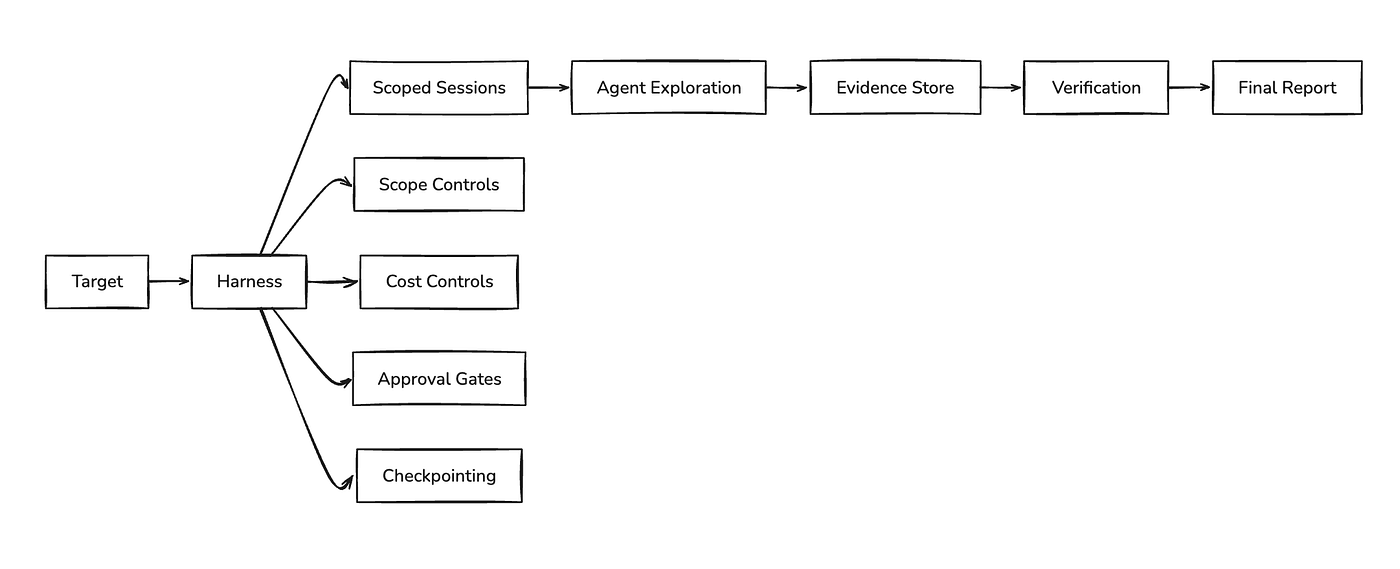
Harness Flow
The Problem With Unbounded Agents
An agent can crawl an application, inspect endpoints, generate payloads, use browser automation, and propose vulnerabilities. That sounds powerful, but it immediately raises hard questions.
Did it stay in scope?
Which tool call produced the finding?
Was the target unstable?
Is the evidence durable?
Can the run be resumed?
Are two findings duplicates?
Is this a confirmed vulnerability or just a hypothesis?
Can another engineer review or reproduce the result?
These questions are not solved by better prompting alone. They require harness engineering.
The Run Directory Is The System Boundary
A strong harness treats each run as a durable artifact.
Every assessment should create a structured run directory with session workspaces, evidence files, transcripts, tool-call logs, recovery state, verifier inputs, and final summaries.
This turns the filesystem into part of the contract. The run is no longer an ephemeral chat. It becomes inspectable, replayable, and reportable.
A good run directory answers: what happened, when it happened, what was observed, what evidence was saved, and what the final system believed.
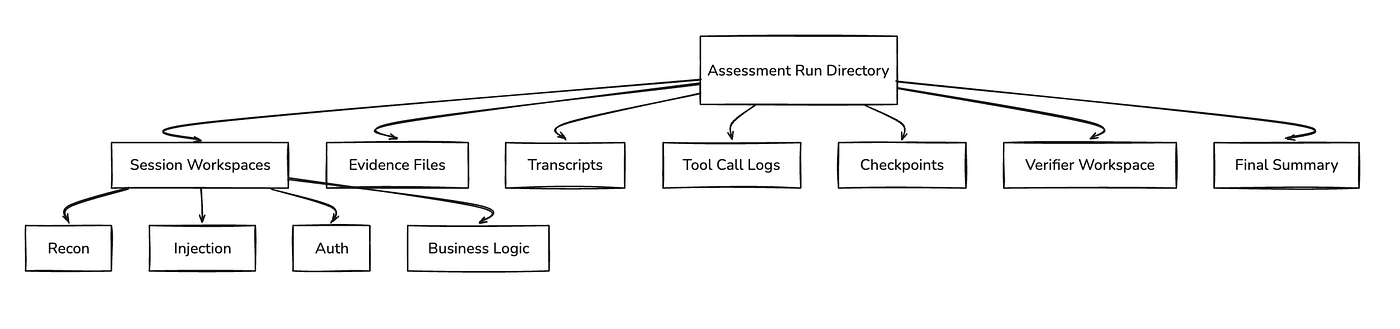
Run Directory As Durable State
Break Autonomy Into Bounded Sessions
One large “test everything” agent run is difficult to control. A better pattern is to split the work into focused sessions.
For example:
-
Reconnaissance
-
Injection testing
-
XSS testing
-
Authentication testing
-
Authorization testing
-
Misconfiguration review
-
Exposure discovery
-
Business logic testing
-
Upload testing
-
Stateful workflow testing
Each session gets its own budget, workspace, prompt contract, expected output shape, transcript, and evidence folder.
This makes autonomy manageable. A failed session does not destroy the whole run. Recon can guide later sessions. High-signal areas can be prioritized. Cost and retry behavior can be controlled per focus area.
Harness engineering often means making autonomous work smaller and more structured.
Prompts Should Behave Like Contracts
In a mature harness, prompts are not just instructions. They define contracts.
A session should be required to return structured output in a known schema. If the output is missing, malformed, or incomplete, the harness should not blindly accept it.
It can attempt controlled repair using only local artifacts. If repair fails, it should retry, checkpoint, or mark the session as failed.
This is a key principle: model output should be parsed, validated, and gated before it becomes system state.
Evidence Comes Before Conclusions
The harness should treat evidence as a first-class object.
A useful finding needs more than a title and severity. It needs supporting artifacts: request and response details, payloads, baseline behavior, probe behavior, response differences, screenshots, browser
observations, logs, and reproduction notes.
The system should preserve raw evidence separately from summarized conclusions.
This distinction matters. A finding without evidence is a claim. A finding with durable artifacts becomes reviewable engineering data.
Separate Finding Generation From Verification
Agents are good at exploration. They are not always good at final judgment.
A strong harness separates candidate generation from validation.
The first phase produces possible findings. The second phase deduplicates them, checks evidence strength, applies deterministic verifiers, compares against artifacts, and classifies each candidate.
Useful verdict states include:
-
Confirmed
-
Needs manual validation
-
False positive
-
Duplicate
-
Suppressed
-
Informational
This separation prevents reports from treating every model-generated observation as a vulnerability.
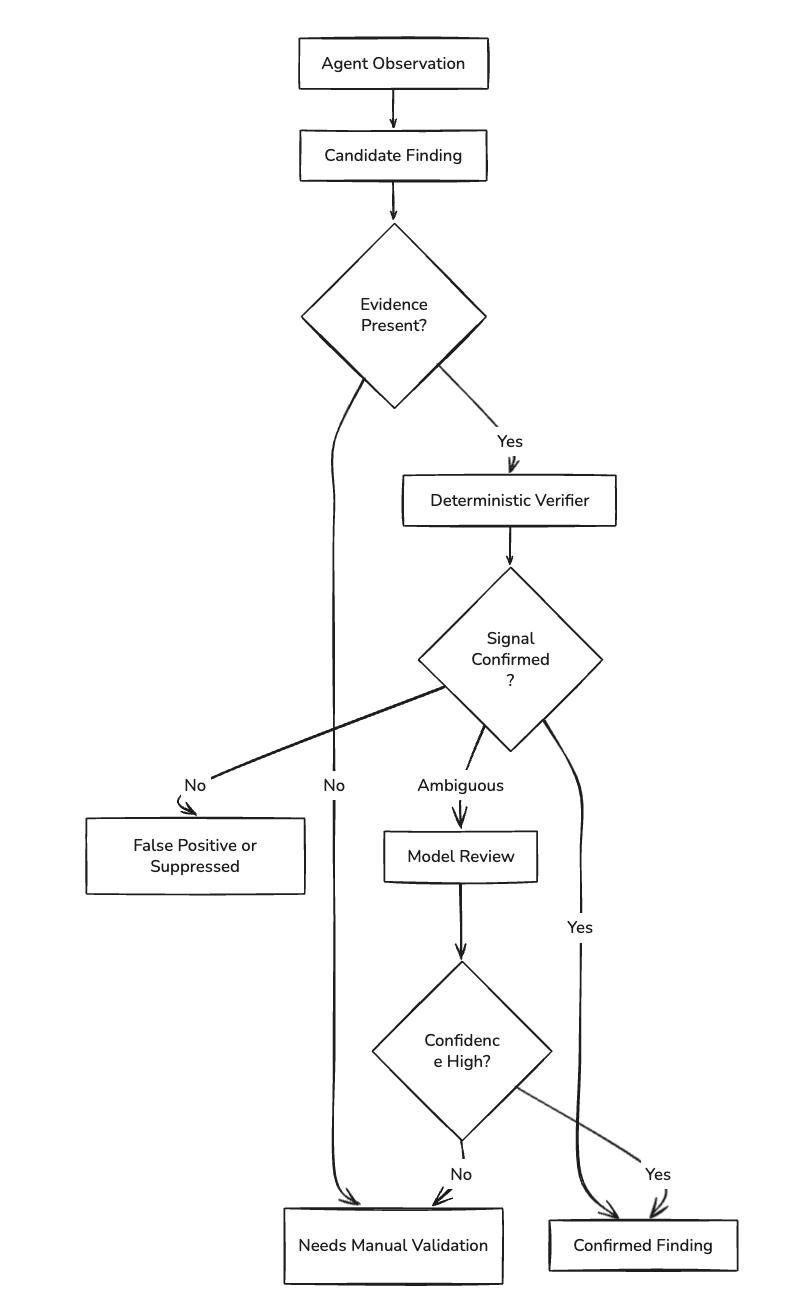
Candidate To Verified Finding
Use Deterministic Checks Wherever Possible
Not every decision should go back to a model.
If a candidate claims SQL injection, look for payload-specific database errors or response deltas. If it claims XSS, check whether the payload actually reflected or executed in the right context. If it claims
missing headers, verify the headers directly.
Models can help reason over ambiguous evidence, but deterministic checks should handle clear cases first.
The strongest validation pipeline combines both: deterministic verifiers for hard signals, model judgment for nuanced review, and human approval for risky or ambiguous actions.
Make The Event Trail Observable
A harness should maintain an append-only event log for the run.
Events might include:
-
Run started
-
Session started
-
Tool selected
-
Tool executed
-
Evidence added
-
Scope changed
-
Candidate produced
-
Verification completed
-
Report generated
-
Run checkpointed
This gives operators a timeline. It also gives later sessions useful memory without dumping every raw transcript back into context.
For security-sensitive workflows, the event trail can be hash-chained to make tampering detectable.
Checkpointing Is Not Optional
Long-running autonomous workflows fail for normal reasons: network issues, provider errors, target instability, browser failures, budget limits, or operator interruption.
A production-grade harness should checkpoint aggressively.
A checkpoint should preserve completed sessions, remaining sessions, current cost, elapsed time, retry state, crash context, and run identity.
Resume support changes the operator experience completely. A failed run becomes recoverable instead of wasted.
Scope, Safety, And Cost Are Runtime Controls
A harness needs explicit controls.
Scope controls prevent out-of-scope network activity.
Approval controls gate high-risk or state-changing actions.
Cost controls stop runaway sessions.
Target health controls stop testing when the application begins failing.
Sandbox controls reduce the blast radius of external tools and generated commands.
These controls should not live only in the prompt. They should be enforced by the runtime.
Treat External Tools As Untrusted
Modern AI systems often use browser automation, local tools, APIs, and external tool servers. Those tools increase capability, but they also increase risk.
A good harness treats external tool output as untrusted.
Raw output should be quarantined as evidence. Sanitized summaries can enter model context. Tool schemas, descriptions, prompts, resources, and results should be inspected before use.
State-changing tools should require explicit approval. Tool behavior or schema drift should require re-approval.
The model should never directly inherit trust from a tool.
The Final Output Should Be An Artifact Graph
The best output of an AI assessment is not just a written report. It is a structured artifact graph.
That graph can include:
-
Raw candidates
-
Endpoint coverage
-
Evidence references
-
Finding clusters
-
Attack chains
-
Verification context
-
Final verdicts
-
Report summaries
This makes the result usable by humans and machines. Reports, dashboards, CI systems, retest workflows, and governance processes can all consume the same structured output.
The Core Lesson
The future of AI security automation will not be defined only by better models. It will be defined by better harnesses.
The model explores. The harness controls.
The model proposes. The harness verifies.
The model summarizes. The harness preserves evidence.
The model reasons. The harness makes the work auditable.
That is the difference between an impressive demo and a system engineers can trust.
Thats all for now folks….
메타데이터
- post_id
- ebb089f74e4b
- slug
- harness-engineering-the-missing-layer-in-ai-security-automation-ebb089f74e4b
- url
- https://medium.com/@grvmukherjee12/harness-engineering-the-missing-layer-in-ai-security-automation-ebb089f74e4b
- canonical_url
- https://medium.com/@grvmukherjee12/harness-engineering-the-missing-layer-in-ai-security-automation-ebb089f74e4b
- author_url
- https://medium.com/@grvmukherjee12
- status
- ok
- fetched_at
- 2026-06-21 12:17:11





