THE SIGNIFICANT POLITICAL DEVELOPMENTS IN BORNO DURING THE LAST QUARTER OF THE 19TH CENTURY
The tale of significant political developments in Bornu during the period under review has been a dialogue among academic scholars…
THE SIGNIFICANT POLITICAL DEVELOPMENTS IN BORNO DURING THE LAST QUARTER OF THE 19TH CENTURY
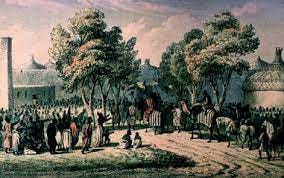
The tale of significant political developments in Bornu during the period under review has been a dialogue among academic scholars. Essentially, some of the political developments that characterized the period involved the Wadai invasion of Borno in 1846 which marked the beginning of the decline of Bornu and the rise of Wadai. The crisis of 1846 had been on one hand a struggle between factions for control of Bornu and on the other a struggle between Bornu and Wadai for control around the Lake Chad. Between 1846 and 1890 Wadai steadily brought Kanem and Bagirmi within its commercial and political orbit, under the overriding shadow of the Sanusiyya. Bornu, in 1800 the undisputed master of the central Sudan, was by 1890 little more than a small state between the two empires, the caliphate and Wadai. Also, Bornu suffered at the hands of an external invader, Rabeh who commanded the private troops of Zubair Pasha, an Egyptian slave trader, marched his army to the west and defeated Wadai, conquered Bagirmi and Borno, burnt Kukawa and established the capital of his empire at Dikwa.
From the outset, the Mai had resented the power of the Shehu. Twice Dunama had conspired to throw out al Kanami and twice the Shewu, showing great tact and diplomacy, had reinstated him. When Umar became Shehu in succession to his father in 1837, Dunama’s brother Ibrahim was the reigning Mai. Umar reduced the Mai’s revenues and exercised his power much more openly than his father had ever done. The personal hatred between Mai and Shehu reflected the Kanuri nobility’s jealousy of the influence and power of the wealth Shuwa and Kokenawa; it was this which led to the civil war in 1846.
When a revolt occurred in Zinder, Mai Ibrahim took advantage of the army preoccupation and opened secret negotiations with the ambitious Kolak of Wadai, Umar executed Mai Ibrahim, but the Kolak invaded Bornu and, supported by the Kanuri nobility, burnt Kukawa, drove Umar into exile, and installed a puppet Mai on the throne. However, the Kolak withdrew his army, on payment of 10,000 silver dollars, and possibly in return for Umar’s recognition of Wadai’s supremacy over Bagirmi and Kanem. The recently installed Mai, seventeen-year-old son of Ibrahim, and the last representative of the thousand-year old Seifawa dynasty, was killed in battle and Umar mounted the throne.
Although, Umar kept the title of Shehu, in every other way he took over the position of Mai, even to the elaborate court ritual which forced him into seclusion as it had the Sefawa before him. Power was entrusted to his Waziri, al-Hajj Bashir, son of a Shuwa who had been advisor to al –Kanami. Bashir became the power behind Umar’s throne just as the Shehus had been shadow rulers of the Mais, but his corruption and greediness kept alive the nobility’s hatred of the dominating Shuwa and led to a second attempt to overthrow them.
In 1883, Abd al-Rahman, ambitious for the throne, and seeking the support of the nobility, led a revolt against his brother, Umar. Bashir was executed and Umar was forced to abdicate. But through the loyalty of the army Umar regained his throne and lived until he was very old and blind. He was succeeded in turn by three of his sons. Another Shuwa, Waziri Abd al-Karim, rose in favour and confirmed Shuwa dominance in Bornu in the last quarter of the nineteen century. The division within the society resulting from the rivalry between Shuwa and Kanuri was a major cause of the decline of Bornu in the last half of the nineteenth century.
Conclusively, the most significant political development in Bornu during the period under review could be traced from the weakness of Borno which became apparent when, in 1893, it fell prey to a new conqueror. This was Rabeh, who was born in eastern Sudan of slave parents, had served in the Egyptian army, and later commanded the private troops of Zubair Pasha, an Egyptian slave trader in the Nile Valley. With the expansion of the Mahdist state along the Nile, Rabeh marched the army to the west and defeated Wadai, conquered Bagirmi and Bornu, burnt Kukawa and established the capital of his empire at Dikwa. He established himself as the virtual ruler of Bornu and began to collect tribute from the provinces of the kingdom. However, the period coincided with the peak period of the partition of Africa by European powers. The British, French and Germans were all laying claims to parts of the Central Sudan. Rabeh was killed in an encounter with the French forces.
메타데이터
- post_id
- ebe19e4ef3fb
- slug
- the-significant-political-developments-in-borno-during-the-last-quarter-of-the-19th-century-ebe19e4ef3fb
- url
- https://medium.com/@dmayowa98/the-significant-political-developments-in-borno-during-the-last-quarter-of-the-19th-century-ebe19e4ef3fb
- canonical_url
- https://medium.com/@dmayowa98/the-significant-political-developments-in-borno-during-the-last-quarter-of-the-19th-century-ebe19e4ef3fb
- author_url
- https://medium.com/@dmayowa98
- status
- ok
- fetched_at
- 2026-07-26 19:06:13