5 Strategic Pillars to Understanding Snowflake’s AI Agent Ecosystem
A Complete Architecture Overview
5 Strategic Pillars to Understanding Snowflake’s AI Agent Ecosystem
A Complete Architecture Overview
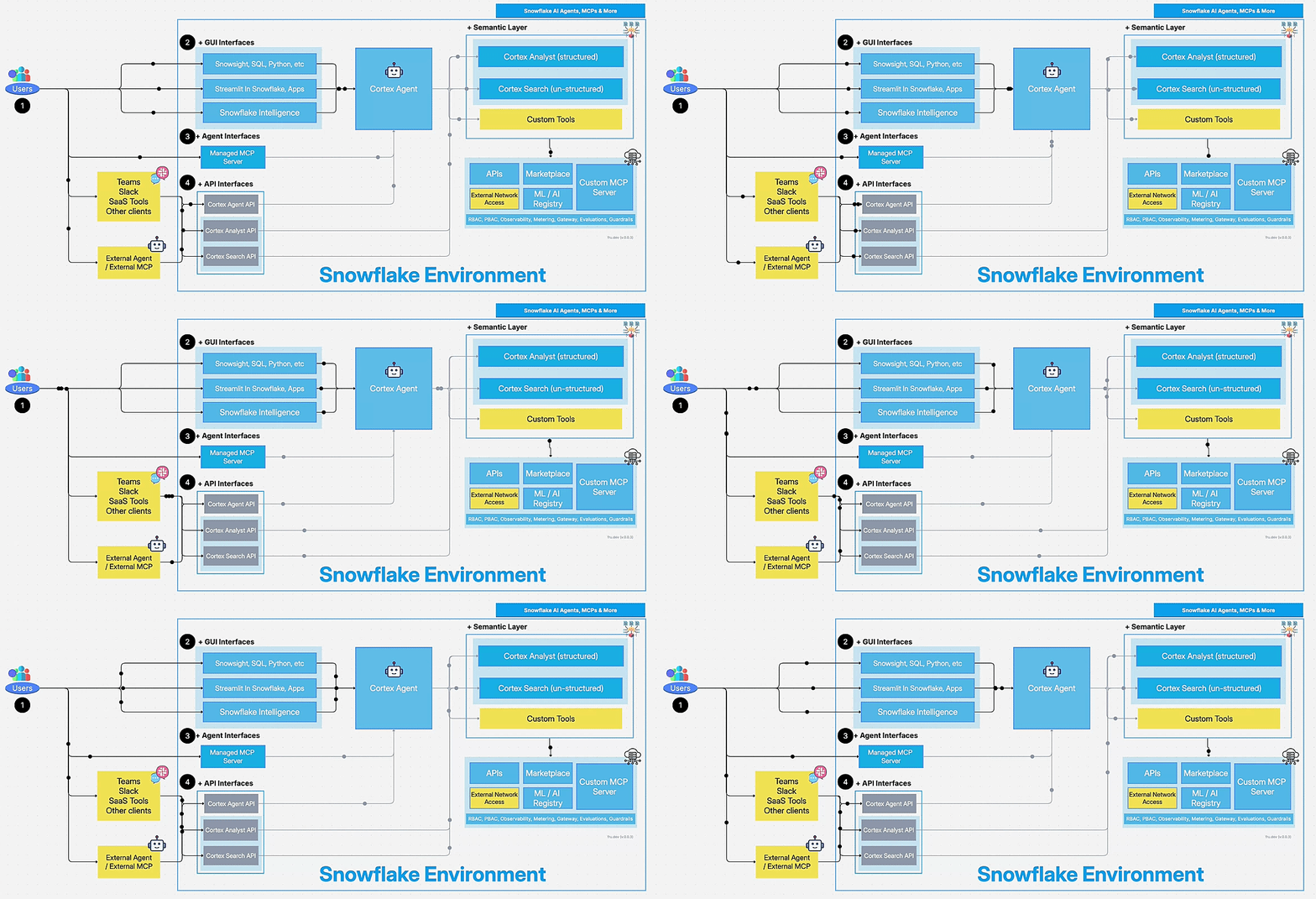
Image by Author
Artificial intelligence is no longer just about building smarter models.
It’s about creating intelligent systems that interact, orchestrate, and extend across business environments.
That’s where the concept of AI agents comes in — autonomous yet cooperative components that analyze data, take action, and connect with both humans and other systems.
Snowflake is positioning itself as a natural home for these agents.
By embedding them directly into the Data Cloud, Snowflake ensures that AI is not bolted on as an afterthought but lives alongside the data, tools, and workflows businesses already depend on.
The diagram above outlines how Snowflake AI Agents, Cortex, and MCPs (Model Context Protocol servers) work together.
Let’s break it down.
1. Users at the Center
At the edge of every system are the users — analysts, engineers, data scientists, and business teams.
They engage with Snowflake through:
- Collaboration tools like Teams, Slack, and SaaS clients
- Applications built with Streamlit inside Snowflake
- Developer surfaces like Snowsight, SQL, and Python
These touchpoints keep interactions natural and context-rich, while agents work behind the scenes.
2. Snowflake Intelligence + Cortex Agents
Inside the Snowflake environment, Snowflake Intelligence and Cortex Agents act as the brain.
- Snowflake Intelligence is a managed purpose built service that provides the connective tissue: routing insights, context, and instructions.
- Cortex Agents are the orchestrators. They receive prompts, query data, reason across structured and unstructured content, and decide when to call other tools or agents.
The Cortex Agent API makes these capabilities available beyond the Snowflake UI, extending intelligence into any external application or workflow.
3. The Semantic Layer + Specialized Agents
At the core sits a semantic layer, which ensures consistent meaning across structured and unstructured data.
This is where specialized Cortex agents thrive:
- Cortex Analyst → Works with structured data (tables, metrics, SQL queries).
- Cortex Search → Handles unstructured data (documents, conversations, logs).
- Custom Tools → Plug-ins that extend agent capabilities for domain-specific use cases.
The semantic layer guarantees that when an agent “asks a question,” it knows how to interpret both numbers in a data warehouse and text in a knowledge base.
4. Managed MCP Servers and External Interoperability
One of the most exciting capabilities in Snowflake’s AI landscape is interoperability.
Agents are not limited to what exists within Snowflake. Through the Model Context Protocol (MCP).
- Managed MCP Servers provide secure, scalable ways for Cortex Agents to connect to approved tools.
- Custom MCP Servers let organizations deploy their own specialized agents and workflows.
- External MCP Servers & Agents enable integration with third-party AI systems, ensuring Snowflake intelligence flows outward into broader ecosystems.
This opens the door to hybrid architectures, where enterprise data meets external AI services in a controlled and governed way.
5. The Ecosystem Layer
Finally, Snowflake surrounds its AI fabric with an extensible ecosystem:
- APIs for programmatic integration
- Marketplace for sharing and adopting prebuilt solutions
- ML/AI Registry for model management
- External network access for reaching tools beyond Snowflake
And beneath it all: RBAC, PBAC, observability, metering, gateways, evaluations, and guardrails.
These governance primitives ensure that AI agents remain not just powerful, but also safe, compliant, and accountable.
Why This Matters
This architecture isn’t just about Snowflake adding AI features.
It’s about:
- Collapsing distance between data, intelligence, and action.
- Unifying structured + unstructured data under one semantic fabric.
- Scaling interoperability with external ecosystems, not locking customers in.
- Making AI practical for everyday business users while keeping control in the hands of IT and governance teams.
Final Thought
Every wave of technology has its turning point.
With AI, that turning point is happening at the system level: not just smarter models, but agents that interact with users, data, and tools seamlessly.
Snowflake’s approach, as shown in this map, is an early glimpse of what AI-first enterprise architecture looks like: governed, extensible, and deeply embedded in the flow of business.
What’s your take: are the bigger opportunities in internal intelligence, external interoperability, or custom agent tooling?
Thank you for being a part of this Tech, Data & AI community!
🧑🏻💻 Before you go:
메타데이터
- post_id
- ebe239f70133
- slug
- 5-strategic-pillars-to-understanding-snowflakes-ai-agent-ecosystem-ebe239f70133
- url
- https://medium.com/demohub-tutorials/5-strategic-pillars-to-understanding-snowflakes-ai-agent-ecosystem-ebe239f70133
- canonical_url
- https://medium.com/demohub-tutorials/5-strategic-pillars-to-understanding-snowflakes-ai-agent-ecosystem-ebe239f70133
- author_url
- https://medium.com/@frulouis
- status
- ok
- fetched_at
- 2026-06-13 16:23:23