From Theory to Reality: How Dell Automation Platform Solves Drift and Delivers True Day 2…
For years, Infrastructure as Code (IaC) has been synonymous with Day 1 provisioning — the ability to spin up infrastructure quickly and…
From Theory to Reality: How Dell Automation Platform Solves Drift and Delivers True Day 2 Automation
For years, Infrastructure as Code (IaC) has been synonymous with Day 1 provisioning — the ability to spin up infrastructure quickly and repeatably. But as anyone running production systems knows, the real challenge lies in Day 2 operations: maintenance, scaling, security enforcement, compliance, and incident recovery.
Two concepts have traditionally been presented as solutions:
- Shift-left with IaC → preventing drift early by baking infrastructure into code, version control, and immutable practices.
- Drift scanning and remediation → detecting and reconciling real-world changes so that the IaC source of truth never becomes stale.
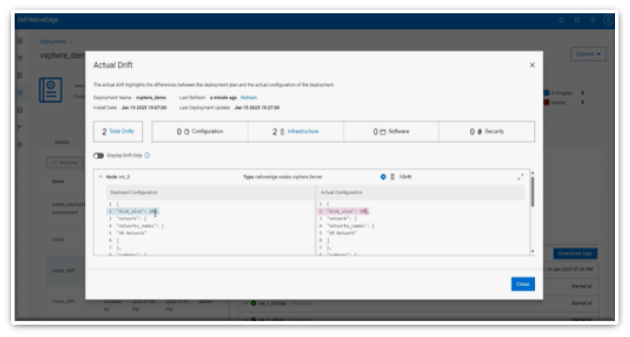
With the Dell Automation Platform, these ideas are no longer just best practices on paper — they are baked into the product, giving organizations a way to not only prevent drift but also continuously manage it in real-world operations.
Why Drift Matters in Day 2 Operations
In any running environment, drift is unavoidable:
- Outcome managers and domain-specific tools optimize parts of the stack.
- Cloud-native services auto-update themselves (think AWS RDS maintenance or Kubernetes node repairs).
- SREs, DevOps, and security teams apply manual or automated changes outside the IaC pipeline.
Without drift visibility, organizations risk:
- Shadow configurations that break automation and CI/CD pipelines.
- Compliance failures when undocumented changes sneak in.
- Slower incident recovery because no one knows what the “real” state is.
Dell Automation Platform solves this by keeping IaC as the single source of truth — even after Day 1.
The Problem with Today’s Drift Management
Today, drift management is fragmented and tool-specific:
- Terraform can detect and reconcile drift — but only for the resources it provisions.
- Kubernetes can track desired vs. actual state — but only for objects inside its cluster.
- Other resources — like SaaS services, legacy infrastructure, or configurations applied manually — fall outside these tools entirely.
This creates silos: each orchestrator maintains its own “truth,” but there is no way to see or manage drift end-to-end across the stack. Resources not onboarded into Terraform or Kubernetes effectively remain “blind spots,” with no drift tracking at all.
Dell Automation Platform changes that. It unifies drift detection across environments, extending simple drift management to resources beyond Terraform and Kubernetes, giving teams visibility where they previously had none.
At the same time, it’s important to clarify the scope: there is no practical way to track every possible configuration change across every component of the stack. Instead, Dell Automation Platform takes a pragmatic approach — tracking the resources you control, capturing the changes that matter, and keeping them aligned with your automation workflows.
How Dell Automation Platform Turns Best Practices Into Reality
1️⃣ Shift-Left Prevention, Powered by IaC
- Native integration with Terraform, Ansible, and Dell NativeEdge ensures all infrastructure is declared, version-controlled, and reviewable.
- Immutable infrastructure practices let you rebuild instead of patching in place, reducing the risk of hidden drift.
- Policy-as-code enforces compliance early, before changes ever hit production.
2️⃣ Continuous Drift Scanning and Reconciliation
- The platform proactively scans live environments against the desired state.
- Teams can choose to:
- Revert drift (restore the IaC-defined state), or
- Adopt drift (intelligently pull legitimate changes into IaC).
- Alerts and dashboards provide visibility across environments, ensuring that nothing slips through the cracks.
3️⃣ Collaboration Across Teams and Tools
- SREs, DevOps, and security teams can all make changes without fear of “breaking IaC.”
- Drift adoption workflows ensure temporary fixes, scaling changes, or compliance updates are reconciled back into code.
- Every change is logged, auditable, and reviewable.
4️⃣ Self-Healing Infrastructure
- Event-driven automation means that when drift is detected, Dell Automation Platform can trigger corrective actions automatically.
- Whether through auto-remediation scripts, policy enforcement, or IaC workflows, infrastructure heals itself back to compliance.
Real-World Outcomes with Dell Automation Platform
✅ Reliable CI/CD — No more broken pipelines due to hidden drift. ✅ Always-Compliant Infrastructure — Every change is reconciled with policy. ✅ Faster Incident Recovery — Clear, version-controlled visibility into every modification. ✅ Cross-Team Alignment — Dev, Ops, and Security all work from the same source of truth. ✅ Day 2 Operations Simplified — IaC doesn’t stop at Day 1; it runs continuously.

Conclusion
What used to be two separate schools of thought — shifting left with IaC to prevent drift and scanning for drift in Day 2 operations — are now seamlessly united in the Dell Automation Platform.
We’ve turned theory into reality:
- IaC isn’t just for provisioning — it’s the backbone of Day 2 operations.
- Drift scanning isn’t an afterthought — it’s built-in, proactive, and automated.
- Compliance, reliability, and scalability aren’t aspirational — they’re delivered.
Dell Automation Platform is redefining what’s possible in infrastructure automation: keeping your environments stable, secure, and always aligned with your intent.
메타데이터
- post_id
- ebf1bc101dd7
- slug
- from-theory-to-reality-how-dell-automation-platform-solves-drift-and-delivers-true-day-2-ebf1bc101dd7
- url
- https://medium.com/@elir/from-theory-to-reality-how-dell-automation-platform-solves-drift-and-delivers-true-day-2-ebf1bc101dd7
- canonical_url
- https://medium.com/@elir/from-theory-to-reality-how-dell-automation-platform-solves-drift-and-delivers-true-day-2-ebf1bc101dd7
- author_url
- https://medium.com/@elir
- status
- ok
- fetched_at
- 2026-07-17 17:03:30