The Fields Are Ready, But the Wires Aren’t: 3 Digital Barriers Crushing Smallholder Farmers and How…
I need to get something off my chest.
The Fields Are Ready, But the Wires Aren’t: 3 Digital Barriers Crushing Smallholder Farmers and How AI Could Actually Help
I need to get something off my chest.
Every conference I attend and I have attended way too many at this point someone gets on stage and talks about how AI will “revolutionize” agriculture. Drones mapping fields. Satellites predicting rainfall. Machine learning optimizing fertilizer use down to the gram.
Sounds incredible, right? Except nobody in the room seems to ask the obvious question: who exactly is this revolution for?
Because right now, it sure isn’t reaching the 500 million smallholder farming households who grow roughly a third of the planet’s food. These are families cultivating tiny plots less than two hectares — in Sub-Saharan Africa, South Asia, Southeast Asia. They’re feeding their communities and, collectively, feeding the world. And most of them can’t even load a webpage.
I have been working in technology and humanitarian development for over twenty years now. Across UN agencies, across 15+ countries, in some of the most resource-constrained environments you can imagine. And I keep running into the same frustrating pattern: we build shiny tech solutions and then wonder why the people who need them most can’t use them.
So before we get lost in another AI hype cycle, let me walk through what I think are the three biggest structural walls standing between smallholder farmers and the digital future everyone keeps promising them.
The connectivity problem is way worse than you think
I know, I know “rural areas lack internet access” isn’t exactly breaking news. But stay with me, because the reality on the ground is more nuanced than the headline.
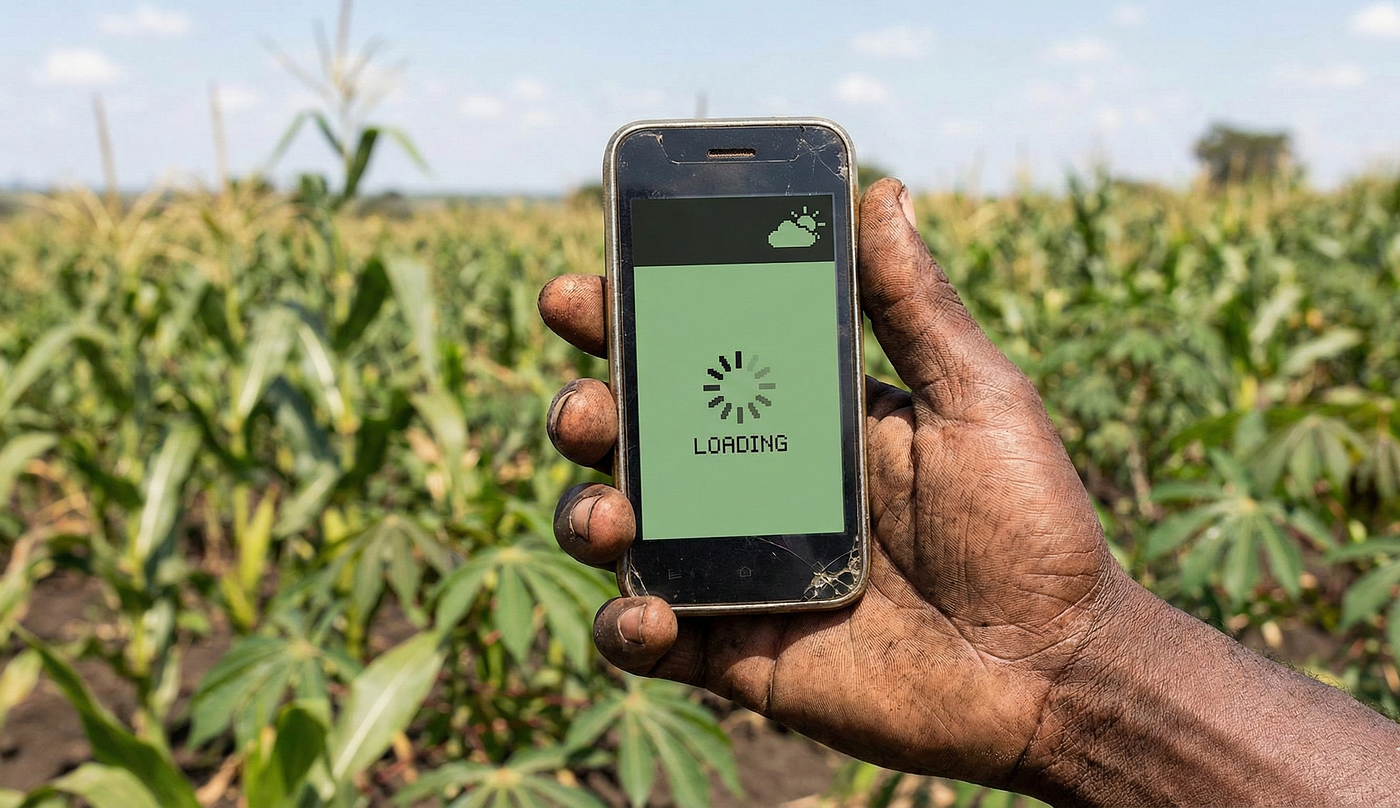
It’s not just about who has internet and who doesn’t. Plenty of farming communities technically have some coverage. A cell tower on a distant hill. Maybe 2G. Sometimes a flickering 3G signal if you stand in the right spot. Enough to make a phone call, sure. Enough to run an AI-powered crop advisory app that pulls weather data and soil analytics? Not a chance.
And here’s what really gets me the cost. I remember talking to farmers in East Africa where a single gigabyte of mobile data costs more than what they earn in a day from their crops. Think about that for a second. We’re asking people to choose between buying seeds and buying data. That’s not a technology gap. That’s a systemic failure.
So where does AI actually fit here? Honestly, I got more hopeful about this in the last couple of years. Edge computing — basically running AI models directly on cheap local devices instead of relying on cloud servers — has gotten surprisingly good. We’re seeing compressed machine learning models that can identify pests, analyze soil conditions, and estimate crop yields on basic smartphones. Some teams are even building solutions that work through USSD menus and SMS on old-school feature phones. No app download needed. No data plan needed.
The trick is designing AI that works within the mess of real-world connectivity, not pretending the mess doesn’t exist.
There’s almost no data that actually represents these farmers
This one bothers me more than it probably should.
Here’s what happens: a team in Silicon Valley or London or Singapore builds a crop disease detection model. They train it on massive datasets from industrial farms in the American Midwest or the Netherlands. High-resolution imagery, controlled conditions, single-crop fields stretching to the horizon. The model works beautifully in those contexts.
Then someone tries to deploy it on a mixed cassava-maize-bean plot in rural Mozambique where three crops are interplanted in a pattern that follows generations of indigenous knowledge, the soil hasn’t been formally tested in decades, and the “field” is roughly the size of a tennis court.
The model falls apart. Obviously. Because it was never trained for this reality.
And the data that would represent smallholder realities — intercropping patterns, indigenous seed varieties, informal water sharing arrangements, hyper-local weather patterns — either sits in scattered paper records, or lives in farmers’ heads as oral knowledge, or simply was never collected at all.
There’s a trust problem too. I’ve seen this firsthand in humanitarian work. Communities that have been surveyed and data-collected to death by NGOs and government agencies, with nothing to show for it. A farmer in northern Uganda once told me something that stuck: “You people come, you ask questions, you write things down, you leave. Nothing changes.” Why would she hand over her data to yet another project?
AI can actually help here, but only if we flip the model. I’m talking about voice-based data collection tools in local languages — a farmer speaks about her crops and AI transcribes and structures the information without requiring her to type a single character. Image recognition where she photographs a sick plant and gets an instant diagnosis. Community data cooperatives where farmers collectively own what they contribute and actually see benefits from it.
Federated learning is another piece I find exciting. It lets AI models learn from distributed data across many small farms without ever pulling that data into a central database. The farmer’s information stays local, the model still improves. It addresses the data problem and the trust problem at the same time.
But none of this happens without deliberate investment. Pilot projects exist. Scaling them? That’s the gap.
Nobody wants to fund digital literacy and it shows
Of the three barriers, this is the one that gets the least money, the least attention, and probably matters the most.
You can solve connectivity. You can fix the data problem. But if a farmer has never held a smartphone, can’t read the language on the screen, or fundamentally doesn’t trust a digital recommendation over what her grandmother taught her about reading the sky — your platform is dead on arrival.
And let me be very clear: this has nothing to do with intelligence. I’ve watched farmers make incredibly sophisticated decisions about planting timing, water management, and market access using knowledge systems that would put most algorithms to shame. The issue is that we design digital tools as if everyone interacts with technology the way a 28-year-old product designer in Nairobi or Bangalore does.
The interfaces assume literacy. The default languages are English or French. The interaction patterns assume familiarity with touchscreens and scrolling and tapping tiny buttons. It’s a design failure, not a user failure.
And it gets worse when you look at gender. Women do nearly half the agricultural labor in developing countries. But they’re significantly less likely to own a smartphone, less likely to use mobile internet, and less likely to have been included in whatever digital literacy programs do exist. Any ag-tech solution that ignores this reality is serving half the population at best.
Now, here’s where I actually get excited about AI’s potential. Natural language processing has gotten remarkably good at handling languages that were completely ignored by tech companies five years ago. We’re not there yet, but the trajectory is clear — a farmer should be able to ask a question about rice blast disease in Bangla or Swahili or Hausa, out loud, and get a spoken answer tailored to her region and her planting conditions.
That changes everything. Because you’re not asking the farmer to learn technology. You’re asking technology to learn the farmer.
Voice-first design combined with multilingual AI models could genuinely bypass the literacy barrier. Not by teaching people to fit into our digital world, but by reshaping that world to fit them.
So what actually needs to happen?
Look, I’m not anti-technology. That would be a strange position for someone who’s spent his career implementing tech solutions in humanitarian settings. At UNHCR, I led teams building AI-powered systems for refugee populations I’ve seen what well-designed technology can accomplish when you respect the context it’s deployed in.
But I’m tired of the magical thinking. AI won’t fix agricultural development the same way apps didn’t fix poverty and blockchain didn’t fix supply chains. Not because the technology is bad, but because the underlying infrastructure physical, digital, institutional, and human — isn’t there.
What I think the real opportunity looks like: AI that runs offline on devices farmers already carry in their pockets. Models trained on data that actually looks like a smallholder’s field, not an Iowa corn farm. Interfaces that speak the farmer’s language, literally. And governance frameworks that treat farmer data as something farmers own and control.
The fields are ready. The farmers have been ready for a long time. The question I keep asking is whether the rest of us are willing to do the harder, less glamorous work of meeting them where they actually are.
I’d genuinely love to hear from anyone working on this — what barriers are you seeing on the ground? What’s working? What’s failing? Drop your thoughts below.
Shahzad Siddiqui works at the intersection of AI, digital transformation, and humanitarian development, with 20+ years across UN agencies including UNHCR, UNICEF, and UNESCWA.
메타데이터
- post_id
- ec27a0b0abe9
- slug
- the-fields-are-ready-but-the-wires-arent-3-digital-barriers-crushing-smallholder-farmers-and-how-ec27a0b0abe9
- url
- https://medium.com/@shahzadasghar/the-fields-are-ready-but-the-wires-arent-3-digital-barriers-crushing-smallholder-farmers-and-how-ec27a0b0abe9
- canonical_url
- https://medium.com/@shahzadasghar/the-fields-are-ready-but-the-wires-arent-3-digital-barriers-crushing-smallholder-farmers-and-how-ec27a0b0abe9
- author_url
- https://medium.com/@shahzadasghar
- status
- ok
- fetched_at
- 2026-07-13 06:23:13