Steel & Iron Markets Enter June 2026: Five Forces That Will Shape the Next 30 Days
Market Outlook | June 1, 2026
Steel & Iron Markets Enter June 2026: Five Forces That Will Shape the Next 30 Days
Market Outlook | June 1, 2026

Global Steel Market Outlook
June 1, 2026. A new month opens with five forces converging simultaneously on global steel and iron markets — each capable of moving prices on its own, each interacting with the others in ways that make this one of the more complex months for commodity participants in recent memory. Here is what to watch.
Force 1 — CBAM: The Carbon Tax That Started Counting This Year
The EU’s Carbon Border Adjustment Mechanism entered its definitive phase on January 1, 2026. That means importers bringing steel, iron, aluminium, cement, fertilizers, and hydrogen into the EU are now required to purchase and surrender CBAM certificates covering the embedded carbon in their products. The first financial settlement takes place in 2027, but the compliance clock is running now.
The practical impact on steel trade is already visible. Every 0.1 tCO₂e per ton difference in emissions intensity changes the cost exposure by approximately €9 per ton — a material number for high-volume steel flows. Default emissions values for hot-rolled coil (HRC) range from around 2.6–3.5 tCO₂/t for relatively cleaner producers (Turkey, China, Serbia) to 4.5–9.05 tCO₂/t for higher-emission producers (South Africa, India, Indonesia).
For Iranian steel exporters, CBAM creates a structural challenge. Iran’s blast furnace-based production is energy-intensive, and the country currently lacks the certified emissions verification infrastructure that EU buyers require. Even if sanctions ease and Iranian exports resume, CBAM compliance costs will be an additional barrier to re-entering the European market. The mechanism is set to expand to cover steel and aluminium-intensive downstream products from 2028, further tightening the scope over time.
One significant simplification was introduced: a 50-tonne annual de minimis exemption removes CBAM obligations for very small importers, exempting approximately 182,000 importers — around 90% of all importers by count, though representing a much smaller share of actual trade volume.
Force 2 — Iran-US MOU: The Deal That Has Not Been Signed
Entering June, the single most market-moving variable remains unresolved. The US and Iran are said to have “mostly agreed” on a 60-day memorandum of understanding — 30 days for Strait of Hormuz procedures, 60 days for nuclear talks — but neither Trump nor Iranian leadership has formally signed off.
Oil markets have already priced in the deal. Brent crude ended May at $92.56 per barrel, down nearly 19% for the month — the worst monthly performance since the Covid-19 pandemic. Iran’s crude loadings in May collapsed to below 0.3 million barrels per day, down from 1.7 million barrels per day in March.
The risk entering June is asymmetric. If the MOU is signed, the market has limited additional upside to price in — much of the good news is already reflected in oil. If talks collapse, oil could spike back toward $110+, pushing steel production costs sharply higher. Prediction markets currently assign roughly 40–45% probability to a permanent peace deal by June 30.
Domestic market participants in Iran can track the real-time impact of these developments on daily mill prices through Ahan Online, which aggregates pricing from major Iranian steel producers including Mobarakeh, Zob Ahan, and Oxin Ahvaz.
For the steel market specifically, the Iran conflict has removed approximately 11% of global semi-finished steel trade from circulation — Iran typically exports around 4 million tonnes of finished steel and 7–8 million tonnes of semi-finished products annually. That supply has effectively disappeared since February, tightening global billet markets and contributing to the April scrap price surge to $418.50 per ton.
Force 3 — UK Safeguard Expiry: 30 Days to July 1
The UK’s current steel safeguard mechanism expires on June 30, 2026 — exactly 30 days from today. From July 1, a new trade defence mechanism takes effect with substantially lower import quotas and a 50% out-of-quota tariff, mirroring the EU approach.
This creates a predictable but often overlooked near-term dynamic: importers who have been using UK quota allocations will attempt to ship as much material as possible before June 30 to benefit from existing, more generous terms. This pull-forward effect typically creates a short-term demand spike followed by a demand vacuum in early July.
Steel producers in South Korea, Brazil, and Canada — who have relied on UK quota allocations — are the most directly exposed. For the broader global market, tighter UK access from July 1 adds another protected market to the growing list of restricted destinations, reinforcing the trend toward a fragmented global steel trade.
Force 4 — China’s May Output Data: The Number That Matters Most
China’s steel output for May will be released in mid-June. April’s figure of 86.63 million tons was the weakest since 2018 — a 2.8% year-on-year decline that raised genuine questions about whether China’s production curbs are structural or cyclical.
If May continues the declining trend, it would confirm that China is entering a sustained period of lower steel output — a meaningful structural shift that would reduce demand for seaborne iron ore over time, even as port inventory buying continues. If May rebounds, the April number will be dismissed as a temporary weather or holiday effect.
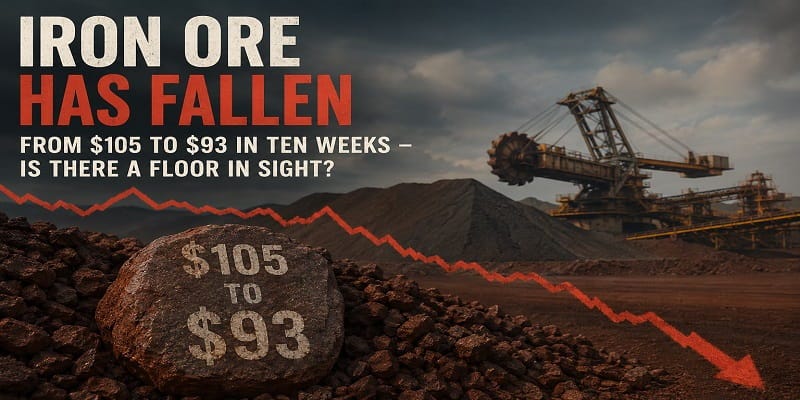
Goldman Sachs revised its full-year 2026 iron ore price forecast to $93 per ton, citing tighter-than-expected market conditions and resilient Chinese steel production. But the bank maintains a bearish outlook, noting that China’s overcapacity and global shipping surges present significant downside risks. The World Bank’s metals outlook also projects iron ore prices to decline further in 2026–27, potentially falling below 2019 levels.
Force 5 — Turkish Scrap: The Wildcard
June is historically an active month for Turkish ferrous scrap purchasing. Turkish EAF mills demonstrated in late March that they can move global scrap prices by $25 per ton in a matter of days when they enter the market aggressively — purchasing more than 30 deep-sea cargoes in three days and driving prices sharply higher.
Turkish steelmakers are currently purchasing scrap at premiums exceeding $15 per ton above prior levels, signalling expectations of continued supply tightness. The Strait of Hormuz disruption has reduced Middle Eastern scrap flows, pushing US and European suppliers into direct competition for the same material.
If Turkish mills enter June with strong order books and an appetite to restock, it could provide the floor that the otherwise subdued scrap market needs. If they hold back — as they did for most of Q1 before the March surge — the downward drift in HMS prices is likely to continue.
June Price Reference Points
Indicator Level at June 1 Direction Iron Ore 62% Fe (CFR China) ~$114.7/t Stable-bearish Iron Ore Futures (Dalian) ~CNY 784/t Stable HMS №1 Scrap (US) Down $8/t (April-May) Cooling HRC Steel (US) $0.36/lb Flat Brent Crude $92.56/bbl -19% in May Iran Semi-Finished Supply ~11% of global offline Disrupted UK Safeguard Expires June 30 Tighter from July 1
The June Outlook in One Paragraph
The base case for June is a market in transition rather than a market in motion. Iron ore holds near recent highs on structural Chinese buying but faces growing supply pressure from Simandou ramp-up and record port inventories. Scrap is cooling after April’s historic peak. Oil — and therefore steelmaking energy costs — will be set by whatever happens in Vienna or Muscat or wherever the Iran-US MOU is eventually signed. The UK safeguard expiry creates a short-term pull-forward effect. And Turkey holds the key to whether the global scrap market gets a floor in June or drifts further into summer softness.
Sources: Akin Gump / CBAM · CarbonChain CBAM · CNBC / Iran-US deal · Expert Market Research · Goldman Sachs via SteelOrbis · SteelOnTheNet · World Bank ·
Published: June 1, 2026 | Steel Market Daily on Medium
메타데이터
- post_id
- ec2b4e47a923
- slug
- steel-iron-markets-enter-june-2026-five-forces-that-will-shape-the-next-30-days-ec2b4e47a923
- url
- https://medium.com/@r.alizadehfard.2026/steel-iron-markets-enter-june-2026-five-forces-that-will-shape-the-next-30-days-ec2b4e47a923
- canonical_url
- https://medium.com/@r.alizadehfard.2026/steel-iron-markets-enter-june-2026-five-forces-that-will-shape-the-next-30-days-ec2b4e47a923
- author_url
- https://medium.com/@r.alizadehfard.2026
- status
- ok
- fetched_at
- 2026-06-09 15:37:30