You can’t get rich by saving alone
Stop putting those Hundos under the mattress
You can’t get rich by saving alone
Stop putting those Hundos under the mattress
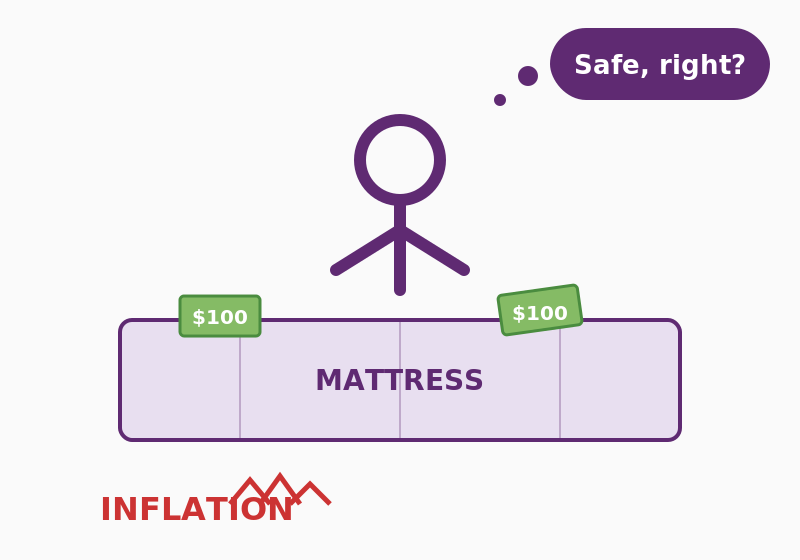
I was reading something this week that stuck with me. The sentence was simple: you cannot get rich by saving alone.
And my first reaction was, “Damn, tell that to my parents.”
Because for a lot of us who grew up first-gen, the saving mentality was the whole game. My dad kept cash in the house. Not a metaphor. Actual cash in actual drawers. A pharmacist with a doctorate, and his financial strategy was proximity to the money.
He wasn’t dumb. He was operating on rules that used to work. Maybe before we left the gold standard in 1971 and the dollar became, as my buddy calls it, “grown-up Monopoly money.” But that old playbook got passed down to our generation like family china. And a lot of us are still using it.
I see it in prospect calls every week. Six-figure earners with $80,000 sitting in a checking account earning 0.01%. That money isn’t growing. It’s shrinking. They just can’t see it because the number on the screen stays the same.
The candy bar test
You want to see inflation? Go to a gas station.
A Snickers bar cost about ten cents in 1970. Today it runs you $1.79 or more, depending on the airport. The bar also got smaller. You’re paying eighteen times more for less chocolate. That’s inflation doing exactly what it’s designed to do: make your dollars buy less stuff from year to year.
Inflation is baked into the system. And it’s the reason saving alone will never build wealth.

The $100 test
Let’s make this concrete. You have a hundred dollar bill. Four places you could put it, four very different outcomes.
Under the mattress at 0% return, after 10 years that $100 buys what $73 buys today. You lost $27 of purchasing power without spending a dime. It just evaporated.
In a checking account at 0.01% APY (the national average), you earned ten cents in a decade. Ten cents. Your $100 still buys $73 worth of stuff. The bank thanks you for the free loan.
In a high-yield savings account at 4.5%, you’d have $155 on paper after ten years. Adjusted for inflation, that’s about $113 in today’s dollars. You kept your purchasing power and gained a little. Not bad for zero risk.
In an S&P 500 index fund averaging 10% historically, that same $100 becomes $259. Adjusted for inflation: $189. Your money nearly doubled in real terms while you did nothing but leave it alone.

The Rule of 72: Divide 72 by your interest rate and that’s roughly how long it takes to double your money. At 10% in the market, that’s about 7 years. In a checking account at 0.01%, it takes 7,200 years. Your great-great-great-great-grandkids would still be waiting.
Now scale it up
The hundred-dollar bill is useful for illustration. But let’s talk about real life. What happens when you put $500 a month away for 30 years?
Under the mattress: $180,000. That’s all you contributed. Zero growth. And after inflation, it buys what $70,000 buys today.
In a checking account: $180,270. You made $270 in thirty years. I’ve made more than that selling jollof rice at a cookout.
In a high-yield savings: $379,693. Respectable. You doubled your contributions. But this assumes 4.5% holds for three decades, which it won’t. Savings rates change with the Fed.
In an S&P 500 index fund: $1,130,244. You contributed $180,000. The market gave you $950,244 on top of it. Over a million dollars from $500 a month.

Read those numbers again. Same person, same $500 a month, same 30 years. The only thing that changed was where the money sat.
So what do you actually do?
I’m not here to make this complicated. Three moves.
First, figure out what it actually costs to be you every month. Fixed expenses. Variable expenses. The subscriptions you forgot about. The ones you remember but pretend don’t count. All of it. Get the real number. I built a worksheet for this: How Much It Costs to Be You. Takes 20 minutes. Changes everything.
Second, multiply that number by six. That’s your emergency fund target. Six months of expenses in something liquid that protects your principal. A high-yield savings account. A money market fund. Something boring and accessible. Not crypto, not your cousin’s startup, and definitely not jigga coin. If you need help tracking it, I use Monarch Money with every client.
Third, everything above that emergency fund? Invest it. Start with your employer’s 401(k) match if you have one, because that’s free money. Then open a Roth IRA or a brokerage account. Pick a broad market index fund and set up automatic contributions. You don’t need to pick stocks. You need to pick a date to start and then stop touching it.
What saving was for our parents’ generation, investing is for ours. The math changed. The strategy has to change with it.
Now you know. Do better.
Chukwudi Uraih, MBA The Financial Engineer · Lampados Financial Group
Take the Free Financial Wellness Quiz · Take the FSIT ($47) · Get the Book ($9.99)
메타데이터
- post_id
- ec32debdd2c1
- slug
- you-cant-get-rich-by-saving-alone-ec32debdd2c1
- url
- https://medium.com/@lampados-financial/you-cant-get-rich-by-saving-alone-ec32debdd2c1
- canonical_url
- https://medium.com/@lampados-financial/you-cant-get-rich-by-saving-alone-ec32debdd2c1
- author_url
- https://medium.com/@lampados-financial
- status
- ok
- fetched_at
- 2026-07-08 16:17:31




