When Your Last Good Eye Needs Cataract Surgery
You have lived for years relying on one eye. The other may have been lost to trauma, retinal detachment, glaucoma, or an infection that…
When Your Last Good Eye Needs Cataract Surgery
You have lived for years relying on one eye. The other may have been lost to trauma, retinal detachment, glaucoma, or an infection that stole its sight long ago. You adapted. You learned to judge distance with a single perspective, to drive with extra caution, to navigate a world that assumes everyone has two working eyes. Then your doctor tells you that a cataract is clouding the lens of your only good eye, and suddenly the ground shifts beneath you. The one thing you could depend on is no longer dependable.
This is a fear unlike the one most cataract patients face. Most people worry about the inconvenience of surgery or the cost of a premium lens. You worry about something far more fundamental. If something goes wrong, there is no backup. There is no second chance. That fear is real, and it deserves to be acknowledged before any discussion of surgical technique or lens choice begins.
WHY THE CALCULUS IS DIFFERENT
In a patient with only one seeing eye, every clinical decision carries more weight. Because any decline in vision has an immediate and profound impact on daily function, surgeons often lower their threshold for recommending surgery compared to a patient with two functional eyes. But earlier does not mean rushed. The American Academy of Ophthalmology Preferred Practice Pattern for Cataract in the Adult Eye emphasizes meticulous preoperative evaluation, careful surgical planning, and a detailed informed consent discussion that covers the rare but serious risk of significant vision loss. No responsible surgeon approaches this procedure lightly.
The All India Ophthalmological Society categorizes surgery on the only seeing eye as a high‑stakes procedure, best performed by an experienced surgeon who has planned for every foreseeable complication. The evaluation is not a quick check. It includes a thorough retinal examination, often with optical coherence tomography, to ensure the macula and optic nerve are healthy. It includes an assessment of the ocular surface because dry eye or blepharitis can increase the risk of postoperative infection. It includes a careful calculation of the intraocular lens power because there is no room for a significant refractive surprise.
THE PREOPERATIVE WORK THAT MATTERS
Before you consent to surgery on your only good eye, your surgeon should do more than glance at your retina. A dilated fundus examination is mandatory, not optional. If you have diabetes, the retina must be evaluated with particular care because the surgery itself can worsen diabetic retinopathy. The AAO recommends that any active retinopathy be stabilized before proceeding. If you have glaucoma, your intraocular pressure must be well controlled because a postoperative pressure spike in your only eye could be devastating. If you have an epiretinal membrane or macular pathology, your surgeon needs to discuss how much of your vision loss is from the cataract and how much is from the retina, because removing the cataract will only solve the part that the lens was causing.
Indian diabetic retinopathy guidelines, such as the 2023 joint position statement by the Research Society for the Study of Diabetes in India and the Vitreo Retinal Society of India, underscore that diabetic patients should have a retinal evaluation before any eye surgery. In the monocular patient, this is not a suggestion. It is a non‑negotiable step.
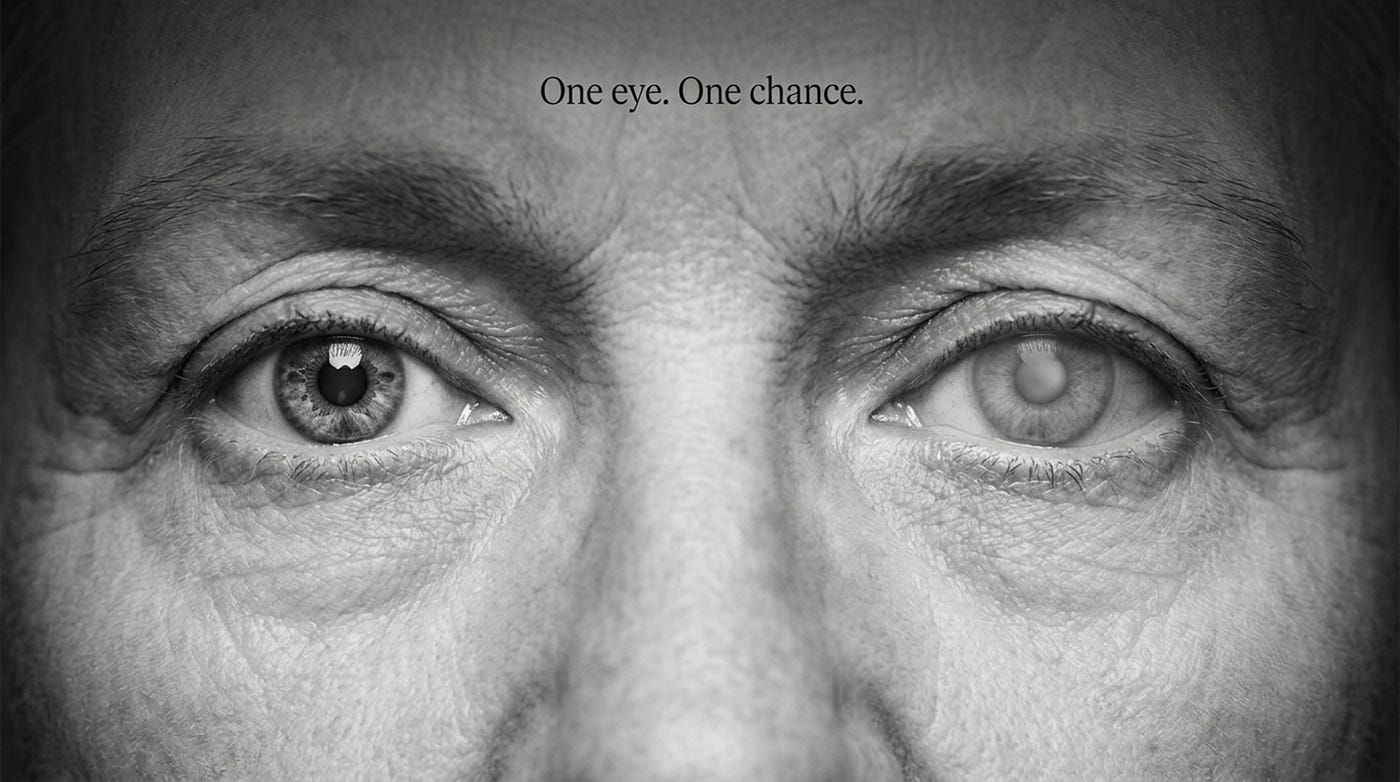
One blind eye. One cataract eye. No second chance.
THE SURGERY ITSELF
The procedure is the same phacoemulsification performed on millions of eyes every year. A tiny incision, an ultrasonic probe that dissolves the cloudy lens, and a folded artificial lens that unfolds inside the eye. It takes minutes, requires no stitches, and patients go home the same day. The technique does not change because it is your only eye. What changes is the margin for error.
An experienced surgeon plans for the unexpected. They may choose a slightly different wound construction to reduce the risk of postoperative infection. They may use a capsular tension ring if the zonules that hold the lens in place appear weak. They may have a backup intraocular lens available in case the first choice cannot be safely implanted. They will review your medications carefully because blood thinners, even aspirin, need to be managed in consultation with your physician to balance the risk of bleeding against the risk of stopping the medication. None of this is alarming. It is simply the kind of thoroughness that a monocular case demands.
WHAT TO EXPECT AFTER SURGERY
The recovery for a monocular patient is no slower than for anyone else. Vision often improves within hours. The eye may feel gritty or look bloodshot for a day or two. Drops are used for a few weeks to prevent infection and control inflammation. The protective shield worn at night reminds you not to rub the eye while you sleep. These steps are routine.
What is not routine is the psychological weight you carry. Every flicker, every momentary blur, every sensation can trigger a spike of fear that something has gone wrong. This is normal. It will fade as the weeks pass and your vision stabilises. But during the early recovery, it helps to have a surgeon who understands that you need to be heard, not dismissed. A phone call to the clinic about a mild ache or a transient shadow is not an overreaction. It is the natural response of someone whose entire visual world depends on a single, healing eye.
THE LENS CHOICE
The decision about which intraocular lens to implant is more consequential for a monocular patient than for someone with two seeing eyes. A standard monofocal lens set for distance will give you sharp far vision, but you will need reading glasses for near work. A multifocal or extended‑depth‑of‑focus lens can reduce spectacle dependence, but it may produce halos or glare at night that are more bothersome when there is no second eye to suppress the unwanted images. A toric lens can correct significant astigmatism. The choice should be made after a conversation that weighs your lifestyle, your visual priorities, and your tolerance for potential side effects. The AAO notes that the choice of intraocular lens should be individualised, and this is especially true when it is your only chance to get it right.
THE PATH FORWARD
A cataract in your only seeing eye is not a tragedy. It is a challenge that can be met with thorough planning, an experienced surgeon, and a patient who is informed and supported. The surgery is safe, the recovery is short, and the outcomes are excellent when the preoperative work is done properly. The fear you feel is real, but it does not have to paralyse you. It can be the very thing that ensures you find the right surgeon, ask the right questions, and take every precaution.
Book a comprehensive cataract evaluation at Infigo Eyecare Hospital, an NABH‑accredited facility, or at a trusted eye centre near you. If you are eligible under MJPJAY, PMJAY (Ayushman card), ESIC, or ECHS, you can receive cashless care. BSNL and Indian Coast Guard employees can also use their service health benefits at our hospital. Ask your surgeon about the precautions specific to your only eye. Ask about the retina behind the cloud. Ask about the lens that fits the life you want to live. This is not just another cataract. It is your vision, and it deserves the care that reflects its singular importance.
메타데이터
- post_id
- ec3cd2ff0e7a
- slug
- when-your-last-good-eye-needs-cataract-surgery-ec3cd2ff0e7a
- url
- https://medium.com/@aniketmmclayinc/when-your-last-good-eye-needs-cataract-surgery-ec3cd2ff0e7a
- canonical_url
- https://medium.com/@aniketmmclayinc/when-your-last-good-eye-needs-cataract-surgery-ec3cd2ff0e7a
- author_url
- https://medium.com/@aniketmmclayinc
- status
- ok
- fetched_at
- 2026-08-12 18:09:30