How to build PLG‑based triggers that feed outbound B2B lead generation in India?
Product-led growth (PLG) generates behavioral data that most outbound teams never use. When product usage signals are connected to outbound…
How to build PLG‑based triggers that feed outbound B2B lead generation in India?
Product-led growth (PLG) generates behavioral data that most outbound teams never use. When product usage signals are connected to outbound workflows, B2B companies can identify high-intent accounts before competitors do — and reach them with precision timing. This is how PLG-based triggers feed predictable outbound pipeline generation in India and globally.
What Are PLG-Based Triggers in B2B Outbound Sales?
PLG-based triggers are behavioral signals generated by user activity inside a product — such as feature adoption, usage frequency, upgrade intent, or team expansion — that automatically initiate an outbound sales response. This is the foundation of **PLG-based outbound lead generation**.
Unlike traditional outbound, which relies on static prospect lists, PLG-triggered outbound acts on real-time evidence of buying intent. The result is outreach that arrives at the right moment, to the right account, with context that makes engagement significantly more likely.
For B2B SaaS companies operating outbound lead generation in India or targeting global markets, this approach reduces wasted SDR effort and improves pipeline quality from the first stage.
Why PLG-Based Outbound Is Gaining Traction in India’s B2B Market
India’s B2B SaaS ecosystem has matured rapidly. Companies building global products from Bengaluru, Hyderabad, Pune, and Chennai are now competing for enterprise accounts in the USA, UAE, Europe, and Australia — markets where buyers expect personalized, well-timed outreach.
Three factors are driving PLG-triggered outbound adoption specifically among Indian B2B companies:
- Product usage data is underutilized. Most SaaS companies collect detailed behavioral data but route it only to product teams — not to sales or outbound automation workflows.
- Outbound costs are rising. Broad prospecting without intent signals produces diminishing returns as email deliverability standards tighten and buyer attention becomes harder to capture.
- AI SDR systems are now deployable at scale. **AI-powered appointment setting services** can process behavioral signals, personalize outreach sequences, and execute follow-up automatically — without proportional SDR headcount growth.
The Core Framework: How PLG Triggers Feed Outbound Pipeline
Building a PLG-triggered outbound system requires connecting four operational layers: signal capture, scoring, routing, and execution.
Step 1: Define High-Intent Product Signals
Not every user action indicates buying readiness. The signals most predictive of outbound opportunity include:
- Activation milestones — a user completing core setup steps that indicate genuine product adoption
- Expansion behavior — inviting additional team members, increasing usage volume, or accessing premium features on a free or trial plan
- Repeated return visits — logging in multiple times within a short window, particularly to pricing or upgrade pages
- Feature-limit encounters — users hitting the boundaries of their current plan, indicating willingness to pay for more
- Dormancy followed by re-engagement — accounts that went quiet and then returned, often signaling a renewed internal evaluation
Each of these signals represents a moment where outbound contact has contextual relevance — the account is already engaged with the product, which removes the cold-start problem from outreach entirely.
Are You Leaving PLG Revenue Signals on the Table?
If your product generates behavioral data but your outbound team is still working from static prospect lists, you are reaching accounts too late — or missing them entirely.
The Global Associates builds PLG-triggered outbound systems for B2B SaaS companies that connect product usage signals to AI-powered outreach sequences — so your SDRs contact high-intent accounts at exactly the right moment.
**→ Request a Free PLG Outbound Audit** We will analyze your current product data pipeline, identify your highest-value trigger events, and outline a structured outbound workflow — at no cost and no obligation.
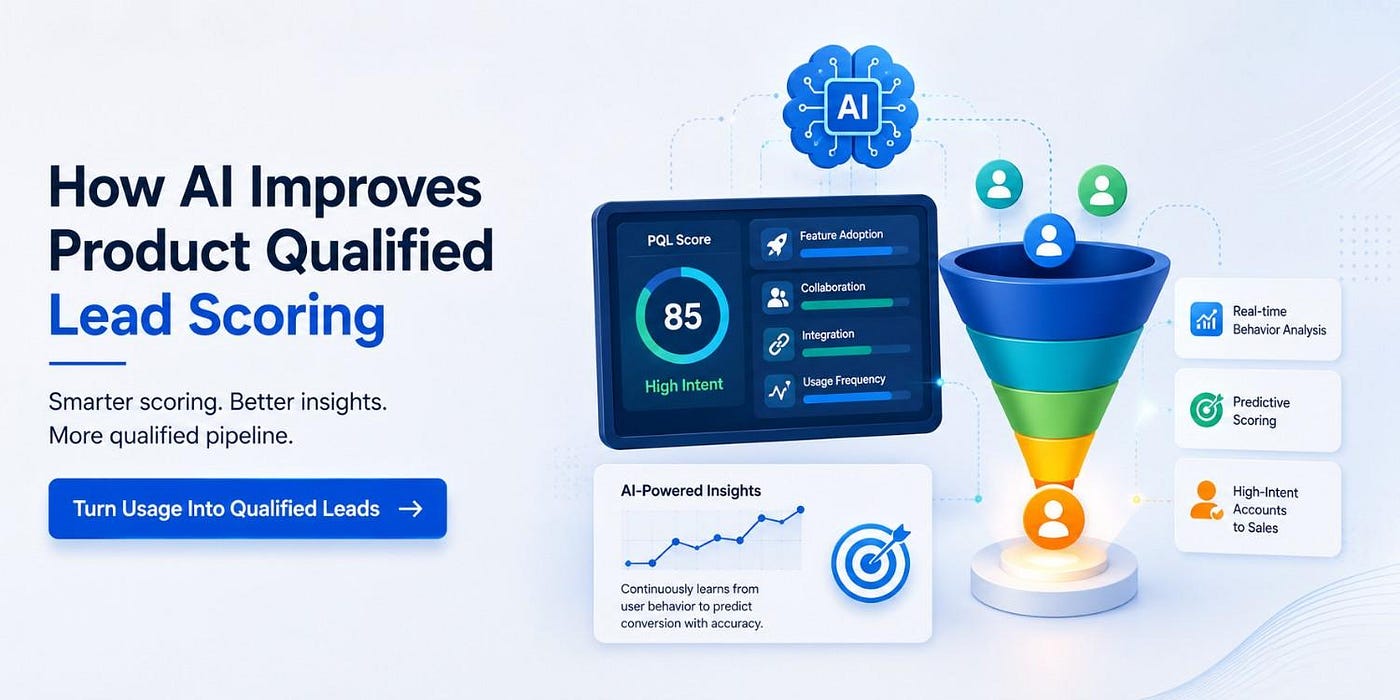
Step 2: Score Accounts Using Behavioral and Firmographic Data
Individual user signals are useful. Account-level signals are more valuable for enterprise B2B outbound.
Effective PLG-based account scoring combines:
- Behavioral depth — how many users from the same company are active, which features they use, and how frequently
- Firmographic fit — company size, industry, geography, and revenue range relative to the ICP definition
- Intent overlay — third-party intent data from platforms like 6sense or Bombora, layered on top of first-party product signals
Accounts that score highly across all three dimensions are the ones SDRs should contact first. This is the operational foundation of ICP-driven targeting in a PLG environment — and it is where **RevOps frameworks** play a critical role in connecting product, marketing, and sales data into a single scoring model.
Step 3: Route Signals Into Outbound Automation Workflows
Once an account crosses a defined score threshold, the trigger initiates an outbound sequence automatically. This routing layer is where CRM systems become essential.
A well-configured routing workflow does the following:
- Creates or updates the account record in the CRM with the triggering signal logged
- Assigns the account to the appropriate SDR based on territory, segment, or account size
- Enrolls the account in a personalized outreach sequence that references the specific behavior that triggered contact
- Sets a follow-up task if there is no response within a defined window
- Escalates to an account executive if positive engagement is detected
Behavioral trigger outbound pipeline automation in SaaS environments requires clean CRM hygiene and clearly defined workflow logic. Without both, signals get lost and outreach loses its contextual advantage.

Step 4: Execute Outreach With Contextual Personalization
The competitive advantage of PLG-triggered outbound is specificity. Outreach that references real product behavior converts at a meaningfully higher rate than generic cold email sequences.
Effective PLG-triggered outreach messaging follows a consistent structure:
- Opening acknowledgment — reference the specific behavior without being intrusive (“I noticed your team has been exploring the enterprise reporting features”)
- Value bridge — connect that behavior to an outcome the account is likely pursuing
- Friction removal — offer a specific, low-commitment next step such as a 20-minute call or a tailored product walkthrough
- Social proof — reference a similar company that achieved a defined outcome
This approach aligns naturally with **Account-Based Marketing (ABM) principles **— treating each account as a market of one, with outreach calibrated to their specific context rather than a generalized value proposition.
Integrating AI SDR Systems Into PLG-Triggered Outbound
Manual execution of PLG-triggered outreach at scale is operationally difficult. AI SDR systems address this by automating signal processing, sequence personalization, and follow-up execution without removing human judgment from high-value interactions.
AI-powered appointment setting services used in PLG-triggered outbound typically handle:
- Signal ingestion — pulling product usage data from the analytics layer into the outbound automation system
- Message personalization — generating outreach copy that reflects the account’s specific usage pattern and firmographic profile
- Send-time optimization — scheduling outreach based on the recipient’s historical engagement patterns
- Response classification — categorizing replies as interested, objecting, or not ready, and routing accordingly
For **B2B lead generation services in India** targeting global enterprise accounts, this automation layer reduces the time between signal detection and first outreach contact — a critical variable in competitive sales environments where multiple vendors may be evaluating the same account simultaneously.
The Global Associates is a B2B lead generation company specializing in AI-powered outbound engines for predictable pipeline growth — helping SaaS companies connect PLG behavioral data to structured outbound workflows that generate qualified pipeline consistently.
Common Implementation Challenges
PLG-triggered outbound delivers strong results when implemented correctly. The following challenges are the most common reasons companies fail to realize its full value:
Data fragmentation. Product analytics, CRM data, and intent platforms often sit in separate systems with no automated connection. Building a unified data layer is a prerequisite — not an optional enhancement.
Signal noise. Not every product interaction is meaningful. Without a defined scoring model that filters high-intent signals from routine usage, SDRs receive too many low-quality triggers and lose confidence in the system.
Messaging relevance. Referencing product behavior in outreach requires careful framing. Outreach that feels surveillance-like damages trust. The goal is to be helpful and timely — not to demonstrate that you are monitoring every user action.
SDR adoption. Outbound teams accustomed to list-based prospecting need structured training to work effectively within a trigger-based system. Workflow clarity and CRM hygiene discipline are essential for adoption.
Ready to Build a Predictable B2B Pipeline From Your Own Product Data?
Most B2B SaaS companies already have everything they need to run PLG-triggered outbound — they just have not connected it yet. The Global Associates helps enterprise B2B teams in India and globally turn behavioral signals into booked meetings, qualified pipeline, and consistent revenue outcomes.
**→ Talk to a B2B Outbound Specialist Today** A focused 30-minute conversation to evaluate whether PLG-triggered outbound is the right growth lever for your current sales stage — no pitch, no pressure.
Sales Pipeline Management in a PLG-Triggered Outbound System
PLG-triggered outbound changes how sales pipeline management functions. Because accounts enter the pipeline with documented behavioral context, pipeline stage definitions become more precise and forecasting becomes more reliable.
Key differences in pipeline management under a PLG-triggered model:
- Stage advancement is tied to engagement depth — not just SDR activity
- Deal health is assessed using product usage continuation alongside sales engagement signals
- Expansion opportunities are identified earlier because product data reveals when existing accounts are approaching usage limits or expanding teams
This integration between product data and sales pipeline management is where RevOps frameworks deliver the most compounding value — ensuring that every team working on revenue has access to the same behavioral signals and acts on them consistently.
Building the System: A Practical Starting Point
For B2B SaaS companies beginning to build PLG-triggered outbound, or looking to **hire B2B lead generation agency India**, the following sequence represents the most practical starting point:
- Audit existing product analytics — identify which behavioral events are currently tracked and which are not
- Define 3–5 high-intent trigger events — focus on signals with the strongest historical correlation to conversion
- Connect product data to CRM — use native integrations or middleware tools like Segment or Zapier to automate data flow
- Build a scoring model — assign weighted values to behavioral and firmographic signals
- Design trigger-specific outreach sequences — create messaging templates for each defined trigger event
- Run a pilot cohort — test the system on a defined segment before full deployment
- Review and refine monthly — analyze which triggers are generating pipeline and adjust scoring weights accordingly
메타데이터
- post_id
- ec54e892df1b
- slug
- how-to-build-plg-based-triggers-that-feed-outbound-b2b-lead-generation-in-india-ec54e892df1b
- url
- https://medium.com/@madhu.sudhan_TGA/how-to-build-plg-based-triggers-that-feed-outbound-b2b-lead-generation-in-india-ec54e892df1b
- canonical_url
- https://medium.com/@madhu.sudhan_TGA/how-to-build-plg-based-triggers-that-feed-outbound-b2b-lead-generation-in-india-ec54e892df1b
- author_url
- https://medium.com/@madhu.sudhan_TGA
- status
- ok
- fetched_at
- 2026-06-09 15:37:30