America250: From Boston Tea to Masala Chai
An Indian-American Reflection on Two Democracies
America250: From Boston Tea to Masala Chai
An Indian-American Reflection on Two Democracies

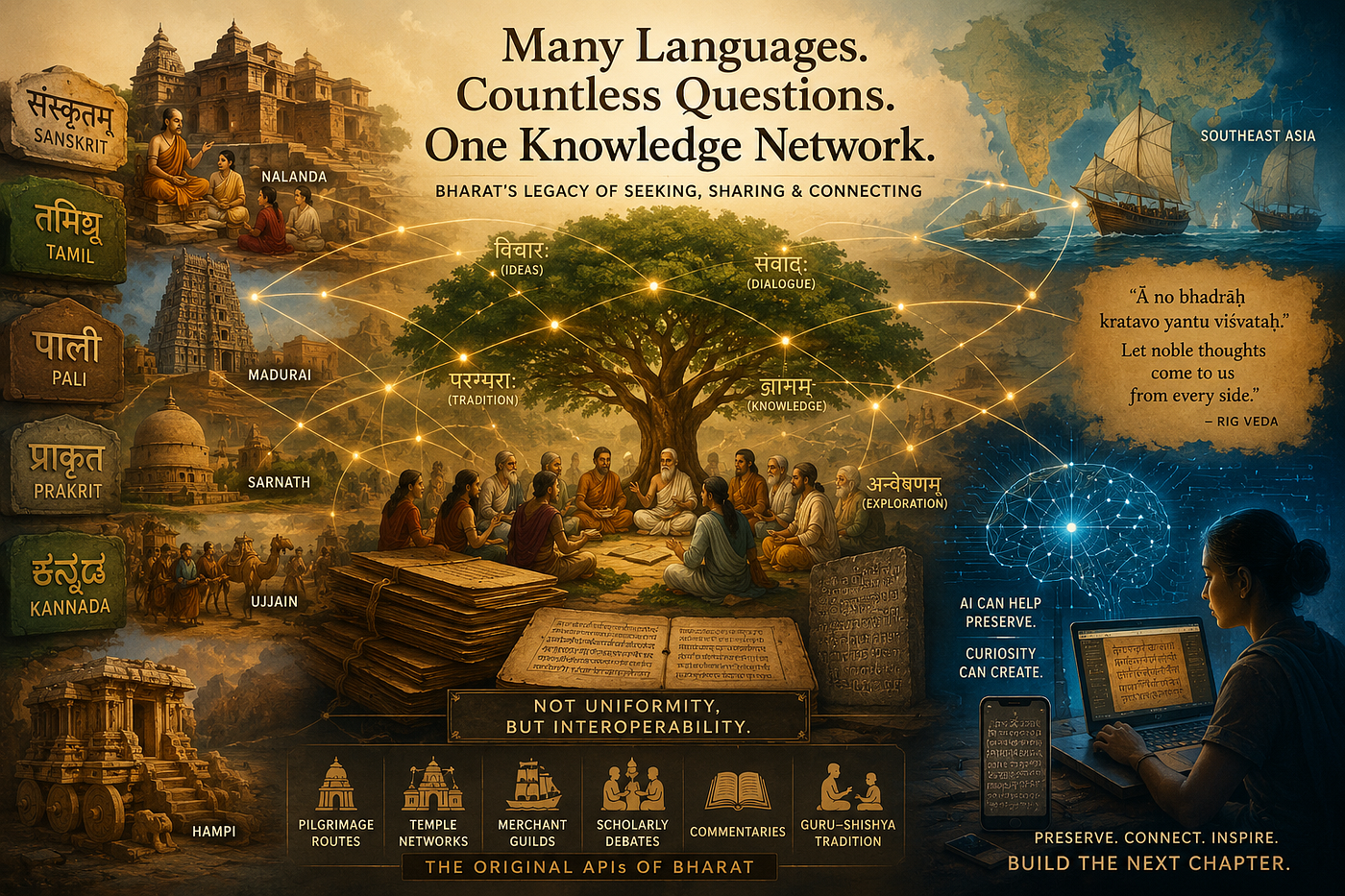
Representative Image — AI generated
“America was born from a revolution. India emerged from a civilization. Yet both continue to confront the same challenge: how to transform diversity from a source of division into a source of strength.”
As America celebrates its 250th year of independence, I find myself reflecting on a question many immigrant families may quietly ask:
What does America’s story mean to those of us whose ancestors were not here in 1776, whose roots lie thousands of miles away, and whose journey to this nation began generations later?
For Indian-Americans like me, the answer is surprisingly profound.
America’s 250-year journey and India’s own march toward freedom are not separate stories. They are increasingly intertwined chapters in a larger narrative about liberty, democracy, opportunity, and the continual expansion of who belongs.
The path from the Boston Tea Party of 1773 — sparked by tea traded through the British East India Company in colonial India — to today’s masala chai conversations in American homes, universities, and boardrooms reveals how two great democratic experiments gradually converged.
Phase One: The Birth of a Republic (1776–1865)
America emerged from a rebellion against imperial rule. The Declaration of Independence proclaimed a radical idea: governments derive their legitimacy from the people. Yet the young republic wrestled with profound contradictions. Freedom coexisted with slavery, and equality remained incomplete.
While America struggled to expand liberty, India experienced the opposite trajectory. The British East India Company steadily expanded its control across the subcontinent. As Americans celebrated independence, millions of Indians entered deeper colonial subjugation.
An intriguing connection emerged here. Elihu Yale, whose donations helped support Yale College, accumulated much of his wealth while serving the East India Company in Madras, present-day Chennai. Like many figures of the colonial era, his success was tied to an unequal imperial system. Yet his story reminds us that India and America were connected through commerce, empire, and education long before large-scale Indian immigration.
Phase Two: Industry, Ideas, and Awakening (1865–1945)
After the Civil War, America entered an era of extraordinary industrial growth. Railroads connected continents, factories transformed cities, and innovation became a national habit.
India, meanwhile, experienced a different awakening. Reformers, spiritual thinkers, and political leaders began asking fundamental questions about identity, freedom, and self-governance.
Then, in 1893, a young Hindu monk crossed the oceans to address the World’s Parliament of Religions in Chicago. When Swami Vivekananda opened with “Sisters and Brothers of America,” he captivated the audience. His message introduced many Americans to religious pluralism, spiritual universality, and mutual respect among civilizations. Long before yoga studios appeared across America, Vivekananda planted the seeds of a lasting dialogue between India and America.
The early twentieth century also witnessed the rise of nationalist, socialist, cultural, and regional movements across India, each offering different answers to a society seeking dignity and self-governance after generations of colonial rule.
Phase Three: Two Democracies Find Their Voice (1945–1990)
The decades following World War II transformed both nations. America emerged as a global superpower. India emerged as an independent democracy.
Despite their differences, both republics confronted similar questions: How do diverse people live together? How do democratic institutions serve vast populations? How do nations expand opportunity while preserving liberty?
America’s Civil Rights Movement and India’s constitutional commitment to equality reflected a shared aspiration: human dignity, even as both societies continued grappling with racial, social, and economic inequalities.
During these decades, Indian scientists, physicians, professors, and students began arriving in larger numbers. They came seeking opportunity. America provided institutional stability, openness, and pathways for advancement. Indian immigrants responded with education, entrepreneurship, and hard work. The partnership had begun.
Phase Four: The Knowledge Economy and the Indian-American Story (1990–2010)
India’s economic reforms of 1991 aligned with America’s growing knowledge economy, creating one of the most productive talent exchanges in modern history.
Indian-Americans helped power technology companies, healthcare systems, universities, research laboratories, and financial institutions. Their contributions extended far beyond a handful of celebrated CEOs. They included physicians serving rural communities, entrepreneurs creating jobs, engineers building critical infrastructure, researchers advancing science, and professors educating future generations.
Indian immigrants were not merely participating in the American economy. They were helping shape it.
Phase Five: From Melting Pot to Global Mosaic (2010–2026)
America at 250 looks very different from the nation imagined by its founders. It is more diverse, more connected, and more representative of humanity itself.
Today’s America includes Diwali celebrations at city halls, yoga in public parks, Indian cuisine in small towns, and Hindu temples standing alongside churches, synagogues, mosques, and other houses of worship. Indian-Americans have become legislators, military officers, technology leaders, physicians, educators, philanthropists, and civic leaders.
Their contributions extend beyond economics. They have strengthened families, volunteered in communities, supported charities, funded universities, advanced medical research, and enriched America’s cultural landscape.
Both nations have also served, in different ways and at different scales, as refuges for the persecuted. America welcomed generations fleeing religious, political, and economic hardship, while India provided sanctuary to communities such as Parsis, Jews, Tibetans, and others seeking the freedom to preserve their traditions.
The American story has not been diluted. It has been expanded.
A Personal Reflection at America 250
As an Indian-American, I often think about the remarkable journey connecting India and America: a colonial administrator in Madras helping support a future American university; a Hindu monk captivating Chicago with a message of universal brotherhood; and generations of immigrants crossing oceans with little more than education, hope, and determination.
Yet this relationship is not simply about what India has contributed to America. It is also about what each nation can learn from the other.
India can learn from America’s strengths in contract enforcement, ease of doing business, local autonomy, sports infrastructure, and ability to attract global talent. America, in turn, can learn from India’s emphasis on family, community, mobile-first service delivery, savings-oriented habits, and growing investments in public transportation.
The founders created a republic. Successive generations expanded its promise. Immigrants helped carry that promise forward.
As America marks its 250th birthday, perhaps its greatest achievement is not simply that the nation survived, but that it continues to welcome new people into an unfinished experiment in freedom.
The journey from Boston Tea to Masala Chai is not merely a story of immigration. It is the story of two democracies learning from one another — one contributing a revolutionary commitment to liberty, the other offering enduring traditions of pluralism, spirituality, family, and resilience.
And for millions of Indian-Americans, that experiment is no longer someone else’s story. It is ours too.
메타데이터
- post_id
- ec57a7aa71ca
- slug
- america250-from-boston-tea-to-masala-chai-ec57a7aa71ca
- url
- https://medium.com/@msln007/america250-from-boston-tea-to-masala-chai-ec57a7aa71ca
- canonical_url
- https://medium.com/@msln007/america250-from-boston-tea-to-masala-chai-ec57a7aa71ca
- author_url
- https://medium.com/@msln007
- status
- ok
- fetched_at
- 2026-07-09 23:31:43