Why Most AI Projects Fail Before They Start: The Hidden Cost of Poor Data Readiness for AI
AI adoption is accelerating across industries — but the failure rate of AI projects remains shockingly high. Gartner estimates that nearly…
Why Most AI Projects Fail Before They Start: The Hidden Cost of Poor Data Readiness for AI
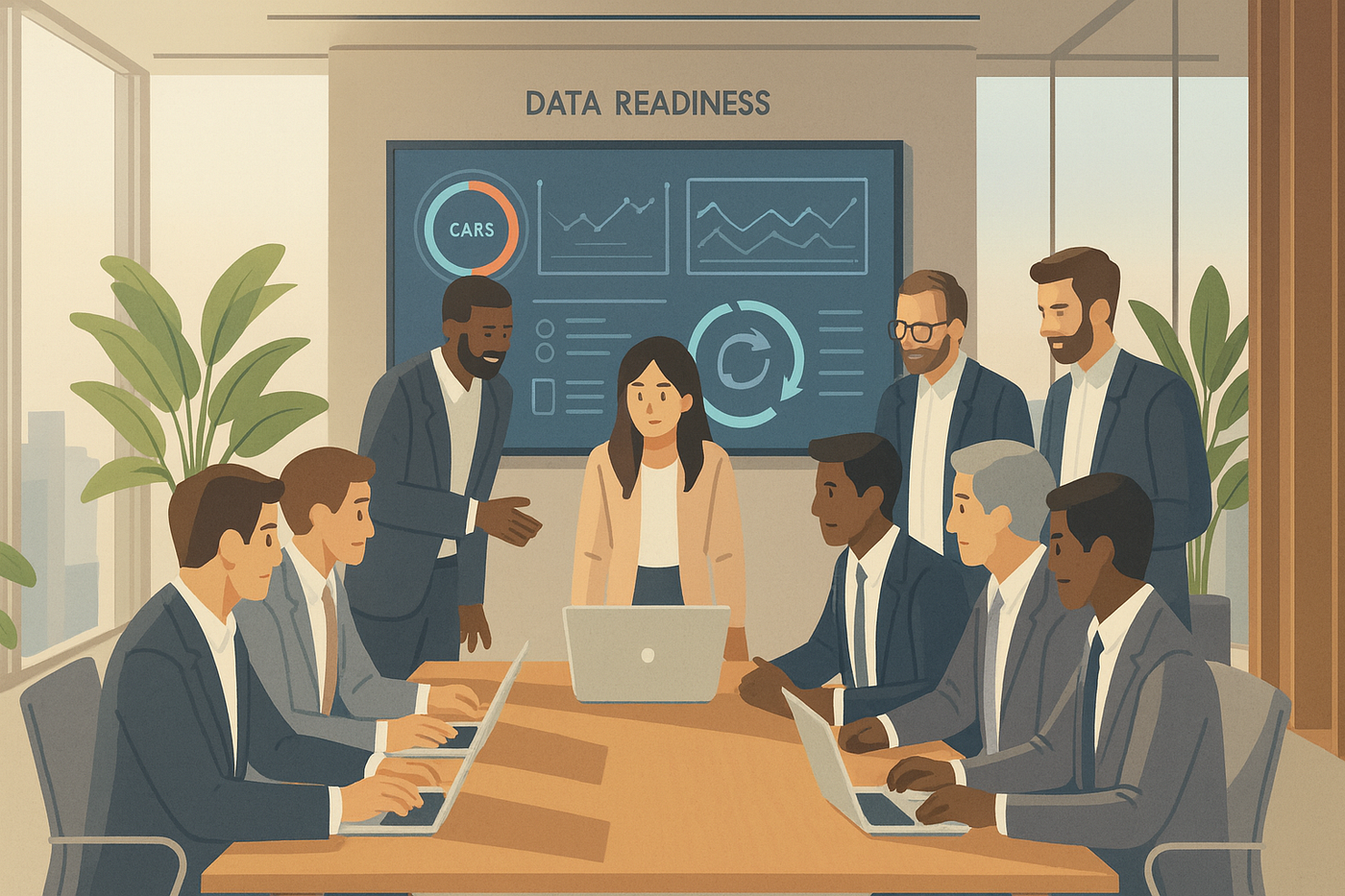
AI adoption is accelerating across industries — but the failure rate of AI projects remains shockingly high. Gartner estimates that nearly 85% of AI initiatives never make it to production. And while most organizations blame model performance or lack of talent, the truth is far more fundamental:
Most AI projects fail before they even begin — because the organization’s data is not ready for AI.
Poor data readiness for AI is the silent killer of transformation initiatives. You can have the right strategy, the perfect use case, and the best AI tools — but without high-quality, accessible, well-governed data, nothing works.
In this article, we uncover the hidden cost of ignoring data readiness — and what leaders can do to ensure their AI investments deliver measurable ROI.
The Real Reason AI Models Underperform
When companies start an AI project, here’s the typical sequence:
- Identify an opportunity
- Select tools or vendors
- Build a model or prototype
- Discover very late that the data is incomplete, inconsistent, or incompatible
- Spend months “fixing” data
- Lose momentum, budget, and stakeholder confidence
This pattern is so common it has become the norm.
Why does it happen? Because AI depends on data ecosystems, not standalone datasets. And most organizations have data that is:
- Scattered across legacy systems
- Full of duplicates
- Missing context
- Lacking governance
- Poorly labeled
- Not standardized
AI models are only as smart as the data they see. When the data is chaotic, the AI behaves chaotically too.
The Hidden Costs of Poor Data Readiness for AI
Most leaders understand that bad data slows down teams. But what they don’t see is the compounding cost AI magnifies.
Here are the real consequences:
1. Delayed Time-to-Value
AI models take 3–5x longer to deploy when foundational data isn’t prepared. Teams spend more time fixing data than training models.
2. Ballooning Project Budgets
Data cleanup becomes an unplanned expense. Organizations often underestimate data preparation costs by 60–80%.
3. Lower AI Accuracy & Reliability
Bad data = bad predictions. Even state-of-the-art models can fail with inconsistent or biased data.
4. Limited Scalability
A model built on incomplete data can’t be replicated across departments. Leaders end up with AI “islands” instead of enterprise-wide adoption.
5. Team Frustration & Stakeholder Fatigue
When data problems emerge late, everyone blames the AI initiative itself. Trust erodes. Projects stall.
The Root Problem: Organizations Think AI Will Fix Their Data
There is a dangerous misconception: “We’ll fix our data once we start using AI.”
This is backwards.
AI doesn’t clean data. AI doesn’t align systems. AI doesn’t unify sources.
AI amplifies whatever data it is given.
- If the data is fragmented, AI outputs will be fragmented.
- If data lacks context, AI will generate incorrect insights.
- If the data is biased, AI will reinforce the bias.
Data readiness for AI must happen before model development — not after.
How to Know If Your Organization Is Not AI-Ready
If you notice any of these red flags, your data readiness is low:
- You cannot easily answer: “Where does this data come from?”
- Teams spend more time searching for data than analyzing it
- Same customer appears multiple times across systems
- Operational reports show conflicting numbers
- You rely heavily on manual spreadsheets
- Data is not consistently labeled or categorized
- Every new AI initiative requires starting from scratch
Even high-growth, tech-enabled companies struggle with this. The problem isn’t lack of data — it’s lack of data readiness for AI.
The Way Forward: Preparing Your Data Before the AI Journey
The good news is this: preparing your data for AI doesn’t have to take years. In fact, with the right approach, organizations can accelerate readiness in weeks.
The essential steps include:
1. Establish a Single Source of Truth
Unify data from different systems into a clean, reliable foundation.
2. Standardize Data Definitions
Ensure every team uses consistent names, formats, and rules.
3. Build Strong Governance
Define who owns what data, how it’s maintained, and how it’s accessed.
4. Automate Data Quality Checks
Identify anomalies, duplicates, and gaps in real time.
5. Create AI-Ready Data Pipelines
Make your data structured, labeled, and contextualized.
6. Prioritize High-Value Use Cases
Don’t prepare all data — prepare the data tied to strategic outcomes.
The Competitive Advantage of Getting It Right
Companies that invest early in data readiness for AI:
- Deploy AI faster
- Achieve higher accuracy
- Reduce operational friction
- Scale AI across departments
- Build an enterprise-wide data culture
- Generate ROI in months, not years
Data readiness isn’t a technical task — it’s a strategic differentiator.
Ready to Accelerate Your Data Readiness for AI?
If your organization wants to implement AI quickly and confidently, the first step isn’t choosing a model or vendor — it’s preparing your data.
Your data is the engine of your AI initiatives. The faster you align it, the faster you realize value.
To understand how fast you can get your data AI-ready, read our in-depth guide: ***Get Your Data Ready for AI Faster Than You Think***
메타데이터
- post_id
- ec6471e33800
- slug
- why-most-ai-projects-fail-before-they-start-the-hidden-cost-of-poor-data-readiness-for-ai-ec6471e33800
- url
- https://medium.com/@vipul.gupta.seo/why-most-ai-projects-fail-before-they-start-the-hidden-cost-of-poor-data-readiness-for-ai-ec6471e33800
- canonical_url
- https://medium.com/@vipul.gupta.seo/why-most-ai-projects-fail-before-they-start-the-hidden-cost-of-poor-data-readiness-for-ai-ec6471e33800
- author_url
- https://medium.com/@vipul.gupta.seo
- status
- ok
- fetched_at
- 2026-07-26 11:40:32




