The Waterless Deluge ThatYeshua Saw Coming (Part 2 of 2).
The Olivet Discourse as Political Prophecy and Military Survival Manual.
The Waterless Deluge ThatYeshua Saw Coming (Part 2 of 2).
The Olivet Discourse as Political Prophecy and Military Survival Manual.
A companion essay to “Noach’s Flood Was Not About Water.”
(Written By Rohan Palmer).
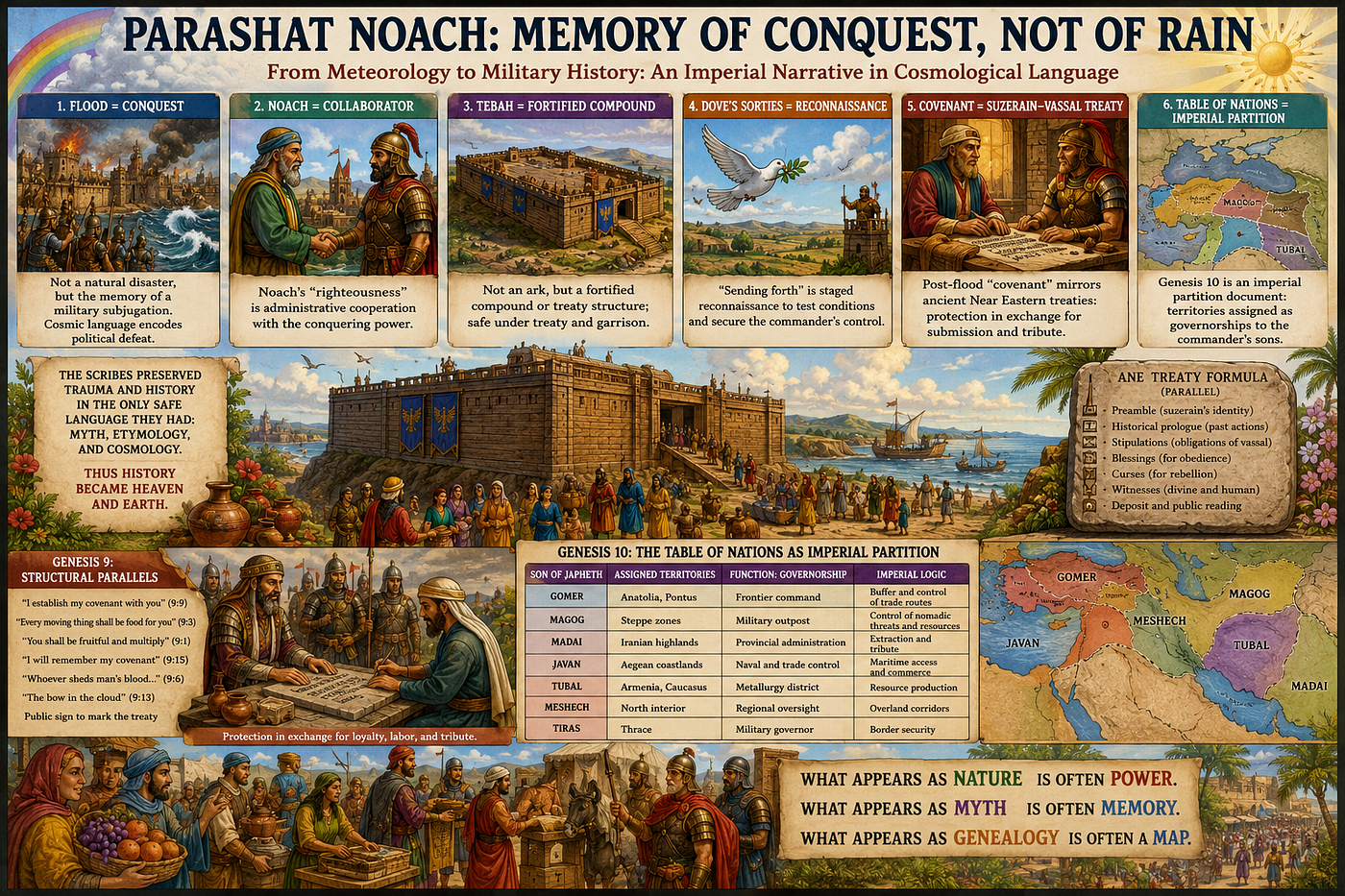
Image By Ai.
The Structural Tension.
To understand what Yeshua was reading, it is necessary to understand the political situation with some precision. The decades between the accession of Herod the Great (37 BCE) and the outbreak of the Jewish War (66 CE) were characterized by escalating structural tension between Roman imperial administration and the Jewish population of Judea, Galilee, and the surrounding regions. The tension was not merely cultural or religious. It was fiscal, demographic, and institutional.
Roman taxation extracted substantial resources from an already stressed agricultural economy. The high-priestly aristocracy collaborated with Roman administration in ways that generated acute popular resentment — the same dynamic the companion essay identifies in the Noach narrative, where the collaborating administrative class is preserved while the broader population is destroyed. The Zealot movement and the “fourth philosophy” of Judas the Galilean, documented by Josephus, represented the organized political expression of resistance to this arrangement. Yeshua was operating in precisely this charged environment, and his Temple action — identified by E.P. Sanders as the most historically certain event of his public ministry — was itself a politically legible gesture against the institutional apparatus of Roman-priestly collaboration.
The Trajectory Yeshua Read.
The political trajectory from Yeshua’s ministry (circa 28–33 CE) to the Jewish War (66–70 CE) was not an unpredictable rupture. It was the accelerating outcome of structural forces visible to any careful political observer. A sequence of incompetent or provocative Roman procurators — Felix, Festus, Albinus, and finally Gessius Florus — combined with intensifying Zealot activity, intra-Jewish factional violence, and a series of inflammatory incidents around the Temple to create conditions in which war became progressively more likely. Josephus’s narrative in the Jewish War documents the incremental escalation with retrospective clarity.
A teacher positioned where Yeshua was positioned — politically alert, rooted in the prophetic tradition, familiar with the history of Assyrian and Babylonian conquest that the Hebrew corpus encoded — had every intellectual resource needed to identify the trajectory and its likely endpoint. The prophetic tradition he inherited was full of exactly this kind of political analysis dressed in theological language. Isaiah’s warnings about Assyria, Jeremiah’s warnings about Babylon, Ezekiel’s oracles against Jerusalem — all follow the same structure: observation of political reality, identification of the trajectory, warning about the consequences of the current path, prescription of survival behavior. Yeshua was working within a well-established genre.
The Pella Flight: The Warning That Was Heeded.
The most remarkable piece of evidence for the political-military reading of the Discourse is not textual. It is historical. Eusebius of Caesarea records in his Ecclesiastical History that the Jerusalem Christian community fled the city before the Roman siege closed — relocating to Pella in the Decapolis, east of the Jordan River — citing a prophetic oracle or warning received before the outbreak of hostilities. The historicity of the Pella flight has been debated, and Gerd Lüdemann among others has questioned the details of Eusebius’s account. But the broad outline is consistent with what we know, the early Jerusalem community survived the destruction of 70 CE in a way that the general population of the city did not. Whether or not the Pella tradition is historically precise in every detail, it preserves the memory of a community that acted on a warning and got out — while those who remained perished or were enslaved.
This is the Noach pattern exactly. A specific group, warned in advance, constructed their structure of survival — in this case not a compound but a community network with routes and destinations identified before the crisis closed — and emerged from the catastrophe while the surrounding population was destroyed. The warning they acted on is, on the most historically plausible reading, the tradition of the Olivet Discourse.
Josephus’s account of the siege itself confirms every tactical element of Yeshua’s instructions. The cordon closed rapidly. Those who tried to flee after the investment was complete were caught and crucified by the Romans — at the rate of five hundred per day at the siege’s height, Josephus records. Those who had fled to the mountains before the siege began survived. Those who remained, whether from inertia, factional obligation, or the conviction that divine intervention would save the city, did not.
Yeshua, Rome, and the Third Way.
Richard Horsley has argued extensively that Yeshua’s teaching constitutes an anti-imperial discourse — a systematic challenge to Roman power conducted through the language of the Kingdom of God. This reading is partially right but requires refinement in the light of the Discourse. Yeshua is not simply anti-Roman. He is also not simply pro-Roman in the sense of recommending collaboration. He is doing something more sophisticated, he is recommending survival through non-engagement with the coming conflict.
The factions he is distinguishing himself from are the Zealots and related resistance movements who advocated armed confrontation with Rome, and the Temple aristocracy who advocated collaboration. Both positions, on Yeshua’s analysis, lead to destruction, the Zealots because they cannot win a military conflict with the most effective fighting force in the ancient world; the collaborators because Roman patience with the Judean political arrangement is finite and will eventually be withdrawn. Josephus documents both dynamics in his account of the war — the Zealot factions destroying each other within Jerusalem as the Roman siege tightened, and the priestly aristocracy being swept away with the Temple in which their authority resided.
Yeshua’s third way is the way of Noach: do not fight the flood. Do not collaborate with the power that generates it. Read the signs, build your structure of survival, and move before the cordon closes. The disciples who flee to the mountains — who do not go back for their cloaks, who move immediately when they see the armies surrounding Jerusalem — are following the same logic that Noach followed when he entered the compound before the operation began.
The crucial difference, and the difference that distinguishes Yeshua’s use of the Noach tradition from the tradition’s original political meaning, is what survival is for. In the Genesis narrative, Noach survives to become a client ruler, to plant his vineyard and receive his land grant and administer his portion of the imperial partition. There is no indication in the text that his survival serves any purpose beyond the perpetuation of his own lineage and the establishment of the new order’s administration. The survival Yeshua prescribes is survival in order to continue the work — the proclamation of the Kingdom, the formation of the community, the practice of the teaching that the destroyed Temple-centered order had failed to embody.
The Encoded Tradition and Its Transmission.
One of the most striking features of the Discourse, read in this light, is how faithfully it reproduces the structural logic of the prophetic tradition’s political warnings. Isaiah warning about Assyria, Jeremiah warning about Babylon, Yechezkel/Ezekiel cataloguing the sins that will bring destruction upon Jerusalem — all follow the pattern, identify the political trajectory, encode the warning in cosmological and theological language, prescribe survival behavior for those who will hear, consign the rest to the coming catastrophe. Yeshua is not innovating. He is using the genre that his tradition had developed over centuries for exactly this purpose, saying politically dangerous things in language that is deniable, portable, and survivable.
David Flusser’s recovery of Yeshua as a thoroughly Second Temple Jewish teacher — not a founder of a new religion but a participant in the rich internal debates of first-century Judaism — is essential here. The Discourse is not anomalous within its tradition. It is a sophisticated deployment of resources that tradition had been developing since the Babylonian exile. The scribal class that edited the Noach narrative during the exile encoded their political trauma in cosmological language. The teacher sitting on the Mount of Olives, looking at the Temple whose destruction he foresaw, was doing the same thing in real time.
Warren Carter’s analysis of Matthew’s Gospel as a sustained negotiation with Roman imperial power adds a further layer, the community that preserved and edited the Discourse after 70 CE — writing in the shadow of the destruction Yeshua had predicted — understood themselves to be doing what the exilic scribes had done. They were encoding the memory of catastrophe, the analysis of its causes, and the prescription for survival in a form that could be transmitted, read, and acted upon by future communities facing analogous situations. The Discourse survived because it was useful. It was useful because it was true — not in the sense of predicting cosmic events, but in the sense of accurately describing how imperial power operates and what survival within its operations requires.
The Flood as Recurring Structure.
The argument of both essays converges on a single structural observation. The flood is not an event. It is a pattern — a recurring structure of imperial violence that the Hebrew scribal tradition identified, encoded, transmitted, and periodically decoded for the communities that inherited it.
The first encoding: the original military conquest that the Noach narrative preserves, wrapped in cosmological language by the exilic scribal class who had survived it by being administratively useful, and who transmitted their trauma and their political analysis as sacred text.
The second encoding: Yeshua’s reading of the same pattern in the political trajectory of first-century Roman-Jewish tension, invoking the Noach tradition explicitly as his framework, and encoding his warning in the same prophetic language of imminent cosmic judgment that the tradition had used for politically dangerous analysis since Isaiah.
The third encoding: the Matthean and Lukan communities’ preservation and editing of the Discourse after 70 CE, in the knowledge that the warning had been accurate, the prediction had been fulfilled, and the tradition of encoding political reality in cosmological language had once again proven its survival value.
What this genealogy reveals is that the Hebrew and early Messianic scriptural tradition contains, running through its center like a structural beam, a sophisticated and consistently applied method for reading imperial power, warning about its operations, and prescribing survival behavior for communities caught in its path. The method works by encoding political analysis in theological language, by invoking precedent (Noach, Lot, the Exodus) as political template, and by prescribing specific behavioral responses — move early, move fast, do not look back, do not go back for your cloak — that are operationally grounded in the realities of military catastrophe.
Implications and Conclusions.
The implications of reading the Olivet Discourse as political prophecy rather than cosmic eschatology are substantial, and they run in several directions simultaneously. For historical Yeshua scholarship, this reading supports the consensus position — represented by Wright, France, Sanders, and Dunn among others — that the Discourse refers primarily to the events of 66–70 CE. But it deepens that position by grounding it in the specific tradition of political-military analysis that the companion essay traces through the Noach narrative. Yeshua is not merely a prophet who happened to predict the Temple’s destruction. He is a reader of political texts and political situations operating within a centuries-old tradition of encoding dangerous analysis in survivable language.
For the interpretation of the Noach narrative itself, Yeshua’s invocation of it is significant. It demonstrates that Second Temple readers were capable of receiving the flood narrative in a political register — that the cosmological surface did not prevent sophisticated readers from engaging the political substrate. Yeshua uses Noach as a political template, not a moral one. He does not invoke Noach’s righteousness as the point. He invokes Noach’s advance knowledge and decisive action. The flood is the warning. The ark is the response. The question is whether you build before the waters rise.
For communities in any era who inherit these texts, the reading offered in both essays suggests that the tradition’s deepest utility is not theological in the conventional sense. It is political in the ancient sense, the sense in which politics encompasses the full range of decisions about how communities survive, what they owe to power structures that threaten them, what forms of cooperation are sustainable and what forms are lethal, and how warnings about coming catastrophe are encoded, transmitted, and acted upon across generations.
The flood Yeshua saw coming arrived in 70 CE. The community that heeded his warning got out. The Temple fell. The world it organized ended.
The text survived. It always does. That is what it was built for…
메타데이터
- post_id
- ec64cd7bdcdd
- slug
- the-waterless-deluge-thatyeshua-saw-coming-part-2-of-2-ec64cd7bdcdd
- url
- https://medium.com/@rpalmerusa19/the-waterless-deluge-thatyeshua-saw-coming-part-2-of-2-ec64cd7bdcdd
- canonical_url
- https://medium.com/@rpalmerusa19/the-waterless-deluge-thatyeshua-saw-coming-part-2-of-2-ec64cd7bdcdd
- author_url
- https://medium.com/@rpalmerusa19
- status
- ok
- fetched_at
- 2026-07-15 22:45:01