How to Legally Reduce Your Loan Interest Rate?
Learn practical ways to legally reduce your loan interest burden and save more money.
Loan Management
How to Legally Reduce Your Loan Interest Rate?
Learn legal and practical ways to reduce your loan interest rate and lower your repayment burden.

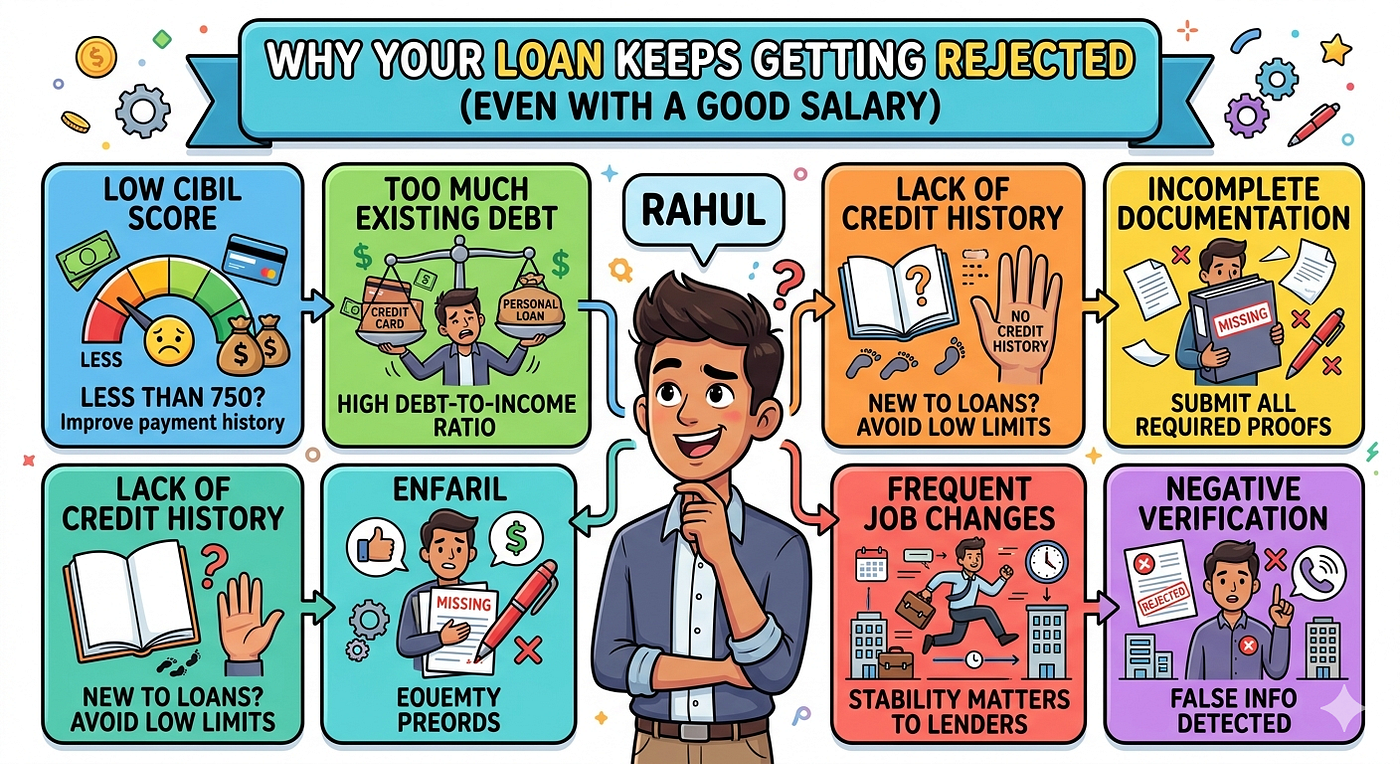
This image is generated through AI
As soon as we opt for a loan and then the time comes to start paying the EMIs, most people regret and think that it is too much. However, in certain cases, there is a way you can actually reduce loan interest while it’s running.
A loan interest rate is not always a “fixed forever” number, especially when we are talking about floating-rate loans and debt consolidation. For example, a ₹5,00,000 Personal Loan for 5 years, a rate cut from 15% to 11% can reduce the EMI from roughly ₹11,895 to ₹10,871, saving about ₹1,024 every month and nearly ₹61,000 over the full tenure.
So yes, lowering the rate legally is possible, and it can make a very real difference.
Which Loan Products Can Be Negotiated Or Refinanced?
Loan interest rates are often fixed on most of the loan products, however, there are some products that allow you to legally change the interest rates.
The most common products where borrowers try to reduce interest are Personal Loans, Business Loans, Overdraft limits and Personal Debt Consolidation loans. A Personal Loan is usually the easiest to compare because rates are widely advertised and balance transfer options are common.
Business Loans can also be repriced if the business has stronger cash flow now than when the loan was originally sanctioned. Overdraft facilities are slightly different because interest is charged only on the utilised amount, but the pricing can still be reviewed if turnover, collateral or repayment history has improved.
Personal Debt Consolidation works as a rescue option when someone has multiple high-cost EMIs or credit card dues and wants to combine them into one lower-rate repayment plan.
The legal trick is that you are not “escaping” the loan; you are using the lender’s own rules, market competition, and your improved credit profile to get a better deal.
Easiest Way To Reduce Your Interest Rate,
There are many ways that can help you achieve a lower interest rate. However, the first and easiest method is to ask your existing lender for a rate revision.
Most of the borrowers skip this step and jump straight to switching banks, but an internal rate conversion can be cheaper. Let’s understand this with an example. Just imagine you took a Personal Loan of ₹8,00,000 at 14.5% for 60 months in 2024.
Your EMI would be around ₹18,805. If your lender agrees to reduce the rate to 11.5%, the EMI drops to about ₹17,597. That is a monthly saving of ₹1,208 and a total saving of more than ₹72,000 across the tenure. Some lenders may charge a conversion fee of ₹2,000 to ₹5,000, but that is still tiny compared to the interest saved.
This works best if your CIBIL score has improved, your salary has increased, your EMI record is clean, and the market rate for fresh borrowers is now lower than what you are paying.
People on Reddit have also mentioned similar things about reducing the interest rate by asking their lenders and it went well just as they thought. Some users also mentioned saving more than before just by cutting only a few points.
How Credit Score Help Here?
As we all already know, most of the banks, lenders, and financial institutions look for borrowers who have a higher CIBIL or credit score. Most of the time borrowers are unaware of the fact that CIBIL score is what decides if they are going to the loan at 7% or 8% or sometimes even higher. Your credit score is basically your bargaining chip in human form.
A borrower with a CIBIL score of 780 and a clean 24-month repayment history is a far better customer than the version of themselves who borrowed with a 690 score during an emergency. Even a 1% reduction matters in some situations.
Let’s assume, you take a ₹10 lakh Business Loan for 4 years at 16% your EMI will be ₹28,157. If the lender replaces it to 14%, the EMI falls to about ₹27,337, saving ₹820 a month and nearly ₹39,000 over the term. In the long-term, math gets even more dramatic for larger Business Loans or long-tenure debt consolidation products.
So before asking for a lower rate, try to clear credit card overdues, avoid bouncing EMIs, correct credit report errors, and bring your debt-to-income ratio down. In simple terms, make yourself look less risky, and use financial tools like LoansJagat for better understanding what to do when the right time comes.
Ending Thoughts
Let me explain this to you in the most simple words. So basically, reducing your loan interest rate is one of those rare money moves that feels boring on paper but gorgeous in real life.
You are not trying to be smarter than the system but you are simply using negotiation, a stronger credit profile, balance transfer, overdraft restructuring or debt consolidation to stop overpaying.
If a few emails, one comparison, and some basic math can save you ₹30,000, ₹50,000 or even ₹1 lakh over time, that is not a small win. That is your future self quietly sending you a thank-you note.
📩 Join Investor’s Handbook Digest — get the best investing, markets, and wealth-building insights each week.
메타데이터
- post_id
- ec6c919079ea
- slug
- how-to-legally-reduce-your-loan-interest-rate-ec6c919079ea
- url
- https://medium.com/the-investors-handbook/how-to-legally-reduce-your-loan-interest-rate-ec6c919079ea
- canonical_url
- https://medium.com/the-investors-handbook/how-to-legally-reduce-your-loan-interest-rate-ec6c919079ea
- author_url
- https://medium.com/@loansjagat.com
- status
- ok
- fetched_at
- 2026-07-08 20:12:56