Seeing Layers: The One Habit That Makes Cities Feel Like Cinema
How a simple question turns flat street photos into frames that feel like movies.
Seeing Layers: The One Habit That Makes Cities Feel Like Cinema
How a simple question turns flat street photos into frames that feel like movies.
You can walk through an incredible city and still come home with flat photos.
Same streets, same light, same crowds… but the images feel like postcards, not scenes from a film.
Most of the time, the problem isn’t your camera. It’s this:
You’re photographing things instead of layers.
Cinematic frames almost always have depth — foreground, middle ground, background, sometimes even reflections on top of that. When you learn to see those layers on purpose, the city stops being “a street” and starts being a stage.
There’s one tiny habit that flips that switch.
The One Habit: Ask “What’s on the other plane?”
That’s it.
Every time something catches your eye — an interesting person, a sign, a shaft of light — don’t shoot it yet.
First, ask:
“What’s happening behind this?” or “What could I put in front of this?”
You’re forcing your brain to search for at least two planes:
- the thing you noticed
- something overlapping it (closer or farther)
When you stack those planes, the frame starts to feel like a movie still instead of a snapshot.
Most people stop at the first thing. Layered photographers stay five seconds longer and look for the second and third.
Why Cities Look Flat in Photos (Even When They Don’t in Real Life)
Your eyes already see in layers:
- people walking past
- traffic behind them
- buildings rising in the distance
- reflections in windows
- light bouncing off glass
But when you bring the camera to your face, panic sets in:
“Quick, don’t miss it!”
You zoom in on the one subject and erase the rest.
The result:
- isolated person against a vague background
- no sense of depth, distance, or atmosphere
- the city’s complexity reduced to a cardboard backdrop
Layers fix that by keeping the environment in play.
Three Types of Layers to Hunt for
Next time you walk with your camera, look for these three kinds of layers.
1. Physical Layers (Front / Middle / Back)
Classic cinema stuff:
- Foreground — out-of-focus shapes, people, railings, café tables
- Middle ground — your main subject
- Background — architecture, traffic, light, sky
Even a simple scene — a person crossing a street — becomes richer if:
- there’s a car or bike passing in front (foreground)
- the person is mid-stride (middle)
- a big billboard or building anchors the back (background)
Tip: Drop your camera lower or higher than eye-level to exaggerate those planes.
2. Transparent Layers (Reflections & Glass)
Any time there’s glass, you can shoot two scenes at once:
- the people inside
- the street reflected outside
You get:
- a man reading a newspaper + ghost pedestrians walking through his face
- café tables + floating traffic lights
- your own silhouette + the building opposite
These transparent layers feel cinematic because they compress time and place into a single frame — like a quiet crossfade inside one still image.
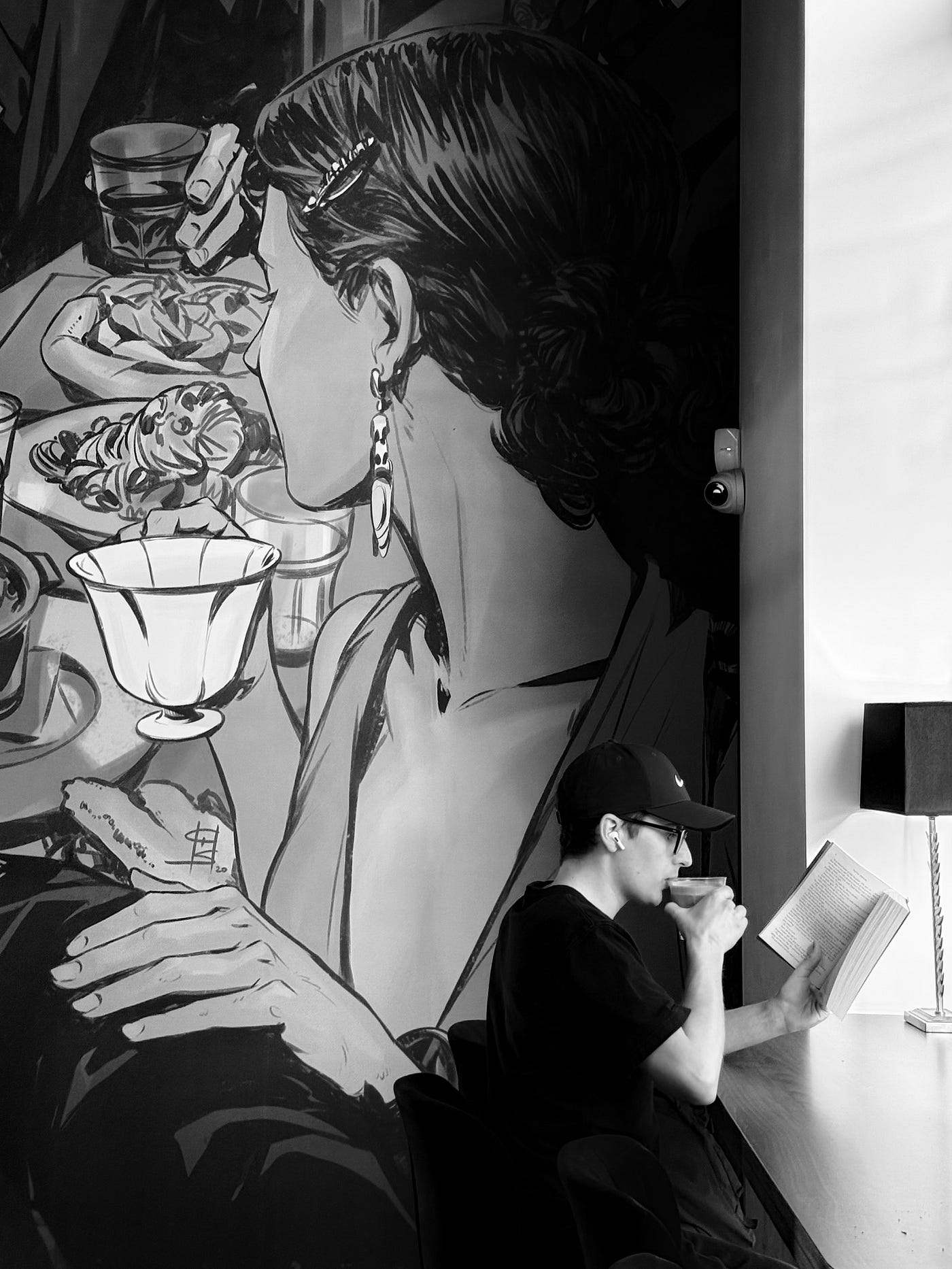
London, UK © 2026 Julien Valleton
3. Conceptual Layers (Story on Story)
This is where things get interesting.
A layered photo doesn’t just stack objects. It stacks meanings:
- a luxury ad behind a worker on a ladder
- a “Forever” slogan over a couple arguing
- a laughing billboard above a man who looks exhausted
Foreground and background are saying different things about the same world.
That’s when your photo stops being “someone on the street” and starts becoming a comment on the street.
How to Practice Layer Vision on a 30-Minute Walk
You don’t need a new city. Just a short loop and a bit of discipline.
Step 1 — Pick one street, walk it twice
- Outbound: no camera, just look for layers.
- Return: same street, now with camera, hunting the moments you missed.
You’ll be shocked how different the street looks the second time.
Step 2 — Limit yourself to “two-plane minimum” frames
Give yourself this constraint:
“I’m not allowed to press the shutter unless I clearly have at least two layers.”
Examples:
- person + background poster
- reflection + interior
- foreground object + subject farther away
If you end your walk with only 5 photos, that’s fine. The whole point is to force your brain to see overlap.
Step 3 — Use people as moving layers
Think of passersby as moving foreground elements you can slide in front of your main subject:
- Wait until someone in a hat crosses your frame.
- Let a bus or bike partially block the scene.
- Use a silhouette or out-of-focus shoulder to frame your subject.
You’re not “ruining” the shot. You’re adding a layer.
Cinema does this all the time — a character framed through doorways, window frames, or other people’s bodies.
Step 4 — Stay for the second beat
The first moment you notice is rarely the best.
- The first man to sit at the café table is fine. The second one might echo the billboard behind him.
- The first pedestrian in a crosswalk is fine. The next three together might create a perfect diagonal.
- The first reflection you see is fine. The person who stops right inside that reflection might create the magic.
Layers reward patience. Films work in scenes, not single frames. Your photos can too.
What Layers Do to Your Brain (And Your Life)
Learning to see layers has side effects that go beyond photography.
You start noticing:
- the conversation in front of you and the mood behind it
- the architecture and how people actually use it
- the public performance and the private gestures
In other words: your perception becomes less “headline” and more “story.”
Cinemascope for your everyday life.
And once you’ve trained that muscle, it leaks into everything:
- work meetings
- relationships
- your own thoughts
You stop believing the first surface layer. You ask, “What’s underneath? What’s behind? What am I not seeing yet?”
That’s a powerful way to move through a noisy world.
Street Mission: One Street, Three Layers
Micro-assignment (20–30 minutes):
- Pick one short block in your city. Stay there the entire time.
- Aim to come home with three photos, each using a different type of layer:
- physical (foreground/middle/background)
- reflection (inside + outside)
- conceptual (message + person)
- For each frame, write one sentence in your notes app beginning with: “This would be the opening shot of a film about…” Finish the sentence.
You’re not just taking pictures. You’re casting scenes.
One Question to Walk With
What’s the second thing happening in this frame that most people would miss?
If you can answer that before you shoot, your photos will almost automatically feel more cinematic.
If you’d like more experiments like these — one big idea + one street photography mission at a time — you can:
- Follow me here on Medium so you don’t miss the next article, and/or
- Join my newsletter **Street Photography Lab**, where I turn books into weekly walks for your mind in the age of AI.
메타데이터
- post_id
- ec6efac94606
- slug
- seeing-layers-the-one-habit-that-makes-cities-feel-like-cinema-ec6efac94606
- url
- https://medium.com/@Street_Photography_Lab/seeing-layers-the-one-habit-that-makes-cities-feel-like-cinema-ec6efac94606
- canonical_url
- https://medium.com/@Street_Photography_Lab/seeing-layers-the-one-habit-that-makes-cities-feel-like-cinema-ec6efac94606
- author_url
- https://medium.com/@Street_Photography_Lab
- status
- ok
- fetched_at
- 2026-06-09 15:37:30