Bitcoin at $65,000: Fear Is Back, but the Monetary Case Is Stronger Than Ever
With CBBI at 34, Fear & Greed at 30, M2 rising to $23.16 trillion, and Bitcoin’s network still secured by near-zettahash proof-of-work…
Bitcoin at $65,000: Fear Is Back, but the Monetary Case Is Stronger Than Ever
With CBBI at 34, Fear & Greed at 30, M2 rising to $23.16 trillion, and Bitcoin’s network still secured by near-zettahash proof-of-work, this correction looks painful—not fatal.
That is not a euphoric market.
That is not a late-cycle public mania.
That is not the emotional state typically seen when Bitcoin is reaching its final peak.
This is fear. This is exhaustion. This is the kind of market where many people who claimed conviction at higher prices suddenly begin asking whether Bitcoin is broken. It is not broken. It is correcting, consolidating, and once again testing whether holders understand what they own.
Bitcoin has fallen sharply from its prior all-time high near $126,160, with the Clark Moody dashboard showing a decline of roughly 48.6% from that peak. That kind of drawdown hurts. It always does. But in Bitcoin history, deep corrections are not rare exceptions. They are part of the monetization process.
The important question is not whether the price has dropped.
The important question is whether the protocol failed.
It has not.
The network is still producing blocks. The supply cap is still enforced. The hash rate remains enormous. The money supply is still hard-capped. The dollar system continues expanding. The on-chain valuation signals are not in euphoric top territory. And long-term holders who understand Bitcoin as monetary technology should view this decline through the lens of history, not emotion.
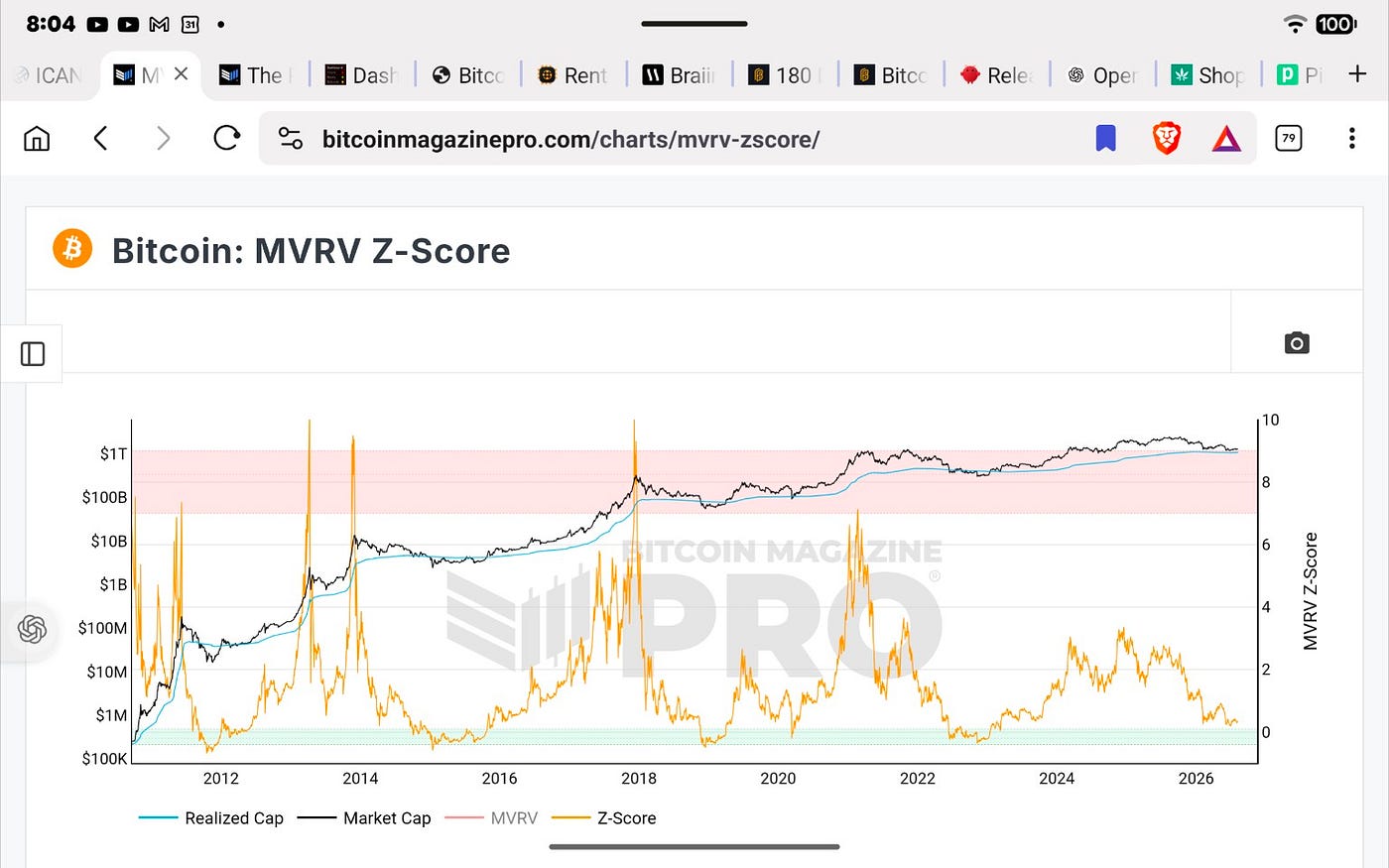
charts.bitbo.io/charts/mvrv-zscore
MVRV Z-Score: This Is Not What a Classic Bitcoin Top Looks Like
The MVRV Z-Score remains one of the best long-cycle valuation tools for Bitcoin because it compares market capitalization against realized capitalization. Market cap is the simple spot-price valuation of the network. Realized cap is more subtle. It values coins based on the price at which they last moved on-chain, providing a rough view of the aggregate holder cost basis.
When Bitcoin enters true mania, the MVRV Z-Score historically explodes upward. That happened in earlier cycles when price detached from realized value and the public became reckless.
That is not what the current chart shows.
The current MVRV Z-Score is depressed compared with prior overheated cycle peaks. It is not flashing the classic red-zone signal that Bitcoin has entered full speculative exhaustion. Instead, it looks more like a reset of market temperature after a painful correction.
That matters.
A CBBI reading of 34 and a Fear & Greed reading of 30 support the same conclusion. The market is fearful, not euphoric. The crowd is cautious, not greedy. The public is not treating Bitcoin as a guaranteed path to wealth. In fact, many are acting as if the thesis is suddenly questionable because the price has dropped.
That emotional reaction is precisely what Bitcoin has done to investors for more than a decade.
It scares people away before teaching them the next lesson.

bitcoinmagazinepro.com/charts/puell-multiple
The Puell Multiple: Miner Revenue Is Not Screaming Final Euphoria
The Puell Multiple looks at miner revenue relative to its long-term average. This is important because miners are the industrial sellers inside Bitcoin. They have real operating expenses: energy, ASICs, facilities, cooling, firmware, staff, debt service, and maintenance.
When miner revenue becomes extremely high relative to history, the market can be entering dangerous speculative territory. When miner revenue is depressed or moderate, the market is usually not behaving like a final-stage mania.
Today, the Puell Multiple is not showing the extreme overheating seen near major historical tops.
That does not mean Bitcoin must immediately rise tomorrow. No honest analyst should claim that. But it does mean the current correction is not supported by the same kind of overheated miner-revenue profile that often appears near cycle exhaustion.
This is a colder market.
And colder markets are where serious Bitcoin accumulation often begins.
Not all at once. Not with perfect timing. Not with public applause. But slowly, while fear still hangs in the air.

bitcoin.clarkmoody.com/dashboard
The Network Data: Price Is Down, but Bitcoin Is Still Doing Its Job
The Clark Moody dashboard shows Bitcoin near $64,880, with market capitalization around $1.30 trillion. It also shows roughly 20,067,888 BTC issued, meaning about 95.56% of all Bitcoin that will ever exist has already entered circulation. Only about 931,881 BTC remain to be mined across the rest of Bitcoin’s issuance schedule.
That is the part the market still has not fully priced.
Bitcoin is abundant regardless of what an executive says. Bitcoin is scarce because independent nodes enforce its scarcity. Bitcoin is not sound money because of branding. It is sound money because users globally enforce the rules by refusing invalid blocks.
That is the difference between Bitcoin and every fiat currency.
The dollar can be expanded.
Bitcoin cannot.
The euro can be expanded.
Bitcoin cannot.
The yen can be expanded.
Bitcoin cannot.
The British pound can be expanded.
Bitcoin cannot.
The dashboard also shows more than 26,000 reachable Bitcoin nodes. That is the constitutional layer of Bitcoin. Miners produce candidate blocks, but nodes enforce the rules. A miner cannot create extra Bitcoin and force honest nodes to accept it. A miner cannot change the subsidy schedule by decree. A miner cannot rewrite consensus and expect sovereign users to comply.
This is why full-node validation matters.
This is why decentralization is not just a slogan.
And this is why price weakness must never be confused with protocol weakness.

bitcoin.clarkmoody.com/dashboard
Mining Security: Nearly One Zettahash of Industrial Proof-of-Work
Bitcoin’s hash rate remains enormous. The dashboard shows a 90-day hash rate near 927.4 EH/s and a recent 2016-block hash rate near 916 EH/s. That places Bitcoin’s proof-of-work security near the one-zettahash era.
For those who understand the history of computing, that is extraordinary.
Bitcoin began in 2009 as software that could be mined on ordinary CPUs. Then GPUs entered. Then FPGAs. Then ASICs. Then industrial mining farms. Today, Bitcoin is secured by a global wall of specialized computation and energy conversion.
That is not an accident.
It is the result of incentives working for more than seventeen years.
The dashboard shows mining difficulty near 127.5 trillion. Difficulty is one of Bitcoin’s great internal balancing mechanisms. If hash rate rises, difficulty adjusts upward. If hash rate falls, difficulty adjusts downward. Bitcoin does not require a central administrator to manage block production. The protocol adjusts.
That is engineering elegance.
At the same time, the fee market remains quiet. The mempool is light, minimum fee rates are around 1 sat/vB, and median fees are low. For ordinary users, that is helpful. It makes transactions inexpensive. For long-term security analysis, it is also a reminder that as block subsidy declines over future halvings, transaction fees must eventually carry a larger portion of miner revenue.
This is not a crisis today.
It is simply part of Bitcoin’s long-term design arc.
Bitcoin is moving from subsidy-dominated security toward a future where block space becomes increasingly important. That makes the quality of block space usage a serious issue. Bitcoin base-layer block space should remain primarily monetary settlement space. Everything else must be judged against that standard.

bitcoin.clarkmoody.com/dashboard
Scarcity: The Supply Clock Keeps Moving
The monetary side of Bitcoin remains the clearest long-term argument.
The dashboard shows realized monetary inflation of around 0.82%, with forward monetary inflation also at about 0.82%. In a world of expanding fiat balance sheets, that is remarkable. Bitcoin’s issuance is already below the inflation target used by many central banks, and unlike central-bank targets, Bitcoin’s issuance schedule is not a promise. It is code that is enforced by consensus.
The stock-to-flow ratio is shown around 122. Stock-to-flow should not be treated as a perfect price prediction tool. That is a mistake. Models can help frame scarcity, but they cannot command markets. Still, the underlying point remains powerful: Bitcoin’s existing supply is large relative to new issuance, and new issuance continues falling every halving.
The future supply milestones matter because they remind us how long Bitcoin’s monetary schedule extends. The dashboard places 99% supply issuance around March 1, 2035; 99.9% around March 9, 2048; the last full Bitcoin around October 30, 2105; and all coins issued around April 8, 2140.
No central bank operates this way.
No committee meets every six weeks to debate Bitcoin issuance.
No politician can promise voters a larger Bitcoin supply.
No emergency allows the protocol to print.
That is why Bitcoin matters.
That is why the drawdowns, while painful, must be placed inside the larger monetary structure.

bitcoin.clarkmoody.com/dashboard
Nodes Are the Constitutional Layer of Bitcoin
The node-version data is one of the most important parts of this report. It shows active Bitcoin Core versions, active Bitcoin Knots versions, and a broad distribution of validating software across the network.
That matters because Bitcoin is not a corporation. It is not a product controlled by one board. It is not a database administered by a cloud vendor. Bitcoin is a rules-based monetary protocol validated by independent users.
The dashboard shows Core 31.0.0 as a major node version and Knots 20260508 with significant network presence. That diversity matters. It shows that Bitcoin users are not passive consumers. They are rule enforcers.
This is where Bitcoin security and Bitcoin investment meet.
A person buying Bitcoin is not merely buying price exposure. A serious holder is relying on a global validation system to protect the supply cap, transaction rules, and monetary history. That is why understanding nodes, mining, wallet security, and self-custody is not optional. This understanding is part of the investment itself.
The next halving is estimated around April 2028, depending on block-time assumptions. Each halving reduces new issuance and tightens the flow of new Bitcoin entering the market. The 2012 halving mattered. The 2016 halving mattered. The 2020 halving mattered. The 2024 halving mattered. The 2028 halving will matter too.
Halvings are not magic.
They are monetary discipline made visible.

The Monthly Chart: This Is Painful, but Not Historically Strange
The monthly Bitcoin chart shows the emotional truth of the current market. Bitcoin rallied strongly into the prior high region, then entered a significant correction. Price is now near $64,900, below the monthly middle structure and well off the prior peak.
That looks ugly.
But ugly is not unusual for Bitcoin.
Bitcoin has always advanced through deep corrections. The 2011 cycle was brutal. The 2013–2014 cycle crushed late buyers. The 2017–2018 bear market erased confidence. The 2021–2022 decline convinced many people that Bitcoin was finished.
Yet each time, the protocol survived.
Each time, Bitcoin continued producing blocks.
Each time, the supply cap held.
Each time, the critics mistook price volatility for protocol failure.
The monthly chart today is not showing comfort. It shows a correction that demands discipline. The question is whether the broader monetary thesis has changed.
In my view, it has not.

The Weekly Chart: A Fight at Long-Term Support
The weekly chart shows Bitcoin hovering near the mid-$60,000 region after a sharp correction. The market is no longer in a clean bullish expansion phase. It is in a support battle.
That is honest.
The weekly structure shows the price below the declining 20-week Bollinger basis and near longer-term support areas. The 200-week and 300-week moving average structure is important because those lines have historically helped separate ordinary volatility from deeper cycle damage.
Bitcoin is not far above some major long-term reference zones. That means the market is serious now. This is no longer an uncomplicated momentum environment. It is the kind of market where investors must decide whether they actually believe the thesis or were simply chasing candles.
For disciplined investors, this is where dollar-cost averaging becomes more attractive than emotional lump-sum guessing. Trying to call the exact bottom is usually foolish. Bitcoin has a long history of humiliating perfect-timing attempts.
The better question is whether current prices offer better long-term value than higher prices did.
The answer is obvious.
Lower prices improve long-term risk/reward, provided the buyer has patience, no leverage, and secure custody.

The Dollar: Strong Enough to Pressure, Not Strong Enough to End the Bitcoin Thesis
The U.S. Dollar Index is near 99.624. The dollar has stabilized, but it is not in the kind of runaway surge that would fully negate the broader liquidity argument. It remains below the higher long-term moving average region and continues to move inside a choppy macro structure.
A strong dollar can pressure Bitcoin in the short term. That is true. Bitcoin trades globally, and dollar strength often tightens financial conditions. But the dollar’s short-term movement does not erase Bitcoin’s long-term monetary function.
The dollar is a managed political currency.
Bitcoin is a rules-based monetary asset.
That distinction remains.
The dollar can rally for months and still lose purchasing power over decades. Even if Bitcoin falls for months, it can still be a superior long-term monetary instrument.
This scenario is where investors must separate trading from saving.
Bitcoin is volatile as a trade.
Bitcoin is disciplined as a monetary protocol.

M2 at $23.16 Trillion: The Fiat Tide Keeps Rising
The M2 money stock is shown near $23.16 trillion, up about $99.6 billion on the chart. That is the macro backdrop that cannot be ignored.
The dollar system continues expanding.
This is not a conspiracy theory. It is the operating model of the fiat monetary system. Debt grows. Deficits grow. Balance sheets expand. Political promises accumulate. Financial markets become dependent on liquidity. When pressure rises, monetary and fiscal authorities eventually respond with more liquidity.
Bitcoin was designed as the alternative to that model.
The message embedded in the genesis block was not decorative. It pointed directly at the bailout era and the failure of trusted financial intermediaries. Bitcoin did not emerge from academic theory alone. It emerged from crisis, distrust, and the recognition that money needed a system outside political discretion.
M2 rising while Bitcoin corrects may feel confusing to short-term traders. But over the longer term, expanding fiat supply remains one of the strongest arguments for owning scarce monetary assets.
Gold has understood this reality for thousands of years.
Bitcoin is the digital version with a fixed terminal supply, native settlement, global portability, and self-custody.
That is why this correction does not weaken the long-term case. It may strengthen it.
CBBI at 34 and Fear & Greed at 30: Fear Has Returned
The CBBI at 34 is important because it tells us Bitcoin is nowhere near classic late-cycle overheating. It is not screaming a top. It is not flashing a euphoric public mania.
The Fear & Greed Index at 30 confirms that the emotional condition of the market is weak. People are cautious. Many are fearful. The casual investor is no longer bragging. The leverage tourist has likely been punished. The late buyer is uncomfortable.
That is precisely the kind of environment where Bitcoin begins separating owners from renters.
Owners understand Bitcoin.
Renters only liked the chart.
This is not the time for reckless leverage or heroic prediction. It is the time for discipline. For long-term investors, lower prices can improve the opportunity, but only if they size and secure their positions properly.
The worst thing a person can do is buy Bitcoin emotionally, keep it on a weak exchange, ignore custody, and then panic during volatility.
Bitcoin rewards knowledge.
Bitcoin punishes shortcuts.

ChatGPT Images 2.0
Self-Custody: The Investment Is Not Complete Until the Coins Are Secure
Every Bitcoin correction brings attention back to price. That is understandable, but incomplete.
The real question is not only whether Bitcoin is a good buy. The real question is whether the buyer can actually hold it securely through time.
That means understanding seed phrases. It means understanding hardware wallets. It means understanding passphrases. It means understanding inheritance. It means understanding why exchanges are not vaults. It means understanding that a Bitcoin purchase is not the same thing as secure Bitcoin ownership.
"Not your keys, not your coins" is not a slogan.
It is engineering truth.
As Bitcoin’s value rises over the coming years, custody mistakes will become more expensive. A person who believes Bitcoin can reach six or seven figures has no excuse for weak operational security. Buying Bitcoin is a simple task. Holding it safely is the real work.
This stage is where investment and security become inseparable.
A long-term Bitcoin thesis without a long-term custody plan is incomplete.
My Long-Term View: $2 Million Bitcoin by Christmas 2029 Remains My Target
My long-term view remains unchanged.
I believe Bitcoin can reach $2 million per coin by Christmas 2029.
That is not a promise. It is not a guarantee. It is not a straight-line forecast. Bitcoin will remain volatile. There will be corrections. There will be political attacks. There will be poor regulation attempts. There will be custody failures by careless users. There will be media panic. There will be people who sell too early and people who buy too late.
But the long-term structure remains powerful.
Bitcoin has a fixed supply.
Fiat money does not.
Bitcoin has a declining issuance schedule.
Government debt does not.
Bitcoin can be self-custodied.
Most financial assets cannot.
Bitcoin settles globally.
Most banking systems do not.
Bitcoin is enforced by nodes.
Fiat money is managed by committees.
When viewed over the next three to five years, the combination of monetary expansion, institutional adoption, treasury accumulation, declining issuance, global settlement demand, and increasing distrust in fiat systems makes a seven-figure Bitcoin not only possible but, in my opinion, likely.
The current correction does not change that view.
It provides disciplined investors a harder but potentially better entry environment.

ChatGPT Images 2.0
Conclusion: Bitcoin Is Doing What Bitcoin Has Always Done
The Historical Lesson From 1971
The closing of the gold window in 1971 changed the world. Once the dollar was no longer redeemable for gold, the global monetary system entered the full fiat era. Since then, debt expanded, asset prices rose, purchasing power weakened, and financial life became more dependent on central-bank policy.
Bitcoin is the answer to that era.
It is digital hard money for a world that has forgotten what hard money is.
The Historical Lesson From 2008
The 2008 financial crisis exposed the fragility of the banking system. Institutions that had taken reckless risks were rescued. Ordinary people watched the system protect insiders while socializing the damage.
Bitcoin was born directly from that moment in time.
The genesis block carried the message. The protocol carried the solution. No central issuer. No bailout committee. No trusted third party is required for final settlement.
That history matters more today than ever.
The Historical Lesson From 2020
The 2020 monetary expansion showed how quickly the fiat system can create money when pressure rises. Trillions of dollars were pushed through the system. Asset prices responded. Purchasing power was distorted. The old lesson returned: when crisis comes, fiat expands.
Bitcoin cannot respond that way.
That is its virtue.
The Historical Lesson From 2022
The collapse of FTX, Celsius, BlockFi, Terra/Luna, and other speculative structures was not a failure of Bitcoin. It was a failure of leverage, custody, yield chasing, opacity, and trust.
Bitcoin kept producing blocks.
Bitcoin did not pause withdrawals.
Bitcoin did not file bankruptcy.
Bitcoin did not ask for rescue.
That distinction must never be forgotten.
The Market Lesson From Today
Bitcoin near $65,000 feels ugly because the drawdown from the prior high is large. But the data does not show a dead network. It shows a fearful market around a robust protocol.
MVRV is not euphoric.
Puell is not euphoric.
CBBI is at 34.
Fear & Greed is at 30.
M2 is near $23.16 trillion and rising.
Bitcoin supply is now over 95.5% issued.
Hash rate is still around one zettahash.
Nodes remain distributed.
The halving clock continues.
The fiat system expands.
Bitcoin does not.
The Security Lesson
Price will always move. Custody must not fail.
The investor who buys Bitcoin without understanding self-custody is only halfway there. Hardware wallets, seed security, passphrase discipline, inheritance planning, and node awareness are not side topics. They are central to serious Bitcoin ownership.
A $2 million Bitcoin future demands $2 million in Bitcoin security habits today.
The Final Word
Bitcoin is not effortless money.
Bitcoin is disciplined money.
It forces patience. It punishes leverage. It exposes weak conviction. It rewards those who understand the protocol, respect the volatility, and secure their coins properly.
The price has dropped.
Fear has returned.
Good.
That is often when Bitcoin becomes most compelling.
The old system prints.
Bitcoin counts.
The old system promises.
Bitcoin verifies.
The old system depends on trust.
Bitcoin runs on rules.
And block by block, cycle by cycle, halving by halving, Bitcoin continues to do exactly what it was built to do.
Reference, Membership, and Support
You can sign up to receive emails each time I publish.
Here is the link to the original **Bitcoin White Paper**.
Become a Medium member and read more stories from **MP Di Fulvio**.
For disciplined Bitcoin accumulation, consider Dollar-Cost-Average Bitcoin through **DCA-SWAN**.
Professional Bitcoin technical services are available through **cccCloud LLC** to help Bitcoin users better understand purchasing, accumulation strategies, self-custody, wallet setup, hardware wallet security, node usage, and long-term protection of their Bitcoin.
Bitcoin contributions may be sent using the following Silent Payments address:
sp1qqdu0agkd6hntv4az88q5y76gkl4qdgxp6na2x8ncwa8nsgjh9uyqxqagnakr6avuzf5qqz238lkgyj8rpkzuxhat9aujr35h0a32vv0xmc59me9p
“This content is for informational and educational purposes only and is not financial, legal, medical, tax, securities, or investment advice. I am not a licensed professional in those fields. My work reflects protocol-level technical analysis, systems engineering, security research, and Bitcoin/blockchain experience. Verify independently and consult qualified professionals before major decisions. Images were created by cccCloud LLC with assistance from OpenAI ChatGPT Images; editorial responsibility and final publication remain with cccCloud LLC.”
메타데이터
- post_id
- ec722678ddc8
- slug
- bitcoin-at-65-000-fear-is-back-but-the-monetary-case-is-stronger-than-ever-ec722678ddc8
- url
- https://medium.com/coinmonks/bitcoin-at-65-000-fear-is-back-but-the-monetary-case-is-stronger-than-ever-ec722678ddc8
- canonical_url
- https://medium.com/coinmonks/bitcoin-at-65-000-fear-is-back-but-the-monetary-case-is-stronger-than-ever-ec722678ddc8
- author_url
- https://medium.com/@miked348
- status
- ok
- fetched_at
- 2026-08-12 11:02:35