Think Social Change
What your fear knows that you don’t. Third in a four-part series reading Deepa Iyer’s social change ecosystem through a developmental lens.
Think Social Change
What your fear knows that you don’t. Third in a four-part series reading Deepa Iyer’s social change ecosystem through a developmental lens.
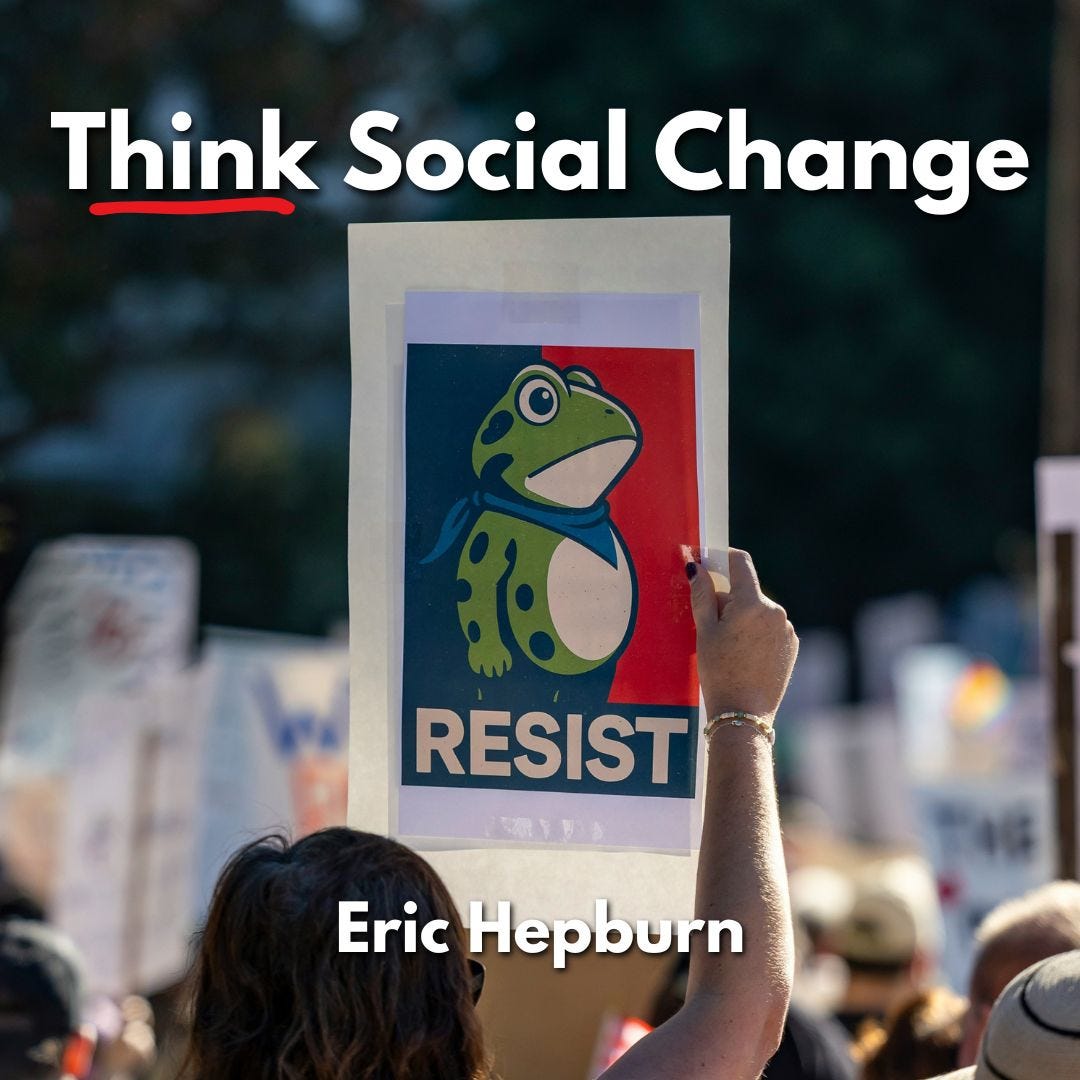
Royalty free image adapted by John Faber.
If, when you watch the news, your main reaction is fear — I’m talking to you. Or at least to some part of you.
If the voice in your head says I can’t possibly see a way out of this. Things are just going to keep getting worse. What could I possibly do? — if the feeling underneath the headlines is helplessness, insecurity, anxiety — this one is for you. And as with the anger two weeks ago and the shame last week, I want to suggest that the feeling is not your defect. It’s your assignment, waiting to be read.
This is the third essay in a series exploring Deepa Iyer’s social change ecosystem — the framework from her book Social Change Now (2022), the 2025–26 Unitarian Universalist Association common read — through a developmental lens: the old wisdom that human beings are motivated from three centers — gut, heart, and head — plus the spirit that moves among them. The roles are Iyer’s; the clustering is mine. The gut’s wound is anger, and it powers the Frontline Responders, Disrupters, and Experimenters. The heart’s wound is shame, and it powers the Caregivers and Healers. This week the series rises to the head — the thinking center — whose wound is fear, and whose mature forms are the Visionaries, the Builders, and the Storytellers.
The siren and the silence
Start with a sound. In July 2025, the Guadalupe River in the Texas Hill Country rose in the night and more than a hundred and thirty people died. This summer — a year later — the river rose again. And this time, something sounded that didn’t exist before: new warning towers went off above the rising water, and the people in its path evacuated.
Hear both the silence and the siren. Back in 2016, a county commissioner stood up and said: we sit in one of the most flood-prone places in Texas, and we have no warning system. The idea surfaced in some twenty public meetings over the years. It was never funded — a silence that was not a failure to speak but a failure to act. Then the unthinkable made the situation unignorable: engineers designed, legislators appropriated, donors gave, crews raised fifty-foot poles along the river. The work isn’t finished — the system needs millions more, and human hands still throw the switch. But this time, when the water came, the warning came first.
A siren is what fear can sound like when it has been transformed into care for neighbors not yet in danger. Someone imagined the flood before it came. Someone built for it. Hold that sound.
The head’s way of knowing
The reading my congregation sat with before this sermon comes from Don Riso and Russ Hudson’s Enneagram work:
If the Instinctive Triad is about maintaining a felt sense of self and the Feeling Triad is about maintaining a personal identity, the Thinking Triad is about finding a sense of inner guidance and support. The dominant feelings (of Thinking Triad types) are anxiety and insecurity.
To put it another way, the Instinctive Triad types are concerned with resisting aspects of the present. The Feeling Triad types are all past-oriented because our self image is built up out of memories and interpretations of the past. The Thinking Triad types are more concerned about the future, as if to ask, “What’s going to happen to me? How am I going to survive? How can I prepare myself to keep bad things from happening? How do I move forward in life? How do I cope?”
The Thinking Triad has lost touch with the aspect of our true nature that in some spiritual traditions is called the quiet mind. The quiet mind is the source of inner guidance that gives us the ability to perceive reality exactly as it is. It allows us to be receptive to an inner knowing that can guide our actions. But just as we are seldom in our bodies or in our hearts, we seldom have access to the quiet, spacious quality of the mind.
Hold onto the quiet mind. We’re going to earn our way back to it.
Because here is the head’s situation: it doesn’t know the world directly, the way the gut does in the body, or relationally, the way the heart does. It knows through representations — models, maps, plans, stories, simulations. Everything the head touches is mediated. And fear lives in that same machinery, because so much of fear is simulation: the mind running futures that haven’t happened but could. The terrible projected future generates more fear; the fear intensifies the projecting; and now you’re in the whirlwind — that vicious cycle of anxious powerlessness where your own prediction engine reports there’s no hope and no way out, even while your gut and heart insist, desperately, that there must be.
That’s the immature response. I’m labeling it what it is — not a character flaw, a developmental stage: getting sucked down the vortex until you can’t see past your own anxiety.
Do you remember the Litany Against Fear from Frank Herbert’s Dune:
“I must not fear. Fear is the mind-killer. Fear is the little-death that brings total obliteration. I will face my fear. I will permit it to pass over me and through me. And when it has gone past, I will turn the inner eye to see its path. Where the fear has gone there will be nothing. Only I will remain.”
That was written for folks from the Thinking Triad. That is the skill that must be mastered by head people to mature into the positive versions of their social change roles.
The rearview mirror
The mind is a prediction engine. It runs on mental models — your model of how the universe works. And here’s the trouble: the seven-to-one negativity ratio that runs through all human perception runs through the prediction engine too. We are roughly seven times more sensitive to threat than to promise, which means we are seven times more likely to catastrophize than to see the narrow path through the obstacles.
Bad models compound. There’s a mental model I argue about regularly with my book group of twenty-plus years: the claim that power is an ultimate good, that no one relinquishes it voluntarily, that hoarding it is simply human nature. My counterargument: power-hoarding in an immature human is indeed natural — in a teenager it’s developmentally appropriate. In a person over fifty, it’s a red flag. If you’ve reached midlife still convinced that holding power is the only way to be safe, that isn’t a deep appreciation of how the world works — that’s unhealed trauma wearing a philosophy. And yes, wounded people in leadership have real consequences; a tradition older than any of us says you know the tree by its fruit. But the poisonous fruit doesn’t prove their model true. It shows what happens when people who cannot see past their own anxiety choose leaders who cannot see past theirs.
Which suggests a working definition of wisdom for the age of cognitive science. Every mirror on a car comes with the warning: objects are closer than they appear. Our threat-perception comes with the opposite distortion — objects appear seven times larger than they are — and no one etched a warning on the glass. Wisdom might just be the ability to correct for the distortion: to override the amplifier and see risks at their actual size. This changes everything about navigation. If the landmines are the size of buildings, there may be no way through. If they’re the size of crates, there’s a lot of room to walk.
Uncorrected, the head’s fear shows up in forms you’ll recognize: analysis paralysis — the friends I love but don’t invite to the complicated board game night, because they must run ninety-seven scenarios before making one move; the freeze that says I can’t act until I know enough, where “enough” never arrives; doom-scrolling, which is vigilance playing as research. All of it is the simulation engine running hot with nowhere to go.
Three superpowers
Matured, the same engine — the head’s love of building better models — transforms into three of Iyer’s ecosystem roles.
The Visionary metabolizes fear into imagination. Catastrophizing and visioning are literally the same cognitive operation: projecting a detailed future and living toward it. The difference is where you look. Every new driver learns this the hard way — stare at the hazard and you steer into the hazard. If you want to steer past it, you have to stare past it. The immature visionary can’t stop staring at the train wrecks; each crate-sized danger swells to fill the windshield. The mature visionary holds every hazard in awareness — this danger here, that catastrophe there — without staring at any of them, because their eyes are on the destination: a world where beloved community is daily life. Through the obstacles, not at them. Not less aware. Just not obsessed.
The Builder metabolizes fear into architecture. Builders design systems, contingencies, structures, and redundancies — security manufactured out of insecurity. Their perpetual interrogation is how will this actually work?, and what they build are the answers. You’ve already heard one this week: the siren on the Guadalupe is fear metabolized into fifty feet of architecture — plus a plan and a process, so that when the rains came, somebody threw the switch and people moved out of the way.
The Storyteller metabolizes fear into meaning. Narrative is the mind’s original technology for converting what is happening to us? into this is where we are in the story. And it addresses the rawest form of fear: disorientation — that waking moment when you don’t know where you are or which direction you’re facing. For head-people especially, losing your bearings means losing the very thing you navigate by: I don’t even know which mental model to apply. Storytellers do collective sense-making. They right-size the terrors that appear seven times larger than life; they remind us of the times we came through catastrophe as a stronger community; they put a human face on the systems the Builders make.
The day I preached this, I wore the example: a shirt reading “From Enslavement to Mass Incarceration” — the subtitle of the Legacy Museum in Montgomery, Alabama. That is a story about race in America told in one line, and the line is doing storyteller-work: if you read it and think I don’t understand, the confusion is your invitation. Oh, do we have a story for you. It runs hundreds of years, and it’s true, and it’s there. Won’t you come listen?
One warning belongs to this whole cluster. Head-people are the ones most likely to mistake the map for the terrain — to prefer their model of the world to the world, to stop the feedback loop through which reality corrects the model. The name for that stoppage is arrogance: I don’t need more data; I’ve seen quite enough. But the data — even when it hurts to watch — is what keeps the model honest. Without it, you become an egotist whether you want to or not. The mature head stays a student of the world it fears.
Metabolize
So the series’ diagnostic, week three. The gut’s wound is anger; the heart’s wound is shame; the head’s wound is fear. If your reaction to the news is terror that things can only get worse — the question isn’t what’s wrong with you, and the answer isn’t in a bottle, neither liquor nor pills. The answer is: what were you built to metabolize?
Were you put on this earth to tell the story of how we surmounted the insurmountable? Or to build the things that make foreseeable catastrophes survivable? Or to imagine, amid all this chaos and danger, how the promise of beloved community still stands — attainable, achievable?
I’ve got good news. Anxiety doesn’t have to be crippling. It can be a calling. Because it is possible for that fear to become foresight — for the loud mind that runs catastrophes to become the quiet mind that builds arks.
May it be so.
This essay is adapted from a sermon preached at the San Gabriel Unitarian Universalist Fellowship in Georgetown, Texas, and available on The Pulpiteer podcast. Deepa Iyer’s social change ecosystem framework appears in Social Change Now: A Guide for Reflection and Connection (2022); the ecosystem map is her work, used with attribution — the developmental clustering is my own interpretive overlay. The passage on the thinking triad is from Don Richard Riso and Russ Hudson, The Wisdom of the Enneagram (1999). The Litany Against Fear is from Frank Herbert’s Dune (1965). “From Enslavement to Mass Incarceration” is the Legacy Museum, a project of the Equal Justice Initiative.
메타데이터
- post_id
- ec780e44f6b4
- slug
- think-social-change-ec780e44f6b4
- url
- https://medium.com/@ericdhepburn/think-social-change-ec780e44f6b4
- canonical_url
- https://medium.com/@ericdhepburn/think-social-change-ec780e44f6b4
- author_url
- https://medium.com/@ericdhepburn
- status
- ok
- fetched_at
- 2026-07-27 09:11:26