From Individualism to Atomism: How Iranian Wisdom Anticipated Existentialism
Iranian existentialism shows freedom as responsibility within a purposeful cosmos, contrasting Western liberalism’s atomized individualism.
From Individualism to Atomism: How Iranian Wisdom Anticipated Existentialism
How Western Liberal Democracy Lost Moral Interior Depth — and Why Iranian Civilization Never Did
By David Ramezani (Cyrus)
Western liberal democracy promised to create free individuals. Instead, it increasingly produces isolated atoms — legally protected, endlessly choosing, yet morally unanchored. This is not a political failure, but a metaphysical one. To understand why, we must look far beyond institutions, and far deeper than rights.
Individualism and Atomism
Individualism refers to the human being as an integrated moral agent — capable of inward judgment, responsibility, and ethical self-governance. Atomism reduces the person to an isolated unit of preference, connected to others only through contracts, procedures, and rights. Western liberal democracy intended individualism but preserved freedom without moral interiority, producing atomized selves.
Iranian Individualism Before Islam
Iranian individualism did not emerge as a rebellion against authority; it predates ecclesiastical or monarchic power. Moral struggle was internalized: the individual was responsible for choosing righteousness, no priest or ruler could decide for them, and truth was accessible directly to conscience. This produced individualism that was free yet cosmically integrated.
Iranian Existentialism Before Nietzsche and Sartre
Long before Nietzsche proclaimed the death of God, and long before Sartre described existence as radical freedom in an indifferent universe, Iranian civilization had already developed a coherent existential philosophy. Unlike Western existentialism, which responds to the absence of meaning, Iranian existentialism arises from an optimistic, purposeful, and teleological worldview.
Where Nietzsche and Sartre wrestled with creating value in a cosmos emptied of inherent purpose, Iranian thought assumed that the universe is ordered and morally intelligible, and that human life is consequential. Freedom is not tragic; it is responsibility. Choice aligns the self with truth and cosmic order (Asha).
In short: Western existentialism reacts to the void; Iranian existentialism acts within purpose. Both celebrate the moral individual, but one emerges from loss, the other from inherent opportunity.
Western existentialism asks how to live without meaning; Iranian existentialism asks whether you will live up to it.
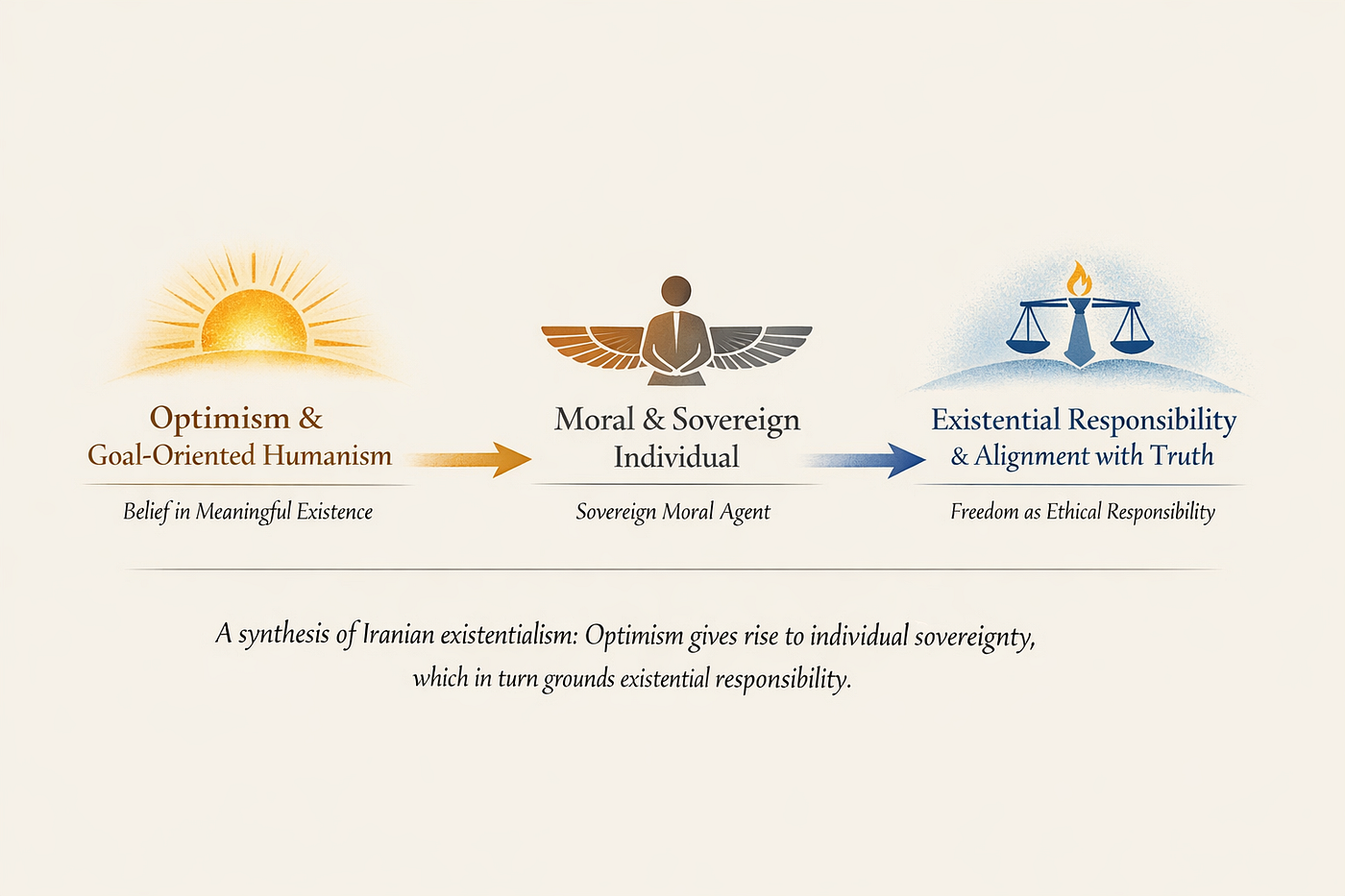
A depiction of the Iranian existential journey, illustrating how optimism, purposeful engagement, and alignment with cosmic order (Asha) cultivate individual freedom, moral responsibility, and ethical action within a meaningful universe.
Comparative Paragraph: Nietzsche and Sartre
Western existentialism emerges from the collapse of external moral authority. Nietzsche diagnosed the resulting void; Sartre elaborated freedom as existential burden. Iranian existentialism, by contrast, presupposes order, meaning, and moral consequence. The individual must act within a teleological universe. Whereas Western existentialists invent value, Iranian existentialists answer it. The burden is ethical, not nihilistic.
Internal vs. External Moral Authority
Internal Moral Authority (Iranian Model):
- Truth / Moral Order → Conscience → Individual Choice → Responsibility → Community through shared alignment
External Moral Authority (Western Inheritance):
- God / Command → Institution → Collective Obedience → Procedure → Individual as protected unit (atom)
“Western existentialism asks how to live without meaning; Iranian existentialism asks whether you will live up to it.”

A visual contrast between internalized moral authority, which grounds Iranian individualism, and externalized authority, which underpins Western procedural atomism. The diagram highlights how internal responsibility fosters ethical freedom, while external command produces isolated, rights-based individuals.
Optimism → Individualism → Existential Responsibility
Diagram Concept: Optimism & Purpose → Individualism → Existential Responsibility (Belief in meaningful existence) (Sovereign moral agent) (Freedom as ethical responsibility)
Designer Prompt: Create a horizontal flow diagram with three nodes, arrows connecting them: 1) Optimism & Purpose (warm golden sun/light) → 2) Moral & Sovereign Individual (abstract human/Faravahar silhouette) → 3) Existential Responsibility & Alignment with Truth (balancing scales/flame motif). Minimalist, modern style, suitable for Medium publication.
Conclusion
Western liberalism succeeded in limiting power but struggled to preserve meaning. Iranian civilization, by internalizing moral authority and cultivating existential responsibility, produced individuals capable of freedom without disintegration. The contrast is not between East and West, nor religion and secularism, but between external command and internal responsibility.
When moral authority is external, freedom dissolves into atomism once command disappears; when moral authority is internal, freedom deepens into responsibility.
Author Bio
David Ramezani (Cyrus) is a writer and independent political philosopher focused on moral order, individual sovereignty, and civilizational thought. His work explores Iranian philosophy, Asha, existential responsibility, and the limits of modern liberalism, seeking alternatives to both authoritarianism and moral relativism. He writes about freedom not as permission, but as responsibility.
If this essay resonates, follow for future writings on moral order, freedom, and civilizational philosophy.
메타데이터
- post_id
- ec8802e1baa2
- slug
- from-individualism-to-atomism-how-iranian-wisdom-anticipated-existentialism-ec8802e1baa2
- url
- https://medium.com/@david_ramezani/from-individualism-to-atomism-how-iranian-wisdom-anticipated-existentialism-ec8802e1baa2
- canonical_url
- https://medium.com/@david_ramezani/from-individualism-to-atomism-how-iranian-wisdom-anticipated-existentialism-ec8802e1baa2
- author_url
- https://medium.com/@david_ramezani
- status
- ok
- fetched_at
- 2026-06-15 20:49:13