Vicenza - The Elegant Palladian City of Veneto
Vicenza is one of the most elegant cities in Veneto, known above all for its extraordinary connection with Andrea Palladio. Located between…
Vicenza - The Elegant Palladian City of Veneto
Vicenza is one of the most elegant cities in Veneto, known above all for its extraordinary connection with Andrea Palladio. Located between Verona and Padua, the city has a refined historic center, beautiful Renaissance palaces, important churches, lively squares, and a surrounding landscape marked by hills, villas, and cultivated countryside. It is not as crowded as Venice or Verona, but its artistic value is exceptional.
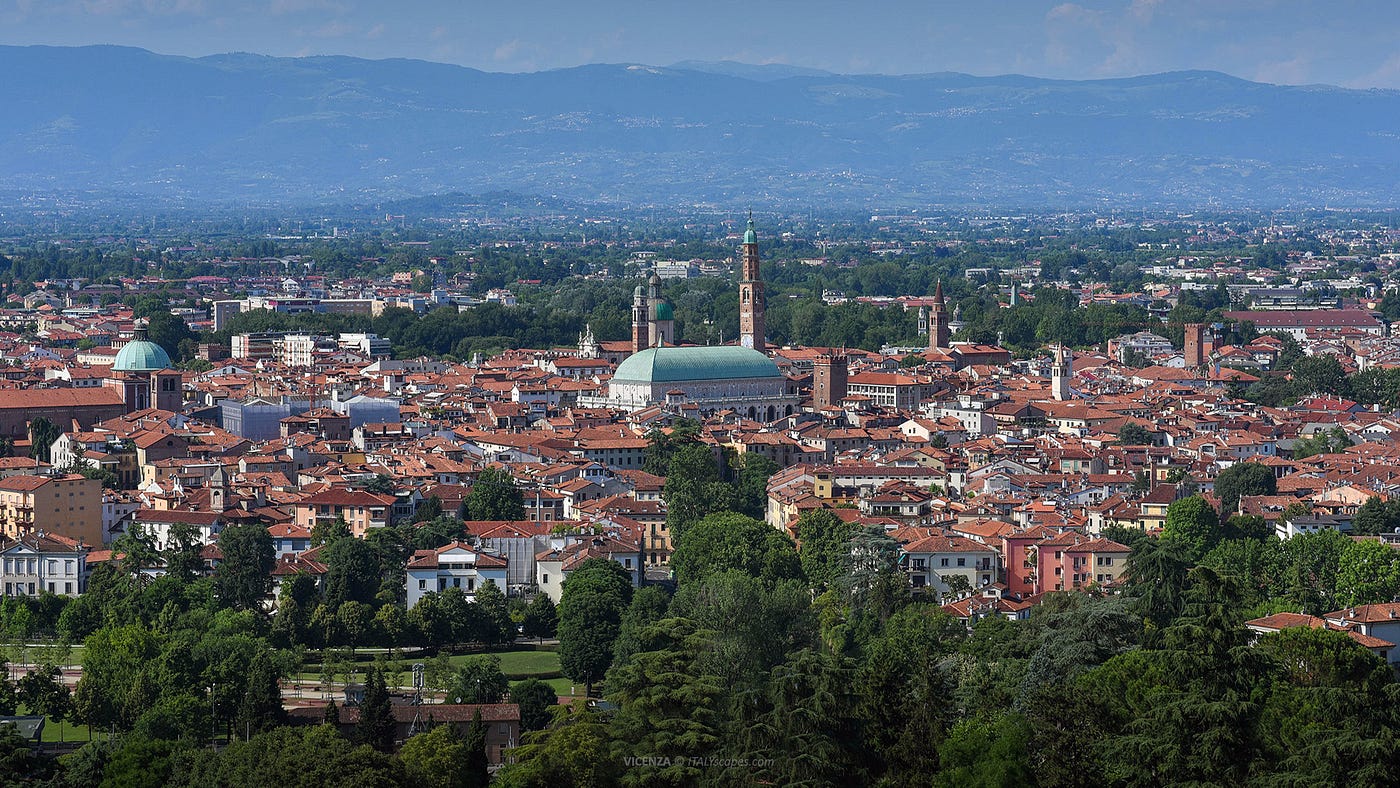
The city lies in the central part of Veneto, at the northern edge of the Berici Hills and not far from the Venetian Prealps. Its territory is crossed by rivers and waterways, including the Bacchiglione, Retrone, and Astichello. This position helped Vicenza grow as a strategic settlement between the mountains and the plain, with good connections toward Verona, Padua, Venice, and the rest of northern Italy.
Vicenza has ancient origins. The area was inhabited before Roman times, and later became part of the Roman world. In antiquity, the city was known as Vicetia, and its position along important routes helped it develop economically and politically. Although modern Vicenza is best known for its Renaissance architecture, its history is much older, with roots going back to pre-Roman and Roman settlement.
After the fall of the Roman Empire, Vicenza passed through difficult centuries marked by invasions, political changes, and local conflicts. During the Middle Ages, it came under the influence of different powers, including bishops, local noble families, the Ezzelini, the Scaligeri of Verona, and the Visconti of Milan. These changes shaped the city’s defensive, civic, and religious development before its long Venetian period.
In 1404, Vicenza became part of the Republic of Venice. This was a decisive moment in the city’s history. Venetian rule brought stability and prosperity, allowing Vicenza to develop as a wealthy urban center. Noble families invested in palaces, villas, churches, and public buildings, creating the perfect conditions for the architectural transformation that would later make the city famous throughout Europe.
The most important figure in Vicenza’s history is Andrea Palladio, the Renaissance architect who changed the appearance of the city and influenced architecture far beyond Italy. Palladio worked in Vicenza and its surroundings during the 16th century, designing palaces, villas, and public buildings. His style, based on classical proportions, symmetry, harmony, and Roman inspiration, gave Vicenza a unique architectural identity.
In 1994, Vicenza was included on the UNESCO World Heritage List because of the works of Palladio. Later, the recognition was extended to include the Palladian villas of Veneto. This makes Vicenza not only an important Italian city, but one of the key places in the history of Western architecture. Its streets are like an open-air lesson in Renaissance design.
The heart of the city is Piazza dei Signori, the most important square in Vicenza. It is dominated by the Basilica Palladiana, one of Palladio’s masterpieces and the main symbol of the city. Despite its name, the Basilica Palladiana is not a church, but a civic building. Its elegant loggias, white stone arches, and monumental presence make it one of the most beautiful public buildings in Veneto.
Near the Basilica Palladiana stands the Loggia del Capitaniato, another important Palladian work. Built as the seat of the Venetian captain, it faces the main square and contrasts beautifully with the surrounding architecture. The combination of brick, stone, classical forms, and urban scale shows Palladio’s ability to create buildings that were both powerful and elegant.
Another essential monument is the Teatro Olimpico, Palladio’s final work and one of the most extraordinary theaters in Europe. It was designed for the Accademia Olimpica and completed after Palladio’s death by Vincenzo Scamozzi. The interior preserves a remarkable fixed stage set, creating the illusion of ancient streets receding into the distance. It is one of Vicenza’s most unforgettable attractions.
Palazzo Chiericati is another important Palladian building and today houses the civic art gallery. Its façade, with open loggias and classical rhythm, shows Palladio’s mastery of urban palace design. Other important palaces include Palazzo Thiene, Palazzo Barbaran da Porto, Palazzo Valmarana, and several noble residences that make the historic center feel coherent, elegant, and deeply connected with Renaissance culture.
Vicenza is also famous for Villa Capra, known as La Rotonda. Located just outside the historic center, it is one of Palladio’s most celebrated villas. Built on a hill, with four identical façades and a central domed hall, the villa represents one of the purest expressions of Palladian architecture. Its influence can be seen in buildings across Europe and America.
Another beautiful site near the city is Villa Valmarana ai Nani, famous for its frescoes and its romantic atmosphere. The villa takes its name from the stone statues of dwarfs placed along the walls. Together with La Rotonda and the other villas around Vicenza, it shows how the city’s aristocratic families shaped not only the urban center, but also the surrounding countryside.
Among Vicenza’s religious landmarks, the Sanctuary of Monte Berico is one of the most important. Located on a hill overlooking the city, it is connected with Marian devotion and offers a wide panoramic view over Vicenza, the plain, and the surrounding hills. The Cathedral of Santa Maria Annunciata and the Church of Santa Corona are also important religious and artistic monuments in the historic center.
Vicenza is pleasant to explore on foot. The center is compact, elegant, and full of arcades, narrow streets, small squares, historic façades, cafés, and shops. Unlike larger and more crowded destinations, the city allows visitors to enjoy its architecture slowly. Walking through Vicenza means discovering Palladian buildings, medieval corners, Renaissance perspectives, and everyday local life in the same urban space.
The city is also well connected. Vicenza lies on the railway line between Venice, Padua, Verona, and Milan, making it easy to reach by train. By road, it is served by the A4 motorway, one of the main east-west routes in northern Italy, and by the A31 motorway, which connects the area with other parts of Veneto. The nearest major airports are in Venice, Verona, and Treviso.
Vicenza also has a strong cultural and economic identity. It is known for goldsmithing and jewelry production, and the Vicenzaoro trade fair is one of the major international events in the sector. The city also hosts cultural festivals, concerts, exhibitions, and local celebrations. Food traditions include dishes such as baccalà alla vicentina, one of the best-known specialties of the province.
What makes Vicenza special is the balance between beauty, calm, and architectural importance. It is a city of palaces rather than spectacle, of proportions rather than excess. Visitors come for Palladio, but they often remember the atmosphere: the quiet streets, the noble façades, the hilltop views, the elegant squares, and the feeling of walking through one of Veneto’s most refined historic cities.
메타데이터
- post_id
- eca3d8f7a540
- slug
- vicenza-the-elegant-palladian-city-of-veneto-eca3d8f7a540
- url
- https://medium.com/@ovidiu.tutunaru/vicenza-the-elegant-palladian-city-of-veneto-eca3d8f7a540
- canonical_url
- https://medium.com/@ovidiu.tutunaru/vicenza-the-elegant-palladian-city-of-veneto-eca3d8f7a540
- author_url
- https://medium.com/@ovidiu.tutunaru
- status
- ok
- fetched_at
- 2026-07-15 10:52:00