Practical Ways to Turn Loneliness into Positive Solitude
Reclaim your focus, creativity, and inner peace
Mental Health
Practical Ways to Turn Loneliness into Positive Solitude
Reclaim your focus, creativity, and inner peace

Photo by author
Imagine you are standing alone on a quiet trail, a thick steam rising from the earth right in front of you. What kind of reaction would you have?
Feeling a sudden rush of fear, uncertainty, and deep isolation?
Or, feeling completely peaceful, grounded, and liberated?
Being alone in the modern world is exactly like standing on that path; people can feel differently about the same landscape.
In real life, our schedules might be full. We might have our dream titles. We might be surrounded by people. But we can still feel hollow. This is loneliness; it quietly steals our inner peace, focus, and creativity.
But this is not the preset ending of our journeys. We can actively train ourselves to transform that state of painful, lonely feelings into internal strength, a state of positive solitude. The secret to this lies within our brains.

Photo by KOMMERS on Unsplash
Our brain sees loneliness and solitude as two different states. To the brain, loneliness is a Threat State, while Positive Solitude is a Reflective State. The following table explains these neural mechanics:
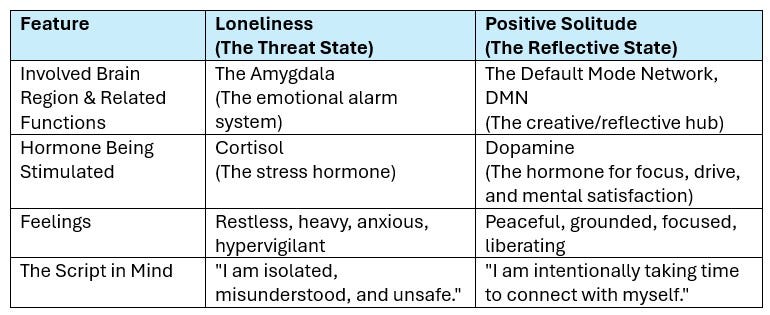
Table created by author using Word
Although, loneliness and positive solitude involve different brain regions, it doesn’t mean you are controlled by your brain. We have a powerful tool called neuroplasticity, the brain’s ability to rewire itself through deliberate practice. We can train our minds to shift from a threat state to a reflective state. That training option is always there; it is simply a matter of whether you choose to take it.
Here are 4 practical ways to begin:
1. Audit the Story (Shifting the State of Mind)
When the Amygdala triggers a threat response, it doesn’t just create a heavy physical ache; it actively hijacks your imagination. Because the brain hates uncertainty, it immediately tries to invent a reason for why you feel this way. It builds a narrative to match your state of mind. It whispers scripts in the mind like:
- “Nobody truly understands you.”
- “You are completely on your own.”
- “You don’t belong anywhere.”
Here is the trap: your brain cannot tell the difference between a real physical threat and a story you are telling yourself. If you accept these thoughts as absolute facts, your Amygdala fires even harder, flooding your system with more cortisol, trapping you in a vicious cycle.
What to Do: Intercept and Rewrite
Pause and tell yourself: “This is just an amygdala sending an alarm signal, just a biological reaction, not the factual definition of my life.”
Examine the script: Physically write down the negative story in your head. Look at the words and ask: “Is this objectively true, or is this just my stress talking?”
Rewrite the script: Change the narrative from passive isolation to active autonomy. (eg, Change “I am so lonely, nobody invited me out tonight.” to “I have the quiet me-time to focus on reading my favorite book, and to take a deep rest for my body and soul.”)
By intentionally auditing and editing your thoughts, your brain begins to view aloneness as a deliberate choice rather than an unwanted rejection. You instantly quiet your emotional alarm system and switch to peaceful solitude.

Photo by Thought Catalog on Unsplash
2. Structured Solitude (The Power of Autonomy)
Loneliness is a passive state, while solitude is an active choice you control. The defining line between them is autonomy. When you live through loneliness without a plan, your amygdala naturally defaults to restlessness and anxiety.
What to Do: Schedule Solo Appointments
Create Structure: By creating a structure, you signal your brain that you are the builder of your alone time, not a victim of it. This can protect your inner peace.
Commit to “Me-Time”: Schedule solo appointments for things you love, a solo run, seeing a movie, cooking a healthy meal, or attending a talk. The goal is to let your brain know this is “intentional”, not “abandoned”. You own the autonomy of your daily life, rather than waiting for someone else to fill your schedule.

Photo by Shengpengpeng Cai on Unsplash
3. Chase a “Flow State” (Unlocking Creativity)
Sometimes, trying to push yourself to relax gives your brain more room to spiral the negative stories. Instead, you need to actively engage your Creative / Reflective Hub (DMN).
What to do: Engage in Immersive Activity
Find Your Flow: Choose an activity that requires deep focus and hand-eye coordination, like gardening, writing, drawing, or learning an instrument.
Quiet the Alarm: These kinds of immersive activities require a level of focus, leading you into a flow state that quiets your survival instincts and rewards your brain with dopamine. Your self-consciousness vanishes, and the feeling of isolation is replaced by reclaimed focus, creativity, and a sense of achievement and deep peace.

Photo by Thought Catalog on Unsplash
4. Practice Connections with “Strangers” (Lowering Cortisol)
Interacting with “strangers”, people in a talk, a runner on the street, or a barista, lets you feel that you are still a part of the external world but without the social pressure of maintaining an image or explaining your life.
What to do: Light Social Engagement
Social Reset: Step outside and engage lightly with the physical world around you. Have a brief, friendly exchange with a barista, give a smile to the people in a talk, nod to a hiker or runner passing by.
Lower the Stress: These tiny, low-stakes moments trigger a small release of oxytocin and naturally calm your brain. It reminds your nervous system that you are safely part of a larger, living ecosystem, helping you quiet the alarm and reclaim your focus.

Photo by Macourt Media on Unsplash
It is completely fine to be alone. Remember that you hold the magic power of neuroplasticity to rewire your brain, quiet the alarm of the world, and transform standard loneliness into your ultimate internal strength: positive solitude.
메타데이터
- post_id
- eca5dfb2f621
- slug
- practical-ways-to-turn-loneliness-into-positive-solitude-eca5dfb2f621
- url
- https://medium.com/health-science/practical-ways-to-turn-loneliness-into-positive-solitude-eca5dfb2f621
- canonical_url
- https://medium.com/health-science/practical-ways-to-turn-loneliness-into-positive-solitude-eca5dfb2f621
- author_url
- https://medium.com/@kl-wu
- status
- ok
- fetched_at
- 2026-06-20 20:29:01