That $0.07/Min Voice AI Rate Looked Beautiful. Then the Invoice Arrived.
You clicked through to Retell’s pricing page. The number at the top said $0.07 per minute. No platform fees. $10 free to start. It looked…
That $0.07/Min Voice AI Rate Looked Beautiful.
Then the Invoice Arrived.
You clicked through to Retell’s pricing page. The number at the top said $0.07 per minute. No platform fees. $10 free to start. It looked like the cheapest voice AI on the market.
You bookmarked it, sent the link to your finance lead, and started drafting the business case.
Then you read more carefully.
$0.07/min is the voice engine. Before you make a single working production call, you also need the language model that powers the conversation, the telephony layer that connects the call, and — once you exceed 20 simultaneous lines — a per-line concurrency fee. Turn on branded caller ID and you’ll pay more for that feature alone than the entire advertised base rate.
Independent analysts at CheckThat, Ringg, Emitrr, and Dialora have all landed in the same place: real-world Retell production cost runs $0.13–$0.31 per minute. The pricing page told you 20–30% of the story. This article tells the rest — and tries to be genuinely honest about which buyer profile each platform is actually built for.
1. The five layers — pulled apart
Think of Retell’s pricing like a restaurant where the menu lists the protein price and the sides are à la carte. The steak is $28. By the time the sides arrive, you’re at $51 — and wondering why you didn’t just order the prix fixe.
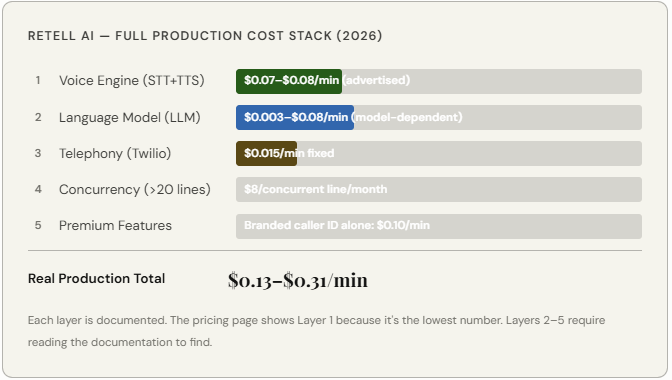
Each layer is documented. The pricing page shows Layer 1 because it’s the lowest number. Layers 2–5 require reading the documentation to find.
Layer 2 is the most variable. Retell lets you bring GPT-4o, Claude 4.5 Sonnet, Gemini, or open-source models. That flexibility is genuinely valuable. It also means your cost per minute varies by 27x depending on which model you pick. A complex sales objection workflow pushes you to the top-end LLM tier by default.
Layer 4 catches outbound campaigns. 20 concurrent lines are free. An outbound campaign hitting 100 simultaneous lines adds $640/month before a single minute is billed. For inbound-only businesses, this barely matters. For outbound teams, it can represent 30–40% of the monthly invoice.

2. The Modular Pricing Paradox — same product, opposite experience
Here’s the insight that pricing comparisons almost never name: the same architectural decision that makes Retell’s pricing attractive to engineering teams makes it hazardous for finance teams.
ORIGINAL INSIGHT — THE MODULAR PRICING PARADOX
Modular, pay-as-you-go pricing is a feature when you’re a developer composing a custom stack. You only pay for what you use. You can swap LLMs. You optimize layer by layer. The flexibility is the point.
Modular pricing is a liability when you’re a business ops lead forecasting next quarter’s spend. Which LLM will we use in three months? How many concurrent lines does the holiday campaign need? What’s our telephony exposure if call volume spikes? None of these questions have fixed answers in a modular model — and each one is a budget variance waiting to happen.
The lowest advertised per-minute rate in the market often produces the highest actual bill, because the advertised number is a layer, not a total. The flexibility engineers value is the unpredictability finance teams fear.
ORIGINAL INSIGHT — THE DEVELOPER TAX ON BUSINESS TEAMS
There’s a second hidden cost that never appears on any pricing page: the engineering time to assemble and maintain a modular stack. Integrating LLM API calls, managing webhooks, debugging concurrent call behaviour, monitoring billing anomalies across five separate cost variables — for an engineering team these tasks are part of the job. For a business ops team that needed a working voice agent by next Tuesday, they’re the Developer Tax.
The real cost calculation: (minutes × rate) + (engineering hours × hourly cost) + (time to deployment × opportunity cost). The cheapest platform per minute is frequently not the cheapest platform per outcome.
3. SuperMIA’s pricing — one number, all layers included
SuperMIA prices on credits where one plan covers voice + chat + knowledge base + analytics + telephony — bundled. No separate LLM invoice. No telephony passthrough. No concurrency surcharge. The number on the pricing page is the number on the invoice.

The second structural difference worth naming: Retell is voice-only. SuperMIA runs voice and chat agents on the same credit pool. For teams running an omnichannel workflow — careers page chat widget plus inbound phone line, or web support plus WhatsApp — that’s the difference between one vendor and two.
4. The cost at three real volumes

The mid-market scenario is where the gap is most decision-relevant. At 10,000 minutes/month, SuperMIA Business ($1,300) undercuts Retell’s typical production cost by 21% — roughly $4,200 annually — and includes chat agents that Retell doesn’t offer at any price point.
5. What’s actually in the box — feature comparison

6. The honest decision framework — which buyer are you?
Most comparison articles are written by one of the vendors, which means they end with “our platform wins.” This one is written by SuperMIA, so we’ll try to earn some credibility by being direct: Retell is the right choice for a meaningful segment of buyers. Here’s how to tell which side of the line you’re on.
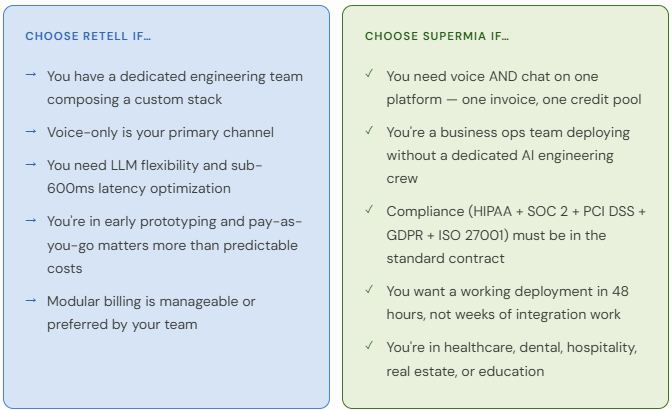
The honest analogy: Retell is building a PC. You pick every component. For someone who knows what they’re doing, you get exactly what you need at a competitive price. SuperMIA is buying a MacBook. It’s configured for the buyer who wants everything to work on day one and doesn’t want to think about the components. Neither is wrong. They’re built for different people.
Retell = Custom PC Build
Every component chosen by you. Maximum flexibility, maximum performance — for buyers who understand what they’re specifying and have the engineering hours to assemble it.
SuperMIA = MacBook
Everything pre-configured. Predictable cost, immediate deployment, no component management — for buyers who need outcomes, not infrastructure.
7. What G2 users actually say — both sides
Retell has a 4.8/5 on G2 with 1,243 reviews. The positive pattern is consistent across reviews: developer experience, API quality, flexibility. The critical reviews cluster around feature velocity and vendor responsiveness. One stands out for its honesty:
VERIFIED RETELL USER — G2 2026
“The product is the same as others on the market — we would switch instantly if there were no switching cost. Very unresponsive to basic feature requests.”
A developer-infrastructure product operating normally: deep technical capability, slower managed-outcome iteration. Neither surprising nor disqualifying — but worth knowing before you sign a contract that takes 6 months to unwind.
SuperMIA’s G2 proof points centre on the Softqube IntelliHire deployment: resume screening 2–3 days → under 4 hours, interview throughput 25 → 40+/week, recruiter NPS 45 → 58.4 in 12 weeks. Managed outcomes over maximum flexibility — the same trade-off showing up in the product comparison, now visible in the review pattern.
8. The Softqube platform decision — why one vendor beat two
Softqube Technologies evaluated building on Retell + a separate chatbot vendor for two simultaneous workloads: voice-based recruiting calls and a chat-based candidate screening widget.
That path: two contracts, two compliance reviews, two integration cycles, two invoices. SuperMIA’s alternative — one platform, one credit pool, one contract — shipped in 4 weeks instead of the estimated 8–10 weeks for the multi-vendor path.
The 4-week vs 10-week delta isn’t a pricing story. It’s a Developer Tax story. The engineering hours that would have gone into cross-vendor integration went into optimising the actual product instead. The 12-week outcomes speak to what that freed capacity produced:
SOFTQUBE + SUPERMIA INTELLIHIRE — 12 WEEKS
Resume screening: 2–3 days → under 4 hours (85% reduction) · Interview throughput: 25 → 40+/week (60% lift) · Auto-screened applications: 0% → 80% · Recruiter NPS: 45 → 58.4 (+13 points)
The $0.07/min number on Retell’s pricing page is real. It just isn’t complete.
For an engineering team composing its own voice infrastructure, the modular model is exactly right. The flexibility is worth the complexity. The Developer Tax is just the job.
For a business ops team that needs voice and chat running in 48 hours with a predictable bill and compliance already in the contract — the modular model adds costs that never appear on any invoice but show up in every calendar week between “we decided to build this” and “this is live.”
The question to ask before you open a pricing page: are you building a stack, or shipping a product? The answer tells you which number to look at.
KEY TAKEAWAYS
Retell’s $0.07/min covers the voice engine only — the full 5-layer production stack runs $0.13–$0.31/min, confirmed independently by four separate analysts.
The Modular Pricing Paradox: the flexibility that attracts engineers (swap LLMs, choose providers) is the same flexibility that makes budget forecasting unreliable for finance teams — same product, opposite experience.
The Developer Tax: integration hours, webhook debugging, billing anomaly management, and concurrent call configuration are real weekly costs that never appear on the invoice but compound for non-engineering teams.
SuperMIA’s $0.10–$0.12/min bundles everything — voice + chat + knowledge base + analytics + telephony — so the pricing page number matches the invoice number.
At 10,000 min/month, SuperMIA Business ($1,300) undercuts Retell’s typical production cost (~$1,650) by 21% — approximately $4,200/year — and adds chat agents Retell doesn’t offer.
Retell is the right choice for developer teams building custom voice infrastructure who value LLM flexibility and modular control. SuperMIA is the right choice for business ops teams needing voice + chat, bundled compliance, and 48-hour deployment.
The Softqube case proves the real cost differential: a 4-week SuperMIA deployment vs an estimated 10-week multi-vendor path the gap is engineering hours, not feature capability.
메타데이터
- post_id
- eca7327affe6
- slug
- that-0-07-min-voice-ai-rate-looked-beautiful-then-the-invoice-arrived-eca7327affe6
- url
- https://medium.com/@marketing_79269/that-0-07-min-voice-ai-rate-looked-beautiful-then-the-invoice-arrived-eca7327affe6
- canonical_url
- https://medium.com/@marketing_79269/that-0-07-min-voice-ai-rate-looked-beautiful-then-the-invoice-arrived-eca7327affe6
- author_url
- https://medium.com/@marketing_79269
- status
- ok
- fetched_at
- 2026-06-22 12:55:45