The Daily Rituals That Fed Hitler’s Machinery of Evil
Inside the private routine that kept Hitler’s worldview intact.
The Daily Rituals That Fed Hitler’s Machinery of Evil
Inside the private routine that kept Hitler’s worldview intact.
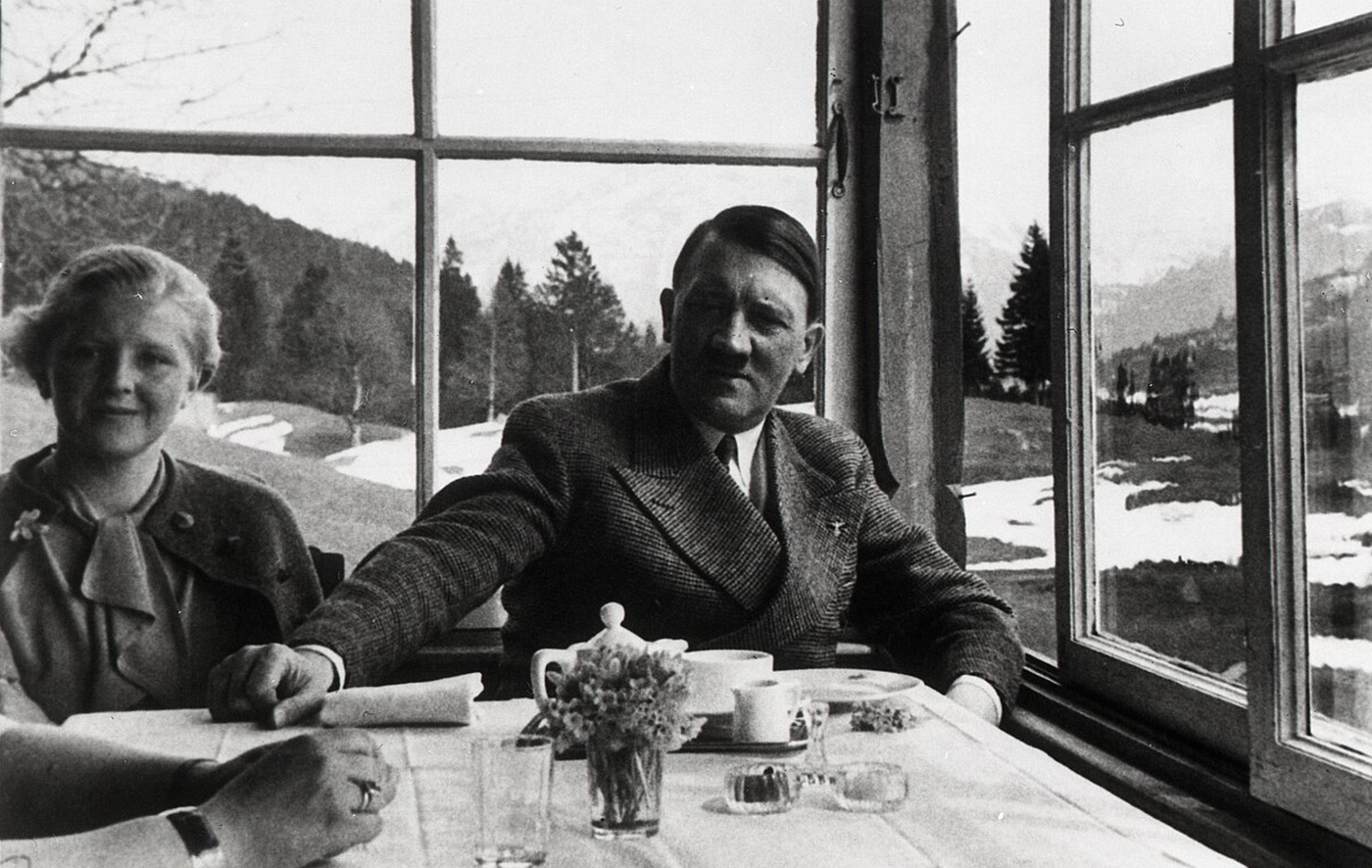
Hitler having tea with Eva Braun in 1935 | Image Source: Wikimedia Commons (Public Domain)
I’ve been reading about Hitler’s private habits for a strange reason. Daily routines can make terrible people feel too ordinary. That’s the risk of writing about them.
A late breakfast, a doctor’s injection, a movie night, or a strange sleep schedule does not explain genocide. That would be cheap history. The better question is what his daily life made routine. He read selected papers, sat among loyal men, kept old grudges alive, and heard fantasies repeated back to him as serious politics. The silence around him mattered too. Men close to power understood that correction could cost them access.
A smaller version of that pattern appeared in September 2024, when a rumor from Springfield, Ohio claimed Haitian immigrants were eating people’s pets. The local police said they had no credible reports to support it. Still, the story jumped from Facebook into the national politics. Schools and public buildings faced threats. Haitian families had to live with a lie strangers kept repeating. By the time anyone checked the facts, the rumor had already found a crowd. That was enough to put real families in danger.
Hitler’s crimes belong to their own historical scale. The modern connection is the system around a lie. A lie repeated in public starts acting like shared knowledge before anyone has checked it.
Hitler brought something far darker into public life. The language was already there in Mein Kampf. Jews were named as enemies, race was treated as political destiny, and eastern Europe was marked as German living space. By summer 1945, the book had sold more than 12 million copies. His private life kept returning him to the same poison. Over time, that poison gained offices, cameras, table talk, architects, doctors, ministries, trains, camps, and men ready to act.
He practiced being watched.
One of the most revealing documents of Hitler’s public life is a set of photographs taken around 1927 in Heinrich Hoffmann’s studio.
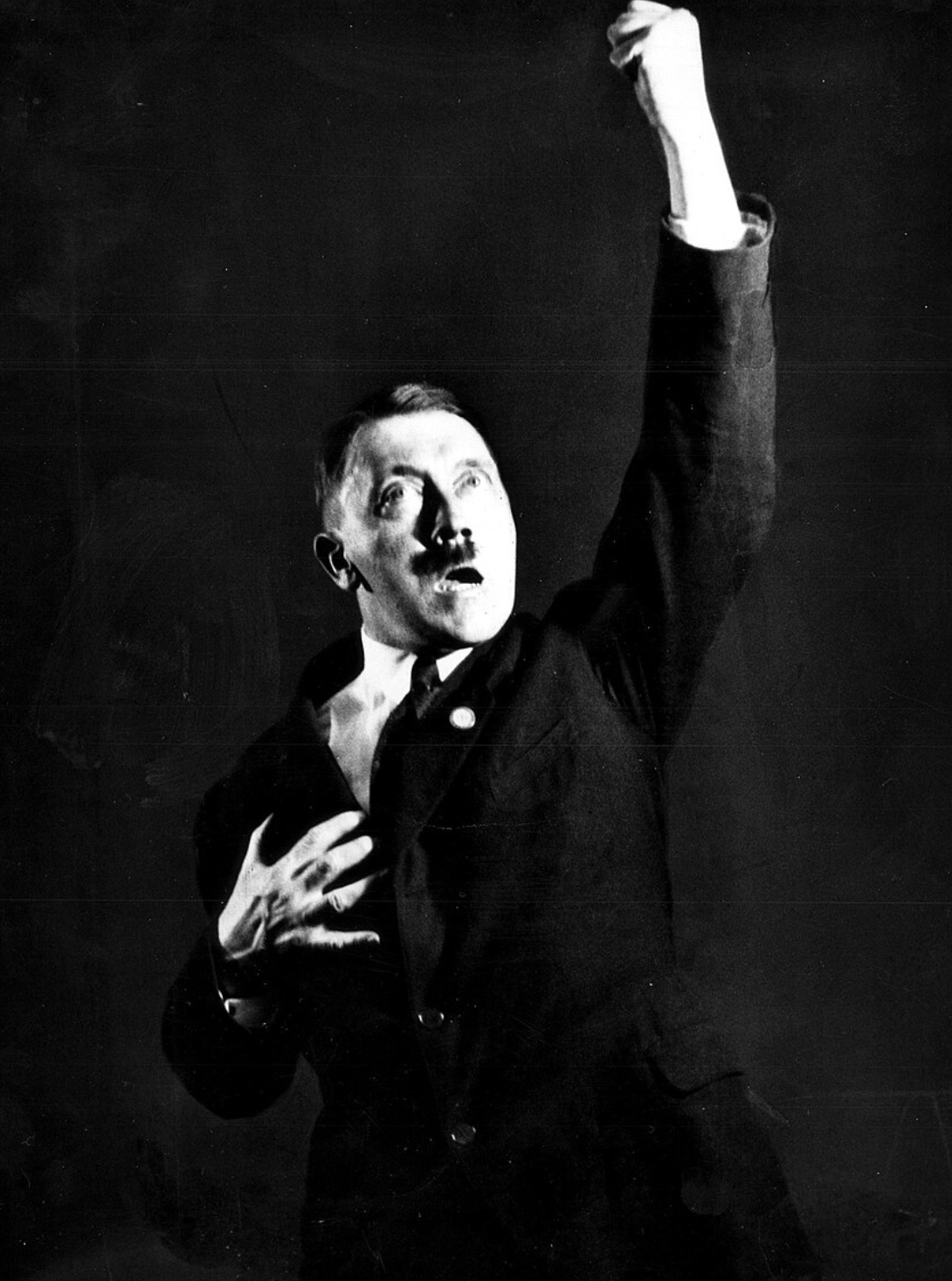
Hitler in Heinrich Hoffmann’s studio around 1927 | Image Source: Wikimedia Commons (Public Domain)
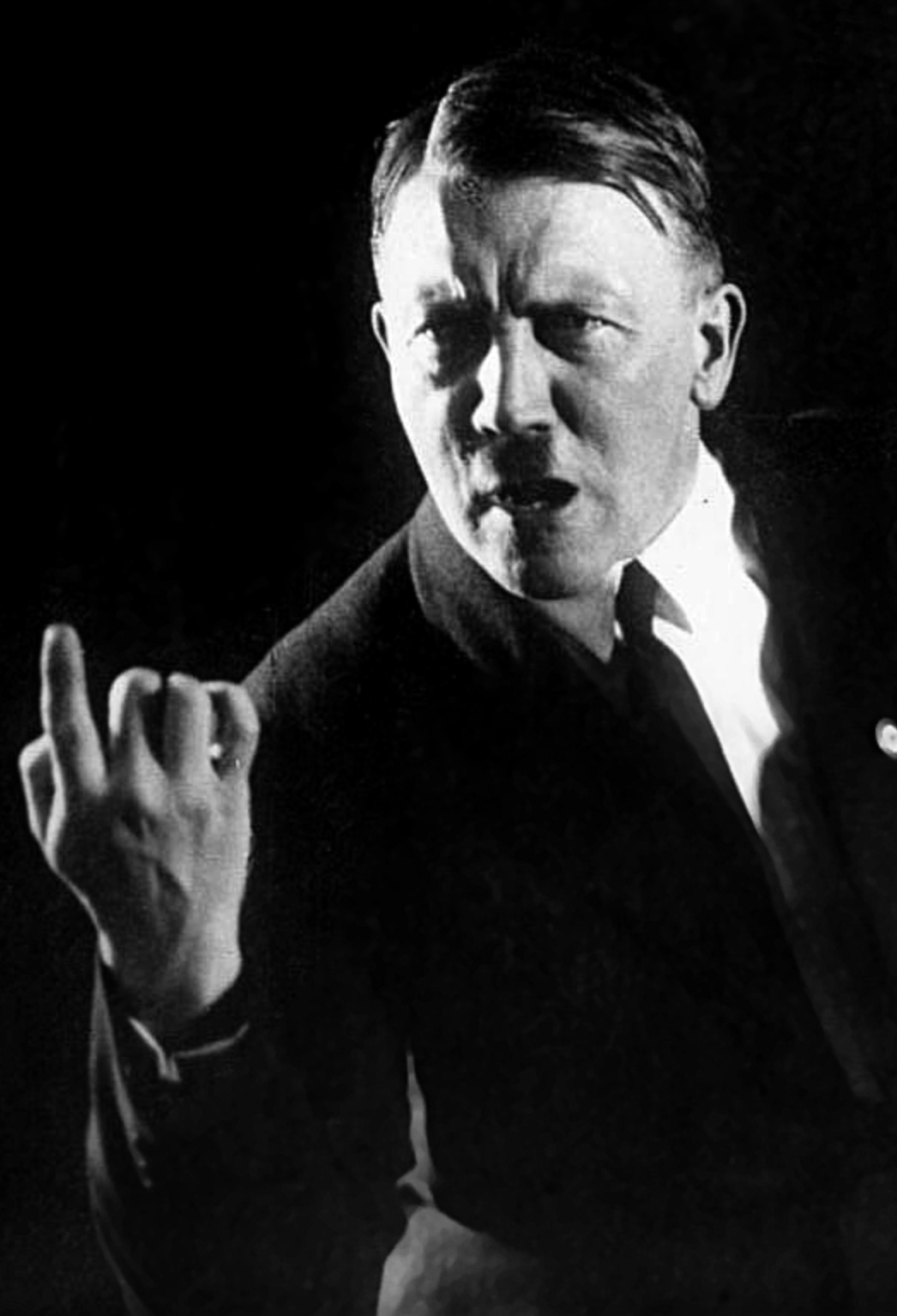
Hitler in Heinrich Hoffmann’s studio around 1927 | Image Source: Wikimedia Commons (Public Domain)
Hitler was practicing speaker poses.
Bavaria had lifted his speaking ban in March that year, which allowed him to return to public speech. German History in Documents and Images says the photos show how consciously he staged speeches through word choice, voice, and gesture.
That detail is disturbing because it is so practical. Hitler was studying how rage looked from the outside. He tested posture, command, and menace before mass audiences became part of the performance.
Hoffmann later became Hitler’s official photographer. The Holocaust Encyclopedia says his pictures helped create the growing Führer cult.
The 1927 poses were early evidence of a larger propaganda instinct. Hitler understood that the camera could make power look personal before the regime learned to stage that intimacy at scale.
His news diet fed an armed worldview.
Albert Speer’s memoir has to be read carefully. Speer wrote after the war with plenty of reasons to protect himself. Even so, his descriptions of Hitler’s daily routine are useful because they came from inside the circle.
Speer describes Hitler appearing late and receiving news excerpts from his press chief. Guests waited while he read. Then he passed along whatever items caught his attention.
Hitler already carried a map of enemies in his head. In that kind of mind, almost any headline could be made to confess.
The Nazi press system made those excerpts far more dangerous. When Hitler took power in 1933, Nazis controlled less than 3 percent of Germany’s 4,700 newspapers. Control came through seized presses, closed opposition papers, and forced compliance. The Reich Press Chamber decided who could legally work as a journalist.
By the time those excerpts reached him, they had already passed through a political filter. Outside reality reached him through selection, fear, flattery, and propaganda.
He turned government into an audience.
Speer often wondered when Hitler actually worked.
That line sounds petty until the pattern appears. Hitler rose late. The day moved through meetings, meals, films, architectural designs, and visitors waiting for time near him. Access became a form of rank.
Speer’s dining room scenes are more useful than they first appear. He wrote that attendance was important for prestige because guests wanted to stay current with Hitler’s daily opinions. The round table let him casually “hand down a political line or slogan.”
People around him learned to read him closely. A comment about Jews, the east, architecture, punishment, or weakness could become useful to anyone seeking favor. In that kind of court, ambition did not wait for paperwork.
Ian Kershaw’s famous phrase for the wider system was “working towards the Führer.” Across the regime, officials learned to anticipate Hitler’s wishes. Kershaw’s point was that Hitler did not need to sign every order for others to move in the direction they believed he wanted.
His nights made isolation social.
During the war, Hitler’s evening tea moved deeper into the night. Speer says it shifted to two in the morning and often ended at three or four. Hitler complained of insomnia. His hours became everyone else’s burden.
The late room had its own politics.
Exhaustion changes a room. People become less willing to interrupt, less willing to argue, and more focused on getting through the night without losing favor. A small circle sitting through monologues at strange hours became a loyalty test with sandwiches.
Speer also remembered evenings of newsreels and films before the war. The films were often light entertainment, celebrity films, love stories, and society films.
The setting is what makes the detail useful. Film nights, gossip, and political access happened in the same rooms. The same guests who watched films also learned how to sit near Hitler without interrupting him. Correction could disappear even in a full room.
His fantasies had floor plans.
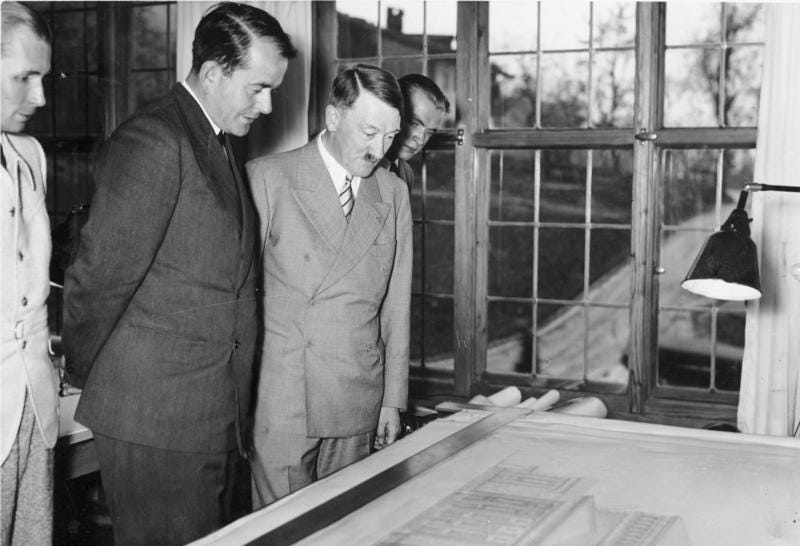
Speer with Hitler in Obersalzberg | Image Source: Wikimedia Commons (Public Domain)
Hitler first came to Obersalzberg in the 1920s. After 1933, the Berghof became a strange hybrid of private residence, propaganda stage, and power center. Dokumentation Obersalzberg says it became a place where Hitler made decisions about persecution, war, and genocide among close associates.
Nazi photographers gave the public a softer version. They showed Alpine views, visitors, children, dogs, and Hitler playing the harmless host.
Behind that image sat state violence.
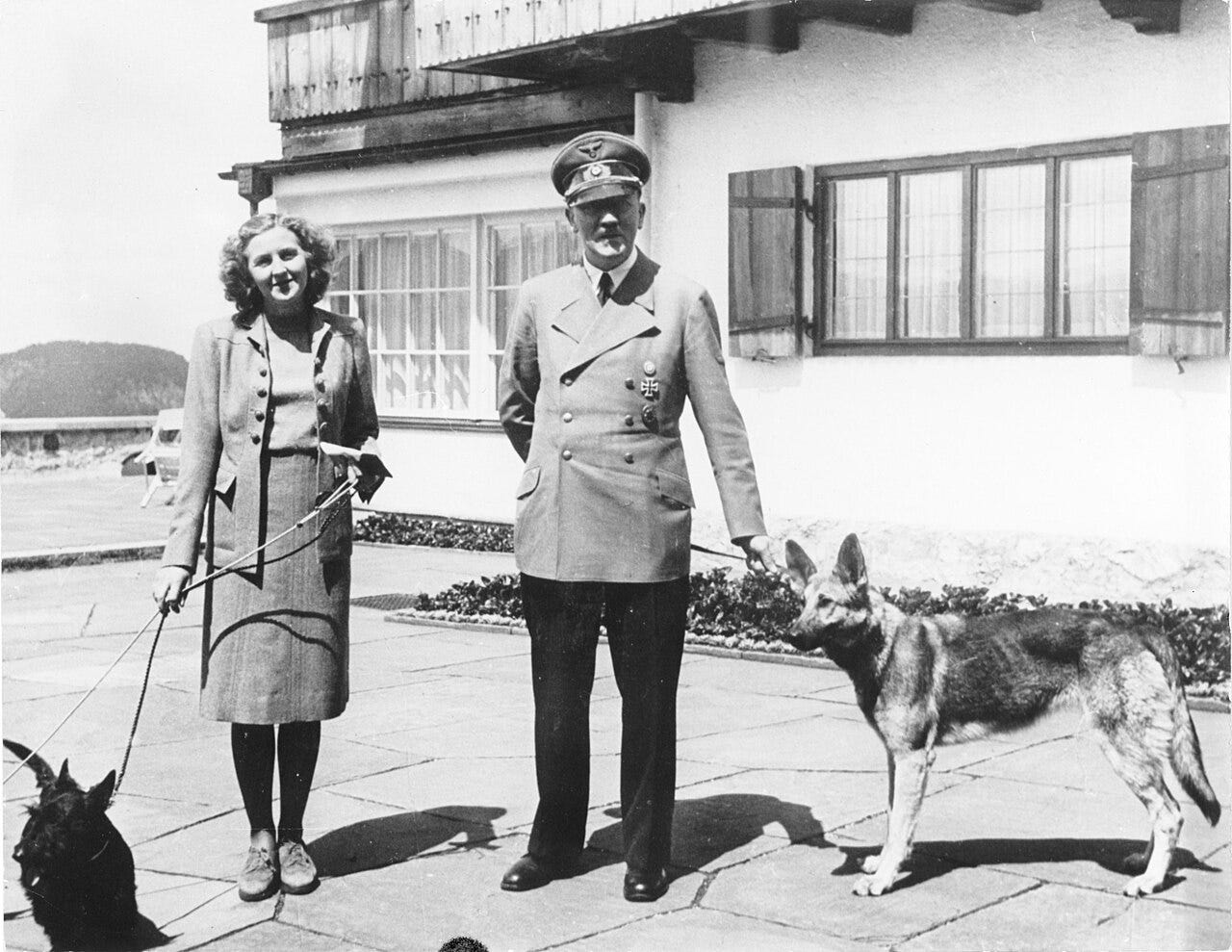
Image Source: Wikimedia Commons (Public Domain)
The same habit appears in architecture. Hitler loved architectural models and future cities. He obsessed over halls, avenues, domes, and ceremonial approaches. Speer records Hitler saying architecture would “bear witness” through the centuries. In January 1939, the New Reich Chancellery was dedicated. Sixty five days later, Czechoslovak President Emil Hácha was brought into Hitler’s new study before the occupation of his country.
Architecture gave Hitler a physical language for empire before conquest had finished the map. The scale mattered. Long approaches, giant halls, raised desks, and ceremonial stone all trained the visitor to feel small before power.
The Lebensraum fantasy had its own architecture too. USHMM explains that Nazi plans for the east were tied to imperial, nationalist, and racist currents that helped lead to the murder of Europe’s Jews.
The plans were not private doodles. Speer’s 1939 wooden model of the Great Hall had a removable floor, so Hitler could study the planned interior from eye level. The hall was designed for about 150,000 to 180,000 people. Its dome was planned at a scale that made St. Peter’s in Rome the natural comparison.
The doctor entered the machinery.
The medical story attracts lazy explanations because drugs make evil sound easier to understand.
Theodor Morell treated Hitler during the final nine years of his life. Medical scholar D. Doyle lists an astonishing range of treatments, including topical cocaine, injected amphetamines, glucose, testosterone, corticosteroids, a compound of strychnine and atropine, vitamins, and tonics. Doyle writes that some of Hitler’s behavior, illnesses, and suffering may be attributed to his medical care, while the record remains unclear on whether Hitler accepted or demanded the treatments.
Careful history stops there.
The injections may have worsened decline. They may have deepened dependency. They may have affected mood, sleep, and judgment. They did not create his antisemitism, his imperial fantasies, the SS, the ministries, the camps, or the war.
By the time Morell’s treatments became part of the daily ritual, Hitler’s worldview already had institutions around it. The doctor entered a violent system already in motion.
Look at the room around any powerful person. Who gets in. What gets read first. Which emotions are rewarded. Which fantasies are treated as serious. Which people learn to move before they are told.
A room can do more work than a speech.
메타데이터
- post_id
- ecab2d20b520
- slug
- the-daily-rituals-that-fed-hitlers-machinery-of-evil-ecab2d20b520
- url
- https://medium.com/lessons-from-history/the-daily-rituals-that-fed-hitlers-machinery-of-evil-ecab2d20b520
- canonical_url
- https://medium.com/lessons-from-history/the-daily-rituals-that-fed-hitlers-machinery-of-evil-ecab2d20b520
- author_url
- https://medium.com/@sal
- status
- ok
- fetched_at
- 2026-06-14 13:58:26