Rethinking Quantum Reality
Robert Spekkens, Epistemic Quantum Theory, and an rCVGT Perspective on Information, Vacuum Structure, and Physical Reality in Modern…
Rethinking Quantum Reality
Robert Spekkens, Epistemic Quantum Theory, and an rCVGT Perspective on Information, Vacuum Structure, and Physical Reality in Modern Physics
Quantum mechanics is the most successful theory in the history of physics. Its predictions match experiments with extraordinary precision, and modern technologies. From semiconductors to MRI scanners and quantum information systems is depending directly on it. Yet, almost a century after its formulation, physicists still debate what quantum mechanics actually means.
Why does nature appear probabilistic at the microscopic scale? Why do measurements seem to disturb systems? Why do quantum states resist copying? And why do quantum correlations seem to violate classical expectations?
A common reaction has been to accept quantum mechanics as fundamentally mysterious. But over the past two decades, physicist **Robert Spekkens** has challenged this conclusion. His work suggests that much of quantum mechanics’ apparent strangeness may arise not because reality itself is bizarre, but because we misunderstand what the quantum state represents.

Robert W. Spekkens, theoretical physicist known for his work on the epistemic interpretation of quantum states and quantum foundations.
From my perspective, this line of thinking aligns closely with ideas explored in my own work on **rCVGT**. While Spekkens focuses on clarifying the conceptual status of quantum states, rCVGT attempts to identify a physical mechanism underlying quantum behavior. Together, these approaches point toward a possible reinterpretation of quantum theory in which many of its mysteries dissolve.
Here, I examine Spekkens’ contribution, why it matters, and how it connects naturally with the rCVGT framework.
The Central Question: What Does the Quantum State Describe?
At the heart of quantum mechanics lies the quantum state, often represented by a wave function. The theory tells us how this state evolves and how it predicts measurement outcomes, but it does not directly tell us what the state is.
Two broad interpretations exist.
In one view, the quantum state is ontic: It represents something physically real. The wave function is part of reality itself.
In the alternative view, the quantum state is epistemic: It represents knowledge or information about reality, rather than reality directly.
This distinction may sound philosophical, but it deeply affects how we understand quantum phenomena. If the wave function is reality itself, then quantum mechanics forces us to accept superpositions, collapses, and strange nonlocal effects as fundamental features of nature. But if the wave function instead represents incomplete knowledge of a deeper reality, then many quantum puzzles might arise from limitations in what we can know, not from exotic physical processes.
Robert Spekkens’ work explores this second possibility.
Spekkens’ Key Insight: Incomplete Knowledge Can Mimic Quantum Behavior
Spekkens introduced a remarkably simple idea: Suppose the underlying physical world is classical, but observers are fundamentally restricted in how much they can know about it. Even in principle, complete knowledge of a system’s state is impossible.
He then constructed a simplified “toy theory” based on this principle. In the model:
- Systems possess definite underlying states.
- But observers can never have full knowledge of those states.
- Allowed states of knowledge must remain partially uncertain.
Surprisingly, when this constraint is imposed consistently, many features usually thought to be uniquely quantum appear automatically.
The result is striking: Phenomena often presented as deep signatures of quantum mechanics can emerge from a classical system governed by epistemic restrictions.
A detailed presentation of this idea can be found in Spekkens’ peer-reviewed paper “Evidence for the epistemic view of quantum states: A toy theory.” and *here on arxiv.org.*
Quantum Features That Reappear in the Toy Theory
Several well-known quantum properties emerge naturally in Spekkens’ framework.
The No-Cloning Principle
Quantum mechanics forbids copying an unknown quantum state perfectly. In Spekkens’ model, copying fails for the same reason: if states represent incomplete knowledge, cloning them would require knowledge one does not possess.
Thus, no-cloning can arise from knowledge limitations alone.
Measurement Disturbance
Quantum measurements disturb systems. In the toy theory, measurement updates knowledge and may change the underlying state because measurement procedures must respect knowledge constraints.
Again, no mysterious quantum collapse is required.
Interference-Like Effects
Interference patterns, often described as uniquely quantum, also appear in systems where observers have restricted information. What looks like wave interference can emerge from constraints on how knowledge combines and updates.
Teleportation-Like Protocols
Even procedures analogous to quantum teleportation can be reproduced in the toy model. What is transmitted is not matter, but structured information about a system.
In all these cases, the phenomena do not require abandoning classical reality. They arise from limits on accessible information.

What the Toy Theory Cannot Reproduce
Spekkens never claims his model replaces quantum mechanics. Certain phenomena remain genuinely non-classical.
Most importantly, quantum mechanics violates Bell inequalities, showing correlations stronger than classical local models allow. Spekkens’ toy theory cannot reproduce these correlations while preserving classical assumptions.
This is crucial. It shows that some aspects of quantum theory remain fundamentally novel. However, Spekkens’ work narrows the mystery. Not everything strange in quantum mechanics is truly quantum.
The question becomes: What exactly must change in our classical worldview to accommodate the remaining phenomena?
Causation, Knowledge, and Quantum Confusion
A recurring theme in Spekkens’ work is the distinction between causation and inference.
In classical reasoning, causes produce effects. But knowledge updates do not imply causal influence. Learning something new may change our description of the past without altering what actually happened.
Quantum theory often mixes these two layers. Measurement updates are sometimes interpreted as physical changes, even though they may instead represent changes in knowledge.
Spekkens argues that many quantum puzzles arise from confusing ontological changes (what physically happens) with epistemic updates (what we learn).
Clarifying this distinction is central to removing conceptual confusion.
How rCVGT Enters the Picture
While Spekkens focuses on the epistemic interpretation of quantum states, my work in rCVGT asks a complementary question: If quantum states represent knowledge, knowledge of what?
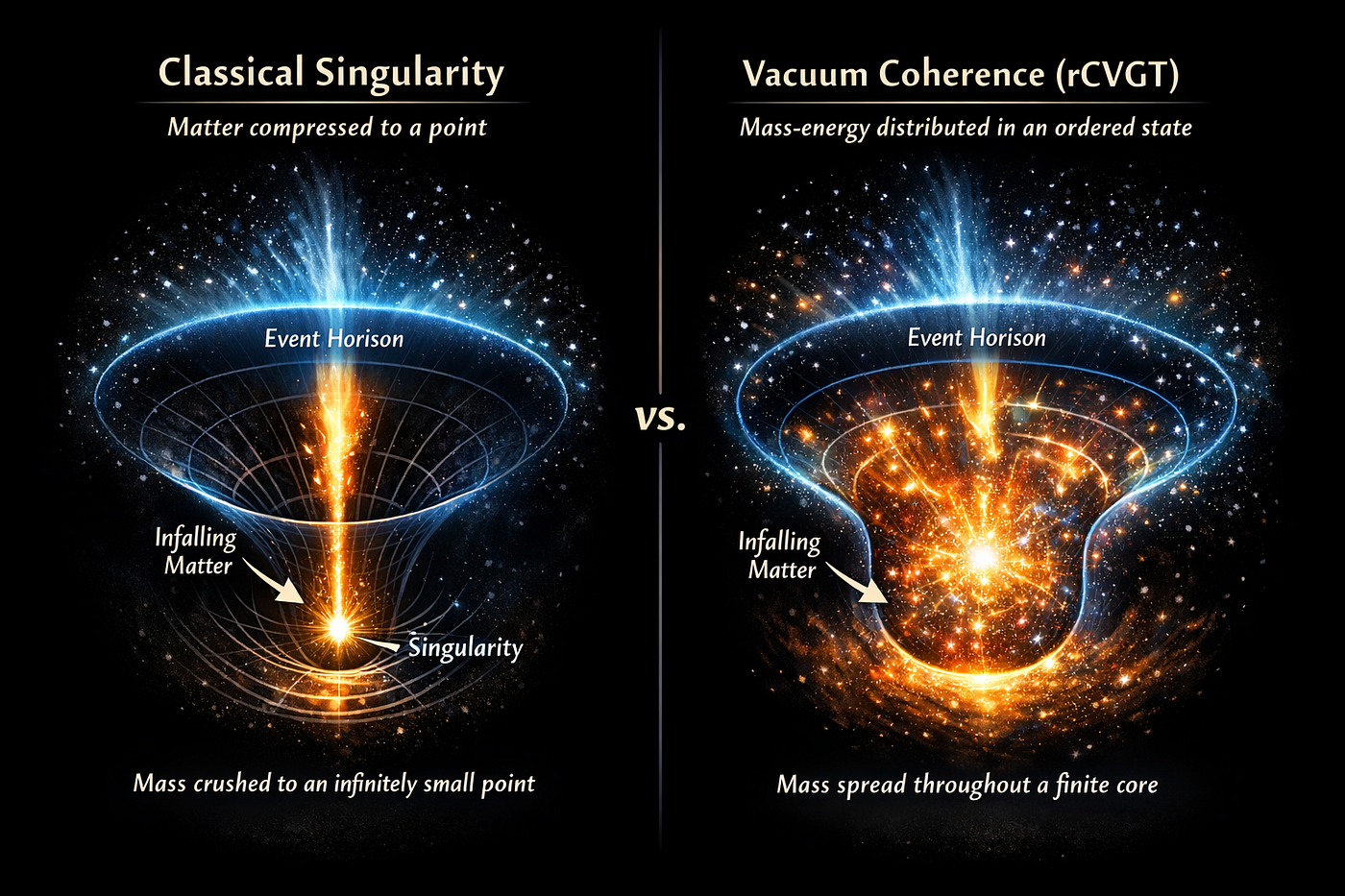
rCVGT proposes that what we perceive as particles and quantum fields may arise from dynamics of a deeper physical medium. A structured, coherent vacuum.
In this framework:
- Vacuum is not empty.
- It possesses coherence structure and dynamics.
- Particles and interactions emerge from excitations of this medium.
- Gravitation and quantum phenomena are linked through vacuum coherence behavior.
Quantum probabilities could then reflect limitations in accessing or describing local states of this vacuum structure rather than intrinsic randomness in nature.
From this perspective, the epistemic restrictions emphasized by Spekkens arise because observers cannot fully access or control the underlying vacuum dynamics.
Thus, Spekkens’ conceptual clarification and rCVGT’s physical proposal can be seen as complementary steps.
Reinterpreting Quantum Mystery
If quantum states represent incomplete knowledge about a deeper vacuum structure, then several puzzles become less mysterious:
- Measurement randomness reflects incomplete information.
- Apparent collapse reflects updating knowledge.
- Nonlocal correlations reflect structure in the underlying medium rather than superluminal signals.
- Quantum probabilities describe constraints on accessible states.
Quantum mechanics remains correct operationally, but its interpretation shifts.
The mystery moves from “nature is fundamentally strange” to “we have been interpreting effective descriptions as fundamental reality.”
Why This Matters for Physics
This reinterpretation matters for several reasons.
First, it reframes foundational debates. Instead of arguing endlessly about interpretations, researchers can ask what physical structures might underlie quantum statistics.
Second, it guides future theory development. If quantum mechanics is emergent from deeper structure, then understanding that structure becomes a central task.
Third, it connects quantum foundations with gravity and cosmology. Vacuum structure and coherence may play roles not only in quantum phenomena but also in gravitational behavior and cosmic evolution.
In this sense, quantum theory may resemble thermodynamics. A powerful effective theory arising from deeper microscopic laws.
A Research Program, Not a Final Answer
Neither Spekkens’ framework nor rCVGT claims to provide the final answer.
Spekkens shows that many quantum phenomena need not imply exotic metaphysics. rCVGT proposes a candidate underlying structure but remains under development.
Both approaches should be understood as parts of an ongoing research program seeking to clarify the foundations of physics.
History shows that revolutions in physics often arise not from discarding successful theories, but from reinterpreting them within broader frameworks. Relativity did not eliminate Newtonian mechanics; it explained its limits. Statistical mechanics did not replace thermodynamics; it explained it.
Quantum mechanics may similarly be an effective layer of a deeper structure yet to be fully understood.
From my perspective, Robert Spekkens’ work provides a crucial conceptual correction. Quantum mechanics does not automatically imply that reality itself is mystical or incomprehensible. Many features arise from how information about systems is structured and constrained.
My own work in rCVGT attempts to go further by proposing a physical substrate that could generate these epistemic limits through vacuum coherence dynamics.
Taken together, these approaches suggest a common conclusion: Much of quantum mechanics’ mystery may come from confusing an effective, information-based description with the deeper structure of reality.
Reality itself may be less strange than our current interpretations suggest.
메타데이터
- post_id
- ecaed945e5c5
- slug
- rethinking-quantum-reality-ecaed945e5c5
- url
- https://medium.com/the-idea-of-reality/rethinking-quantum-reality-ecaed945e5c5
- canonical_url
- https://medium.com/the-idea-of-reality/rethinking-quantum-reality-ecaed945e5c5
- author_url
- https://medium.com/@steen_m_n
- status
- ok
- fetched_at
- 2026-07-13 06:23:13