Not All A1c Tests Are Created Equal
From the Reddit forum r/Prediabetes, Intell-Soft32 writes:
Not All A1c Tests Are Created Equal
From the Reddit forum r/Prediabetes, Intell-Soft32 writes:
“I went to Walmart to get an A1C check 2 weeks ago — it was 4.8. I went to my doctor to get A1C checked and it’s 5.8, two different A1C results — Which do I go by?”
While Redditor Intel-Soft32 might regard these two results as an unwelcome surprise, she is rather fortunate, having learned that not all A1c tests are created equal.
Many physicians operate Physician-Owned Labs (POLs). While these labs are convenient for the patient because the results are fast, the tests may not have the same quality as a hospital or commercial lab. Their tests and testing practices may not always adhere to the same rigorous oversight and regulatory standards as large commercial or hospital laboratories.
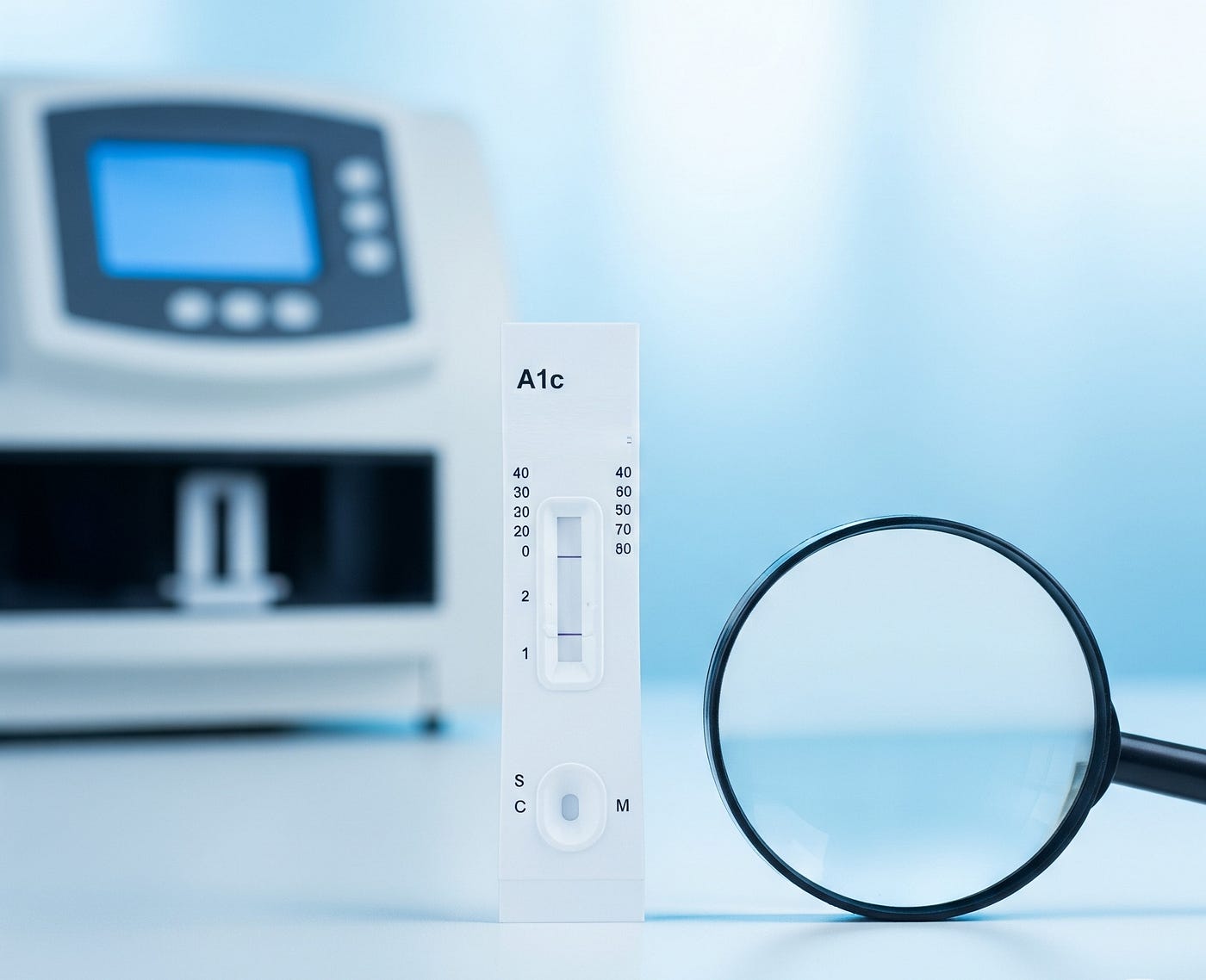
Many patients are unaware that tests performed at the bedside and within POL’s, especially A1c tests, likely fall under a different regulatory framework and make a tradeoff between speed for less precision. It is highly likely POL’s use POCT (Point of Care Tests) A1c test kits or analyzers. For the most part, these are FDA-cleared for diabetes monitoring, and with few exceptions, have not been cleared specifically for the diagnosis of diabetes or the monitoring and diagnosis of prediabetes. At the time of this writing (2025), there are two exceptions, Abbott Afinion™ HbA1c Dx assay (for use on the Afinion™ AS100 and Afinion™ 2 Analyzers and the Bio-Rad D-10 Hemoglobin A1c Program.
The NIDDK (National Institute of Diabetes and Digestive and Kidney Diseases) and other bodies caution that a doctor’s office or clinic using an A1c POCT for diagnosis should always confirm the results with a lab-based test. Therefore, patients like Intel-Soft32 should either carefully review her lab report for the name of the analyzer and test kit used, or contact her doctor’s office to inquire about the specific A1c testing method.
Many healthcare professionals may not be fully aware of the distinct regulatory frameworks for different A1c POCTs and might inadvertently use a device designed for monitoring diabetes for guiding management of prediabetic patients. These monitoring-only A1c tests may lack sufficient precision for diagnostic purposes and can be unknowingly affected by interferences that raise or lower the result. While major commercial laboratories largely use robust test analyzers that can generally be trusted, a degree of reproducibility error can still occur, especially within the prediabetic range, which can be exacerbated by factors such as equipment turnover or variations in calibration. To ensure accuracy, it’s advisable to check if your A1c test was performed on an FDA-cleared analyzer that holds the necessary diagnostic claims. Click here.
메타데이터
- post_id
- ecbf191de02a
- slug
- not-all-a1c-tests-are-created-equal-ecbf191de02a
- url
- https://medium.com/@usafmd/not-all-a1c-tests-are-created-equal-ecbf191de02a
- canonical_url
- https://medium.com/@usafmd/not-all-a1c-tests-are-created-equal-ecbf191de02a
- author_url
- https://medium.com/@usafmd
- status
- ok
- fetched_at
- 2026-06-25 16:53:31
