Kraft Stand Up Pouches With Window & Zipper: The Go-To for Indian Organic and Snack Brands
Why the natural kraft pouch with a clear window has become India’s most-trusted packaging format for dry fruits, organic snacks, home-baked…
Kraft Stand Up Pouches With Window & Zipper: The Go-To for Indian Organic and Snack Brands
Why the natural kraft pouch with a clear window has become India’s most-trusted packaging format for dry fruits, organic snacks, home-baked goods, and clean-label D2C brands — and how to pick the right variant for your product.
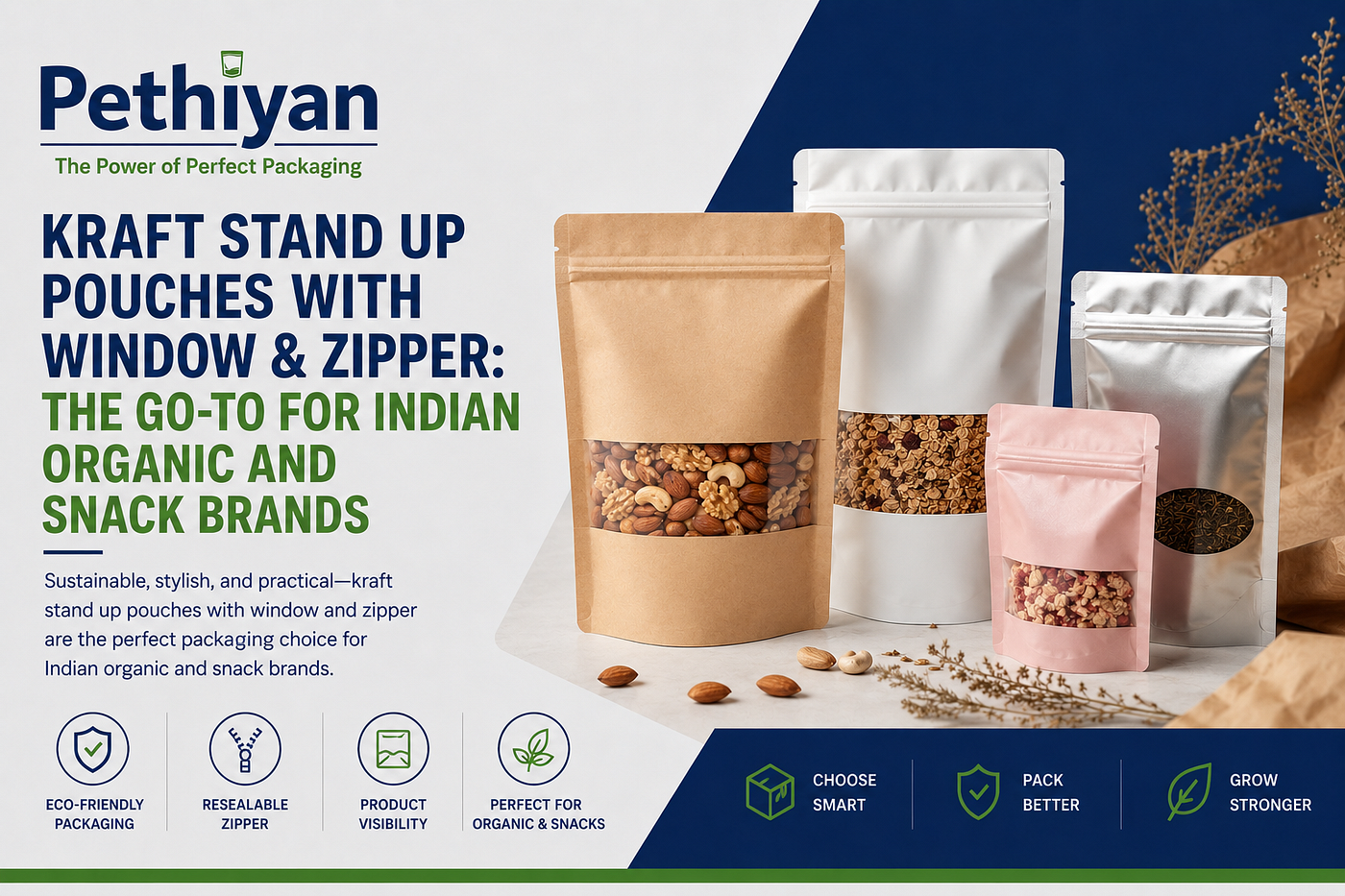
Walk into any premium dry fruit shop in India today — or scroll through any Instagram snack brand’s product listing — and you will see the same format everywhere: a natural brown kraft pouch, standing upright on its gusseted base, with a clear transparent window showing exactly what is inside, and a resealable zipper at the top keeping it fresh between uses.
This is not a coincidence. The kraft stand up pouch with window and zipper has become the signature packaging format of India’s organic food movement for a specific and logical reason: it communicates everything a clean-label brand needs to communicate, without a single word of marketing copy.
The natural kraft paper says: no artificial materials, no greenwashing. The transparent window says: I have nothing to hide — look at my product. The resealable zipper says: I care about your convenience and your food’s freshness. Together, they make a packaging argument that converts browsers into buyers more effectively than any label copy can.
This guide explains exactly why kraft stand up pouches with window have taken over India’s organic and snack packaging landscape — and how to choose the right variant, size, and supplier for your brand in 2026.

Why Kraft Pouches Are Winning India’s Organic Packaging Market
India’s clean-label food market has grown significantly in the past three years, driven by a generation of D2C founders building premium food brands on Instagram, quick-commerce, and ecommerce platforms. These brands — selling makhana, cashews, artisan granola, cold-pressed oils, and specialty teas — face a packaging challenge that kraft pouches solve perfectly.
Their customers are educated, sustainability-conscious, and highly visual. They scroll Instagram at speed. They read ingredient lists. They notice packaging. And they associate natural materials — kraft paper, unbleached textures, earthy tones — with the values they already hold about clean food and responsible consumption.
This is the core commercial insight: the kraft window pouch does not just package the product. It packages the brand’s values. The material itself is the message — and that message is being received clearly by India’s growing base of premium food buyers.
The sustainability signal matters to Indian buyers
Kraft paper pouches are made from wood pulp, are recyclable, and are significantly more biodegradable than full plastic alternatives. For brands selling to urban Indian consumers aged 25–40, the eco-credentials of kraft packaging are a genuine purchase driver — not just a label claim.
Anatomy of a Kraft Stand Up Pouch With Window and Zipper
Understanding the structure of a kraft stand up pouch helps you make better sourcing decisions. These pouches are not simple single-layer bags — they are multi-layer laminates engineered to balance aesthetics, food safety, and barrier performance.
The three-layer structure
A standard food-grade kraft stand up pouch with window is built from three laminated layers, each serving a distinct purpose:
- Outer kraft paper layer: Natural brown or white kraft paper gives the pouch its characteristic look and feel. This layer is printable with food-safe inks for branding, and its texture communicates authenticity to buyers at a glance.
- Middle barrier layer: A thin metalised PET or VMPET film laminated between the outer and inner layers provides the moisture and oxygen barrier the product needs to stay fresh. This is what separates a functional food pouch from a decorative one.
- Inner food-contact layer: A food-grade LDPE or PE liner that is in direct contact with the product — BPA-free, FSSAI-compliant, and non-leaching under normal storage conditions in India’s climate.
The transparent window
The transparent window is a clear PET or OPP film panel laminated into the kraft body. It can be positioned as a full-front rectangle, an oval cutout, a side strip, or a top band — depending on the pouch design. The window allows buyers to see the product inside without opening the pack, which is the single most powerful trust-building feature available in food packaging.
The resealable zipper
The zipper — also called a press-to-close zipper or zip lock — sits at the top of the pouch, above the heat-seal line. It allows the pouch to be opened cleanly, partially used, and resealed to maintain freshness. For products like cashews, almonds, makhana, and granola — which are consumed over multiple sittings — the resealable zipper is not a feature, it is a requirement.
Types and Variants of Kraft Stand Up Pouches Available in India
The Indian market offers several variants of kraft stand up pouches with window, each suited to different products, price points, and brand aesthetics:

Which Products Work Best in Kraft Window Pouches
The **kraft stand up pouch with window and zipper** is not universally right for every product. It shines brightest for categories where natural aesthetics and product visibility are both purchase drivers. Here is a practical guide:

One product category where kraft window pouches do not work
Products that need very high oxygen and moisture barrier protection — such as fried snacks, chips, and highly processed foods with long shelf-life requirements — are better served by a full foil stand up pouch. Kraft, even with a barrier layer, has a lower OTR (oxygen transmission rate) than aluminium foil, making it unsuitable for products that are very sensitive to air exposure over extended periods.
Kraft vs Foil vs Transparent: Choosing the Right Material
When sourcing packaging for the first time, most Indian D2C founders ask the same question: should I use kraft, foil, or transparent? The answer depends on three variables — your product’s barrier requirements, your brand’s visual identity, and your budget at the order volume you need.

If your product needs to communicate “natural, clean, and real” before the customer even reads a word — kraft is the only material that does this automatically, without design effort.
Size Guide for Indian Organic and Snack Brands
Getting the size wrong is one of the most common and most expensive mistakes a new D2C brand makes with its first packaging order. An over-sized kraft pouch makes your product look sparse inside. An under-sized one means the product does not sit well behind the window — defeating the entire visual purpose of the window design.
Here is a size guide calibrated specifically for the product categories most commonly packed in kraft stand up pouches by Indian brands:
The 70–75% fill rule for window pouches
For any window pouch, fill it to 70–75% of its capacity. This leaves enough head space for a clean zipper seal, and ensures the product sits naturally behind the window in the visible zone. Test this with a physical sample before placing your bulk order — it takes 5 minutes and prevents a very expensive mistake.
How to Buy Kraft Stand Up Pouches in India With Low MOQ
The biggest sourcing challenge for new Indian D2C brands is minimum order quantity. Traditional packaging manufacturers require 1,000 to 10,000 units minimum — a commitment that does not make sense when you are still validating your product, testing a new variant, or launching a limited seasonal edition.
Here is the practical sourcing approach for brands at different stages:
Stage 1: Validation (under 100 orders per month)
Start with plain kraft window pouches with no custom printing. Add your brand’s identity using a professionally designed sticker label applied to the front panel. MOQ starts at 10 pieces at Pethiyan — making it viable to test sizes, validate the product-to-pack fit, and start selling before committing to a custom print run. A well-designed label on a quality kraft window pouch looks genuinely premium and does not signal “startup on a budget” to the buyer.
Stage 2: Brand building (100–500 orders per month)
At this volume, consider a custom-printed kraft window pouch via digital printing (MOQ typically 100–500 units). Your logo, brand name, product claims, and FSSAI details are printed directly on the kraft surface — no sticker. Digital printing allows short runs with complex, full-colour designs and is cost-effective at small volumes. Per-unit cost at 200 units: approximately ₹12–₹18 for a standard 13 × 20 cm kraft window pouch.
Stage 3: Scale (500+ orders per month)
At 500+ monthly orders, move to flexographic printing for the lowest per-unit cost on printed kraft stand up pouches. Flexo requires higher MOQ (typically 1,000–5,000 units) but reduces the cost to ₹8–₹14 per unit for the same size and print quality. At this stage, also worth considering custom sizes and window positions to differentiate your packaging from generic stock formats.
Order Kraft Stand Up Pouches at Pethiyan
Plain and printed kraft window pouches available with MOQ from 10 pieces. Brown kraft, white kraft, and kraft-foil hybrid variants. All food-grade, FSSAI-compliant, BPA-free. Pan-India delivery with tracked shipping.
Browse kraft pouches → pethiyan.com
Before You Order: 5 Questions to Ask Your Kraft Pouch Supplier
- Is the inner liner food-grade and FSSAI-compliant? Kraft pouches for food must have a food-safe LDPE or PE inner layer. Ask for written confirmation, not just a verbal assurance.
- What is the barrier specification? Ask for the WVTR (Water Vapour Transmission Rate) for your pouch. For dry fruits in India’s humid climate, you need a barrier that keeps moisture out effectively over 3–6 months of shelf life.
- Is the window panel food-safe? The clear PET or OPP window must also be food-grade. Some cheap imports use non-food-safe window films that are fine for non-food products but unsafe for direct food contact.
- Can I get physical samples before bulk order? Any credible supplier should offer physical samples. At Pethiyan, samples are available from 10 pieces — allowing you to test the size, clarity, zipper function, and print quality before committing.
- Are the printing inks food-safe? On a printed kraft window pouch, inks must be non-migrating and positioned on the outer layer only, never in direct contact with the product.
The right **kraft stand up pouch with window and zipper** is not the cheapest pouch you can find. It is the pouch that keeps your product fresh, represents your brand accurately, and converts a browser into a buyer at the moment of first contact. In India’s increasingly competitive D2C food market in 2026, that moment is worth investing in.
For a complete guide to all window stand up pouch types, sizes, and pricing, read our full buying guide: Stand Up Pouches With Window in India: Complete Buying Guide (2026).
메타데이터
- post_id
- ecc0ed929d82
- slug
- kraft-stand-up-pouches-with-window-zipper-the-go-to-for-indian-organic-and-snack-brands-ecc0ed929d82
- url
- https://medium.com/@pethiyan/kraft-stand-up-pouches-with-window-zipper-the-go-to-for-indian-organic-and-snack-brands-ecc0ed929d82
- canonical_url
- https://medium.com/@pethiyan/kraft-stand-up-pouches-with-window-zipper-the-go-to-for-indian-organic-and-snack-brands-ecc0ed929d82
- author_url
- https://medium.com/@pethiyan
- status
- ok
- fetched_at
- 2026-07-07 14:10:04