Return to the Croisette
Fjord by Cristian Mungiu won the Palme d’Or at the 79th edition of the Festival de Cannes. When jury president Park Chan-wook announced the…
Return to the Croisette
Fjord by Cristian Mungiu won the Palme d’Or at the 79th edition of the Festival de Cannes. When jury president Park Chan-wook announced the winning title, the audience erupted into a long round of applause for a film that explores xenophobia in a small Northern European town and the strength of parents determined to protect their children.
Before diving into this story, however, I would like to take you back for a moment and explain how I first found myself attending the Cannes Film Festival.
This was my sixth Cannes. By now, I should be used to it. I should know the rhythms, the endless queues, and the constant rush from one screening room to another. Yet every time I return to the Croisette, I feel something remarkably similar to what I experienced in 2021.
I still remember the flashes of photographers’ cameras, the haute couture gowns, the iconic red steps of the Grand Théâtre Lumière, and the applause that welcomed the arrival of a director and cast during a world premiere.
Several years have passed since then, but the feeling remains exactly the same.

Cristian Mungiu with the Palme d’Or and the other winners of the 2026 Cannes Film Festival © Joachim Tournebize / FDC
The Beam of Light
Obtaining accreditation for the Cannes Film Festival is no easy task. It is primarily an event designed for industry professionals, but thanks to my studies and professional experience, I managed to earn a place among the people who live and breathe cinema every day.
To explain how I arrived in Cannes, I need to go back several years, when I moved to Florida to study Film Production at Full Sail University. That was where I learned that a film does not begin on set. It begins long before that.
During my master’s degree, my professors taught me how a film is made from beginning to end without skipping a single step: from a screenwriter’s initial idea to pre-production, from production with actors and crew to post-production, marketing, and distribution.
Over the years, I have had the opportunity to work as both a producer and director on several short films. It was a fundamental experience because it allowed me to understand just how much work lies behind every single frame. Many people assume that making a film is simple. In reality, every project depends on the dedication of countless professionals and technicians who work tirelessly to transform an idea into something tangible.
My passion for cinema, however, began much earlier, when I was a child sitting beside my parents in a dark movie theater, watching a beam of light cut across the room.
Entire worlds appeared on the screen. To me, it felt like magic. And, to be honest, part of me still believes it is.
I have always admired the people who climbed the twenty-four steps of the Cannes Film Festival every year. For a long time, I watched them from afar on television. Then, in 2021, it was finally my turn.
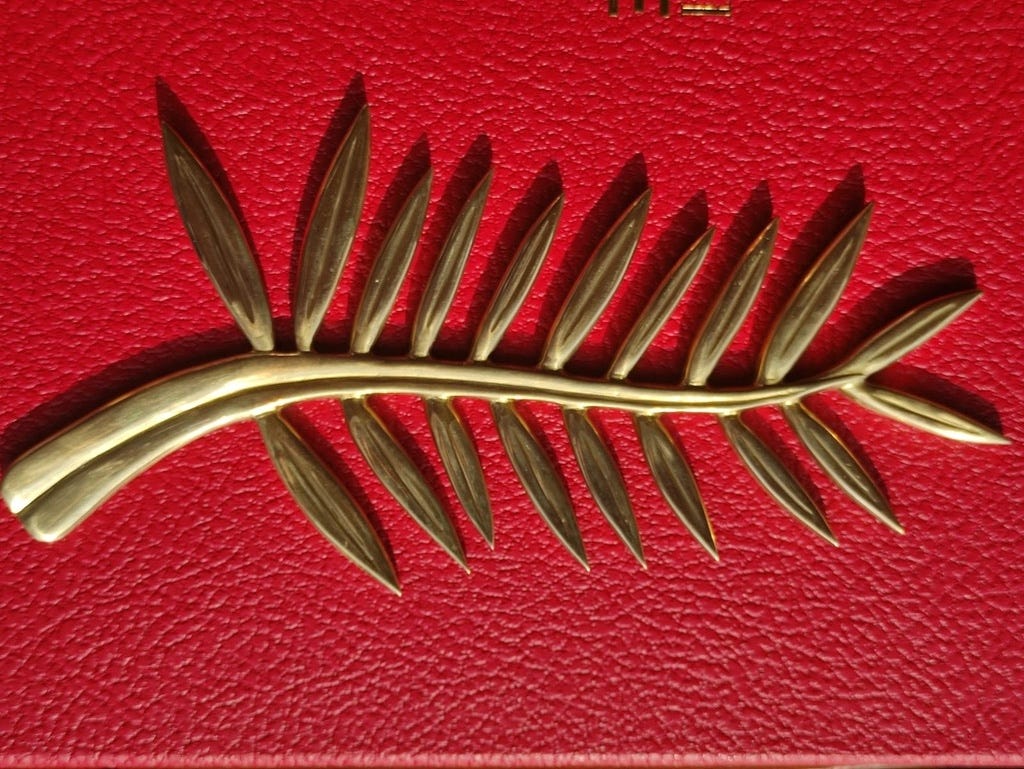
The Palme d’Or, the symbol of the highest honor in cinema at the Cannes Film Festival
Much More Than a Red Carpet
Whenever I return from Cannes, my friends always want to hear about the celebrities I met, the red carpet, the photographers shouting for actors’ attention, and the glamour surrounding the festival.
What few people know is what lies behind all of that. Attending Cannes means waking up at seven in the morning to secure tickets for upcoming screenings, attending your first film at eight, and ending the day after watching four or five movies, with the final screening sometimes finishing at two-thirty in the morning. By the end of the day, your eyes are tired, your notebook is filled with notes, and you often struggle to remember which theater hosted a particular film. In between, there are endless queues, constant movement throughout the Palais, rushed meals, and last-minute schedule changes that can completely reshape your day. Then there are the gala screenings. Whenever one appears on the schedule, you have to rush back to the hotel, change clothes, and put on a tuxedo, which remains mandatory for entry. Elegance is an essential part of the Cannes ritual; a stage where cinema meets refinement and spectacle.
To survive Cannes, preparation is essential, not only mentally, but physically as well. In my case, I can count on the support of my parents, who help me throughout this project and assist me in selecting outfits, often personalized with Palme d’Or-inspired pins. Many people imagine Cannes as a vacation on the French Riviera, filled with beaches and seaside cocktails. The truth is that true cinephiles rarely see the beach.
During breaks, most of us look for a quiet corner inside the Palais to pause for a few minutes, reflect on the film we have just seen, and mentally prepare for the next screening. For me, one of the best places is the fourth-floor terrace overlooking the city. It is one of those rare spots where you can finally slow down and organize the emotions accumulated throughout the day.
Another question I am often asked is: “How do you choose which films to watch?”
The answer is both simple and complicated. The first selection depends on which tickets you manage to obtain. The second relies heavily on intuition. During the festival, very little information is available about the films being screened. You know the director, the cast, the running time, and perhaps you have seen a poster, but little else. As a result, you often rely on a filmmaker’s reputation and experience, trying to determine which works deserve priority. Yet Cannes also teaches you that predictions rarely matter and that hidden gems are always waiting around the corner.
One of the things I love most about the festival is the opportunity to interact with people from all over the world who share the same passion for cinema. We exchange opinions, recommendations, interpretations, and impressions. After every screening, spontaneous discussions emerge about the strengths and weaknesses of the films, possible award winners, and the jury’s decisions. It is not simply a matter of deciding whether a film is good or bad. It is about analyzing it, understanding it, and comparing different perspectives. And that ongoing exchange is what makes Cannes something far greater than a film festival.

Behind every major event, there are also moments of togetherness, encounters, and memories that last a lifetime
The Joy of Discovery
Cannes is unpredictable, and that unpredictability is precisely what makes it special. Sometimes the biggest surprises come from the most anticipated films. Other times they emerge from works you know almost nothing about. That is one of the reasons I love this festival: every screening has the potential to become a discovery.
One of the most recent examples was La Bola Negra by Javier Calvo and Javier Ambrossi, winner of the Best Director Award. It is an extremely ambitious project that intertwines three stories within a single narrative. Despite its considerable running time, the film maintains the audience’s attention through a structure that constantly fuels curiosity. The different narrative threads develop with remarkable balance, each preserving its own identity while contributing to a larger, unified vision.
Another surprise was Resurrection by Bi Gan, which received a Special Mention. It is one of those films that reminds you why cinema remains such a unique art form. The first part of the film poetically retraces the birth of cinematic language and its evolution over time. It is a journey through images, dreams, and transformations that have accompanied cinema’s growth across decades. As someone deeply passionate about film, I particularly appreciated its tribute to the Lumière brothers, pioneers of everything we now take for granted when we enter a movie theater.
Yet one of the most beautiful aspects of Cannes is that extraordinary discoveries often happen outside the official competition. This year, I had the opportunity to attend the premiere of a film dedicated to Charles de Gaulle. The atmosphere was electric. The red carpet glowed beneath the flashes of photographers’ cameras and was filled with actors, directors, and industry professionals. Once inside the Lumière Theatre, I found myself seated only a few rows away from the director. Watching his reaction during the final applause was almost as moving as the film itself. Seeing the cast visibly emotional, witnessing the audience’s response, and feeling the intensity of that moment is something that words struggle to describe.
Perhaps that is what makes Cannes so special. Walking into a theater knowing almost nothing about what you are about to see. No trailers revealing too much. No overwhelming marketing campaigns. Just a title, a director, and the opportunity to be surprised.
And when the lights come back on and the room erupts into spontaneous applause, you remember why cinema still has the power to move us.

Amid the house lights and applause, a moment that captures the connection between the film and its audience
When the Lights Go Down
One of the moments I will remember forever is my first time in Cannes.
Through a combination of luck and timing, I managed to secure a ticket for the premiere of Paris, 13th District by Jacques Audiard in the Lumière Theatre. For my very first screening, I had the opportunity to climb those twenty-four steps that I had only ever seen on television. I found myself in the middle of the red carpet, surrounded by photographers, journalists, and guests from all over the world. I was almost overwhelmed by everything happening around me. I kept looking around and seeing things that I had only imagined from afar, things that were now unfolding before my eyes. Climbing those steps was not easy. My legs were trembling. I wanted to memorize every detail, as though I were afraid I might forget something.
I had never seen the Lumière Theatre from the inside. When I finally entered, I realized that I was surrounded by people who shared the same passion that had accompanied me throughout my entire life: a love for cinema. It was at that moment that I understood I was exactly where I wanted to be.
Another memory I cherish is meeting Academy Award-winning director Paolo Sorrentino. He was in Cannes attending a screening of Kidnapped by Marco Bellocchio, and after the screening ended, he happened to walk past me. I managed to greet him and exchange a few words. It may seem like a simple moment, but for someone who loves cinema, certain encounters remain etched in memory for years. Sorrentino is one of the filmmakers I admire most, and meeting him in such a unique setting felt like one of those unexpected gifts that Cannes occasionally offers.
Yet the most symbolic moment always arrives at the end. The Palme d’Or has been awarded. The doors of the Lumière Theatre close. The Palais slowly begins to empty. People return to their respective countries, and the frenzy that animated the festival for nearly two weeks gives way to silence.
Only darkness remains. The same darkness that precedes the beginning of a film. I walk along the Croisette, reflecting on the screenings, encounters, and emotions of the previous days. Then I look up and notice that the giant festival poster is still illuminated above the Lumière Theatre. In that moment, I realize that the festival is over, but cinema continues.
It is a feeling that is difficult to describe. A mixture of joy, gratitude, and melancholy. The sadness of leaving a special place. The happiness of having lived another unforgettable experience. And above all, the certainty that the following year I will return to the Croisette once again.

There are places you’ve seen a thousand times on screen, and when you finally get there, they seem even more incredible in person
Why I Keep Coming Back
For me, returning to Cannes every year matters for many reasons.
It is not simply about attending the world’s most prestigious film festival or seeing the most anticipated premieres. It is also about reconnecting with people I have met over the years, sharing new emotions, and contributing, however modestly, to keeping cinema alive. One aspect that strikes me every year is that many films presented in Cannes never reach theaters in numerous countries. Some obtain international distribution. Others remain known only to a small audience. That is why I believe attending the festival also carries cultural value.
Talking about these films, writing about them, and discussing them gives them another chance to be discovered.
Every film represents an author’s vision. Every director brings a different perspective on the world to the screen. And that is precisely what deserves to be celebrated. Sharing opinions, exchanging ideas, and discussing cinema is just as much a part of the experience as attending the screenings themselves. In a way, that too is cinema.
Every year I approach the festival with dedication and enthusiasm. Perhaps that is why exhaustion becomes secondary. The lack of sleep, rushed meals, and constant race from one theater to another become almost irrelevant. By the end of the festival, only one feeling remains: “What an extraordinary experience!”
Yet there is an even deeper reason that keeps bringing me back to Cannes. Every film is a journey. For a few hours, I can find myself in another era, another country, or inside the life of someone completely different from me. I can share their hopes, fears, triumphs, and failures. Cinema possesses a unique ability: it allows us to live many lives while remaining seated in the same chair. And perhaps that is the real reason I keep returning.
Because every year Cannes offers me the opportunity to discover new stories, new perspectives, and new ways of seeing the world. And there is no journey more fascinating than the one that begins when the lights go down and the screen lights up.

The heart of the festival is getting ready to welcome the public: the main façade basking in the sun on the Croisette, amid cinema, anticipation, and celebration
Long Live Cinema
Over the past few years, the Cannes Film Festival has continued to grow, attracting increasing attention from audiences, journalists, and industry professionals.
A significant part of that success is linked to the work of Thierry Frémaux, who has served as the festival’s General Delegate for twenty-five years. Every year, he is responsible for selecting hundreds of films from around the world, identifying new directions in contemporary cinema and giving visibility to filmmakers who might otherwise never receive such an opportunity.
It cannot be an easy task. Choosing which stories to showcase, which voices to support, and which visions to bring to the Croisette means helping define not only the present, but also part of cinema’s future.
Yet when I think about Cannes, I do not think only about the official selection, the awards, or the celebrities. I think about a child sitting beside his parents in a dark movie theater. I think about that beam of light crossing the room and transforming a blank screen into something magical. I think about the years I spent studying film in the United States. I think about the people I met on the Croisette, the conversations after screenings, the emotions experienced inside the Lumière Theatre, and all those stories that allowed me to see the world through eyes different from my own.
Perhaps that is why I keep returning. Because for me, Cannes is not merely a festival. It is the place that reminds me, year after year, why I fell in love with cinema in the first place. And as long as I continue to feel that same emotion whenever I enter a dark theater, I know that part of me will always keep searching for that beam of light. The same beam that felt like magic when I was a child. The same beam that, deep down, still feels like magic today.
Long live Cannes.
And long live Cinema.
메타데이터
- post_id
- ecc697f60bba
- slug
- return-to-the-croisette-ecc697f60bba
- url
- https://medium.com/@louisinframes/return-to-the-croisette-ecc697f60bba
- canonical_url
- https://medium.com/@louisinframes/return-to-the-croisette-ecc697f60bba
- author_url
- https://medium.com/@louisinframes
- status
- ok
- fetched_at
- 2026-06-11 17:15:47




