How AI Is Quietly Rewriting the Rules of Banking-as-a-Service?
The next wave of financial infrastructure won’t be built by banks. It’ll be built by algorithms.
How AI Is Quietly Rewriting the Rules of Banking-as-a-Service?
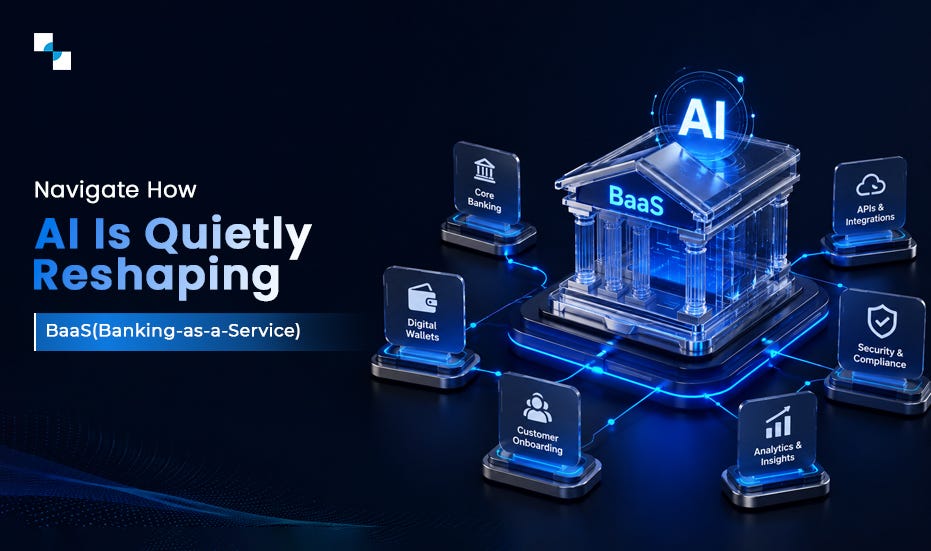
Image created by the author
The next wave of financial infrastructure won’t be built by banks. It’ll be built by algorithms.
When Banking Became an API
Not long ago, launching a financial product meant navigating a labyrinth- regulatory approvals, core banking integrations, compliance teams, and years of runway. Then Banking-as-a-Service (BaaS) changed the equation. It handed startups the infrastructure of a licensed bank wrapped in developer-friendly APIs.
But here’s what most people don’t talk about: BaaS has an operations problem.
Compliance monitoring, fraud detection, customer onboarding, risk scoring, dispute resolution- these processes are labor-intensive, error-prone, and expensive at scale. The global BaaS market, valued at approximately $7 billion in 2024, is projected to surpass $74 billion by 2030 (Allied Market Research). That’s a 10x expansion in six years. Scaling human operations to match that growth isn’t viable.
That’s where AI steps in, not as a buzzword, but as the actual engine room.
The Operational Weight BaaS Providers Carry
Running a BaaS platform is operationally heavier than most people realize. Behind every embedded finance product, a crypto neo bank, a white label crypto bank, a fintech lending app that sits a stack of continuous processes:
- Real-time transaction monitoring for AML/CFT compliance
- KYC/KYB verification and ongoing due diligence
- Fraud risk scoring across millions of daily events
- Regulatory reporting across multiple jurisdictions
- Customer support triage and dispute resolution
- Credit decisioning and limit management
Traditionally, these required large teams, manual reviews, and high operational costs. For a startup building on a **BaaS platform development** foundation, this overhead can quietly kill unit economics before the product ever finds product-market fit.
How AI Is Changing the Game — Operation by Operation
1. Intelligent KYC and Identity Verification
AI-powered document verification and liveness detection have reduced average KYC onboarding time from days to under three minutes in leading BaaS deployments. Machine learning models trained on millions of identity documents can detect forgeries, cross-reference sanctions lists, and flag anomalies — all without a human touching the queue.
More importantly, AI enables risk-tiered onboarding: low-risk users get frictionless flows, while higher-risk profiles trigger enhanced due diligence automatically. This isn’t just faster — it’s smarter.
2. Autonomous Fraud Detection and Prevention
Legacy rule-based fraud systems catch what they’re programmed to catch. AI models catch what they learn to catch, and that’s a meaningful distinction in an era where synthetic identity fraud and account takeover attacks evolve weekly.
Modern BaaS development solutions now embed adaptive ML layers that analyze behavioral biometrics, device fingerprinting, transaction velocity, and network graphs in real time. Fraud decisions that once took hours are made in milliseconds, with false positive rates dropping significantly, which matters enormously for user experience.
3. AI-Driven Compliance Engines
Regulatory compliance is perhaps the most underappreciated cost center in fintech. Jurisdictional rules change constantly. What’s compliant in the EU may require a completely different workflow in the UAE or Singapore.
AI is enabling dynamic compliance engines that ingest regulatory updates, auto-classify transactions, generate suspicious activity reports (SARs), and flag policy drift- all without manual intervention. For companies building a white-label crypto bank or an embedded finance product across multiple geographies, this capability is no longer optional.
4. Predictive Risk and Credit Modeling
AI models now assess creditworthiness using non-traditional data- transaction patterns, wallet behavior, on-chain activity, and spending velocity, giving BaaS providers the ability to serve underbanked populations that traditional FICO-based scoring systematically excludes. This opens enormous market opportunities, particularly in emerging markets and Web3-native finance.
What This Means for Builders and Investors
For crypto startups and Web3 founders evaluating BaaS development solutions, AI automation changes the calculus in three concrete ways:
- Lower operational costs at scale. A platform that automates 80% of compliance workflows doesn’t need to double its compliance headcount every time it doubles its user base.
- Faster time-to-market. Pre-integrated AI modules for KYC, fraud, and risk mean that teams using modern **BaaS development company** infrastructure spend less time on operational plumbing and more time on product.
- Competitive defensibility. Platforms that accumulate proprietary transaction data and train models on it build a compounding advantage that’s extremely difficult for competitors to replicate.
Antier and similar infrastructure providers are increasingly embedding AI capabilities directly into their BaaS frameworks, recognizing that operational automation is no longer a feature but a prerequisite for enterprise-grade deployments.
The Road Ahead
We’re at an inflection point. AI is moving from experimental tooling inside fintech operations to the foundational layer that makes modern financial infrastructure work. The platforms that get this right- building AI into the architecture of BaaS from the ground up, not bolting it on afterward will define the next decade of embedded finance.
For crypto startups, blockchain enterprises, and technology decision-makers evaluating where to build: the question is no longer whether your BaaS provider uses AI. The question is how deeply it’s embedded, and whether it’s auditable, adaptive, and aligned with your regulatory reality.
As Web3 adoption accelerates, businesses that invest in scalable, AI-powered blockchain infrastructure today will be better positioned to capitalize on tomorrow’s digital economy.
메타데이터
- post_id
- ecc825584f80
- slug
- how-ai-is-quietly-rewriting-the-rules-of-banking-as-a-service-ecc825584f80
- url
- https://medium.com/illumination/how-ai-is-quietly-rewriting-the-rules-of-banking-as-a-service-ecc825584f80
- canonical_url
- https://medium.com/illumination/how-ai-is-quietly-rewriting-the-rules-of-banking-as-a-service-ecc825584f80
- author_url
- https://medium.com/@jamesjo6281106
- status
- ok
- fetched_at
- 2026-08-16 07:00:21