A Child Starting School Today Will Enter a Completely Different World by 2035
Imagine a child beginning Grade 1 today.
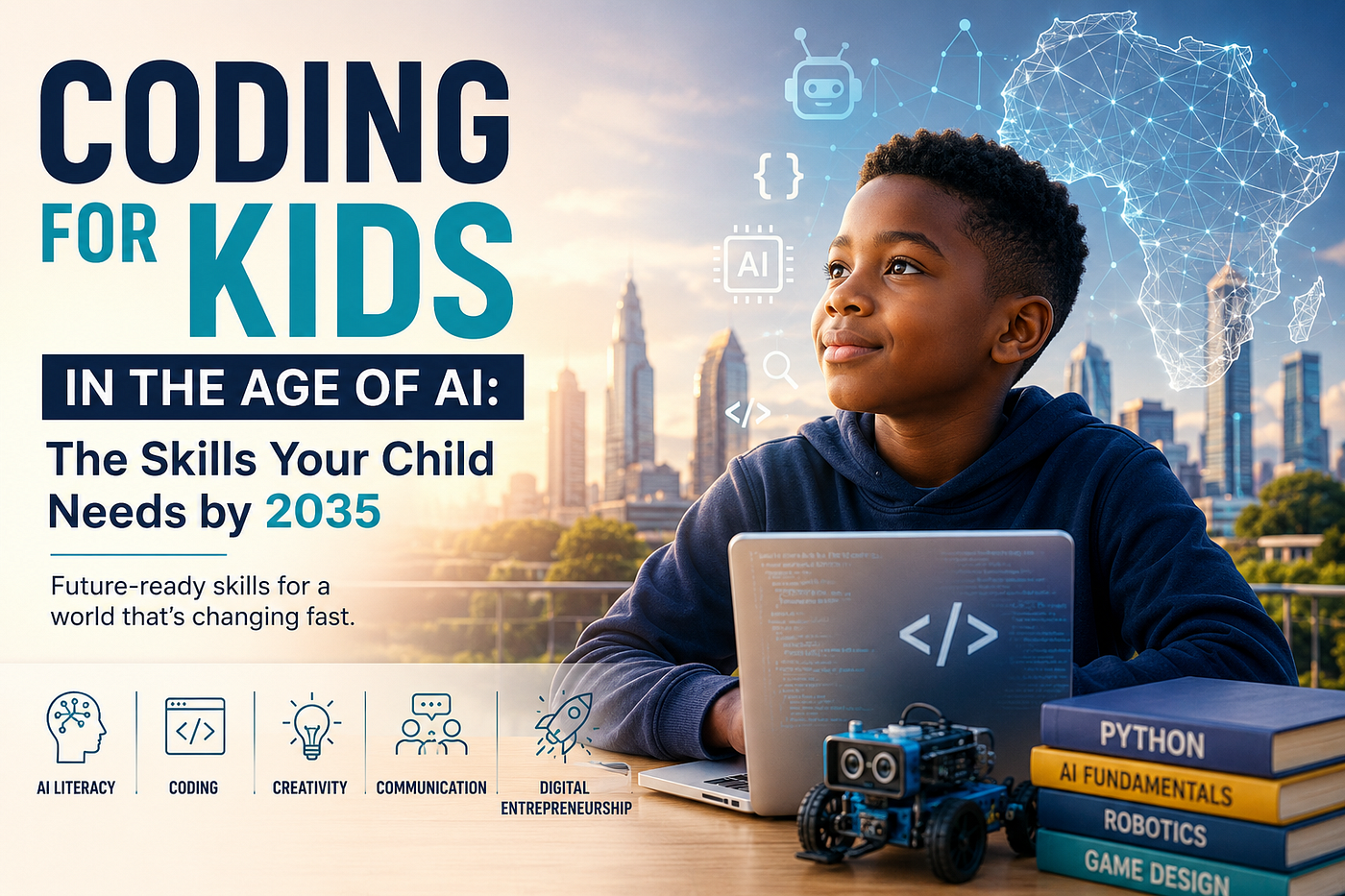
A Child Starting School Today Will Enter a Completely Different World by 2035
Imagine a child beginning Grade 1 today.
By the time they enter the workforce, artificial intelligence may be able to perform many of the routine tasks humans currently do.
Businesses will rely heavily on automation. Entire industries will look different from the way they do today. New careers will emerge, while some existing jobs may disappear altogether.
In fact, many of the jobs that today’s children will hold in 2035 may not even exist yet.
Across Africa, technology is rapidly transforming how people learn, work, communicate, and build businesses. From digital banking and e-commerce to artificial intelligence and remote work opportunities, the future is arriving faster than many expected.
Yet despite these changes, much of the education system still operates as it was designed decades ago. Students often spend years memorizing facts, preparing for examinations, and following standardized learning paths that may not fully reflect the demands of the modern world.
This raises an important question for parents:
Are we preparing children for the future they will actually live in, or for a world that is slowly disappearing?
The answer to that question could determine how well today’s children adapt to tomorrow’s opportunities.
Why Today’s Education System Was Built for Yesterday’s Economy
To understand the challenge, we first need to understand where modern education came from.
Much of today’s school system was designed during the industrial era, when economies needed large numbers of workers who could follow instructions, perform repetitive tasks, and fit into standardized roles. Schools were structured to produce graduates who could succeed in factories, offices, and traditional professions.
This approach made sense at the time.
Students learned the same subjects, followed similar schedules, and were evaluated using standardized examinations. Success was often measured by how well a student could remember information and reproduce it during tests.
While these systems helped educate millions of people, the world has changed dramatically. Now, coding for kids is not an option but a basic need.
Today, information is available instantly online. Artificial intelligence can answer questions, summarize complex topics, and generate content within seconds.
Employers increasingly value creativity, adaptability, problem-solving, collaboration, and technological literacy skills that are often difficult to measure through traditional examinations alone.
This does not mean schools are failing.
In fact, many African schools are making significant progress. Governments are introducing competency-based curricula, investing in digital learning, and exploring new approaches to education. Teachers across the continent continue to work hard to prepare students for success.
However, curriculum reforms often move more slowly than technological change.
Technology evolves every year. Educational systems can take years or even decades to fully adapt.
As a result, many children are growing up in a world powered by artificial intelligence while learning in systems originally designed for the industrial era.
That is why parents must begin looking beyond academic grades alone and start asking a new question:
What skills will help my child thrive in 2035, regardless of which career they choose?
The World Your Child Will Graduate Into
The world of 2035 will look very different from the world we know today.
Just as the internet transformed society over the past two decades, artificial intelligence is now accelerating change across nearly every industry. The pace of innovation is increasing, and children entering school today will grow up in an environment where technology is deeply integrated into daily life.
Artificial Intelligence will assist professionals in fields ranging from medicine and law to agriculture and education.
Robotics will automate repetitive physical tasks in factories, warehouses, hospitals, and even homes. Remote work will continue to break geographical barriers, allowing talented individuals to work for companies anywhere in the world without leaving their home country.
Digital entrepreneurship will become more accessible than ever before. A teenager with a laptop and an internet connection can build software, create digital products, launch online businesses, and reach customers across continents.
Global freelancing platforms will continue opening opportunities for skilled individuals regardless of location. For example, a young professional in Africa could design websites for clients in Europe, develop software for companies in North America, or provide digital services to businesses in Asia.
Automation will reshape traditional jobs, reducing the demand for routine work while increasing demand for critical thinking, creativity, and innovation.
Lastly, new industries will emerge around climate technology as countries seek solutions for sustainable energy, environmental conservation, and food security.
At the same time, cybersecurity will become one of the world’s most important fields as governments, businesses, and individuals work to protect digital systems and data.
While no one can predict every job that will exist in 2035, one thing is becoming increasingly clear:
The future belongs to problem solvers, creators, and innovators.
Children who can identify challenges, think critically, adapt quickly, and use technology to create solutions will be better positioned to thrive in the decades ahead.
The question is no longer whether technology will shape the future.
The question is whether our children will be prepared to shape it themselves.
The 7 Skills Every Child Needs by 2035
If parents want to prepare their children for a rapidly changing world, academic knowledge alone will not be enough.
The most successful children of the future will combine traditional education with practical, future-focused skills that help them think, create, communicate, and adapt.
Here are seven of the most important skills children should begin developing today.
1. Problem-Solving
At its core, every major innovation begins with a problem.
Businesses hire people who can solve problems. Entrepreneurs build companies by solving problems. Engineers, scientists, doctors, and technology professionals all succeed by finding better ways to overcome challenges.
That is why problem-solving is consistently ranked among the most valuable workplace skills.
Unfortunately, many educational systems focus heavily on finding the right answer rather than exploring multiple possible solutions.
Project-based learning helps bridge this gap.
When children build games, create websites, design mobile apps, or develop simple technology projects, they learn how to identify challenges, test ideas, make mistakes, and improve their solutions over time.
2. AI Literacy
Artificial intelligence will be one of the defining technologies of the next generation.
Just as previous generations learned how to use computers and the internet, today’s children must learn how to work effectively with AI.
AI literacy does not mean becoming an AI engineer.
It means understanding:
- What AI can do well
- What AI cannot do well
- How to use AI responsibly
- How to ask effective questions
- How to verify AI-generated information
- How to identify misinformation and bias
Children who understand AI will be able to use it as a powerful tool for learning, creativity, and productivity.
Children who do not may struggle to compete with peers who know how to leverage these technologies effectively.
The goal is not to fear AI.
The goal is to learn how to use it wisely.
3. Coding and Computational Thinking
Few skills have generated as much debate in recent years as coding.
With artificial intelligence now capable of generating software code in seconds, many parents are asking an important question:
If AI Can Write Code, Is Coding for Kids Still Worth Learning?
The short answer is simple:
Yes, perhaps more than ever.
One of the biggest misconceptions about Coding for Kids is that its purpose is to turn every child into a software developer.
In reality, coding is about much more than programming languages.
Coding teaches children how to think logically. It teaches them how complex systems work. It encourages experimentation, persistence, and creative problem-solving.
When children learn coding, they learn how to break large problems into smaller, manageable pieces. They learn how to identify patterns, test solutions, and improve their work through iteration.
These abilities form the foundation of computational thinking — a skill that is becoming increasingly valuable across every industry.
Even if a child never becomes a professional programmer, the mindset developed through Coding for Kids can help them become better engineers, entrepreneurs, scientists, designers, analysts, and innovators.
Artificial intelligence may be able to generate code.
But it still depends on humans to provide direction, identify meaningful problems, evaluate solutions, and make important decisions.
As AI tools become more powerful, understanding how technology works will become even more important.
As one simple truth reminds us:
AI can generate code, but it cannot replace human curiosity, creativity, and the ability to identify meaningful problems worth solving.
In the age of AI, coding for Kids is no longer just about learning to code.
It is about learning how to think.
4. Creativity
Technology is becoming increasingly capable of performing routine tasks.
Creativity remains uniquely human.
Artificial intelligence can generate images, write text, and suggest ideas.
But humans imagine possibilities that do not yet exist.
The future will reward people who can combine imagination with technology to create new products, new experiences, and new solutions.
Children should be encouraged to design, build, experiment, and create — not simply consume content.
The creators of tomorrow are often the curious children of today.
5. Communication
Brilliant ideas have little impact if they cannot be communicated effectively.
In an increasingly connected world, children will need to communicate with people from different backgrounds, cultures, and industries.
They should learn how to:
- Present ideas confidently
- Explain their thinking clearly
- Work collaboratively in teams
- Listen actively to others
- Give and receive constructive feedback
Strong communication skills amplify every other skill a child develops.
Whether they become entrepreneurs, engineers, scientists, or leaders, communication will remain essential.
6. Digital Entrepreneurship
Previous generations often needed significant capital to start businesses.
Today’s children have opportunities that were almost unimaginable just a few decades ago.
Using digital tools, they can:
- Build apps
- Create websites
- Develop online services
- Launch digital products
- Create educational content
- Reach customers globally
The barriers to entry have never been lower.
A child in Africa can build a product used by people around the world.
They can learn to create value rather than simply consume technology.
Digital entrepreneurship teaches initiative, creativity, leadership, and problem-solving — all valuable skills regardless of whether a child eventually starts a business.
7. Adaptability
Perhaps the most important skill of all is adaptability.
Technology will continue evolving.
Industries will continue changing.
New opportunities will emerge.
Some careers will disappear while entirely new professions are created.
The children who succeed in this environment will not necessarily be those who know the most today.
They will be those who can learn continuously, adapt quickly, and embrace change.
In other words, the most valuable skill of the future may be the ability to learn new skills.
The jobs of 2035 may not exist today.
But children who learn how to learn will be ready for whatever comes next.
The Future Won’t Wait
Every generation faces a defining technological shift.
For our parents, it was the rise of personal computers.
For us, it was the internet and smartphones.
For today’s children, it will be artificial intelligence.
The decisions we make about education today will shape how prepared our children are for the opportunities and challenges that lie ahead.
While academic subjects will always matter, future success will increasingly depend on skills that go beyond traditional examinations. Problem-solving, creativity, adaptability, communication, digital literacy, and technological confidence will become essential in a world where change is the only constant.
By 2035, the children who thrive may not be those who simply know how to use technology.
They will be the ones who understand it, improve it, and create with it.
Across Africa, we have an extraordinary opportunity.
We are home to the world’s youngest population. We have some of the fastest-growing technology ecosystems. We have ambitious young people, innovative entrepreneurs, and communities eager to embrace the future.
메타데이터
- post_id
- eccbf2cff6e3
- slug
- a-child-starting-school-today-will-enter-a-completely-different-world-by-2035-eccbf2cff6e3
- url
- https://medium.com/@alltpprogramming/a-child-starting-school-today-will-enter-a-completely-different-world-by-2035-eccbf2cff6e3
- canonical_url
- https://medium.com/@alltpprogramming/a-child-starting-school-today-will-enter-a-completely-different-world-by-2035-eccbf2cff6e3
- author_url
- https://medium.com/@alltpprogramming
- status
- ok
- fetched_at
- 2026-07-24 19:02:38




