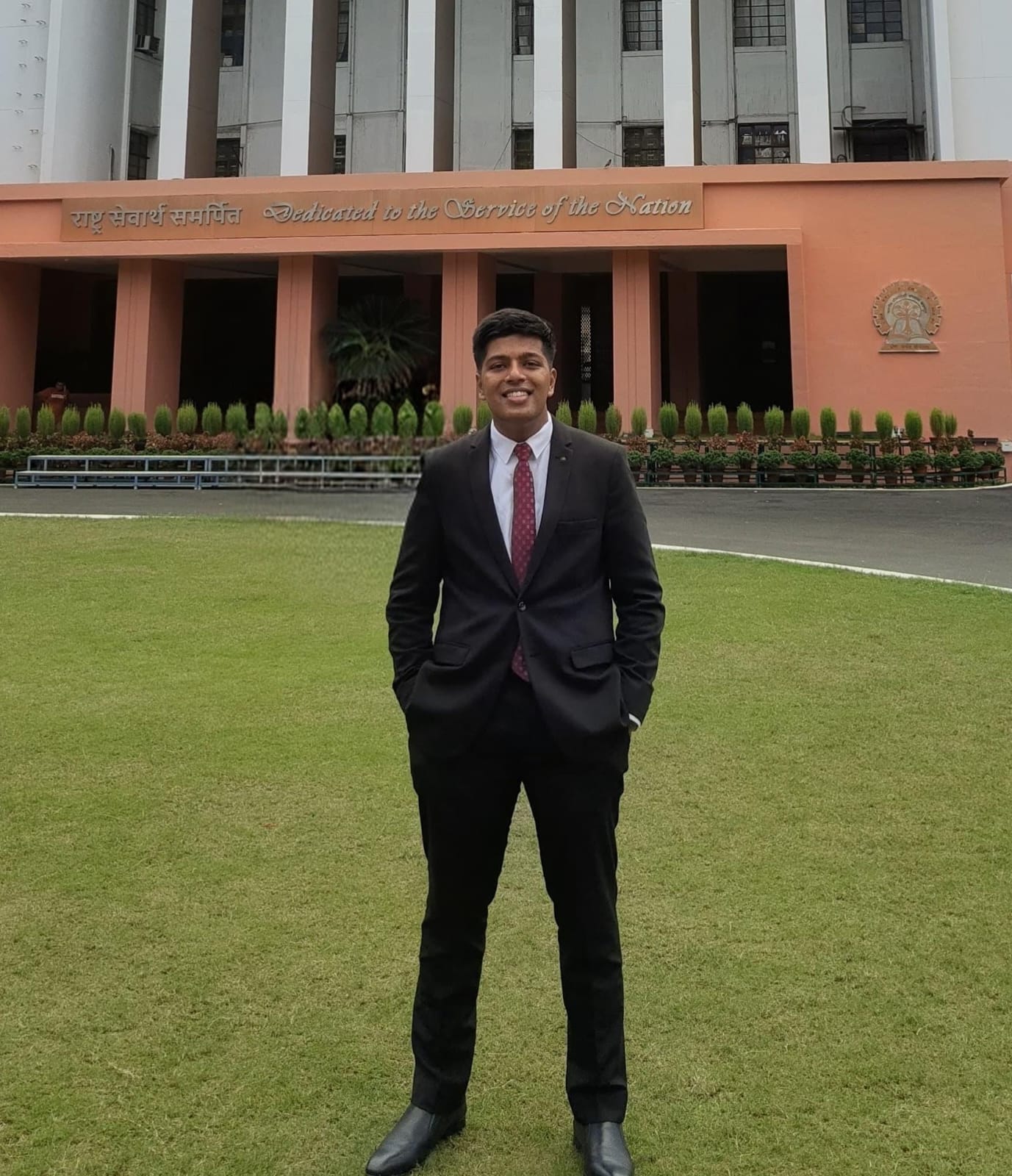
CQ_Core_Combat | Utsav Agarwal | Texas Instuments
Interviewer: Hello Utsav, this is Nihar, Associate at Communiqué. First of all, I offer my heartiest congratulations on securing an…
CQ_Core_Combat | Utsav Agarwal | Texas Instuments

Interviewer: Hello Utsav, this is Nihar, Associate at Communiqué. First of all, I offer my heartiest congratulations on securing an internship at Texas Instruments. Shall we begin with the interview?
Utsav: Hello Nihar, yeah, sure!
Interviewer: How did you decide on the core profile?
Utsav: Talking about this, I tried to explore as much as I could. I explored data science and several other domains, but I did not enjoy them as much. One thing I realized is that people from almost any department can eventually move into data-related roles, but very few people can enter the EC core industry without an Electronics degree.
So, if I am spending four years studying Electronics and Communication Engineering, why not make use of it? Also, the EC core industry is one of the fastest-growing industries right now. Domains like data science and AI were not as prominent 20 years ago, and we cannot be certain what they will look like 20 years from now. However, core engineering roles have remained relevant throughout time.
Apart from that, I genuinely enjoy EC core subjects. These were the major reasons behind my decision to pursue EC core.
Interviewer: Kindly explain the general selection and shortlisting process of the company you applied to, including the number of rounds and some of the questions asked during the interview.
Utsav: There are a limited number of EC core companies that come to CDC, especially during the first phase. This year, on Day 2, the companies that visited were Texas Instruments, NVIDIA, Qualcomm, and Google.
I’ll talk specifically about the selection process for Texas Instruments, where I secured an Analog Design Internship. TI offers four internship roles: Analog Design, Digital Design, Embedded Systems, and Signal Processing.
You can apply for all four roles, but you can attempt the online assessment for only two of them. The OA consists of two sections: an aptitude test and a role-specific technical test. The aptitude section was relatively easier compared to many other companies. The technical sections for Analog and Digital focused heavily on fundamental concepts. There were no advanced topics; instead, the questions tested basic concepts in tricky ways.
The questions covered concepts taught up to the end of the second year. Unlike companies such as NVIDIA, Qualcomm, and Google Hardware, which may ask questions from third- or fourth-year courses, TI’s OA does not require studying beyond the standard curriculum up to the second year. I applied for both Analog and Digital and got shortlisted for both
Interviewer: For people who haven’t started preparing for CDC yet, assume a person has only 1–1.5 months left before the interviews and wants to secure an internship at TI. What steps would you suggest?
Utsav: Before answering that, I would like to explain the kind of questions asked during the interviews.
In my case, they didn’t even open my CV. The interview started directly with technical questions. There were around 15–20 questions in total. No HR questions, no CV discussion — just technical questions. However, this was not the case for everyone.
For the Analog interview, they started with a basic RC circuit question from Network Theory. Then they gradually increased the complexity and checked my understanding of poles and zeros.
After that, they asked whether I was more comfortable with BJTs or MOSFETs. I said both, and they were quite flexible in choosing topics based on my comfort level.
They then asked MOSFET-related questions, starting from the operating regions and current equations. Later, they moved on to current mirrors, analyzed different circuit configurations, and asked me to predict circuit behavior.
They also covered operational amplifiers (OP-AMPs), including Golden rules of OP-AMPs, Positive feedback, Negative feedback, Basic OP-AMP circuit analysis. For the Digital interview, they began with very simple but tricky questions.
For example, Implement an XOR gate using a 2×1 multiplexer. Design a 4×1 multiplexer using only 2×1 multiplexers.
Then they moved to Finite State Machines (FSMs), where they expected the complete design process,State assignment, State minimization, Identifying redundancies, Drawing state transition diagrams, Designing FSM logic. If you are comfortable with FSMs, you are already in a strong position for the Digital role.
Apart from these, they asked questions from various subjects in the curriculum, but nothing beyond what is officially taught.
Regarding competition among the four roles, Signal Processing was the least competitive, with very few applicants. I believe only one student was selected for that role.
Interviewer: How important is CGPA in the core field? How can EE and ECE students maintain a good CGPA? Also, what role do extracurricular activities and positions of responsibility play in strengthening a core profile?
Utsav: A CGPA above 8 is generally sufficient. If possible, try to maintain it above 8.5. Even with a CGPA around 7.5, you can still apply, but it may become a disadvantage during shortlisting. So, the ideal range is probably between 8.5 and 9.5.
At this stage, you cannot drastically change your CGPA overnight, so don’t stress about it. Focus on building strong fundamentals and perform well academically going forward.
Interviewer: What is the importance of DSA? Is it required? If yes, to what extent?
Utsav: For core EC roles, DSA is not important at all.
For Digital Design roles, you may need a basic understanding of programming concepts, but extensive DSA preparation is generally unnecessary. Your focus should remain on core electronics fundamentals.
Interviewer: What is the importance of a research internship?
Utsav: Research internships are essentially a bonus.
Companies do not expect students at the end of their second year to have completed major internships or research projects because most students have only recently finished learning the fundamental subjects.
However, if you have done a research internship or project and can explain it confidently, it definitely helps.
Even laboratory experiments can be included on your CV. Many students mention their final lab experiments as projects, and interviewers often ask questions about them.
The main objective is to evaluate your understanding of whatever you have done. For Analog and Digital roles, lab projects are perfectly acceptable additions to your CV.
Interviewer: Are there any specific pointers you would like to discuss when it comes to building a core profile?
Utsav: The biggest takeaway from my entire interview experience is that fundamentals matter the most.
I am not exaggerating when I say that almost everything revolved around basic concepts. For example, you should understand how a MOSFET works, how the equations are derived ,important design considerations, and the intuition behind circuit behavior.
You don’t necessarily need deep semiconductor device physics, but you should have a strong grasp of the practical concepts.
Another common question among students interested in EC core is whether they should prepare only for core roles or simultaneously prepare for software, data science, and DSA.
My answer is simple: if you genuinely want a long-term career in EC core, focus on EC core.
Suppose you prepare for both and eventually secure a software or data internship. If your long-term goal is core electronics, that internship may not contribute much toward your future objectives.
CDC also involves a significant amount of luck, especially for core roles. If you don’t get selected in Phase 1, there is Phase 2. If not Phase 2, there are off-campus opportunities.
There are many alternatives, Off-campus internships, Industry internships, Research internships, Faculty-guided projects.
Even if you don’t secure an internship immediately, most professors are willing to offer research opportunities if you approach them sincerely. If one professor cannot accommodate you, they may refer you to another.
There are many excellent professors in the Electrical and Electronics departments who actively support students interested in research.
So, if your goal is EC core, build strong fundamentals, stay consistent, and don’t get distracted by paths that don’t align with your long-term interests.
Interviewer: Thank you so much, Utsav. That was incredibly insightful. We really appreciate you breaking down the realities of core recruitment for the student community. It was great talking to you.
For more updates, join the Road to Intern group.
메타데이터
- post_id
- ecd5f065895d
- slug
- cq-core-combat-utsav-agarwal-texas-instuments-ecd5f065895d
- url
- https://medium.com/@cq-iitkharagpur/cq-core-combat-utsav-agarwal-texas-instuments-ecd5f065895d
- canonical_url
- https://medium.com/@cq-iitkharagpur/cq-core-combat-utsav-agarwal-texas-instuments-ecd5f065895d
- author_url
- https://medium.com/@cq-iitkharagpur
- status
- ok
- fetched_at
- 2026-06-23 03:48:11