Sacred Grounds: What Historical Gardens Teach Us About Healing Landscapes
Long before wellness became an industry, a trend and mental health entered mainstream discourse, civilisations were already designing…
Sacred Grounds: What Historical Gardens Teach Us About Healing Landscapes
Long before wellness became an industry, a trend and mental health entered mainstream discourse, civilisations were already designing spaces to soothe the human spirit.
They didn’t call them “therapeutic environments.” They called them gardens.
Across cultures and centuries, gardens were conceived not merely as decorative landscapes, but as metaphors for paradise, spaces of contemplation, political statements, and sanctuaries from chaos. And if we look closely, many of them embody principles we now identify as psychologically restorative.
Let’s travel through time.
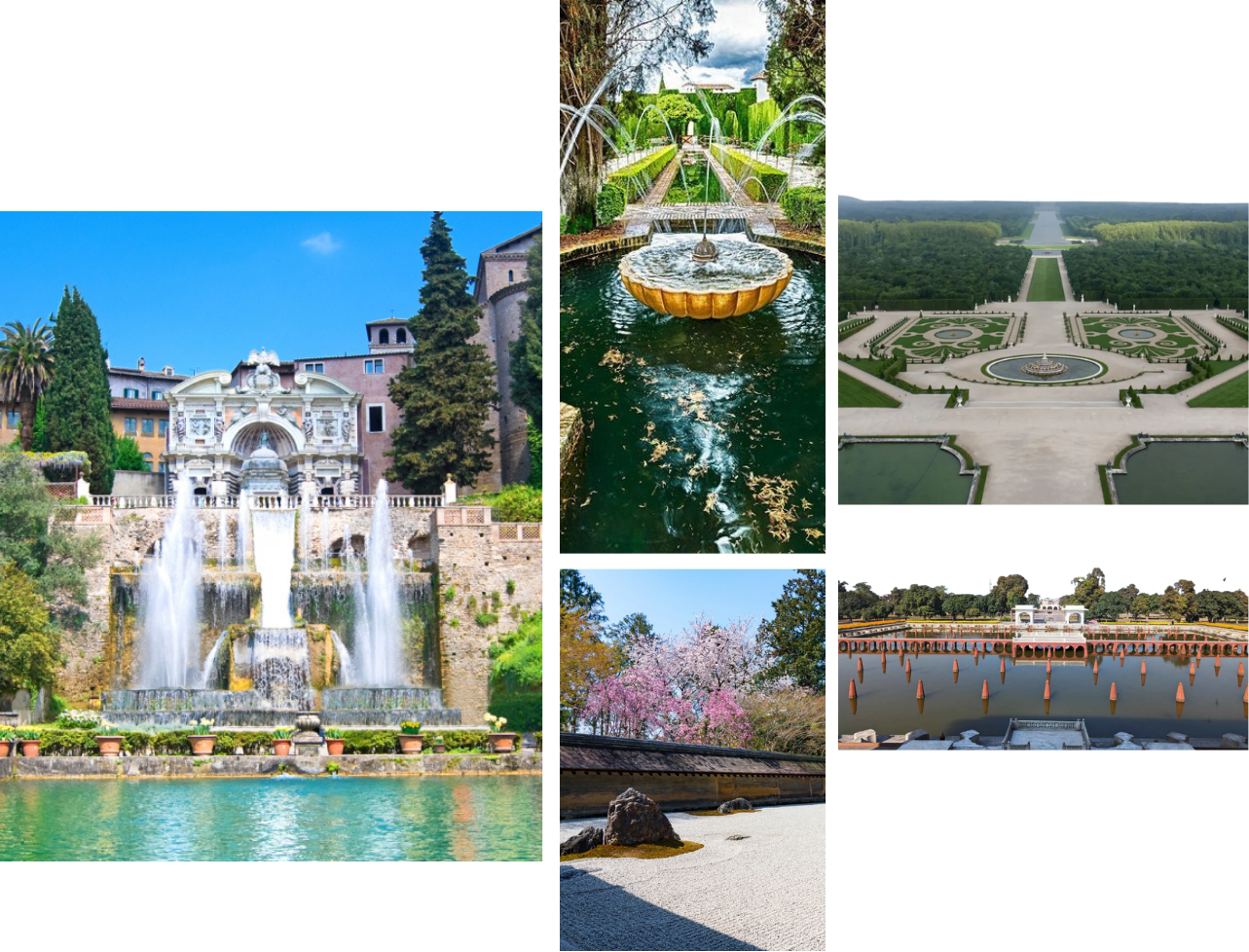
Ryoan-ji — Silence as Architecture
Originally an aristocrat’s villa during the Heian Period, the site was converted into a Zen temple in 1450 and belongs to the Myoshinji school of the Rinzai sect of Zen Buddhism. In 15th-century Japan, Zen Buddhism shaped spatial thinking profoundly. The temple’s most famous feature is the rock garden (Dry landscape garden) located in the southern part of the Hojo, or main hall.
The dry rock garden at Ryoan-ji is minimal; fifteen stones are arranged in a bed of white gravel, arranged in such a way that no matter where you stand, you can never see all 15 stones at once.
No lush vegetation. No fountains. No colour drama.
Yet it is deeply meditative.
The asymmetry invites contemplation. The emptiness creates mental space. The act of raking gravel becomes ritualistic, almost therapeutic. It demonstrates that healing does not require abundance; it requires intentionality.
In today’s overstimulated world, Ryoan-ji feels radical. It reminds us that subtraction can be restorative.
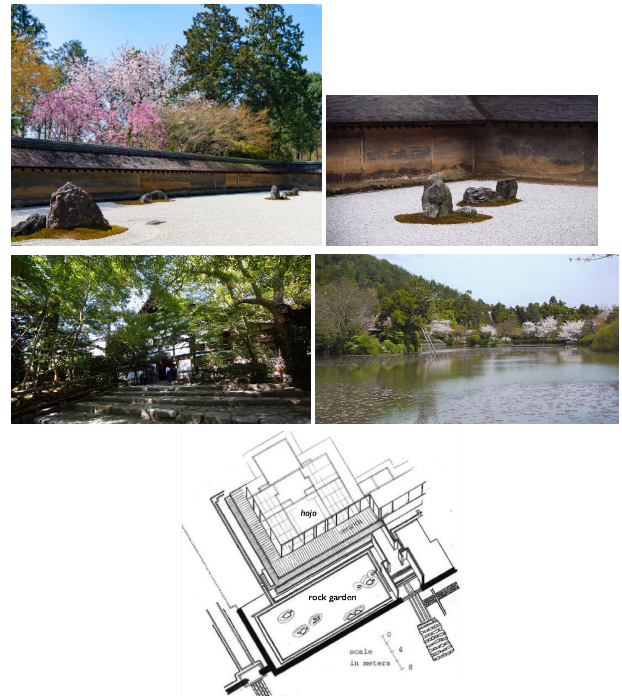
Image sources: Japan-guide.com., koyoto-to-do.com , Khan Academy
Shalimar Gardens — Paradise as Order
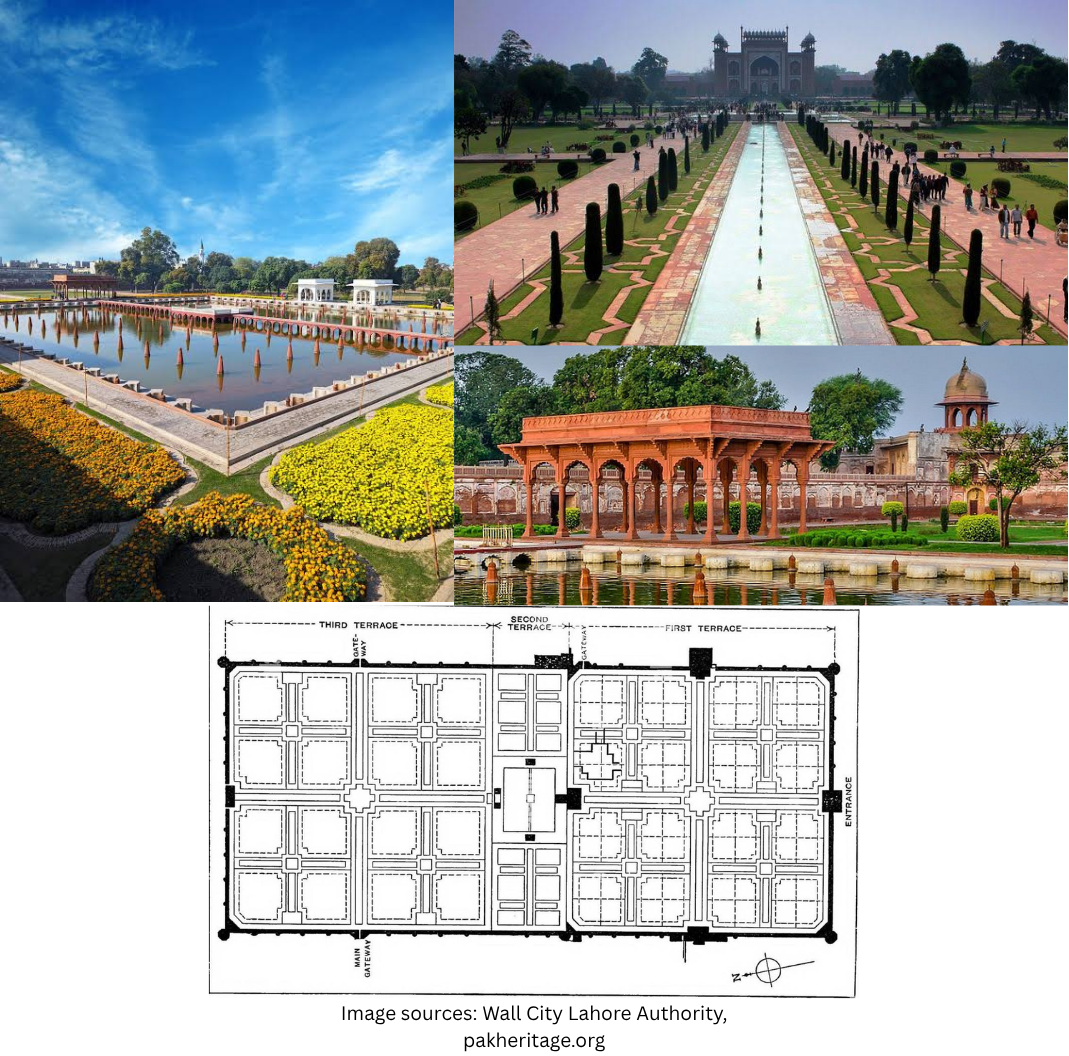
Commissioned during the Mughal era, this garden spans over 40 acres of land and was laid out in 1642 A.D. at the command of Emperor Shahjahan. The Shalimar Gardens, “abode of love” in Lahore, reflect the Persian concept of Charbagh, a quadrilateral garden divided by water channels symbolising the four rivers of paradise.
The garden is divided into three descending terraces: the upper terrace- ‘Farah Baksh’ (Bestower of Pleasure), the middle terrace- ‘Faiz Baksh’ (Bestower of Goodness) and the lower terrace- ‘Hayat Baksh’ (Bestower of Life), each symbolising a different aspect of the cosmic world.
Water cascades through terraces, creating sound, movement, and cooling microclimates. Geometry imposes calm. Symmetry offers psychological stability.
These gardens were not random displays of wealth. They were carefully structured sensory experiences — shade, fragrance, water, enclosure — designed to create respite from harsh climates and political turbulence.
Here, Order becomes healing.
Villa d’Este — Water as Emotional Choreography
16th-century Renaissance Italy saw gardens as extensions of intellectual life. At Villa d’Este, water becomes theatrical — fountains, cascades, hidden hydraulic surprises.
Nestled along the idyllic shores of Lake Como, where the mountains crease the water and the air is perfumed with cypress and jasmine, Villa d’Este is more than just a hotel.
But beyond spectacle lies psychology. The rhythmic sound of water masks noise. Terraced views provide a prospect. Shaded groves offer refuge.
Movement through the garden is narrative-driven. You don’t just roam around; you discover.
Healing, in this context, emerges from curiosity and sensory immersion.
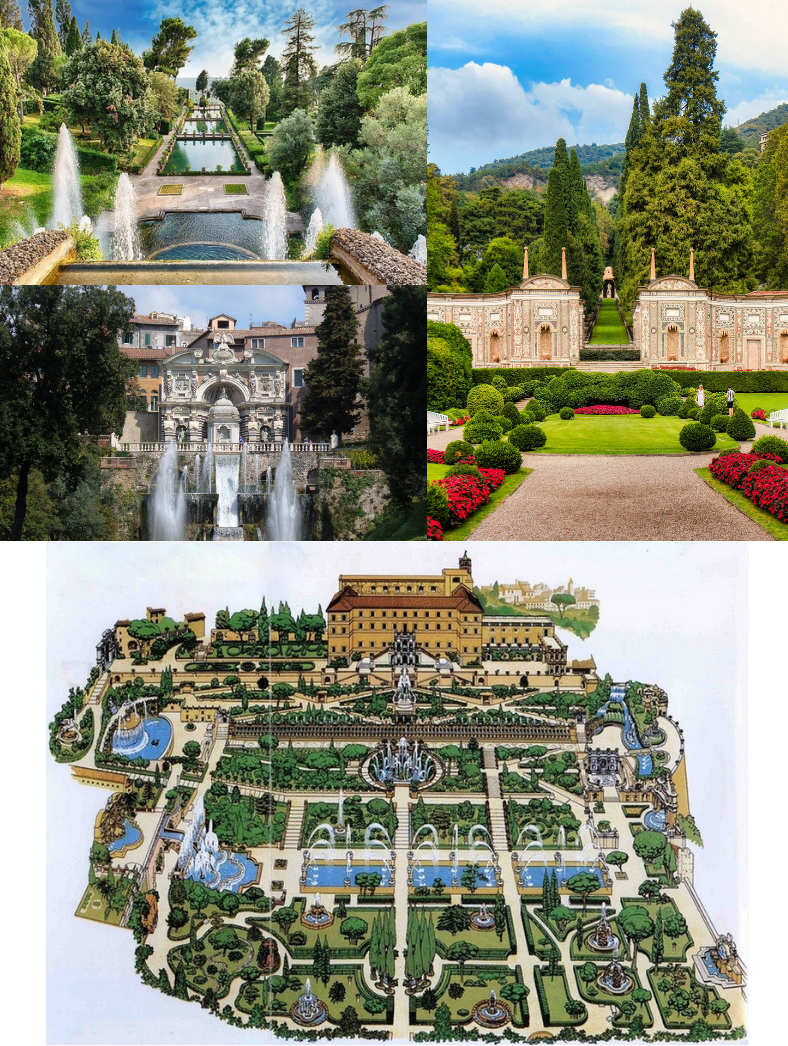
Image sources: .tivolitickets.com, comofootball.com , pinterest
Alhambra — Reflection and the Inner World
Within the Alhambra’s courtyards, especially the Court of the Myrtles, water acts as a mirror — literally and metaphorically.
Still pools reflect architecture and sky, dissolving the boundary between built form and nature. The sound of gentle fountains softens the atmosphere.
The characteristics? Symmetry, geometric layouts, lush greenery, and water features are key elements, symbolising harmony, order, and the divine.
Moorish poets described the Alhambra as “a pearl set in emeralds”, referring to the trees that clothe the slopes below the palace. The Ahambra woods are lush and green, tall trees tower above sparkling rills of water and the deep green leaves and architectural spikes of acanthus, which seem to grow everywhere. Nearer to the palace, limes fill the air with their sweet fragrance in early summer.
Islamic garden design often emphasised inwardness. High walls separated chaos from serenity. The garden became a protected microcosm — a psychological retreat embedded within fortified architecture.
In dense urban contexts today, this principle is more relevant than ever.
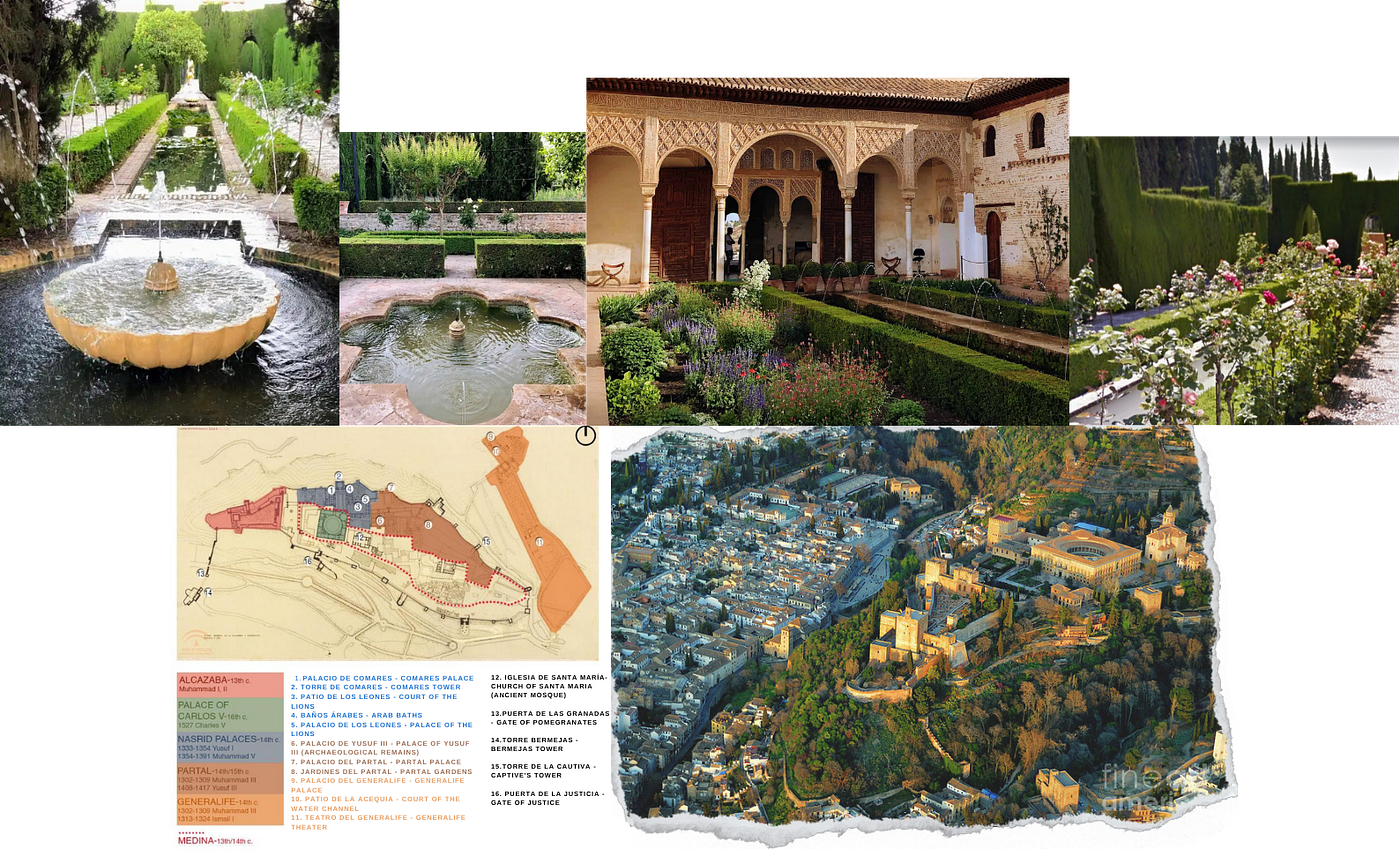
Image sources: , Granda Tickets, Britannica, Pinterest
Versailles Gardens — Power, Control, and the Limits of Healing
Not all historical gardens healed equally.
The Gardens of Versailles, designed under Louis XIV, represent dominance over nature. Rigid geometry, grand axial planning, monumental scale. At 2,000 acres, first built in 1624, the Gardens of Versailles stand as a masterclass in Baroque landscape architecture.
They are awe-inspiring but not necessarily intimate.
Every element within the landscape was strategically deployed to project the Sun King’s omnipotence. André Le Nôtre’s design enforced a rigid, geometric hierarchy upon the earth
This raises a critical question: can a landscape designed primarily for power also nurture well-being?
Versailles teaches us that scale and spectacle alone do not guarantee psychological comfort.
True healing landscapes require a degree of accessibility, user agency, and unstructured space where an individual can decompress without surveillance. Versailles, conversely, was an open-air theatre for rigid courtly etiquette.
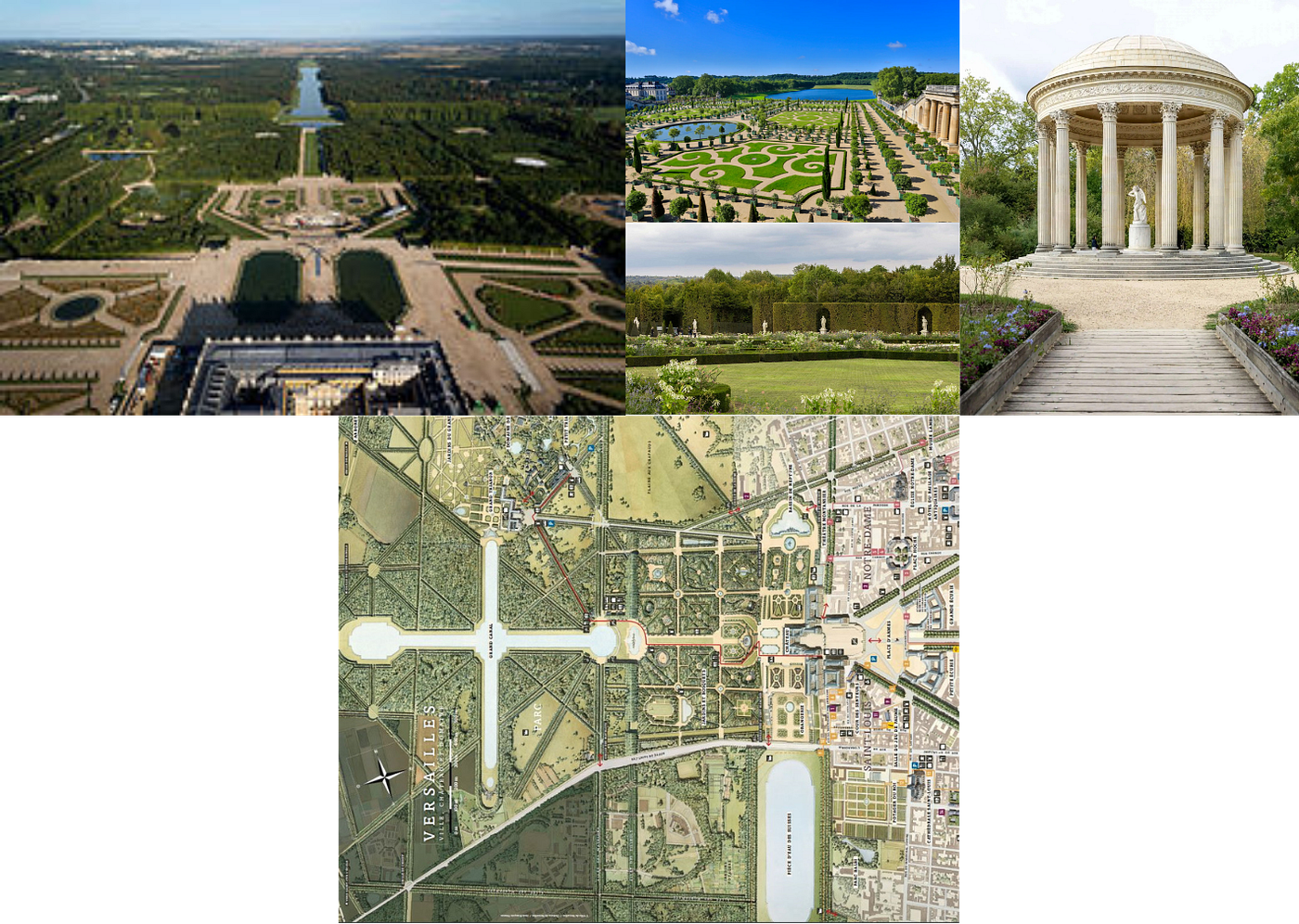
Image sources: AD, chateauversailles, anniewearsit.com, Pinterest, Paris Digest
Patterns Across Civilisations
When we strip away cultural aesthetics, common principles emerge:
- Water as regulator and symbolic purifier
- Enclosure creating refuge
- Geometry establishing order
- Nature used as a spiritual mediator
- Movement structured as a ritual
Different languages. Different regions. Unchanging desires of humanity.
The universality is striking.
What This Means for Contemporary Design
Today, we speak of biophilic design, sensory landscapes, trauma-informed environments, and therapeutic gardens. Yet history shows that we are not inventing these ideas — we are remembering and rediscovering them.
The challenge for contemporary landscape architects is not replication. It is a translation.
How do we reinterpret the contemplative minimalism of Ryoan-ji in a hospital courtyard? How do we integrate the climatic intelligence of Mughal water systems into modern urban parks? How do we design spaces that prioritise emotional safety over Instagram aesthetics?
If history proves anything, it is this: societies that valued gardens understood something profound about the human condition.
We do not merely inhabit landscapes. We internalise them.
And perhaps the most powerful lesson from historical gardens is that healing is not a modern innovation; it is a timeless design responsibility.
메타데이터
- post_id
- ecdcd5ffeb73
- slug
- sacred-grounds-what-historical-gardens-teach-us-about-healing-landscapes-ecdcd5ffeb73
- url
- https://medium.com/@abeer15.bll/sacred-grounds-what-historical-gardens-teach-us-about-healing-landscapes-ecdcd5ffeb73
- canonical_url
- https://medium.com/@abeer15.bll/sacred-grounds-what-historical-gardens-teach-us-about-healing-landscapes-ecdcd5ffeb73
- author_url
- https://medium.com/@abeer15.bll
- status
- ok
- fetched_at
- 2026-06-20 20:29:01




