How Professional Spine Rehabilitation Helps Reduce Chronic Back Pain
Chronic back pain is one of the most pervasive, debilitating, and exhausting medical conditions affecting modern society. Millions of…
How Professional Spine Rehabilitation Helps Reduce Chronic Back Pain
How Professional Spine Rehabilitation Helps Reduce Chronic Back Pain
Chronic back pain is one of the most pervasive, debilitating, and exhausting medical conditions affecting modern society. Millions of individuals globally find themselves trapped in a cycle of persistent discomfort that disrupts their sleep, compromises their work productivity, and dramatically diminishes their overall quality of life. Often, those suffering from this condition try a temporary mix of heating pads, over-the-counter pain medications, or extended bed rest. While these quick-fix measures may offer brief moments of relief, they fail to target the structural root causes of spinal dysfunction. To break free from this painful loop, a structured, medically driven approach is essential. This is exactly where professional spine rehabilitation steps in.
At specialized centers like Apokos Rehab Center (https://apokosrehab.com/), recovery is approached not as a passive treatment, but as an active, therapeutic transformation. Rather than relying on temporary masks for pain signals, a comprehensive clinical framework seeks to rebuild, stabilize, and optimize the entire musculoskeletal network supporting the spinal column. Understanding how these customized clinical interventions work can give back pain sufferers a clear blueprint for reclaiming a pain-free life. Below, we examine the core biomechanical and physiological pillars that make a dedicated recovery program incredibly successful in mitigating chronic back pain.
1. Precision Biomechanical Assessment
A primary reason self-managed back exercises often fail — or worse, aggravate injuries — is the lack of precise clinical diagnostic clarity. Chronic back pain rarely stems from a single, isolated muscle twitch. Instead, it is frequently the complex result of degenerative disc disease, facet joint arthritis, hidden postural misalignments, or long-standing muscular imbalances that overwork specific regions of the vertebral column.
A professional program always begins with an exhaustive biomechanical assessment. Specialized physical therapists analyze the patient’s functional movement patterns, checking pelvic alignment, core activation ratios, joint mobility, and segmental flexibility of the spine. By isolating the exact spinal segments that are hypermobile or restricted, the clinical team can design a focused plan that accurately targets the specific drivers of the pain, rather than relying on generalized lumbar stretching protocols.
2. Targeted Core Stabilization and Muscular Re-education
When people think of the “core,” they often picture superficial abdominal muscles. However, from a spinal biomechanics perspective, the core functions as an internal muscular corset. This deep stabilizing system includes the transverse abdominis, multifidus, pelvic floor, and diaphragm. When these deep muscles fail to fire optimally, the bony segments of the spine are subjected to excessive mechanical sheer stress during basic movements like walking, bending, or sitting.
Dedicated spine rehabilitation focuses heavily on retraining and re-educating these deep intrinsic stabilizers. Through highly controlled, evidence-based exercises, patients learn to consciously and subconsciously recruit these crucial supporting structures. Strengthening this internal scaffolding significantly unloads the intervertebral discs and facet joints, directly reducing chronic mechanical strain and preventing painful flare-ups.
“True recovery from chronic spinal pain is achieved when we stop treating the back as an isolated pillar and start reinforcing the dynamic muscular corset that stabilizes the entire human frame.”
3. Controlled Progressive Overload and Functional Restoration
A common pitfall for chronic pain sufferers is the development of fear-avoidance behaviors. Because specific movements cause discomfort, patients naturally begin to avoid physical activity altogether. While this instinctual protective mechanism makes sense in the short term, it ultimately leads to a severe cycle of disuse, muscle wasting, joint stiffness, and increased vulnerability to further injury.
Professional clinical rehabilitation breaks this destructive loop through the scientific application of progressive overload within a safe, controlled setting. Therapists gradually expose the spinal structures to increasing physical demands, carefully monitoring structural alignment and technique throughout the process. This measured exposure safely reconditions spinal tissues, rebuilds cardiovascular and muscular endurance, and restores the patient’s psychological confidence to perform daily tasks — such as lifting groceries or bending down — completely free from the fear of sudden pain.
4. Advanced Manual Therapy Techniques
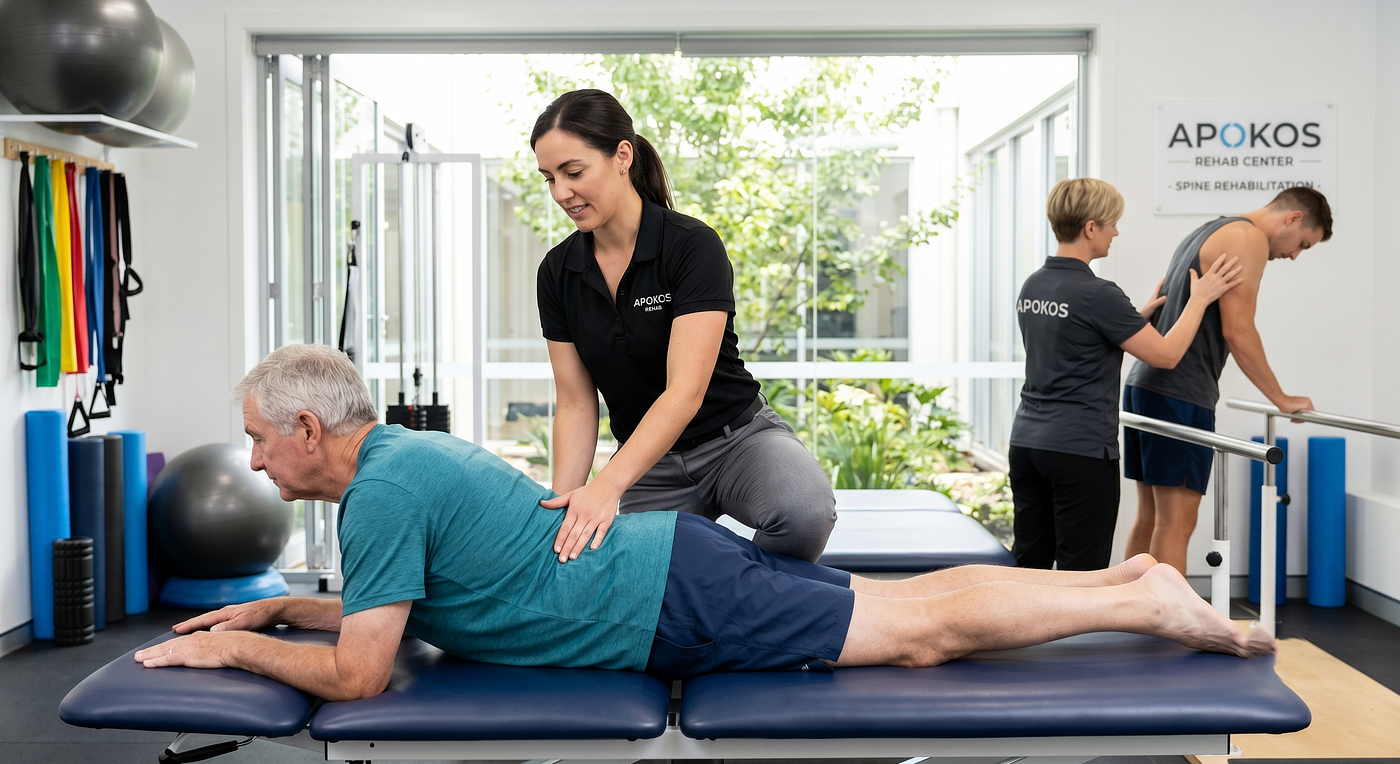
While targeted exercise forms the core foundation of long-term spinal stability, tight myofascial tissues and stiff joint capsules can often create major hurdles to movement. To resolve these localized restrictions, specialized clinicians incorporate advanced manual therapy techniques into the overall rehabilitation plan.
These hands-on interventions may include:
- Joint Mobilizations: Designed to restore normal gliding mechanics between stiff vertebrae.
- Myofascial Release: Used to systematically alleviate painful muscular trigger points and spasms.
- Neural Tissue Mobilizations: Directed at easing nerve root irritation and tracking issues (such as sciatica).
By combining these manual therapies with active movement protocols, clinicians can rapidly reduce muscle guarding, boost local blood circulation, and open up vital movement windows. This allows patients to perform their essential rehabilitation exercises with significantly less discomfort.
5. Ergonomic Correction and Postural Literacy
Even the most advanced clinical therapy sessions can lose their effectiveness if a patient returns to destructive postural habits for the remaining hours of the day. Modern lifestyles frequently demand prolonged, sedentary desk work, which places immense, continuous mechanical strain on the lumbar and cervical spine.
A comprehensive rehabilitation program places a major emphasis on ergonomic education and postural literacy. Clinicians work closely with patients to break down their daily environments, analyzing office desk setups, sleeping postures, and lifting mechanics used at work. By teaching proper spinal alignment and introducing functional habits — such as dynamic sitting postures and safe lifting techniques — the program ensures that the patient’s spine is protected from micro-trauma during everyday activities, preserving recovery gains over the long term.
The Apokos Blueprint for Lasting Spinal Wellness
Ultimately, long-term relief from chronic back pain is not found in a quick medical fix or a passive treatment script. It requires a structured, scientific approach that combines targeted biomechanical retraining, advanced clinical guidance, and lifestyle modifications. By choosing a dedicated, comprehensive spine rehabilitation program like the one offered at Apokos Rehab Center, patients can successfully address the deep structural root causes of their discomfort. This targeted care allows them to confidently break the cycle of chronic pain, regain full physical autonomy, and step forward into a vibrant, active future.
메타데이터
- post_id
- ece2b73adf33
- slug
- how-professional-spine-rehabilitation-helps-reduce-chronic-back-pain-ece2b73adf33
- url
- https://medium.com/@marketing.apokos/how-professional-spine-rehabilitation-helps-reduce-chronic-back-pain-ece2b73adf33
- canonical_url
- https://medium.com/@marketing.apokos/how-professional-spine-rehabilitation-helps-reduce-chronic-back-pain-ece2b73adf33
- author_url
- https://medium.com/@marketing.apokos
- status
- ok
- fetched_at
- 2026-06-12 22:02:08