Black History Is Not Behind Us. It Is Standing at AgFair.
After February, Lineage and Firsts Call Us Back to the Sacred Work of Preparation
Black History Is Not Behind Us. It Is Standing at AgFair.
After February, Lineage and Firsts Call Us Back to the Sacred Work of Preparation
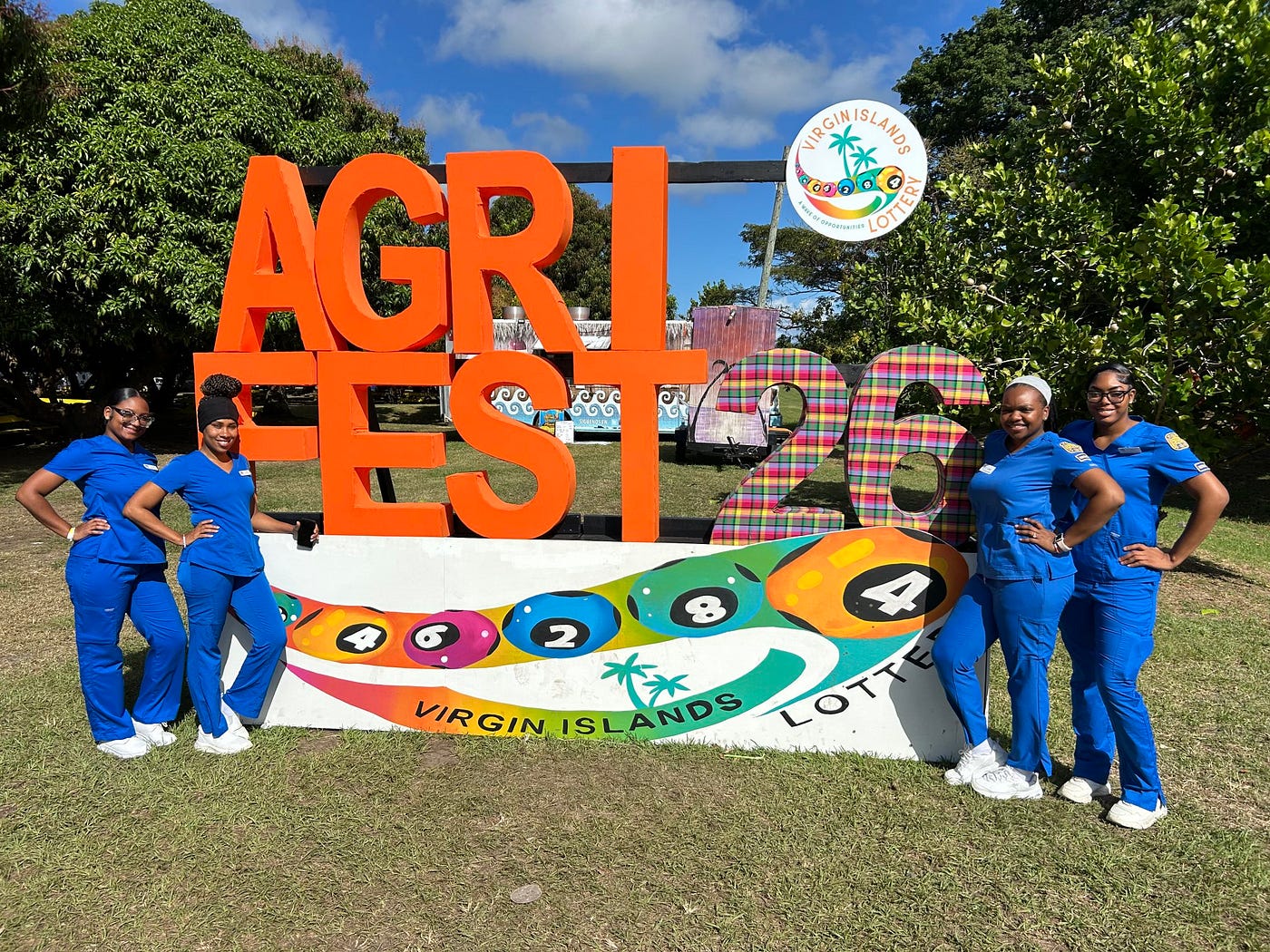
A few UVI nursing students at AgFair this past February, translating knowledge into community care.
Not a Medium member? Read here: https://medium.com/@dr.lewisuvi/ececb8b08b06?source=friends_link&sk=e57faee216edc22143b7c03334874095
Now that Black History Month has passed, I have found myself reflecting on what that observance means here in the Virgin Islands, within the University of the Virgin Islands School of Nursing, and across the Territory our students serve. For me, February is never a contained commemoration. It becomes an invitation to look more carefully at what we are building and whom we are honoring in the process.
This past February at AgFair, I watched our students stand beneath the bright Caribbean sky in blue scrubs, smiling easily but working with focus. AgFair is a cherished three-day St. Croix tradition, an annual celebration of agriculture, culture, food, music, and community that draws families from across the island and throughout the Territory. It is where generations gather under open sky, where heritage and livelihood meet in one shared space. Our students checked blood pressures. They answered questions. They explained what numbers mean and why follow up matters. They represented nursing not as theory, but as presence. I thought about them at domestic violence awareness walks and at cultural festivals throughout St. Croix and St. Thomas, where outreach tables become sites of education, advocacy, and quiet reassurance. In those spaces, clinical knowledge is translated into practical care, and the profession becomes visible in the daily life of our community.
Those images stayed with me. In the days that followed, I found myself lingering a little longer in the waiting area of our School of Nursing building, studying the historical display that lines the wall.
That display has been there since before I became Dean. But over the past seventeen months, I have come to see it differently. Students walk past it each day on their way to class or clinical, often without realizing how much history surrounds them. The photographs, maps, and documents mounted there tell a story of U.S. Virgin Islands midwives and nurses whose work predates our modern program by generations.
Listed carefully are the names of midwives practicing in St. Croix between 1884 and 1917: Eve Zaccheus, Sarah Gumbs, Pomelia Petersen Bladwell, Beatrice Cornelius, Ann Margaret Farrington Hoyer, Sophia Cochrane Hill, Lucinda van Brackle, Evelyn Richardson, and others whose names deserve to be spoken and studied. I invite you to look them up. Their lives are not footnotes. They are foundational.

Midwives practicing in St. Croix between 1884 and 1917. UVI School of Nursing historical display.

Early nursing personnel in the Virgin Islands. Archival image from the UVI School of Nursing historical display.
Each of these women was assigned responsibility for a district and for the women within it who were pregnant or in need of care.

Archival listing of local midwives, free and enslaved, serving estates in the Frederiksted area, mid nineteenth century.
Historical records describe midwives traveling by horse and carriage from one estate to another, carrying lanterns for night deliveries. Their work unfolded within colonial systems shaped by plantation economies and racial hierarchy, yet their authority rested in community trust and clinical skill. They practiced at a time when infrastructure was limited and formalized nursing education was still emerging, and yet they carried entire quarters of the island on their shoulders.
As Dean, I pass that wall every day I am at work, and each time I am reminded that I am not constructing something entirely new. I am stewarding a lineage that existed long before I arrived.

Historical display in the UVI School of Nursing building.
The historical display also includes images of the Frederiksted Hospital, once a prominent three-story building on Strand Street. After the transfer of the islands to the United States in 1917, the hospital was renamed the Frederiksted Municipal Hospital, and its third floor housed the maternity ward, where doctors, assisted by midwives, delivered babies. Before that transition, district nurses often made deliveries on estates. The photograph of the hospital, with a horse and carriage positioned in front, makes visible what the records describe. Care moved between estates and hospital corridors. Infrastructure evolved, but the responsibility remained constant.

Frederiksted Hospital, early twentieth century.

Early nursing personnel in the Virgin Islands. Archival image from the School of Nursing historical display.
Over the past seventeen months as Dean, I have walked by that wall countless times. At first, I noticed it as history. Over time, I began to feel it as inheritance.
Standing before those names repeatedly has shifted something in me. Their work was clinical, but it was also profoundly vocational. They used the best of their training, their judgment, and their endurance to strengthen the communities around them, often within systems that did not fully honor their expertise. Reflecting on their lives has reminded me that the work we do in nursing education is not merely administrative or academic. For me, it feels spiritual.
Not spiritual in the sense of organized religion, but in the sense of alignment. It is the practice of using one’s gifts in service of something larger than oneself. It is the discipline of doing excellent work not for applause, but because lives are shaped by the quality of our preparation.
On many days, when meetings stack and inboxes fill and the noise of external distraction grows louder than I would like, I step away from my desk and walk the perimeter of our buildings on the grass. Sometimes I listen to advocacy music that reminds me why equity matters and why this work requires courage. Sometimes I walk in silence, focusing only on the responsibility in front of me and on doing this work in excellence with whoever and whatever will help me sustain it. And sometimes I walk simply to appreciate the green campus, the palm trees, the hills rising in the distance, and the warmth of the sun on my face. Those moments recalibrate me. They quiet the peripheral distractions and return me to the seriousness and privilege of this calling.
It is from that posture that I look at our students.
This year, some of them achieved historic firsts that feel especially meaningful within this broader context. For the first time, a UVI nursing student earned a national scholarship from a leading professional nursing organization, placing our program in conversations that extend far beyond our shores. For the first time, partnerships between the Territorial Board of Nursing and industry leaders resulted in scholarships created specifically for students here at home, signaling an investment in local excellence.
For the first time, two of our students entered a prestigious research internship focused on cardiovascular disease. I will admit that as a hypertension researcher, I felt particular joy in that moment. Watching those two UVI nursing students step into a national research space addressing cardiovascular inequities felt like a convergence of my scholarly life and my administrative calling.
For the first time, students from our program secured competitive nurse externships on the mainland, expanding their clinical experience while carrying the Virgin Islands with them into new environments.
These achievements represent institutional turning points that expand what future cohorts will consider possible.
They will forever be the first.
As Dean, part of my responsibility is to ensure that our students have access to the most current educational tools available. This year, I secured funding to bring advanced virtual reality simulation into our clinical skills lab because students in the Virgin Islands deserve the same preparation as students anywhere in the world. At the same time, I remain aware that innovation in Caribbean nursing did not begin with technology. It began with midwives who navigated dark roads with lanterns and nurses who delivered care across estates with limited resources but unwavering commitment. The equipment we are adding today continues that tradition of refusing limitation.
Black history in nursing also demands accountability. Recently, I sat with a student to explain that they would be withdrawn from courses because they were not progressing as required. That conversation was difficult, yet it was necessary. The midwives whose names line our historical display carried enormous responsibility. They could not afford carelessness, and neither can we. To uphold rigorous standards is not to diminish opportunity. It is to honor the seriousness of the profession they helped establish.
Black History Month may have ended on the calendar, but the work it calls us to continues. It continues at AgFair under open skies. It continues in classrooms and clinical sites. It continues in scholarship letters and research internships. It continues on the walls of our building and in the steady hands of students who carry stethoscopes instead of lanterns, yet inherit the same obligation to competence, courage, and care.
When I step outside and walk across the grass beneath palm trees and Caribbean sun, I am reminded that this work is rooted in place as much as it is rooted in history. The hills in the distance have witnessed generations before us, and they will witness those who come after. Our responsibility is to prepare students worthy of that horizon.
It is my privilege to walk that ground. It is my responsibility to lead in a way that honors it.

Seventeen months into this deanship, still walking the grass, still listening for clarity, still committed to preparing nurses who will make history long after February ends.
메타데이터
- post_id
- ececb8b08b06
- slug
- black-history-is-not-behind-us-it-is-standing-at-agfair-ececb8b08b06
- url
- https://medium.com/@dr.lewisuvi/black-history-is-not-behind-us-it-is-standing-at-agfair-ececb8b08b06
- canonical_url
- https://medium.com/@dr.lewisuvi/black-history-is-not-behind-us-it-is-standing-at-agfair-ececb8b08b06
- author_url
- https://medium.com/@dr.lewisuvi
- status
- ok
- fetched_at
- 2026-07-13 06:23:13