Don’t buy a DTF Printer. You Probably Don’t Need One Yet.
The most expensive mistake new t-shirt sellers make is buying the machine before the first sale.
Don’t buy a DTF Printer. You Probably Don’t Need One Yet.
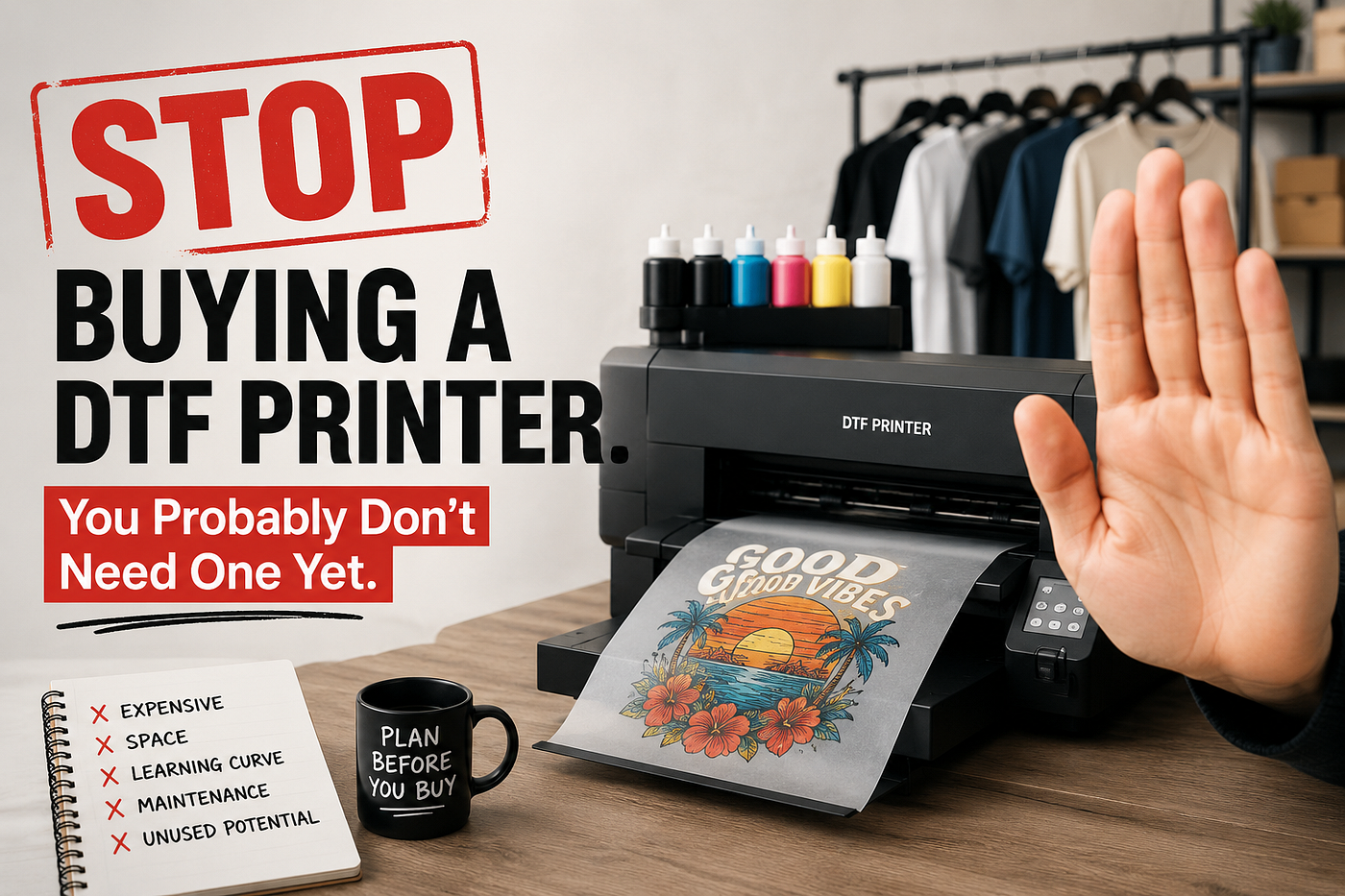
The most expensive mistake new t-shirt sellers make is buying the machine before the first sale.
Spend a week in any t-shirt printing group online and you will see the same post over and over. Someone just spent two or three thousand dollars on a DTF printer. Now their white ink has clogged, the prints are coming out streaky, and they have not sold a single shirt. The comments are full of people offering the same advice they ignored a month earlier.
I get the impulse. Buying the printer feels like starting the business. It is tangible. It is exciting. It sits in the corner of the room and says “I am doing this now.”
But the printer is not the business. The business is selling shirts people want. And you can do that today, this week, for a fraction of the cost, without owning a printer at all.
What nobody tells you about owning a DTF printer
A DTF printer is not a buy-it-and-go appliance. It is a piece of production equipment that demands a routine, and that routine is unforgiving for a beginner with a handful of orders.
The big one is white ink. DTF relies on a white underbase, and white ink settles and clogs if the printer does not run regularly. Professional shops print every day, so their machines stay healthy. A new seller with three orders a week cannot keep a printer busy enough to keep the ink moving. So the machine sits, the heads clog, and the first real job comes out ruined.
Then there is everything around the printer. You need a powder station, a curing oven or press, a maintenance habit, RIP software to learn, and a tolerance for troubleshooting that has nothing to do with making art or selling shirts. None of that is hard once you know it. All of it is a distraction when you are trying to find out whether anyone will buy your designs in the first place.
> The DTF printer is not the business. The business is selling shirts people want.
The version of this that actually works for beginners
Here is the part the printer-first crowd skips: you can buy the finished transfers instead of making them.
A DTF transfer is your full-color design, already printed on film, ready to press onto a shirt. You order the DTF or UV DTF transfers ready-made, line one up on a blank, press it with heat, and peel. That is the whole job. No white ink to babysit. No clogged heads. No curing oven. The design comes out consistent on your very first shirt because someone with a calibrated machine already did the hard part.
This flips the economics of starting. Instead of a few thousand dollars of equipment you have to keep busy, your only real purchase is a heat press, which you can find for a couple of hundred dollars. Everything else is shirts and transfers you buy as orders come in.
And because good suppliers have no minimum order, you can test a brand-new design for the price of a coffee. Print one. Press one. See if it sells. If it does, order more. If it does not, you are out a few dollars instead of a production run.
When you do start getting volume, the trick that keeps your costs down is the DTF gang sheet: you arrange a whole batch of designs onto one large sheet of film and pay for the space you actually use, instead of ordering each design on its own. It is the closest thing to printing in bulk without owning the printer.
The math is not close
Compare the two ways to start.
Buy the printer: roughly two to three thousand dollars before you have made a dollar, plus ink, film, powder, a curing setup, software, and the time to learn all of it. Your first prints are practice. Your machine needs feeding whether or not orders come in.
Buy the transfers: a heat press, a stack of blanks, and transfers ordered as needed. You can be pressing sellable shirts the day your press arrives. Your costs scale with your sales, not ahead of them.
For someone testing whether a t-shirt business is even for them, the second path is not just cheaper. It is the only one that lets you fail cheaply, which is exactly what you want when you are still learning what sells.
When a printer actually does make sense
I am not anti-printer. I am anti buying one too early.
There is a real point where owning a machine pays off. It looks like this: you are selling consistently, the same designs over and over, in enough volume that the per-transfer cost is genuinely eating your margin. You have the space, you can commit to running and maintaining the machine on a schedule, and you have the order book to keep it busy.
That is a great problem to have. It means the business is working. At that stage, bringing printing in-house can lower your unit cost and give you more control.
But notice the order of events. The sales came first. The printer came second, as a response to demand you had already proven. That is the opposite of how most beginners do it, and it is why most beginners stall.
The takeaway
If you are standing at the edge of starting a t-shirt business with a printer in your shopping cart, close the tab. Buy a heat press instead. Order a few transfers of your best design idea. Press a shirt, wash it, list it, and find out if anyone wants it.
Let the sales tell you what to buy next. Most of the time, the answer is more designs, not more machines. And on the rare day the answer really is “buy a printer,” you will know, because the orders will be telling you so.
Start small. Stay cheap. Sell first. The machine can wait.
메타데이터
- post_id
- eceff79c1cfc
- slug
- dont-buy-a-dtf-printer-you-probably-don-t-need-one-yet-eceff79c1cfc
- url
- https://medium.com/@andycroft1985/dont-buy-a-dtf-printer-you-probably-don-t-need-one-yet-eceff79c1cfc
- canonical_url
- https://medium.com/@andycroft1985/dont-buy-a-dtf-printer-you-probably-don-t-need-one-yet-eceff79c1cfc
- author_url
- https://medium.com/@andycroft1985
- status
- ok
- fetched_at
- 2026-07-24 23:01:47