The News That Knew What We Wanted to Feel…
Manipulation rarely arrives as an enemy.
The News That Knew What We Wanted to Feel…
Manipulation rarely arrives as an enemy.
That would be too crude.
More often, it arrives well dressed, well designed, and strangely familiar. It speaks in a voice we almost recognise. It confirms the fear we had already begun to enjoy. It returns our suspicion with better lighting. It tells us we were right all along — and this, naturally, is where the trouble begins.
The modern media world no longer needs to force belief upon us.
It studies us.
Then it offers us the version of reality most likely to feel like our own conclusion.
And we call this independence.
This piece explores news, fear, confirmation, algorithms, and the uncomfortable little moment when the mirror begins to look less like the media — and more like us.
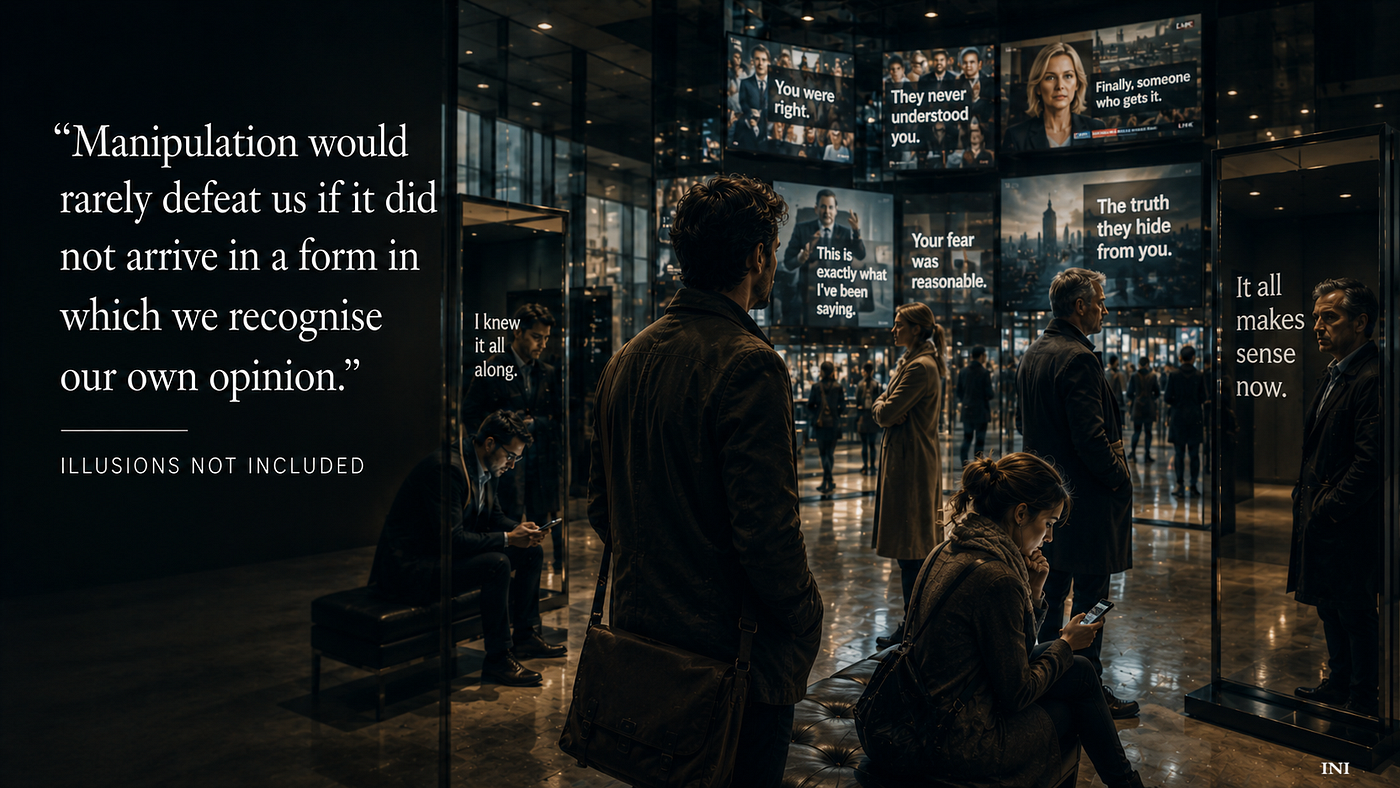
“Manipulation would rarely defeat us if it did not arrive in a form in which we recognise our own opinion.”
Illusions Not Included
People like to believe they are difficult to manipulate.
This, in itself, is touching.
Especially in an age when the average citizen receives, on an ordinary day, roughly enough targeted messages to satisfy the quarterly propaganda plan of a small twentieth-century dictatorship. Back then, one still needed posters, editorials, ceremonial speeches, marching music, perhaps a stern man on the radio. Today, a phone, an algorithm, and one well-timed outrage are enough for everyone to arrive independently at the thought that had been prepared for them three minutes earlier.
This is progress.
Old propaganda was at least a laborious craft. It had to be written, printed, pasted, spoken, repeated. There was something artisanal about it.
The lie still sweated.
The manipulator still worked.
And the people, if they really wanted to, could still suspect that something was being sold to them.
Modern manipulation is far more polite.
It does not enter wearing boots. It does not bang the table. It does not say: believe this. It shows you something you would probably have looked at anyway. A headline that scratches exactly where your pride was already itching. A video that proves nothing, but rings that small inner bell on which is written: “You see? I was right all along.”
The greatest trick of manipulation is not that it plants a foreign thought in us.
It is that it returns the thought as our own.
A little shinier. A little louder. Better packaged. Like an old, worn prejudice suddenly fitted with a premium label: independent thinking.
And how gladly we accept it.
Because people do not look first for truth. Truth is exhausting. It arrives untidily, with poor communication timing, and with inconvenient subordinate clauses such as “it is more complicated,” “let us also consider the other side,” or — which in a fast world is almost offensive — “perhaps we are not entirely right.”
People much prefer confirmation.
Truth knocks.
Confirmation is already sitting in the living room, wearing slippers, and knows exactly how you take your tea.
That is why the modern media environment works so impeccably. It does not simply inform. It serves mood. It does not provide facts, but inner weather. It tells us what to fear, whom to hate, whom to mock, whom to worry about, whom to feel ashamed for, and which issue today requires us to be outraged as though the moral future of humanity genuinely depended on whether we shared a video in time.
News used to mean that something had happened.
Now it increasingly means what we are expected to feel about it.
This is a great relief. Producing one’s own emotional response is terribly time-consuming. One would have to read, think, remember, compare, even doubt. The modern system is kinder. It provides the reaction ready-made. Like a frozen meal. One only has to warm it up with a little personal resentment, and it is ready to consume.
Anger? Here you are.
Fear? Freshly delivered.
Contempt? Family pack.
Self-righteousness? On special offer, for a limited time.
Sensation, in this arrangement, is not a by-product. It is fuel. Silence is too cheap. Sobriety performs poorly. A measured sentence is like an honest accountant in a circus tent: useful, perhaps, but not what anyone came to see.
Sensation, however, knows its job.
It enters, overturns the table, points at someone, and announces that this is now the problem. The audience relaxes. At last there is direction. At last there is a face. At last there is an enemy. A world that five minutes earlier seemed unbearably complicated suddenly fits into a thirty-second video and one sufficiently angry sentence.
At such moments, people do not feel manipulated.
They feel informed.
That is the beautiful part.
The manipulated person rarely looks like someone who has lost his judgement. More often, he looks like someone who has finally found it. Slightly flushed, morally energised, glowing with the happy inner certainty that he sees through the whole thing.
Especially through the sieve designed precisely for his eye level.
Manipulators know this perfectly well. In the past, they could only guess what people feared, desired, envied, resented, which words softened them, and which sentences made them feel as though their dignity had finally been restored.
Now they do not have to guess.
They measure.
Where the thumb stops. What makes us angry. What we return to. What we forward with the noble little lie that it is “just interesting.” Which particular stupidity makes us feel compelled to show it to someone else, naturally only so that we can laugh at it together.
One of civilisation’s finest self-deceptions is the belief that, when we share something, we are using the system.
Sometimes, perhaps.
Mostly, the system is taking notes.
And learning.
It learns our fears. Our vanity. Our private grievances. Our tribal reflexes. The precise point at which we no longer want to hear what is true, only something strong enough to feel true.
Modern manipulation does not coerce.
That is an old method.
It serves.
Like a very attentive waiter in a poisoned restaurant.
It does not say: this is what you must think.
It says: perhaps this is what you already thought.
And at that moment, we relax.
Because nothing is quite as pleasant as having one’s own prejudice returned in professional form. It no longer looks like prejudice, but position. Not anger, but moral instinct. Not fear, but reasonable caution. Not laziness, but healthy scepticism. Not ignorance, but an alternative perspective.
The modern age is merciful.
It has given every weakness a more elegant name.
Gullibility became openness.
Malice became critical thinking.
Ignorance became doing one’s own research.
Paranoia finally found a community.
Once, a person sat alone in the kitchen with his delusions. Today he creates a group for them, designs a logo, explains them live, and if enough people applaud, he may even be invited as an expert.
Meanwhile, society complains.
That we are being manipulated.
Lied to.
Misled.
That the media distorts.
That the algorithm traps us.
That politics plays with us.
All of this is true.
Only one unpleasant supporting character is often missing from the sentence: us.
Because manipulation does not work in a vacuum. It needs material. Human desire, human vanity, human fear, human laziness, human resentment. It needs that deeply democratic demand that someone please stop overcomplicating the world and simply tell us who the good people are, who the bad people are, where to applaud, whom to hate, and when one may go to bed with a sense of moral superiority.
The manipulator does not create everything inside us.
Often he merely tidies the dark drawer.
He takes out what we had already placed there: suspicion, bitterness, envy, fear, the hunger for a convenient explanation. Then he labels it neatly, packages it graphically, prepares a video, a statistic, a soundtrack, and, when necessary, an enemy easy enough to remember.
The enemy is an especially useful invention.
Without one, a person might have to do something with himself.
And no civilised system should ask that of its citizens for any extended period of time. Self-examination is a poor mass product. It is difficult to build a campaign around it, its sharing rate is weak, and it looks particularly bad in front of flags. The enemy, by contrast, performs beautifully. Simple, portable, flexible. If necessary, it can be updated. If one enemy loses effectiveness, another one arrives.
Anger always needs an address.
People are not always manipulable because they are stupid.
That would be far too flattering an explanation — especially to those who consider themselves intelligent.
Often they are manipulable because they are tired. Afraid. Hurt. Overloaded. Lonely. They receive too much information and too little meaning. They know more and more about the world, while feeling less and less able to influence anything within it.
At such moments, good manipulation does not feel like a lie.
It feels like a handhold.
In a bad world, false simplicity can feel warm.
That is the black humour of the modern age.
The greatest tragedy is not that people are misled.
It is that they are often grateful for it.
Because manipulation removes the burden of thinking. It arranges the world on our behalf. It assigns the characters. Divides the map. Explains who is responsible for life being bad, prices being high, patience running out, fear being necessary, and hatred finally becoming morally respectable.
We feel relieved.
The world is understandable again.
Ugly, but understandable.
And for understandability, many are willing to pay the price of truth.
Manipulators today have everything they need for this: data, money, platforms, psychology, design, targeting, bots, studios — and, above all, an audience that sincerely believes it is not an audience, but a collection of alert, critical, independent thinkers.
No manipulator could ask for a finer gift.
The perfect victim is not the person who believes everything.
It is the person who is certain he believes nothing.
And so modern man sits before the screen. Suspicious. Intelligent. Ready not to fall for anything — except what sounds exactly the way he likes the world to sound.
And then the system smiles quietly.
Not triumphantly. It is too professional for that.
Only as someone who understands that human freedom no longer necessarily has to be taken away.
It is enough to personalise it.
Manipulation once placed chains on the human being.
Now it holds up a mirror.
And the human being, as always, looks into it for a very long time.
메타데이터
- post_id
- ecfc6ba21691
- slug
- the-news-that-knew-what-we-wanted-to-feel-ecfc6ba21691
- url
- https://medium.com/illusions-not-included/the-news-that-knew-what-we-wanted-to-feel-ecfc6ba21691
- canonical_url
- https://medium.com/illusions-not-included/the-news-that-knew-what-we-wanted-to-feel-ecfc6ba21691
- author_url
- https://medium.com/@alex.buday
- status
- ok
- fetched_at
- 2026-07-10 01:40:30