Kienyeji
Let’s embrace our kienyejiness
Kienyeji
Let’s embrace our kienyejiness
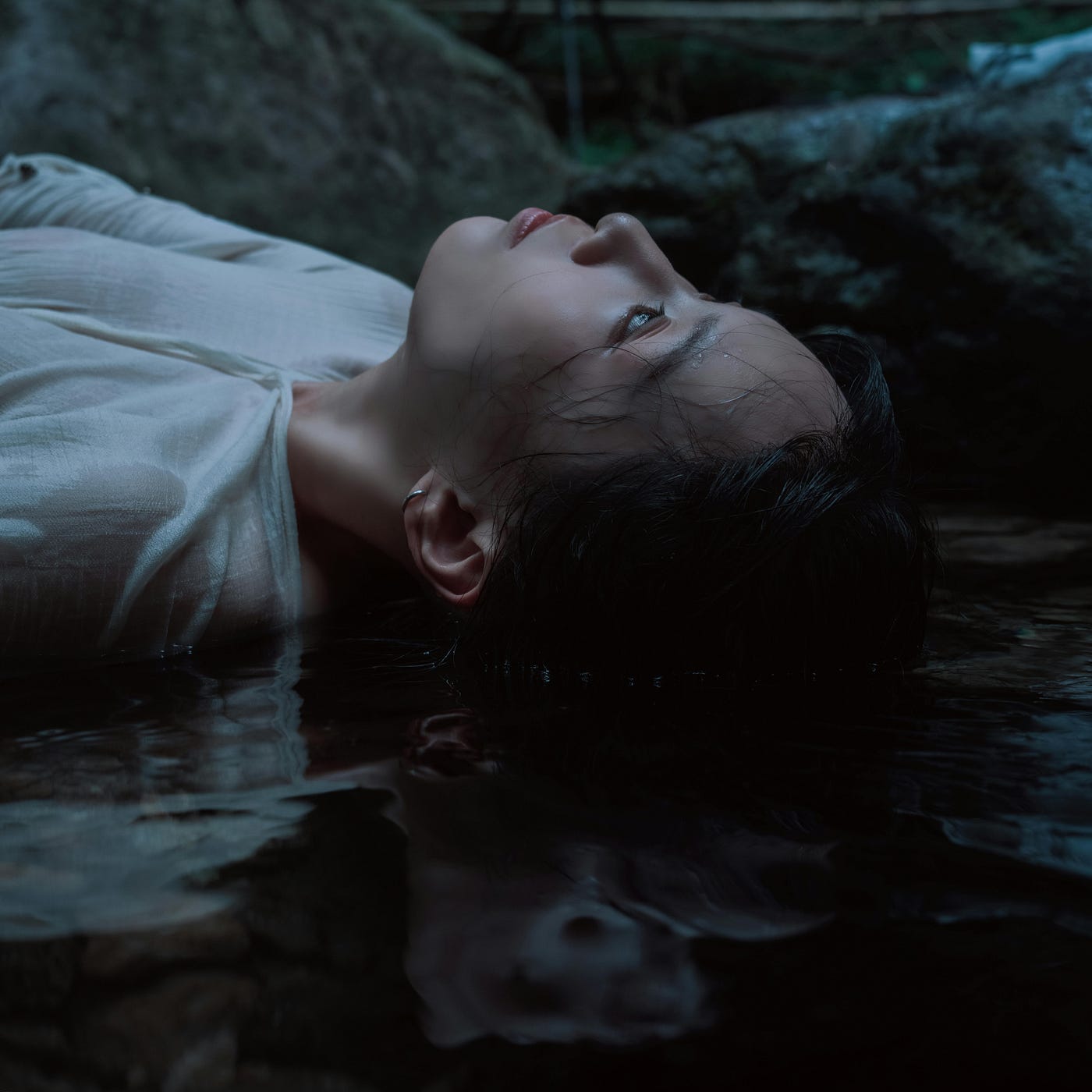
Jogoo wa shamba huwika mjini. Photo by İsmail Efe Top on Unsplash
I am simply one of one
— Nyashinski
To whom it may concern,
My mother struggled to take me to one of the best primary schools in Kenya. But when I landed in class 6 red, culture shock, like a smooth criminal, snuck an uppercut to connect with my budding adolescent chin.
I didn’t know people could have girlfriends in primary school. I was more concerned with the fact that Manchester United only had one black player (Louis Saha) in their starting eleven. According to my standards, this was more important.
I was the tallest in my class, and spoke like any thug brought up in Kayole, or Komarock, Nairobi’s Eastlands. When my classmates spoke to me in English, I would respond in sheng’. I never noticed it until Afam Onyebadi, one of my good friends, pointed it out. Nevertheless, I didn’t make any effort to proactively change how I interacted with my classmates. By many standards, I was a kienyeji pro max.
My previous school was much closer to home. As my teacher of English would say, “in fact, a lot much more” closer than any other student in that school. I would literally cross the road, and I’d be within the school’s tiny compound. Yet, on many days, I would report late to morning classes. What do you expect from a kienyeji?
There, in Tender Care Academy, I found my people. I was loud. As strange as those who later came to know me in high school, I was a class comedian. Buzzing with energy, an athlete, a scout, and a smart ass. But my mother didn’t like that the school didn’t have a big field. Recall that my biggest concerns were the starting 11's of the big football teams.
When I moved to this other school, that’s when I discovered just how different I was. The dam holding my adolescent juices broke. I discovered I was very different. I was brought up with KBC channel, and I never minded that there were other stations besides the local ones, until then. Heck, I didn’t know that kids could party except on birthdays. Girls would fight each other over boys who couldn’t care less. I think I was the only one in my class who never had a phone. Facebook was a hot topic, and if you weren’t on it, you were lame. For comparison, I set up my first email after high school. Kienyeji, huh?
I didn’t let such issues stick, but only in retrospect did I discover how I had shielded myself. Being tall, athletic, and smart helped. Nobody could raise it against me. Strangely enough, I got glances from girls, the kind that made me lose my cool when I walked past them. Kienyejis, too, can be thrown off by pretty faces.
And I was in the top class. Everyone in that class went to a national school or a private school of equal stature. My mother wouldn’t hear any of it. We were just licking our wounds after the post election violence, and she wanted me protected. Her ideal school for her son would be somewhere close to Nam Lolwe.
Perfect. I would learn Dholuo. I’m the type that understands and speaks like a jamwa. A jamwa is someone whose accent is so off that it reveals you were a “born tao.” As a doctor and a human anatomist, I know how the brain operates. But my credentials and understanding of the human brain cannot stand in the face of an argument such as “there’s no such thing as I understand but can’t speak.” I usually let it slide, for the culture.
Anyway, in high school, I was taken as the cool one. The one from Nairobi. A Nai boy. Everyone wanted to speak in English. Teachers insisted that nobody speak in their mother tongue. Fridays were reserved for Kiswahili. If only they knew how much that iron-clad rule bothered me. How was I going to learn Dholuo and speak it confidently?
Their reasons? So that we can pass the languages. As much as my people pride themselves in understanding the Queen’s language, English was still difficult to pass. The only pass a Luo considers is an A plain or a grade close to that, such as A-. The solution, our teachers surmised, was insisting on English. And yet, they were unable to shake off the kienyejiness from the students. As Morgan Freeman once said, trapped in that prison (Shawshank Redemption): You can take the kienyeji out of the village, but you cannot take the village out of the kienyeji.
During the annual interclasses football competition, you could hear a brazen bass shouting from the sidelines, “A boy is sweet, is sweet how?” And we would all get what he meant. Others could approach a teacher, seeking the pocket money sent to them by their guardians or parents, and request, “Untie me.” And we would understand. And when the teachers were not in class, we would all “beat story,” and we would all understand. If either of these phrases eluded you, ask your Luo friends for interpretation.
Despite our Engluo, a harmonious gel of English and Dholuo, during our year, we set the record for the highest mean ever in English. Our kienyejiness triumphed. But more than that, I found that the crowd in that school was what I needed all along. I forgot the strangeness that preceded me from primary school. They allowed you to be you without shame. I recall how my soccer coach insisted that we pick our soccer boots in preparation for the term 1 games. I was so accustomed to playing barefoot that I thought he would understand. Eventually, I yielded.
Fast forward to today, kienyeji is used as a derogatory term to define anyone from the village who cannot keep up with the trends, is obviously out of touch with the current fashion, and worse, when they speak, their heritage becomes conspicuously apparent. These individuals get castigated as lowly folk. It is an unbecoming behaviour that needs to cease, for reasons that are not outright obvious.
My good friend and fellow doctor, Oliver Kiaye, was the second top student in the national high school examination. When he speaks, you may think he is a romantic, a poet, but his Dholuo traits manifest. For instance, the socket that houses the head of the femur is known as the acetabulum. Oliver would pronounce it “asetabooloom.” And he never cared who would think otherwise about his unique christening. In another world, my brother would have been infuriated by his pronunciation. Oliver would smile and continue dissecting. Oliver embraced his kienyejiness, and it has remained untainted to date.
But what happens when we embrace it? We begin to appreciate one important fact — when you hear an accent or broken English, it means someone was smart enough to learn a second language other than their mother tongue. Shrubbing or kushema are not moments for laughter; they are triumphs. Despite our kienyejiness, we can still speak different languages.
Our kienyejiness is so strong that new languages cannot shake it off. Indeed, it should not. I love how Watendawili are incorporating Dholuo in their songs, and how they are setting trends. Atoti was a legendary song by Wikimosh and Gidi Gidi Maji Maji, the same group that had the whole nation chant an Engluo word, “Unbwogable.” Years later, H_art the Band and Watendawili mixed and matched Atoti, honoring the original legends. Today, many Kenyans sing Taya without knowing what Okello Max is hinting at. I love it. We are indeed embracing our kienyejiness without noticing it. Ironically, you will find those who scold the kienyeji pro maxes singing these songs in the nightclub.
[embed]The original Atoti. Source — YouTube
Khaligraph Jones was once advised to stop rapping about Kayole in most of his songs. Today, he is the only artist who can flaunt such a flex and still shout “Kwenda” in his songs, and have fans laud it. For clarity, that’s a kienyeji rap king who went on to bag the award for the biggest hip hop artist on the continent.
Bien further took his culture to the USA, singing while holding a cockerel in his arm. His biggest hit in 2025, All My Enemies Are Suffering, should be the anthem of anyone who thinks being a kienyeji is a flaw. A single song whose bridge is laced with kiluhya became an international sensation, attracting remixes from all over the world.
[embed]Notice the rooster. Source- YouTube
Being a kienyeji is being authentic. This is what the whites used to scramble and partition Africa. They brought their language, suits, and clean fashion sense to Africa and enforced it on us. It is decades after independence, and we still wish to look like them. The strangest thing is, they don’t wish to look like us. So who’s the patsy?
Here’s how they did it. The whites brought their “kienyeji” version to us, and told us that our kienyeji version was not the best kienyeji version. They then created a culture where anyone with a kienyeji version that doesn’t match theirs would not rise in the ranks. You had to look the part. By the time we were gaining independence, our kienyeji versions were assimilated and in the ICU. It started with the names.
Most families insist on calling their children by at least one Christian name. A clever way to insist that your child gets a Christian name is to tell them that it is that particular name that will be written in the book of life after baptism. And we fell for it. I’m called Innocent. My mother named me Innocent, after a pope she loved. What does Oliver Kiaye call me? Ouko. Nothing Christian there.
In high school, I recall two characters that will always reside rent-free in my mind. Onguko Oginga Odinga. Three O’s. The guy was so bright that he aced all the subjects when he joined Form 1. The teacher loved how the three names rolled off his tongue, just to mention only one boy, for all eleven subjects, as he ran to collect his awards. That was the first half. On the flip side, there was a student who had just joined us from another school. He went by the name Papa Jey Papoye. The same teacher who called Onguko called Papa Jey. He tailed on all subjects. The next term, Papa Jey became the most improved student. These are African names. Our kienyeji names. You will not hear the whites name their kids Onguko or Odinga. But we will name our children after their names. We need to start embracing our kienyejiness.
I was shocked to hear that most Americans cannot understand us when we speak English. Siri and Alexa are biased towards the western accents. I forget the one who told me that films in a foreign language are exactly that, foreign to those who have not heard such eclectic tongues. Yes, our wide kienyejiness is a mark of unimpeachable eclectic taste. We should embrace it.
A while back, I waxed poetic about the second largest fresh water lake in the world. It was named after a monarch who hardly set foot in the region. Yet, the people there had a name for it. Nam Lolwe. When I wrote those words in my Word document, Grammarly insisted on changing it to Lake Victoria. Word for word. Respectively. I was furious. What the hell?
We should not be quick to create unnecessary castes based on who’s a kienyeji and who isn’t. Just look at how Afrobeats became a sensation. We don’t know what they say, but we move to their beats at home, at work, and in the nightclubs. South Africa has also risen to international fame through Amapiano. What is amanikiniki? Or ngibolekeni? I don’t know, but you’ll find my head bobbing to these songs like I’m a native. Mr. Money, Asake, sings in Nigerian pidgin, and we don’t know what the hell he says, but we will be there singing: Jo! Jo! Jo! These genres became popular not despite but because of their kienyejiness.
Afrobeat was a name coined by the legendary Fela Kuti. Forbes magazine recounts:
Fela made his official transition from highlife-jazz in 1968 and declared at a press conference that his music would thereafter be known as Afrobeat, effectively coining the name of the genre.
When Nyashinski says, “Hakuna level sijai reach,” he is not just referring to himself, an undisputed fact, but to authenticity. Kienyeji is as authentic as one can get. Nobody can be more kienyeji than Fela at a time when such music was completely different from the kind popularized by the King and Queens of pop in the West. Now Fela will be the first person, alongside Whitney Houston (my favorite artist), to get the lifetime Academy Award posthumously, come January 31st. You can’t kill kienyejiness even when the person dies.
If you come back to Kenya and visit the clubs, you may not notice how we have embraced Kenyan music with a vice-like grip. We no longer get out of our seats because of Afrobeats, inviting as they may be. That was the case five years ago. Today, crowds want you to play Iyanii and Dufla’s Donjo Maber, literal Dholuo for “entering very well.” We should embrace our kienyejiness, because hiyo ndio inadonjo.
When I attended the 2025 SolFest, I noticed something I never quite considered. Mentally, I yielded that there will never be another voice like Jua Cali’s. And I imagined Tom Cruise walking to receive his Oscar with Jua Cali’s song *Bidii Yangu* playing in the background. It would be epic. I wish that Kenyan artists would begin to embrace the artistry outside the stage and incorporate it in as wide a field as we can. We do this by first acknowledging our kienyejiness.
What I’m trying to say is…
Imagining the downfall of someone because you call them “kienyeji” is a moot effort. Nyashinski raps:
Nafanya unakaa fala Kupredict downfall ya mine Mmebonga sana na nimewaskia Sa nawachapa one at a time
And below is the evidence:
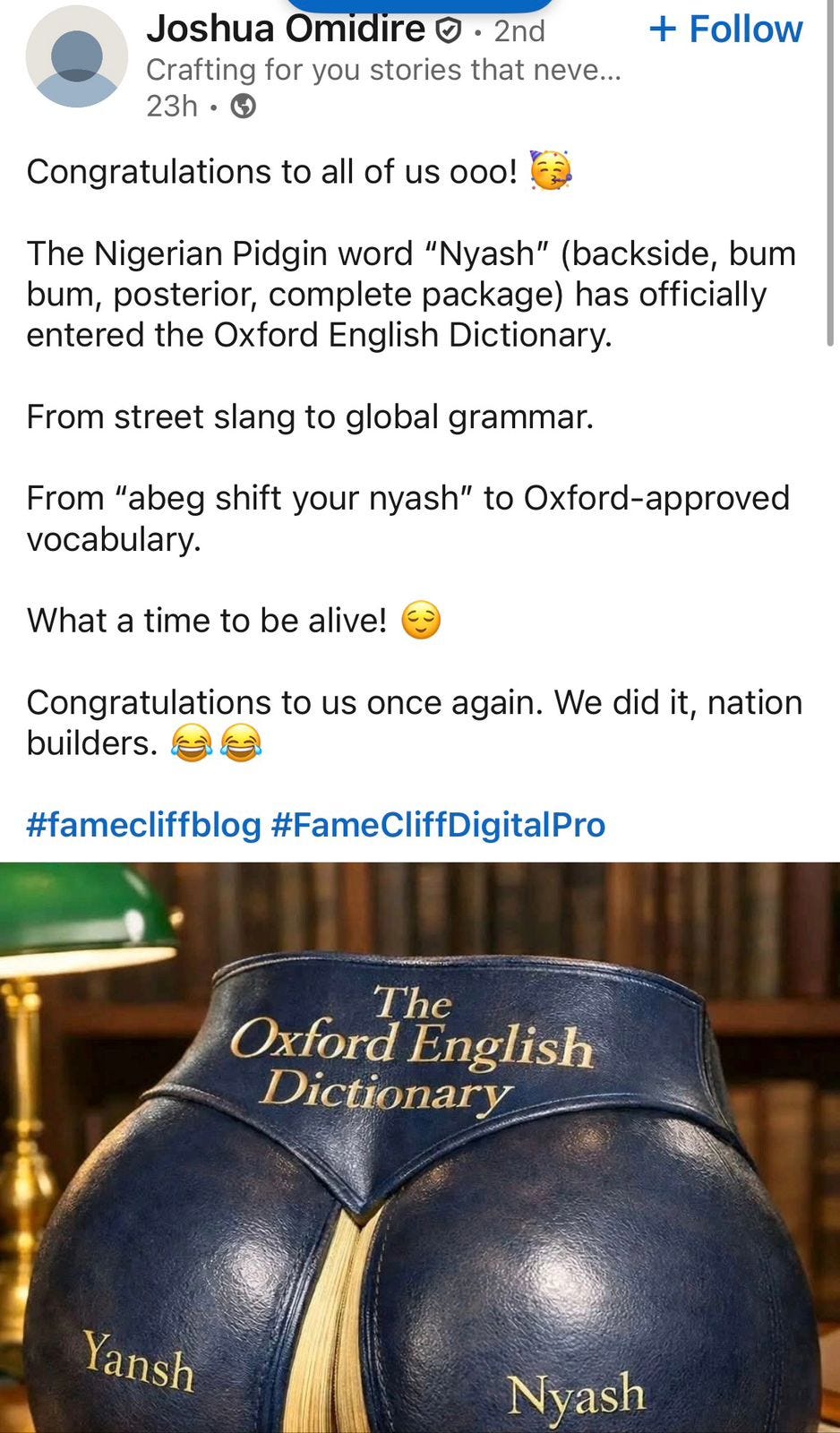
I had to share this. From a kienyeji word such as “nyash” and “abeg” to the Oxford Dictionary. Kienyeji to the world!
While shedding my milk teeth, the sight of mboga kienyeji stirred enough nausea to hesitate submitting my visceral opinion about the meal, very much aware that a stern eye from my mother would silence any resistance. The stern eye won. Today, given a chance to pick between a meal by the best chef and mboga ya kienyeji, you know which I would pick. Mboga kienyeji to the world.
After years of barrenness, our kienyejiness is rising. It is plausible that it is bothering others so much that it has been converted into a weapon. As a weapon of destruction, it sometimes wins the battle, but as an asset, every other signal shows that it is winning the war. As Bien sang, all our enemies are suffering, hata wakipanga njama kutuendea kwa waganga.
A kienyeji, as Nyashinski raps, cannot be replicated:
I am simply, one of one
So is every other authentic person. Our kienyejiness is an asset. Those who use it as a tool to disparage others are unintentionally blind or intentionally separating themselves from a culture that they cannot escape. Your skin is black. Your ancestors wore loincloths. Your climate always has the sun throughout the year. Your kienyejiness resides in the richest terrestrial land in all of evolution. And you want to throw it away or scold another for it?
Yaye! Be serious!
Yours truly.
[embed]This song inspired some of the lines used in this article. Source — YouTube
메타데이터
- post_id
- ed0fdacbc9cf
- slug
- kienyeji-ed0fdacbc9cf
- url
- https://medium.com/@theonealternativeview/kienyeji-ed0fdacbc9cf
- canonical_url
- https://medium.com/@theonealternativeview/kienyeji-ed0fdacbc9cf
- author_url
- https://medium.com/@theonealternativeview
- status
- ok
- fetched_at
- 2026-07-13 08:59:31