What is Skinner’s Theory of Operant Conditioning and How Does It Apply to Corporate Training?
Designing Enterprise Competency: How Modern Behavioral Science Eliminates Operational Risk
What is Skinner’s Theory of Operant Conditioning and How Does It Apply to Corporate Training?

Operant Conditioning
Designing Enterprise Competency: How Modern Behavioral Science Eliminates Operational Risk
For learning and development executives across highly regulated and performance-driven sectors, the ultimate objective of corporate training is not merely content completion. The true benchmark of success is systemic behavioral change. Traditional training models often fail because they treat education as a static event rather than a continuous process of behavioral modification. To bridge the gap between compliance mandates, sales targets, and actual daily workforce execution, organizational leaders are returning to a foundational psychological principle: B.F. Skinner’s Theory of **Operant Conditioning**.
When integrated into a sophisticated Learning Management System, this psychological framework transforms a standard repository of content into an active, automated behavioral engine. By structuring learning around immediate consequences — rewards for correct execution and rapid adjustments for knowledge gaps — enterprises can mitigate human error, protect operational margins, and engineer a culture of consistent excellence.
The Science of Workforce Action: Defining the Reinforcement Framework
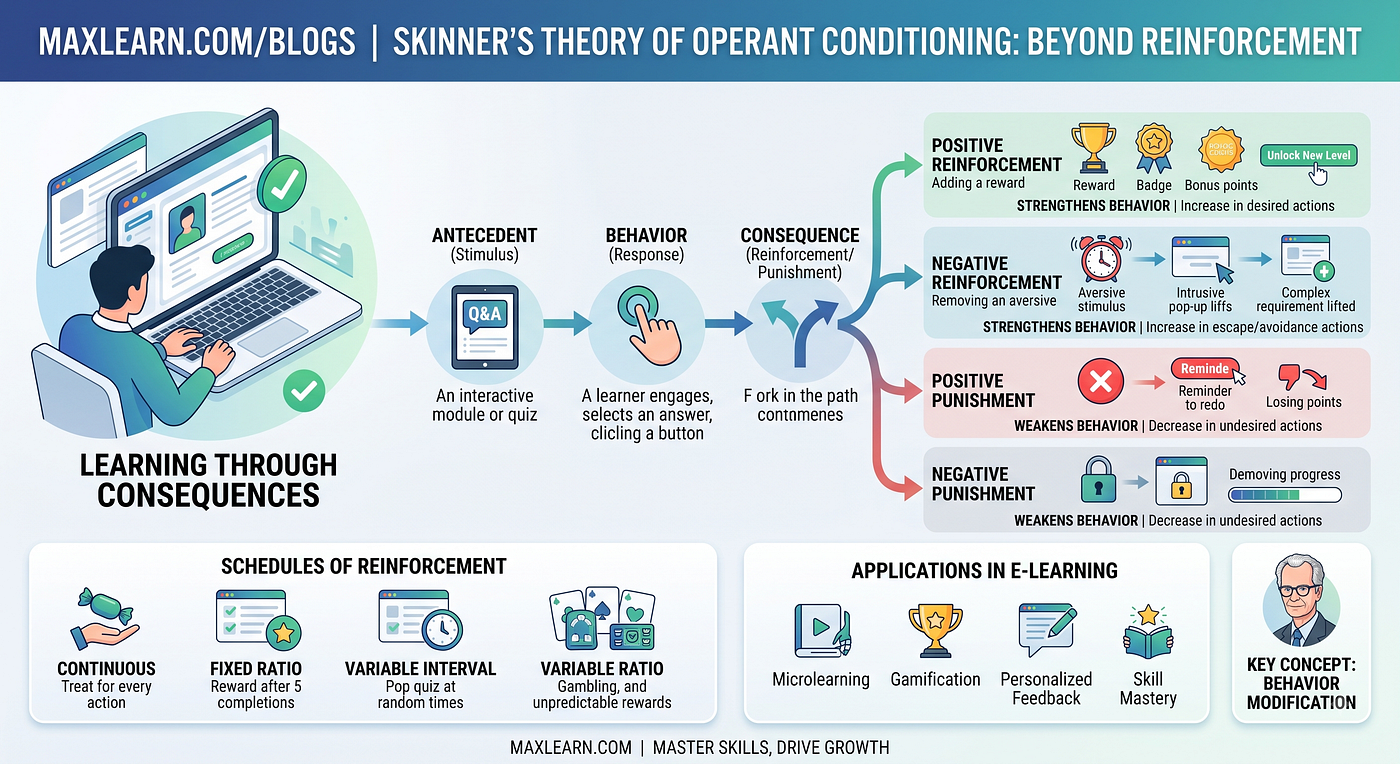
Operant conditioning posits that voluntary behavior is shaped and maintained by its consequences. When an action leads to a positive outcome, the subconscious brain is wired to repeat it. Conversely, when a behavior results in an undesirable outcome or an explicitly missing reward, the frequency of that action declines.
For Vice Presidents and Directors of L&D, translating this science into digital architecture requires a precise understanding of the four primary operational mechanisms:
- Positive Reinforcement: Introducing an immediate, desirable reward following a correct action to guarantee its repetition. In a modern digital environment, this manifests as automated progression indicators, points, or professional status markers upon mastering a complex protocol.
- Negative Reinforcement: Removing an ongoing, unpleasant or stressful stimulus when the desired behavior is successfully completed. For example, when a supervisor automatically removes mandatory remedial calendar alerts once an employee proves competence, the relief reinforces proactive learning habits.
- Positive Punishment (Corrective Intervention): Delivering direct, automated feedback or remedial friction immediately following an error. In professional training, this means the system instantly presents targeted explanatory context when a critical safety or compliance question is answered incorrectly, correcting the cognitive path before a bad habit forms.
- Negative Punishment (Privilege Modification): Withholding or temporarily removing a desired status or credential when performance drops below operational benchmarks. This can involve losing a position on a team leaderboard or requiring a learner to re-verify proficiency before regaining an advanced access tier.
By implementing these structural principles through a specialized microlearning platform, organizations move away from passive, unengaging page-turning and shift toward precise cognitive engineering.
Industry Applications: Solving Critical Competence Risks at Scale
The application of behavioral conditioning varies significantly depending on regulatory environments and operational goals. A **cloud-based learning management system** must be agile enough to operationalize Skinnerian principles across diverse high-stakes business environments.
Banking, Finance, and Insurance
In sectors governed by strict regulatory bodies, a single non-compliant action can result in catastrophic financial penalties or severe legal exposure. Traditional annual testing fails because human memory degrades over time. By deploying an advanced Learning Content Management System, financial institutions can run ongoing retrieval practice.
When a commercial loan officer or insurance adjuster accurately identifies compliance red flags within a digital case study simulation, the system delivers immediate positive reinforcement. Conversely, missing an update to anti-money laundering regulations triggers automated, immediate feedback loops, ensuring that errors are corrected long before a live audit occurs.
Pharma and Healthcare
For medical institutions and pharmaceutical manufacturers, training is directly tied to patient safety, product validation, and strict regulatory adherence. Operating room technicians, laboratory scientists, and nurses must perform complex protocols with zero variance.
Using an enterprise learning management framework, instructional designers break down intricate regulatory procedures into minor, successive milestones — a process Skinner termed “shaping”. As clinicians demonstrate accuracy at each micro-stage, they receive immediate confirmation, building long-term memory retention and automaticity in high-pressure clinical environments.
Oil, Gas, Mining, and High-Risk Sectors
In heavy industry, operational mistakes carry physical, environmental, and life-safety consequences. Here, the strategic application of structured feedback loops is essential.
A Microlearning LMS can simulate hazardous field scenarios. If a field engineer fails to identify a pressure anomaly in a diagnostic exercise, the system applies positive punishment constructively by introducing immediate corrective modules and restricting simulated site access until absolute mastery is verified. Safety milestones and consistent compliance streaks are visibly celebrated with digital credentials, reinforcing defensive workplace behaviors.
Sales, Retail, and Hospitality
Frontline environments suffer from high turnover, distributed workforces, and rapid product lifecycles. To maintain service consistency and drive revenue growth, sales representatives must possess instant, accurate product knowledge.
A gamified microlearning platform utilizes variable reinforcement schedules — the exact mechanism Skinner identified as the most powerful driver of habit formation. By rewarding quick daily check-ins with points, levels, and digital achievements, organizations transform routine training into an engaging daily routine, directly translating into higher conversion rates and superior customer satisfaction scores.
Engineering Behavior with MaxLearn LMS
To successfully scale behaviorist principles across an entire global enterprise, L&D leaders require infrastructure designed specifically for behavioral shaping. Traditional, linear learning platforms are fundamentally unsuited for this task because they delay feedback and deliver monolithic blocks of content that induce cognitive fatigue. MaxLearn LMS solves this problem by directly integrating the mechanics of operant conditioning into its core algorithmic architecture.
- Algorithmic Spaced Reinforcement: MaxLearn automates Skinner’s scheduled reinforcements. The platform continuously tracks individual forgetting curves, algorithmically predicting the exact moment a learner is poised to forget a compliance protocol or product feature. It then injects a targeted microlearning pulse, solidifying retention without disrupting the workday.
- Precision Behavioral Shaping: Instead of overwhelming teams with lengthy, multi-hour courses, MaxLearn LMS breaks expansive corporate curricula into bite-sized, digestible components. Learners are guided step-by-step through complex operational goals, receiving rewards and real-time validations at each milestone, which rapidly builds confidence and deep operational competence.
- Gamified Reinforcement Architecture: MaxLearn translates positive reinforcement into tangible, enterprise-grade mechanics. Through automated leaderboards, milestone streaks, and personalized digital achievements, the platform leverages the intrinsic human desire for growth and recognition, boosting engagement and reducing compliance risk simultaneously.
- Predictive Risk Analytics: Beyond delivering content, MaxLearn offers deep analytical visibility to senior executives. L&D leaders can pinpoint precisely which business units, geographic regions, or specific employees possess critical knowledge gaps before those lapses manifest as costly real-world errors.
Conclusion: Transforming Corporate Culture into a Behavioral Asset
In modern enterprise operations, knowledge that is unapplied or rapidly forgotten is a wasted capital investment. For L&D executives tasked with protecting organizational integrity and driving revenue, building an effective training strategy requires moving past passive learning models.
By embedding B.F. Skinner’s proven principles of operant conditioning into your enterprise architecture via the **MaxLearn LMS**, your organization does more than distribute information. It systematically shapes behavior, reduces operational risk, and builds a highly competent, agile, and resilient workforce prepared for long-term success.
메타데이터
- post_id
- ed4aa207b0a7
- slug
- what-is-skinners-theory-of-operant-conditioning-and-how-does-it-apply-to-corporate-training-ed4aa207b0a7
- url
- https://medium.com/@maxlearn-microlearning/what-is-skinners-theory-of-operant-conditioning-and-how-does-it-apply-to-corporate-training-ed4aa207b0a7
- canonical_url
- https://medium.com/@maxlearn-microlearning/what-is-skinners-theory-of-operant-conditioning-and-how-does-it-apply-to-corporate-training-ed4aa207b0a7
- author_url
- https://medium.com/@maxlearn-microlearning
- status
- ok
- fetched_at
- 2026-06-22 05:41:33