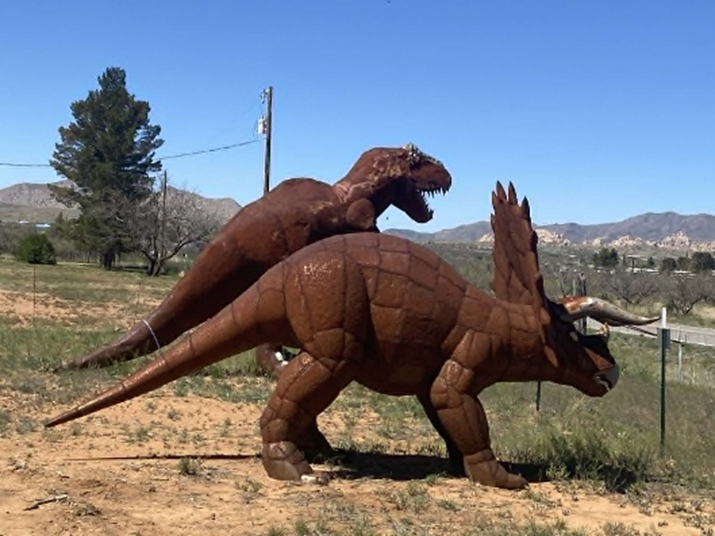
Use It Or Lose It: Why Did Some Dinosaurs Have Such Ridiculously Tiny Arms?
A recent study shows that gigantic predatory dinosaurs repeatedly evolved powerful, prey-crushing skulls in lieu of long arms
FOSSILS ET AL.
Use It Or Lose It: Why Did Some Dinosaurs Have Such Ridiculously Tiny Arms?
A recent study shows that gigantic predatory dinosaurs repeatedly evolved powerful, prey-crushing skulls in lieu of long arms
Skeleton of a T. rex with tiny forearms. Credit: Tofan Teodor on Unsplash
Have you noticed that many carnivorous dinosaurs (theropods) had ridiculously tiny forelimbs (arms and hands)? You may have found yourself asking, ‘Why? What’s the point?’
Too short to grab, hold, defend, or even scratch themselves with, why did theropods evolve such small forelimbs? Was it a hereditary trait passed down from a single short-armed ancestor? Or perhaps something that evolved independently in different dinosaur lineages?
To find out, paleontologists Dr. Charlie Roger Scherer and his colleagues set out to measure these tiny forelimbs and determine whether bigger bodies and larger, tougher skulls may provide answers as to why some of the most fearsome predators to ever walk the earth ended up with comically small forelimbs.
Theropod Dinosaurs
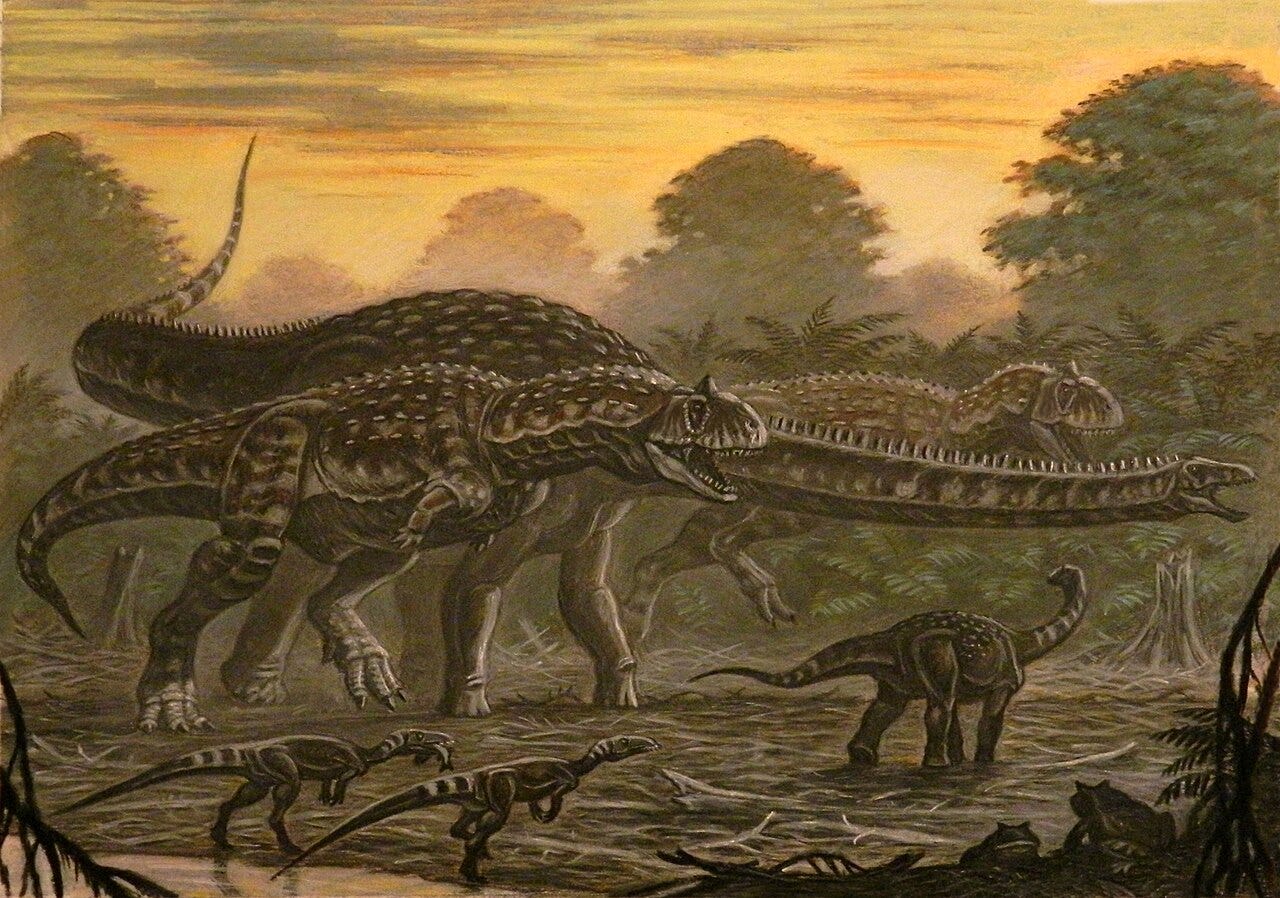
Majungasaurus chasing a Rapetosaurus. Credit: Wikimedia Commons by ABelov2014
Theropod dinosaurs were one of the most successful land vertebrates to ever exist. Evolving in the Late Triassic, they evolved into a myriad of different shapes, sizes, and functions throughout the Jurassic and Cretaceous, before being wiped out around 66 million years ago.
Some lived in trees, others on the ground, some in the water, and some straddled the boundary between land and sea. Among them were various groups that evolved into massive giants that lived alongside each other in a constant battle for survival. Among them are at least four distantly related theropods (abelisaurids, alvarezsaurs, carcharodontosaurids, and tyrannosaurids) that possessed ridiculously tiny or even vestigial (no longer serving any evolutionary purpose) forelimbs.
Having vestigial traits isn’t new; many animals have them, for example, eyes in blind animals, hindlimb bones in whales and dolphins, or the ability to wiggle your ears in humans (aka me! At age 7, I believed I could hear better when I wiggled them, sadly, that didn’t really work).
It was once believed that these short forelimbs were likely inherited from a common short-armed ancestor. However, more recently, scientists have learned that short forelimbs evolved independently across different groups at different times. This convergent evolution is similar to how birds, bats, and insects all evolved the ability to fly, but don’t share a common flying ancestor. The thing is, being able to fly is pretty useful, but what are short forelimbs good for?
One trend scientists have noticed is that theropods with short forelimbs are often massive, with some individuals evolving gigantism (>1,000kg) and super-gigantism (>2,500kg), often combined with sturdy skulls and skull ornamentation (e.g., horns). One simple explanation that has been posed is that as these dinosaurs evolved larger and larger sizes, their forelimbs simply could not keep up. However, if this were the case, why don’t all massive dinosaurs show similar trends? For example, *Deinocheirus and [Therizinosaurus](https://en.wikipedia.org/wiki/Therizinosaurus)*, giant plant-eating dinosaurs, did not have tiny forelimbs.
Perhaps it was a carnivore exclusive trait? But that would not explain the existence of, for example, Spinosaurids, massive theropods with relatively proportionally sized forelimbs.
To find out why, this study measures forelimb reduction across many theropods and tests whether it is associated with larger bodies and larger, tougher skulls. The researchers combined forelimb, body weight, and skull data and ran those through various statistical tests to determine whether a pattern emerged.
The Evolution of Tiny Arms
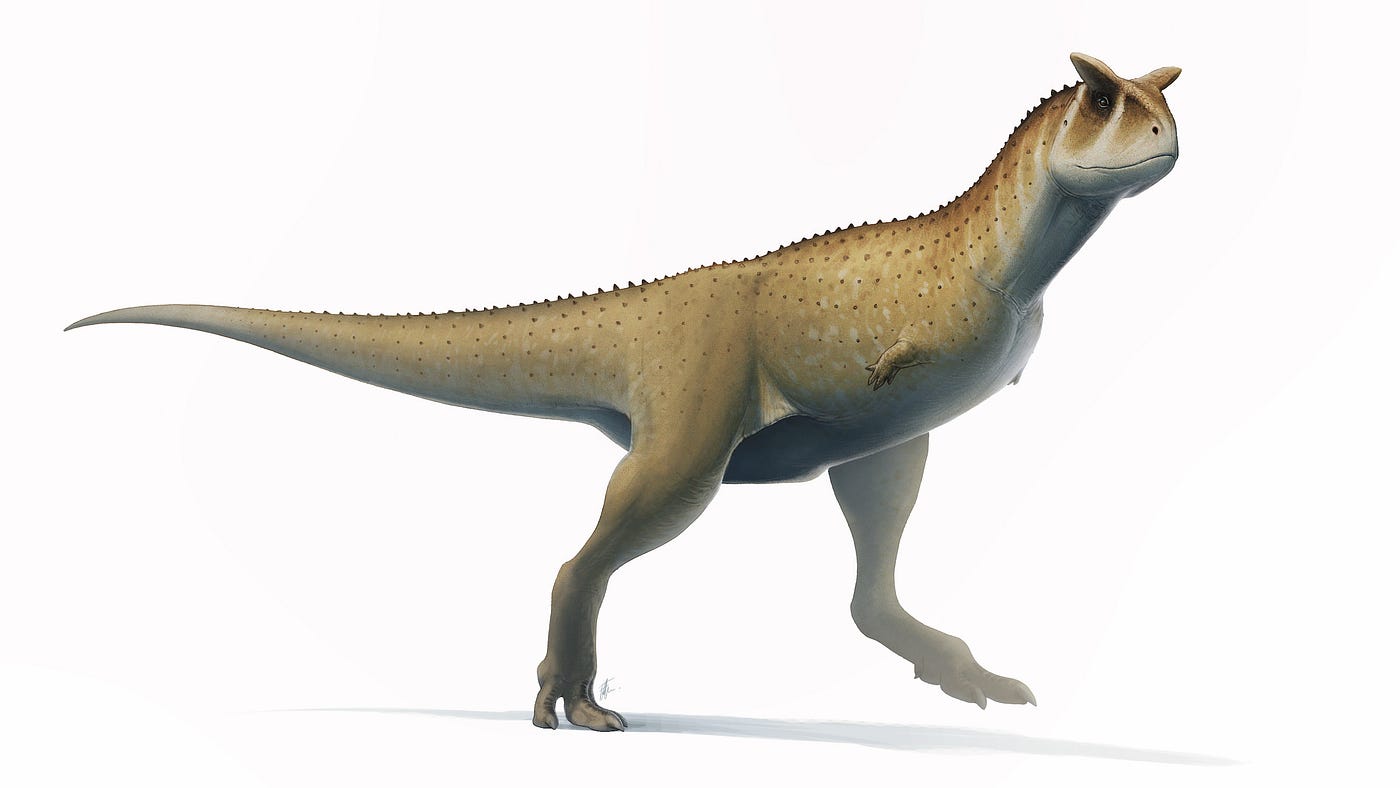
An abelisaurids dinosaur with tiny forelimbs, Carnotaurus sastrei. Credit: Wikimedia commons
The researchers built an evolutionary tree of 176 theropod dinosaurs before collecting forelimb, body weight, and skull data from 85 of them. They then measured the length of the forelimbs and compared these to the skull to create a unique scoring system. Each skull’s sturdiness was rated based on its shape, teeth, bite force, and how tightly fused the bones were. Analyses were run twice, once with and once without plant-eating dinosaurs.
They found that tiny forelimbs evolved at least five times in abelisaurids, carcharodontosaurids, ceratosaurids, megalosaurids, and tyrannosaurids independently, with three of them eventually developing vestigial forelimbs. Interestingly, Alvarezsaurids, which were previously thought of as also representing theropods with reduced forelimbs, actually had relatively proportional forelimbs. However, the fact that short forelimbs evolved multiple times in distantly related lineages suggested there was some evolutionary pressure driving this (it was not coincidental).
In some lineages, such as *Eoabelisaurus, the hand (claw?) shrank first, followed by forearms. Others, such as carcharodontosaurids, showed the opposite pattern, with the forearms shrinking first and the hands later, while [Tyrannosaurs](https://en.wikipedia.org/wiki/Tyrannosaurus)* had their entire forelimbs shrink in unison.
The analyses showed that reduced and vestigial forelimbs were strongly linked to sturdier skulls and to increased body size. However, the robustness of skulls was the most significant factor and thus the primary driver of small forelimbs. Having a giant body size was secondary, hence why some dinosaurs like *Majungasaurus had extremely reduced arms despite being relatively light for a giant theropod (about 1614 kg), while others like [Taurovenator](https://en.wikipedia.org/wiki/Taurovenator) and [Tyrannosaurus* ](https://en.wikipedia.org/wiki/Tyrannosaurus)had arms more reduced than their body weight alone would predict.
So if robust skulls and tiny forearms were linked, what exactly was the evolutionary pressure? In modern groups like toothed whales, rodents, lizards, and crocodiles, more robust, powerful skulls are linked to the size and type of prey they eat. Toothed whales are especially apt comparisons because, like in theropods, they capture prey with their jaws. The larger and more powerful the prey, the larger and more powerful the skull. Using that same logic, theropod skulls likely reflect the type of prey they consumed.
Throughout the Mesozoic, prey species grew larger and larger, which likely pushed some theropods to evolve larger sizes as well. However, when your prey weighs more than a bus, having strong jaws becomes more important than having strong arms. After all, trying to pull and grab at something just as big, if it’s not bigger than you, is not ideal. So, the evolution of small forelimbs became a case of ‘use it or lose it.’
Some theropods, like Spinosaurids, never evolved this trait because they still used and needed their forelimbs for hunting fish and other smaller prey. Similarly, plant-eating dinosaurs did not have this problem and thus did not need to trade off forelimb length for a more robust skull.
Therefore, the answer to the question, why did some of the most intimidating, powerful, and successful predators on earth evolve such comically tiny forelimbs? As prey grew to enormous sizes, theropods that invested in bigger, stronger skulls could capture and kill using their jaws alone. Forelimbs were simply no longer necessary.
In a recent study, Dr. Charlie Roger Scherer and colleagues analyzed the reason behind the evolution of tiny forelimbs in theropods. Their results revealed a clever trade-off: large and robust skulls for redundant and useless arms.
Do you agree with this conclusion or do you have another hypothesis for why such fearsome predators ended up with such tiny, almost useless arms? And can you think of any modern animals that have shrunken or vestigial body parts, and what do you suppose drove those to fade away?
Let me know your thoughts, and if you’d like to support the countless hours I pour into researching, writing, and bringing these hidden corners of history to life, why not Buy Me A Coffee
Reference
Charlie Roger Scherer, Elizabeth Steell, Paul Upchurch; Drivers and mechanisms of convergent forelimb reduction in non-avian theropod dinosaurs. Proc Biol Sci 1 May 2026; 293 (2071): 20260528. https://doi.org/10.1098/rspb.2026.0528
Published in Fossils et al. **Follow **to learn more about Paleontology.
메타데이터
- post_id
- ed4fbae896a6
- slug
- use-it-or-lose-it-why-did-some-dinosaurs-have-such-ridiculously-tiny-arms-ed4fbae896a6
- url
- https://medium.com/fossils-et-al/use-it-or-lose-it-why-did-some-dinosaurs-have-such-ridiculously-tiny-arms-ed4fbae896a6
- canonical_url
- https://medium.com/fossils-et-al/use-it-or-lose-it-why-did-some-dinosaurs-have-such-ridiculously-tiny-arms-ed4fbae896a6
- author_url
- https://medium.com/@sandeeoster17
- status
- ok
- fetched_at
- 2026-06-09 15:37:30