Moz’s 4-step playbook for fixing duplicate content (so Google ranks the right page)
Duplicate content rarely looks like a “mistake” inside a CMS. It shows up as perfectly normal URLs: filtered category pages, color…
Moz’s 4-step playbook for fixing duplicate content (so Google ranks the right page)
Duplicate content rarely looks like a “mistake” inside a CMS. It shows up as perfectly normal URLs: filtered category pages, color variants, pagination, HTTP vs HTTPS, WWW vs non-WWW, old slugs that still load.
Then Search Console starts labeling pages as duplicates. Rankings wobble. Reporting gets messy.
Moz’s January 9, 2026 Whiteboard Friday breaks the problem into a clean decision tree: redirect, canonicalize, noindex, or differentiate. That framing is useful for founders and marketers since it forces one question first: Do we want this page to exist for humans, search engines, both, or neither?
Duplicate content isn’t “a penalty” problem. It’s a “signal split” problem.
Google’s own docs frame canonicalization as a sorting job: when multiple URLs look like the same primary content, Google selects one “representative” URL as canonical and crawls it more often; the rest get crawled less often. Google also says duplicates on a site can be normal and not a spam-policy violation.
So the risk is not “Google punishes you for duplicates.” The risk is simpler:
- Google picks the wrong URL as canonical.
- Links and internal signals point at multiple versions, so equity gets diluted.
- Crawl time gets wasted on repeats, so new or updated pages get discovered slower.
If you run ecommerce, marketplaces, programmatic SEO, or any site with parameters, this shows up fast.
What Moz means by “duplicate” is closer than most teams assume
In the Whiteboard Friday transcript, Meghan Pahinui makes a point that trips teams up: crawlers judge similarity from source code, not the rendered experience a person sees in a browser. Two pages can “feel” different to a marketer and still look near-identical to a bot.
Moz’s own tooling uses a 90% similarity threshold (based on code) to flag duplicates. That number is not a Google rule. It’s a practical warning light: your site is creating near-clones at scale.
The cupcake analogy in the episode is the right mental model: two items look the same, no labels, no guidance. A system has to guess which one customers should buy. Search engines do the same.
The “choose-your-fix” framework: 4 options, 4 intents
Here’s the core value of the episode: it maps each fix to a content intent. That beats the usual SEO advice that throws canonicals at everything.
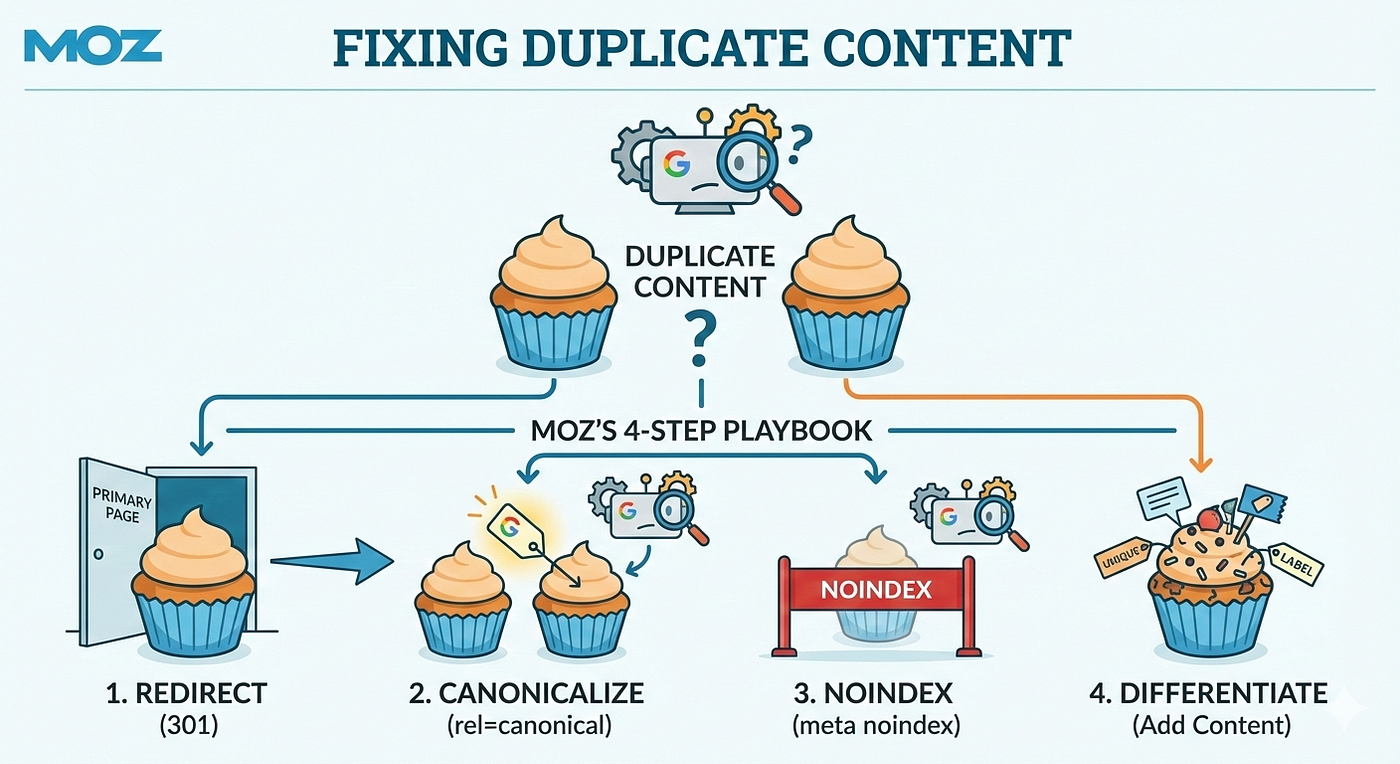
A practical framework — redirect, canonicalize, noindex, and differentiate — to ensure Google ranks the right page.
1) 301 redirect: you want one page to exist
Use a 301 when an older URL should stop being a destination. That includes:
- old slugs after a content refresh
- protocol or subdomain consolidation (http→https, non-www→www, or the reverse)
- retired pages that have a clear replacement
Moz frames this as “send people to the streaming version, not the VHS.” Redirects push both users and crawlers to the single current page.
Operator note: A redirect is not subtle. It’s a commitment.
2) rel=canonical: you want multiple pages for humans, one “main” page for search
Canonical tags fit cases where variants must exist, yet ranking should consolidate on one URL:
- product color variants
- parameterized category pages that users browse
- duplicate pages created by tracking parameters
Moz’s cookie analogy lands: you can offer both cookies, yet you point crawlers to the “primary” one.
Google backs the direction here: redirects are a strong canonicalization signal, rel=”canonical” is a strong signal, sitemaps are weaker, and stacking signals raises the odds Google shows your preferred canonical. Google still treats your preference as a hint, not a rule.
Operator note: Canonical tags fail most often when your site sends mixed signals (internal links, sitemaps, redirects, and canonicals all disagree). Google explicitly warns against declaring different canonicals via different techniques.
3) meta noindex: you want the page for users, not for search results
This is the option teams skip, then regret. Some pages should exist for navigation or UX, yet add zero value as landing pages:
- paginated pages deep in a series
- internal search results pages
- thin filter combinations that explode URL counts
Moz positions noindex as “keep the old edition on your shelf, don’t feature it in the store window.”
Google’s docs include a pointed caution: noindex is not their recommended tool for canonical selection inside a site; canonical annotations are preferred for canonicalization goals.
Operator note: Use noindex when the intent is index exclusion, not “please pick the other URL.”
4) Add content: you actually want two distinct pages, so make them distinct to crawlers
Sometimes the “duplicate” is real only from a bot’s view. Two pages target different intents, yet share templates, boilerplate, and a thin body.
Moz’s fix is blunt: add enough unique content so the crawler stops treating them as clones.
Operator note: This is the right move for “two pages that deserve rankings.” It is the wrong move for near-identical variants that exist only from CMS sprawl.
What practitioners should take from this
Most duplicate content “work” is not SEO wizardry. It’s product decisions:
- Which URL is the main one?
- Which variants exist for merchandising?
- Which URLs exist only by accident?
Google lays out why declaring canonicals helps: clearer search-result URL choice, consolidated signals, cleaner analytics, less crawl waste.
Moz adds the practical layer: pick a fix based on user intent, then execute it consistently across your stack.
Quick Action Box: what to do this week
- Inventory duplicate groups, not single URLs. Export duplicates and group them by Moz’s “Issue Grouping Identifier” field so you solve patterns, not one-offs.
- Label each group with intent: “one page,” “variants for humans,” “UX-only,” or “two real pages.”
- Pick one canonical URL per group and align signals: internal links, sitemap entries, redirects, canonicals. Google says stacking methods can raise success odds.
- Kill URL factories: tighten parameter handling, reduce filter indexation, remove legacy paths. (This is where crawl waste is born.)
- Recheck Search Console after changes to confirm Google’s chosen canonical matches your intent.
Closing take
Duplicate content fixes work best when they start as a positioning decision: one page, many pages, or pages that should never hit the index — then your technical SEO simply follows that call.
메타데이터
- post_id
- ed587d89b2cc
- slug
- mozs-4-step-playbook-for-fixing-duplicate-content-so-google-ranks-the-right-page-ed587d89b2cc
- url
- https://medium.com/@infinityrank/mozs-4-step-playbook-for-fixing-duplicate-content-so-google-ranks-the-right-page-ed587d89b2cc
- canonical_url
- https://medium.com/@infinityrank/mozs-4-step-playbook-for-fixing-duplicate-content-so-google-ranks-the-right-page-ed587d89b2cc
- author_url
- https://medium.com/@infinityrank
- status
- ok
- fetched_at
- 2026-07-13 06:23:13

