2026: A milestone year for Calypso music
This new year, 2026, is a milestone year in the continuing timeline of the development and the growing mainstream awareness in Calypso and…
2026: A milestone year for Calypso music
This new year, 2026, is a milestone year in the continuing timeline of the development and the growing mainstream awareness in Calypso and Carnival music in general. Some iconic names have spread the music that celebrates the Caribbean’s and Carnival’s ethos, and those biographies continue to be told. The intersection of the lives of calypsonians Lord Melody (Fitzroy Alexander), the Mighty Sparrow (Slinger Francisco), and calypso singer Harry Belafonte traces an interesting pathway towards the growth of calypso, beyond its Trinidad birthplace. Some landmark historic moments have etched the music’s name into the library of world music, while exposing the harsh differences between international celebrity and island competition.
To understand the music’s significance is to understand the island and its society yearning to be modern and international. Writer V.S. Naipaul spoke about calypso in his 1962 book, The Middle Passage:
“The calypso is a purely local form. No song composed outside Trinidad is a calypso… The pure calypso, the best calypso, is incomprehensible to the outsider. Wit and verbal conceits are fundamental; without them no song, however good the music, however well sung, can be judged a calypso.”
In time, a new generation of singers would elevate the calypso and soundtrack of Carnival, soca music, in terms of popularity and prestige.
1926: A Star is Born
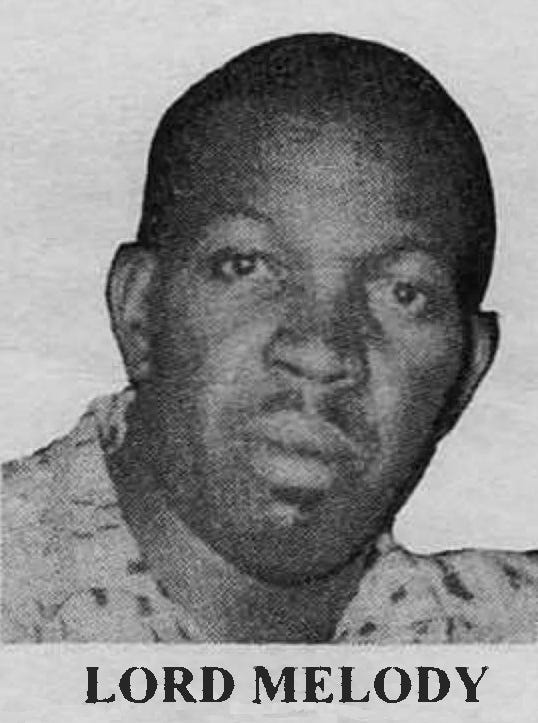
A century ago, one of the most important calypsonians and calypso composers began a life that would intersect with many other important artists who would give the genre a lift and spread. Fitzroy Alexander was born in San Fernando, Trinidad, and was raised in the Belmont Orphanage. Moving up the ranks of calypso artists from his teens onwards, he would become one of the top calypsonians ever, as a performer and recording artist, producing 19 albums and many singles over a forty-year career. Melody was a gifted songwriter who wrote timeless songs. Belafonte took notice, recording “Mama Look a Boo Boo” (first recorded as “The-Bo-Bo-Man”) and “Sweetheart from Venezuela” (aka “Juanita”), among others, to global success. His lyrically updated version of the 1943 Sir Lancelot calypso “Shame & Scandal” (initially called “Wau Wau” and “Waa Waa” on the Melody recordings) would be covered by myriad calypsonians and a number of singers internationally over the years.

Lord Melody singles: “The Bo-Bo-Man” (1955: GEMS); “Mama Look a Booboo” (1955: Monogram) and “Waa Waa” (1962: Cook Records)
Melody was liked by his fellow calypsonians, who praised his camaraderie, his influence, and his reach in the 2004 documentary Calypso Dreams. Gypsy, Lord Superior, and Mighty Sparrow sing his praises as a performer and, significantly, as a calypso composer with a global oeuvre who defied the norms of composing for oneself exclusively. Gypsy said, “As a matter of fact, I daresay he is one of the most successful calypsonians out of Trinidad and far as international calypsos go.” As a performer, Sparrow said, “his style of singing was beautiful. It suited me well…Melody was one whom I tried to be like in terms of phrasing and tempo and that kind of thing. He had a bounce there that was out of this world.”
America’s King of Calypso, Harry Belafonte, a beneficiary of Melody’s songs, revealed, “he eventually came to New York, and he came to find me, and I fell in love with the guy and his style and his talk. We must have done about six or seven songs thereafter.” He continues, “Melody was one of the big elusive people in my life, and I admired him. In the way in which he wrote things, and the style in which he wrote. It was very, very influential.” Melody himself would say of his relationship with Belafonte, metaphorically, “we was totally married.”
[embed]
He evolved with the music, singing soca into the last few years of his life. After a career of ups and downs, Lord Melody died in 1988 of cancer remembered as a pioneer who was the important link to calypso’s worldwide recognition.
1956: Who is the King of Calypso?
Seventy years ago, at the burgeoning of a new political era in Trinidad and Tobago, two landmark occurrences happened for calypso music: The Mighty Sparrow released his breakout hit, “Jean & Dinah (Yankees Gone)”, before the February Carnival days, and Harry Belafonte released his album Calypso in May. These two singers would define calypso for different audiences in the world and cement their legacies around these jumping off points that year.

Mighty Sparrow with Cyril Diaz and his Orchestra, “Jean & Dinah Yankee’s Gone” (1956: Kay Records); Harry Belafonte, Calypso (1956: RCA Records)
The Mighty Sparrow made a bold statement on his ascent to Calypso King and Road March winner in 1956: “The Yankees gone and Sparrow take over now.” Since that time, Sparrow has dominated the calypso landscape in the Caribbean, covering a broad range of subjects using droll satire, risqué and ribald humour, and social and political commentary. He has won more calypso titles than others, many Road Marches, and remains relevant with his album releases on all digital platforms to this day.
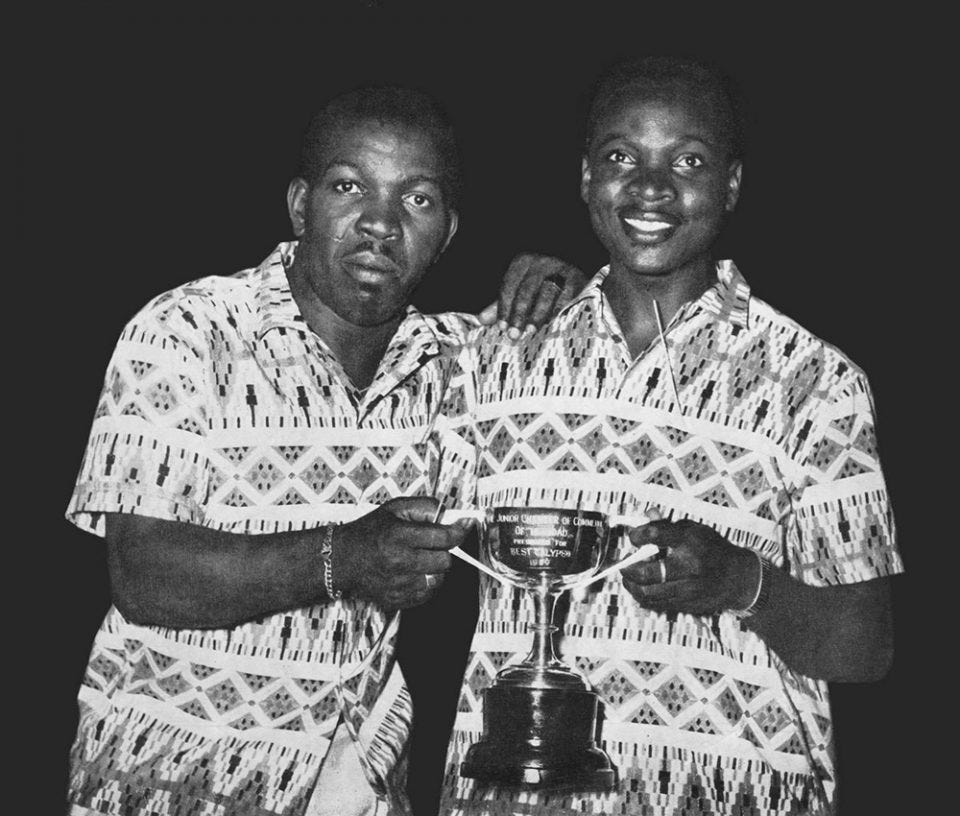
Lord Melody and Mighty Sparrow
Friendly rivalry sells: Michael Jackson vs Prince, The Beatles vs the Rolling Stones, Mighty Sparrow vs Lord Melody. This pair were friends and musical rivals for decades. Over the years, these brash, satirical songs — calypso picong, if you will — engendered spirited ‘calypso wars’ between the two and fuelled a music industry in the island: Lord Melody on Mighty Sparrow (and his wife, “Belmont Jackass”), and Sparrow on Melody (and his wife, “Madame Dracula”). The push was for greater uptake by an international audience. Sparrow and Melody later went to the U.S. seeking out Belafonte; Sparrow said that “Melody wanted some money from him, and I wanted him to open some doors for me.” It paid off.
Sparrow is a performer par excellence; the juxtaposition of him and Belafonte could have sparked a keener awareness of the potential of calypso if the “fad from Trinidad” did not unfortunately have a shelf-life of less than a year. Sparrow would release 11 albums from 1960 to 1963 on RCA, the same label as Belafonte, and altogether release more than 60 calypso albums over a 70-plus-year career.
Belafonte became the avatar of calypso and much of island music in 1956, and seemingly forever. A reluctant King of Calypso; he did not want to be stereotyped. Belafonte brought calypso and other Caribbean folk music into the consciousness of the wider world. On Calypso, “Brown Skin Girl” and “Man Smart (Woman Smarter)”, both by King Radio (Norman Span), were the only true calypsos; however, diluted as covers for an American market. That album is closer in many ways to Jamaican music than Trinidadian, and as a result, the word ‘calypso’ came to mean just about any music from the Caribbean. He would make three other “calypso” albums and sing Trinidad calypsos wherever he performed, and even record “Jean & Dinah”.
This contestation about who was the true Calypso King of the World pitted international record business marketing against parochial pride and bombast. Belafonte recalled that Trinidadians accused him of not being genuine: “You never come here, and you never go up into competition, you never do jump up, you never go in the tent. You never do nothing, you t’ief the music and call yourself King.” Belafonte’s response to the media was “first of all, let me say that I have never personally laid claim to be ‘King of Calypso.’ That was a decision of those I work for [at the record label, RCA Records]. But even if I could be the true King of Calypso, I wouldn’t want to be.” Belafonte admitted that if he wanted to sing pure calypso, he would have. He focussed on singing songs that reflected the dignity of the people, “the tender side, the human side.”
[embed]
Trinidadian renaissance man Geoffrey Holder responded in 1956 to the upsurge in interest in calypso music in the New York Times:
“The new [calypso] craze was started, I must say, by Harry Belafonte. He is a fine singer, but he is not a Calypsonian…It is somewhat saddening, too, to know that a lot of what you hear now is amusing, oh yes, but not a true Calypso. It is a Manhattan Calypso… It is an American version of West Indian melodies and lyrics… It is slicked up, prettied up, and sophisticated up. It is not spontaneous; it is calculated.”
Belafonte would die at 96 in 2023, still with the moniker “King of Calypso” attached to his name. Sparrow’s recorded output would dwarf Belafonte’s. How history would record who had a greater global influence on the genre is still in a state of flux.
1986: The New Order Emerges
Forty years ago, two artists who would define calypso and soca for a new generation would become household names on the backs of their hits: 12-year old Machel Montano would unleash “Too Young To Soca” on Carnival audiences and build a new young fanbase forever, and David Rudder would release “The Hammer” and “Bahia Girl” to move a nation and redefine Carnival music. Calypso is a performer’s and a lyricist’s art, and Montano and Rudder — defying tradition by using their names instead of sobriquets — would respectively dominate soca and calypso into the new century.
[embed]
[embed]
Montano would become the undisputed King of Soca; versatile, superlative, still relevant after a forty-year career with 11 Road March wins and a Calypso Monarch title. Rudder’s charisma created a new market for calypso. His lyrics would stand heads and shoulders above the rest, even eliciting praise from Nobel laureate Derek Walcott, a one-time critic of the idea of calypso as poetry. What the world knows now of the genres is fed by the prolific output of these two trailblazers.
As Carnival 2026 arrives, the stories of the artists who give the festival life with their music should not be forgotten. The connections, the coincidences, the competitiveness are all a part of the continuing saga made in the Caribbean.
© 2025, Nigel A. Campbell. All Rights Reserved.
메타데이터
- post_id
- ed60858c4e91
- slug
- 2026-a-milestone-year-for-calypso-music-ed60858c4e91
- url
- https://medium.com/@jettsamm/2026-a-milestone-year-for-calypso-music-ed60858c4e91
- canonical_url
- https://medium.com/@jettsamm/2026-a-milestone-year-for-calypso-music-ed60858c4e91
- author_url
- https://medium.com/@jettsamm
- status
- ok
- fetched_at
- 2026-07-28 17:41:00