Data-Driven Loan Risk Prediction: From Exploratory Analysis to Model Deployment
Introduction
Data-Driven Loan Risk Prediction: From Exploratory Analysis to Model Deployment
Introduction
In today’s data-driven financial landscape, loan risk assessment plays a vital role in determining whether an applicant is likely to repay a loan or default. Traditional manual evaluation methods are time-consuming and often prone to bias. This project leverages machine learning techniques to automate and enhance the loan application risk prediction process.
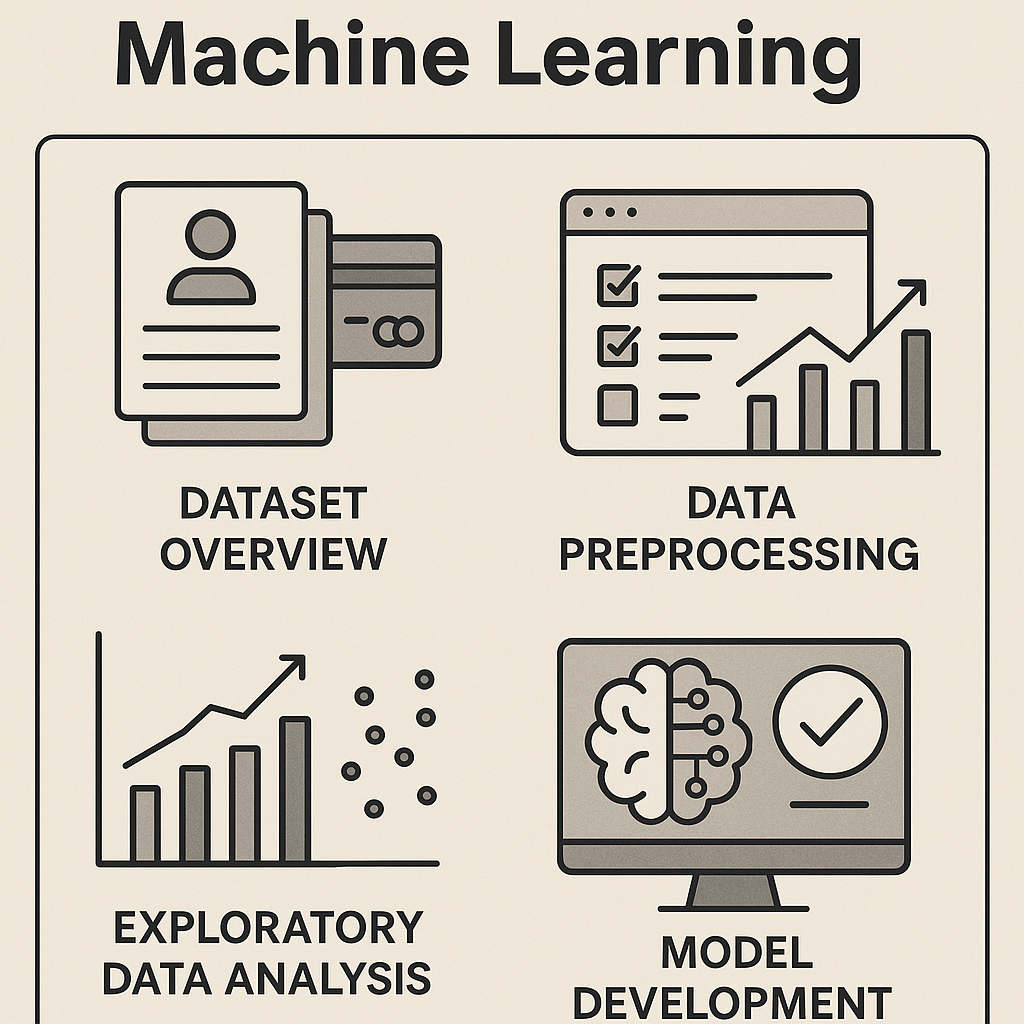
Dataset Overview
The dataset used in this project consists of:
- Loan Application Data: Basic information about applicants.
- Credit Features: Additional financial and behavioural features related to credit risk.
These datasets were merged using a common identifier (UID)to form a comprehensive view of each applicant.
Data Preprocessing
Key preprocessing steps included:
- Merging datasets and handling missing values.
- Dropping the
ALL_TimeSinceMostRecentDefaultcolumn due to excessive null values. - Removing non-numeric columns for modelling, as most machine learning algorithms operate on numerical inputs.
- Normalising and reducing dimensionality using Principal Component Analysis (PCA) to simplify the feature space while retaining variance.
Exploratory Data Analysis
Several visualisations were generated to understand data patterns:
- A line plot showing the trend of successful applications across months.
- Bar plots and scatter plots to explore relationships between employment type and loan success.
- Correlation analysis to identify features most associated with loan success.
Model Development
A Random Forest Classifier, known for its robustness and accuracy, was used to build the predictive model. The workflow included:
- Splitting data into training and test sets.
- Fitting the model on the training set.
- Evaluating the model using metrics such as the classification report and the confusion matrix.
Results
- The model achieved strong performance on the training set and reasonably good generalisation on the test set.
- Classification metrics (precision, recall, F1-score) were used to gauge effectiveness in identifying high-risk applicants.
Conclusion
This machine learning pipeline demonstrates the power of automation in financial decision-making. By combining PCA for dimensionality reduction and Random Forest for classification, the model provides a scalable solution to predict loan approval risks. With further tuning and feature engineering, it could be integrated into real-world financial systems to support risk management strategies.
메타데이터
- post_id
- ed64264c8a3d
- slug
- data-driven-loan-risk-prediction-from-exploratory-analysis-to-model-deployment-ed64264c8a3d
- url
- https://medium.com/@rohitgitam014/data-driven-loan-risk-prediction-from-exploratory-analysis-to-model-deployment-ed64264c8a3d
- canonical_url
- https://medium.com/@rohitgitam014/data-driven-loan-risk-prediction-from-exploratory-analysis-to-model-deployment-ed64264c8a3d
- author_url
- https://medium.com/@rohitgitam014
- status
- ok
- fetched_at
- 2026-07-10 08:43:10