⚡ My Complete Journey to the eJPT v2 — Course, Exam & Final Tips
Introduction
⚡ My Complete Journey to the eJPT v2 — Course, Exam & Final Tips
Introduction
Hey, I’m Rajarshi Sarkar, and this was my first step into the world of cybersecurity certifications. I passed the eLearnSecurity Junior Penetration Tester v2 (eJPTv2) exam on 16 July 2024.
Before starting the eJPT journey, I began learning the fundamentals on TryHackMe. I highly recommend beginners start with the Pre-Security and Cyber Security 101 learning paths. These paths helped me understand important basics like networking, operating systems, and how attackers think.
Those beginner labs gave me the confidence to move forward. I didn’t know everything yet, but I knew enough to start the eJPT journey — and now I’m proud to say I’ve earned my first cybersecurity certification and I’m hungry to learn more.

eJPT Badge😎
About the eJPTv2 Course
The eLearnSecurity Junior Penetration Tester v2 (eJPTv2) course is a great starting point for anyone who wants to build a career in cybersecurity, especially in penetration testing. It is part of the INE Penetration Tester Student Path, which is designed specifically for beginners who want to learn the fundamentals of offensive security.
What I really liked about this course is that it doesn’t just throw tools at you and expect you to memorize commands. Instead, it focuses on helping you understand why you perform certain actions during a penetration test. You begin to understand how attackers think, how they explore networks, and how they identify potential weaknesses in systems.
The course builds a strong foundation by covering the core concepts that every aspiring pentester should understand before moving on to more advanced certifications or real-world security engagements.
Some of the major areas covered in the course include:
• Scanning networks to identify live hosts and open ports using industry-standard tools • Enumerating services to understand what technologies are running on a target system • Identifying potential vulnerabilities in services such as FTP, SMB, and web applications • Exploiting misconfigurations and weak services to gain initial access • Performing privilege escalation after gaining access to a system • Understanding how attackers move deeper inside a network during a penetration test using simple pivoting techniques.
One of the strongest aspects of the course is its hands-on learning approach. Instead of focusing only on theory, the training encourages students to immediately apply what they learn in practical lab environments.
Another important thing I noticed during the learning process is that the course emphasizes methodology rather than just tools. Many beginners fall into the trap of memorizing commands without understanding the logical flow of a penetration test. The eJPTv2 training helps you develop the mindset of a pentester — teaching you how to think systematically, enumerate thoroughly, and approach a target step by step.
By the time I finished the course, I wasn’t randomly trying tools anymore. I had developed a structured approach when attacking a target machine. I understood how to begin with reconnaissance, gather useful information, identify attack surfaces, and continue logically when something didn’t work.
Training Path and Course Structure
The eLearnSecurity Junior Penetration Tester v2 (eJPTv2) certification is delivered through the INE Penetration Tester Student (PTS) Learning Path created by INE Security.
This learning path is designed specifically for beginners who want to move from basic cybersecurity knowledge into practical penetration testing skills.
The training itself is quite comprehensive. The complete course contains around 160 hours of content, including video lessons and hands-on labs. What makes the course effective is that it doesn’t just explain concepts theoretically — after learning a topic, you immediately get the chance to practice it in a lab environment.
This approach helps reinforce the learning process because you are actively applying the techniques rather than just reading about them. The course is structured into four main sections, each representing an important stage of the penetration testing process.
Assessment Methodologies
This section focuses heavily on information gathering and enumeration, which are fundamental skills in penetration testing. You learn how to collect intelligence about target systems, identify active hosts, and discover services running on a network. In many real-world penetration tests, successful exploitation depends heavily on how well you enumerate the target environment. Because of this, this section plays a critical role in building the right mindset for approaching security assessments.
Host & Network Auditing
This is a smaller section that introduces vulnerability assessment techniques. It covers how tools like Nmap and vulnerability scanners such as Nessus can be used to analyze systems and detect possible security weaknesses. Even though this part of the course is relatively short, it helps beginners understand how security professionals identify vulnerabilities during security assessments.
Host & Network Penetration Testing
This is the core part of the entire training path. In this section, you move beyond scanning and enumeration and begin learning how to actually exploit vulnerabilities. The lessons cover different exploitation techniques, post-exploitation activities, and privilege escalation methods. One of the highlights of this section is the extensive training on Metasploit, which spans many hours and explains how the framework can be used effectively during penetration testing engagements.
Web Application Penetration Testing
The final section introduces the fundamentals of web application security testing. You learn about common vulnerabilities found in web applications and how security professionals test for them using specialized tools. Even though the eJPT exam focuses more on network penetration testing, understanding web vulnerabilities is still an important skill for anyone planning to work in offensive security.
Exam Format
The eJPTv2 certification exam is designed to evaluate practical penetration testing skills rather than theoretical knowledge. The exam environment contains a small network of machines that you must analyze and compromise in order to answer the questions. The exam is conducted in a browser-based lab environment, where candidates are given access to a virtual attacker machine (Kali Linux) directly through the browser. This machine is connected to a small isolated network with multiple target systems that must be analyzed and compromised during the exam.
In total, the exam includes 35 questions, and you need a minimum score of 70% to successfully pass the certification. The exam duration is 48 hours, giving candidates enough time to carefully analyze the environment and perform the required attacks.
Unlike traditional exams that focus on memorization, this exam requires you to apply the skills learned during the course — such as enumeration, vulnerability analysis, exploitation, pivoting, and privilege escalation — to gather the information needed to answer each question. Because of this hands-on format, the exam feels similar to performing a real penetration testing engagement, where analysis and logical thinking are more important than simply remembering commands.
Exam Day Experience
I know many of you have been reading this far and are probably waiting for the part that matters the most — how the actual exam experience went. So let me walk you through what my exam day looked like and how everything unfolded.
I began my eLearnSecurity Junior Penetration Tester v2 (eJPTv2) exam on 15 July 2024, and honestly, even after all the preparation, I was still a bit nervous. I had completed the training, practiced the labs, and prepared my personal notes and cheat sheets — but when it’s the real exam, the pressure feels completely different.
Late in the morning around 10:45 AM, I sat down in front of my computer and prepared everything I needed. My notes were open, my cheat sheet was ready, and I took a moment to mentally prepare myself. A few minutes later, around 11:00 AM, I finally clicked the “Start Exam” button.
The first thing I noticed was that a file contained several IP ranges for the exam environment. After reviewing them, I started scanning the network to identify the available machines. Using network scanning tools, I began discovering the active hosts and then moved on to analyzing each system one by one. My approach was simple: “first identify the hosts on the network, and then perform more detailed scans to understand what services were running on each target.”
Since the lab environment is browser-based and hosted on INE’s servers, the systems sometimes felt slightly slower compared to running virtual machines locally on my own machine. However, the performance was still stable and completely usable for scanning, enumeration, and exploitation tasks, so it did not cause any major issues during the exam.
One Important Tip: Take Notes During the Exam This is something I strongly recommend to anyone attempting the exam. Write down everything as you go.
Keep track of:
- Commands you executed
- Discovered IP addresses
- Running services and open ports
- Credentials you find
Saving this information on a system can save you a lot of time later. During long exams it’s easy to forget small details, especially when you’ve been working for hours and your focus starts to drop.
Pay Close Attention to the Questions Another thing I noticed during the exam is that the questions themselves often contain useful hints. If you carefully read them, they can guide you in the right direction. In my case, some of the usernames were already hinted at directly within the question text. If I had ignored that information, I might have spent unnecessary time trying to enumerate users or running brute-force attacks that weren’t even required. So my advice is simple: “slow down and read the questions carefully before jumping into action.” Sometimes the exam is already giving you valuable clues.
Password Cracking When it came to cracking passwords, I didn’t try anything complicated. I kept things simple and practical. Using a common wordlist like rockyou.txt was enough to crack the required passwords during my exam attempt.
After several hours of enumeration, exploitation, and answering the questions step by step, I finally completed the exam in around 16 hours. By the end of the session, it was already around 3:00 AM the next morning, but seeing the progress and finishing the exam felt incredibly satisfying.
Once I submitted the exam, the result appeared immediately on the screen🤩🤩. Seeing that I had successfully passed the eJPTv2 exam was an amazing feeling and made all the preparation and long hours of practice completely worth it🥹.
Overall Exam Experience
During my eLearnSecurity Junior Penetration Tester v2 (eJPTv2) exam, one thing became very clear to me — “enumeration is the key to everything”. If you take the time to properly enumerate the target systems, most of the answers start revealing themselves.
The exam environment included several machines running both Linux and Windows. Instead of rushing straight into exploitation, the most important step was to carefully enumerate every machine. This meant scanning all available ports, identifying running services, and understanding what each system was exposing.
Another very important point is to read the exam questions carefully. In many cases, the questions themselves contain valuable hints. Sometimes usernames are directly mentioned or indirectly hinted at in the question text. If you skip over those details, you might end up wasting time trying to enumerate information that was already given to you.
Once the services and potential entry points were identified, the next step was usually trying to gain initial access. In many cases this involved credential attacks, and honestly, there was no need to overcomplicate things. A simple wordlist like rockyou.txt was often enough for password brute-forcing.
“It was about being patient, enumerating properly, and paying attention to small details”. Many services were running on non-standard ports, so checking every open port carefully was extremely important.
After gaining initial access to a machine, the focus shifted toward privilege escalation. This involved looking for weak permissions, misconfigured services, or vulnerable programs that could allow elevation to administrator or root privileges.
Sometimes you could also find useful information such as credentials or configuration files stored on the compromised systems. These pieces of information could then be used to move further within the environment or access additional services.
Final Tips for Future eJPTv2 Candidates
If you are planning to take the eLearnSecurity Junior Penetration Tester v2 (eJPTv2) exam, here are a few lessons I learned during my preparation and exam experience that might help you.
1. Focus on Enumeration First The most important skill for this exam is proper enumeration. Before trying to exploit anything, take the time to carefully scan the target systems, identify open ports, and analyze the services running on them. In many cases, the information you collect during enumeration will already point you toward the correct attack path. If you rush into exploitation without understanding the target environment, you will likely waste time.
2. Read the Questions Carefully One thing I noticed during the exam is that the questions themselves often contain valuable hints. Sometimes usernames, services, or specific actions are already implied in the question text. Taking a moment to read and understand each question properly can save you a lot of unnecessary work.
3. Keep Detailed Notes During the Exam Maintaining clear notes throughout the exam is extremely helpful. Write down important information such as:
- IP addresses you discover
- Open ports and running services
- Credentials you obtain
The exam environment can become complex after several hours of testing, so having organized notes will make it much easier to keep track of your progress.
4. Keep Your Approach Simple The exam is designed to test your understanding of the penetration testing process, not your ability to perform overly complex attacks. Many tasks can be solved using basic techniques and commonly used tools. Sometimes a straightforward approach — such as using standard wordlists for password attacks or carefully analyzing misconfigurations — is all that is needed.
5. Manage Your Time and Take Breaks The exam provides 48 hours, which is more than enough time if you stay calm and methodical. If you find yourself stuck on something, stepping away for a short break can help reset your thinking and give you a fresh perspective when you return.
6. Practice Before the Exam Before attempting the certification, it is helpful to spend time practicing on beginner-friendly platforms like TryHackMe. Even simple labs can help you become more comfortable with scanning, enumeration, and exploitation techniques.
🎉 Finally, after all the preparation and exam challenges, I successfully earned my certification.
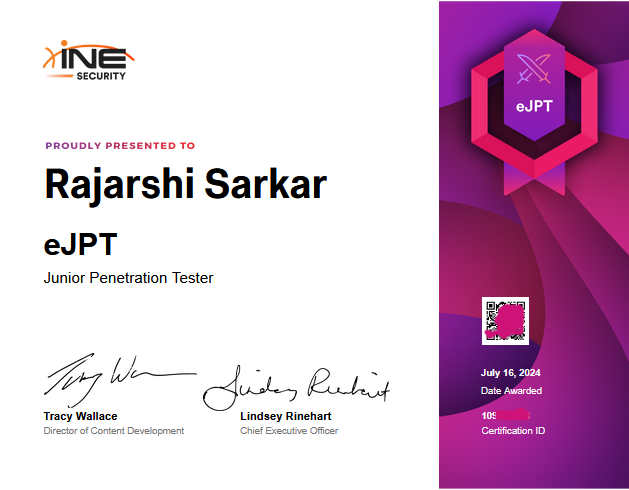
Certified!!🫣🫣
Conclusion
Completing the eLearnSecurity Junior Penetration Tester v2 (eJPTv2) was an important milestone in my cybersecurity journey. As my first certification, it not only tested my technical knowledge but also helped me understand how a real penetration testing process works in a structured way. From learning the basics on TryHackMe to completing the INE Penetration Tester Student Path, the entire journey helped me build a strong foundation in networking, enumeration, exploitation, and privilege escalation. More importantly, it taught me how to approach problems logically rather than randomly trying tools or commands. One of the biggest takeaways from the exam was the “importance of proper enumeration and careful analysis”. If you take the time to understand the target system, read the questions carefully, and follow a structured approach, many of the answers naturally reveal themselves. For beginners who want to enter the cybersecurity field — especially penetration testing — the “eJPTv2 certification is a great starting point.” It provides practical experience, hands-on labs, and a clear understanding of how attackers think and operate in real-world environments. For me, this is just the beginning of the journey. The field of cybersecurity is huge, and there is always more to learn, explore, and practice. Passing the eJPTv2 gave me the confidence to continue moving forward toward more advanced skills and certifications in penetration testing. If you’re just starting out, stay curious, keep practicing, and don’t be afraid to get stuck sometimes — because that’s where the real learning happens.
🚀 Don’t worry if things feel difficult at first. Every pentester starts exactly where you are right now.
💻 Keep learning, keep practicing, and stay curious. 🔍 Every lab you solve and every concept you understand makes you stronger. 🔥 Stay consistent, trust the process, and don’t give up. 🎯 Sooner than you think, you’ll be celebrating your certification too. 🎉🏆
메타데이터
- post_id
- ed704c95e63e
- slug
- my-complete-journey-to-the-ejpt-v2-course-exam-final-tips-ed704c95e63e
- url
- https://medium.com/@rajarshi-sarkar/my-complete-journey-to-the-ejpt-v2-course-exam-final-tips-ed704c95e63e
- canonical_url
- https://medium.com/@rajarshi-sarkar/my-complete-journey-to-the-ejpt-v2-course-exam-final-tips-ed704c95e63e
- author_url
- https://medium.com/@rajarshi-sarkar
- status
- ok
- fetched_at
- 2026-07-16 21:47:15