AI — the next energy crisis?
The hidden cost of AI
AI — the next energy crisis?
The hidden cost of AI
In just a few years, artificial intelligence (AI) has gone from a niche technology to a global phenomenon, transforming how millions of people work, learn and create. Since the launch of ChatGPT in 2022, ~40% of households in the US and UK have interacted with LLMs, with ChatGPT at 1 billion monthly active users as of May 2026. The growth in AI usage has significantly outpaced other history-defining advances such as personal computers and the internet. This is because unlike earlier innovations, AI arrived in a mature digital ecosystem with billions of connected users, sharply reducing the learning curve that earlier technologies had to overcome to reach consumers. AI has become woven into the fabric of modern life in remarkably little time, with increasing utilization reflecting its entrenchment. However, every innovation has a cost, and AI’s is energy.
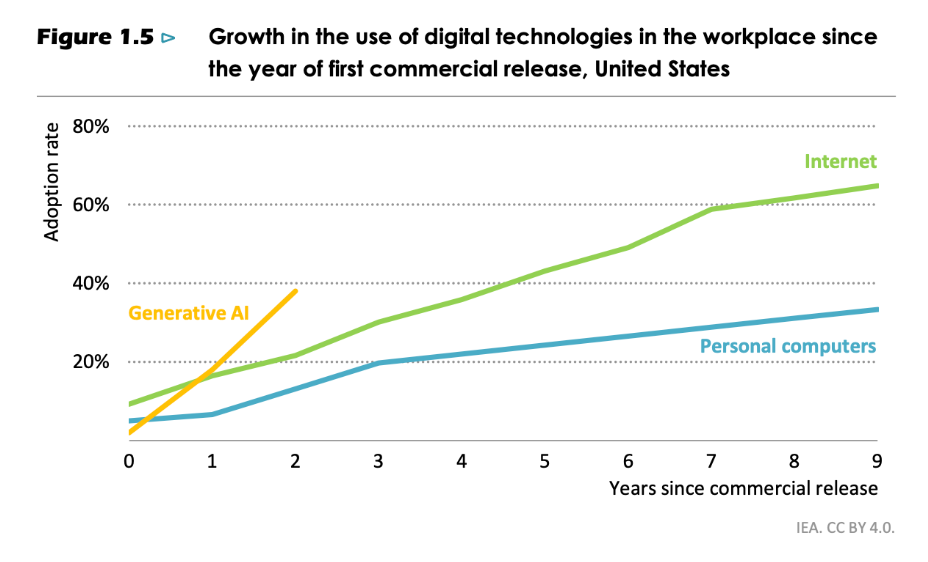
Behind every model, every prediction, and every conversation is a constant demand for energy, one of society’s oldest and most fundamental resources. Even before you type a prompt into ChatGPT, Claude or Perplexity, AI has already burned through significant energy to “train” the model you’re interfacing with. For example, it’s estimated that training OpenAI’s GPT-4 consumed ~50 gigawatt-hours of energy. To put this in perspective, that’s roughly enough energy to power the city of San Francisco for three days. As companies rush to build more specialized and competitive models, energy demand for AI will undoubtedly increase.
While model training represents a massive fixed cost, inference, the point at which you type your question into an LLM and typically the initial point of interaction for most retail users, is even more energy intensive. According to a 2024 Goldman Sachs Research Report, on average a ChatGPT query needed nearly 10x as much energy to process as a Google search. While costs per query have compressed significantly, inference still represents ~80–90% of computing power for AI, largely driven by rising usage. Energy usage can also vary depending on the underlying model used, showing that AI adoption represents a significant step-up in energy demands.
Infrastructure under pressure
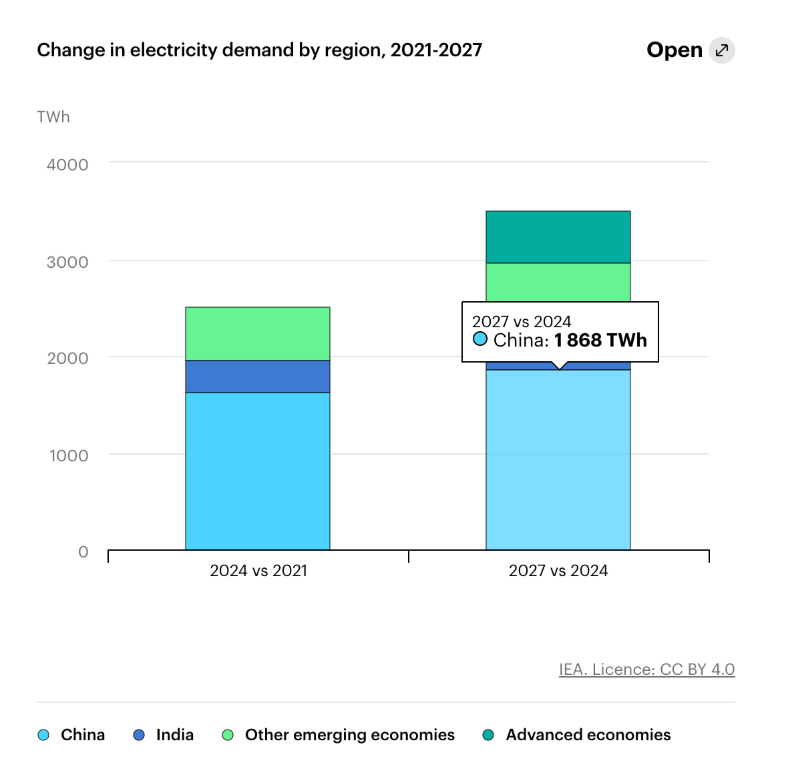
Today, a typical AI-focused data center utilizes as much electricity as 100,000 homes and these data centers continue to grow in size and breadth. It’s estimated that many of the centers under construction today will consume up to 20x their current rate. According to the International Energy Agency (IEA), data centers accounted for ~1.5% of global electricity consumption in 2024. However, in advanced economies such as North America and Europe where electricity demand has been largely stagnant for decades, data center expansion is expected to represent 20% or more of demand growth through 2030. In 2024, the US accounted for the largest share of global data center consumption at 45%, followed by China (25%) and Europe (15%). On their current trajectory, however, data centers are expected to account for 10% of global electricity demand growth by 2030.
Electricity grids, the physical infrastructure most don’t think about when they consider AI, could be one of the biggest bottlenecks in its expansion. Today ~20% of planned data center projects are expected to be delayed due to grid strain. Before a new AI data center can begin to operate it must connect to the local electricity grid. New projects can experience wait times up to ten years. Northern Virginia, which is considered one of the most rapidly growing data center markets in the world, has an average queue time of seven years, while centers in the Netherlands average a decade. There are also reports of data center interconnection agreements being frozen in cities like Dublin, Ireland due to capacity limitations.
Delays across data center rollouts have been further exacerbated by critical component shortages. Deficits across both transformers and cables, which are necessary for grid expansion and interconnections continue to deepen. Since 2019 demand for high-voltage power transformers and generator step-up transformers (GSUs) has skyrocketed, with backlogs for GSUs and power transformers averaging ~2.5–3 years since Q2 2025.
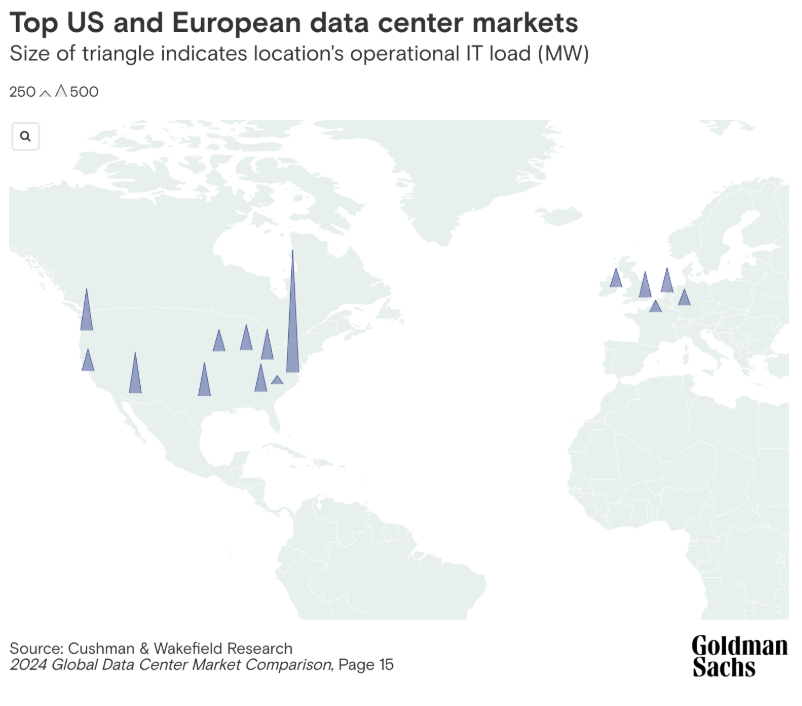
Hyperscalers and AI developers are increasingly pursuing behind-the-meter (BTM) generation–i.e. gas turbines, reciprocating engines or co-located generation to avoid interconnection delays. However even this workaround has become challenged, with the market for large gas turbines becoming highly constrained. In many cases lead times now top 3yrs and large OEMs like GE Vernova have seen backlogs reach ~100 GW.
Even in cases where data center timelines aren’t constricted by supply-chain bottlenecks, we believe that electrification risks remain. Net new capacity typically aggregates in the same regions where high quality fiber networks and cloud infrastructure already exist. However this concentration puts these clusters at increased risk of strain and outages, as competition for capacity, overloaded substations and stress on cooling systems challenge grid resilience.
AI x Energy — A funding gap
While significant venture funding has flowed into downstream AI infrastructure such as training, computer vision and physical or embodied AI, only 2% of equity raised by energy start-ups has gone to companies with an AI-related focus. Today the primary application of AI in the energy sector is focused on weather or load forecasting, activity scheduling and image recognition. AI applications have helped significantly improve the accuracy of weather forecasts which is essential for building management & optimizing operations of heat sensitive GPUs and energy systems alike, particularly as rising temperatures and associated hardware damages become a loss leader for data centers. A recent report by First Street examining 97 global data center markets showed that ~79% of current data center capacity is at acute risk of climate-related hazards. Rising temperatures also generate increased demand from HVAC, which can overload power grids, cause blackouts and disrupt critical AI infrastructure.
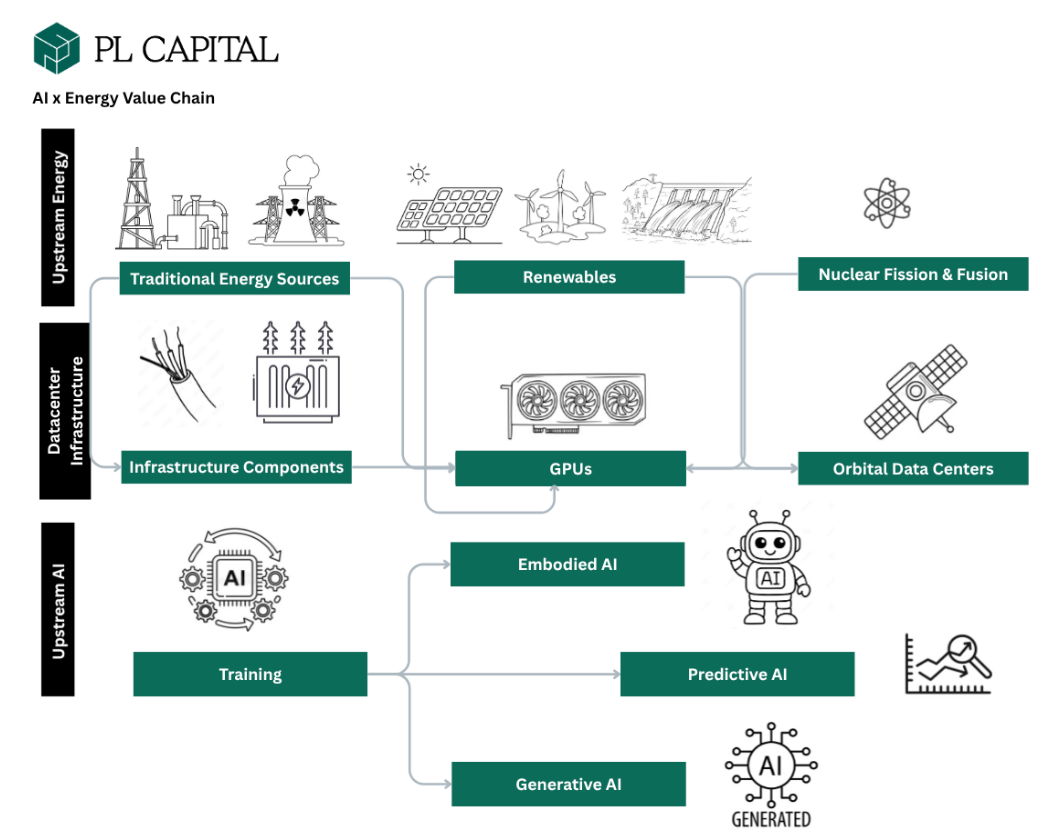
PL Capital AI x Energy — Simplified Value Chain Illustration
To escape the limitations of our strained energy infrastructure, a number of startups have started actively building or outlined plans for space-based computing infrastructure. We see this as an interesting niche that is perhaps uniquely poised to solve AI energy issues. Theoretically, space-based data centers could offer advantages that outweigh initial development challenges, benefitting from both abundant continuous solar energy and an environment better adapted to thermal management through radiative cooling versus terrestrial HVAC. Additionally, as earth observation satellites and space bases expand, these orbital data centers could also play an important role in reducing communication failures and delays within the space-based ecosystem. We’ve invested in companies like Aptos Orbital* which focus on solving space-based communication issues by connecting satellites directly to the cloud. Throughout this piece we denote our investments with an asterisk when they first appear. More upstream, companies like Starcloud have deployed GPU-filled satellites that target AI training and inference workloads and Axiom Space’s orbital data center program is focused on supporting AI/ML workloads by reducing the need to transmit raw data back to earth. The latter has also tested a prototype datacenter on the International Space Station in conjunction with IBM. However, while orbital data centers potentially represent an elegant solution to energy and related climate issues faced by data center rollouts, the reality of building space-based data centers remains challenging, with high launch costs, difficult maintenance, and potential disruption from radiation.
Growing data center demand has also made us increasingly bullish on renewable energy investments as wind and solar PV technologies are currently among the cheapest sources for electricity. While the US government has announced a push to 4x nuclear power production by 2050, the timeline for nuclear power development is time-consuming, expensive, and full of regulatory complexity that makes it largely inaccessible to startups. The last two nuclear reactors to have been built recently in the US took 15 years to complete and cost ~$35B, well above initial estimates. Aside from gas turbines, renewables are also some of the only net new electricity sources that can be developed within a short time-frame. Solar PVs can be reliably launched in 1–2 years, strongly aligning with data center construction timelines, while wind turbines can also see similar speed to launch. However, in the latter case, deployment is heavily dependent on permitting processes which may extend timelines up to 5 years. We continue to look at solutions that accelerate renewable energy deployment as well as improving energy capacity to ensure the continuous uninterrupted power supply required by LLM training and other downstream AI use-cases.
In the base case, global data center electricity consumption will require the installation of over 320 GW of additional electricity generating capacity between 2024–2035, and it’s estimated that renewables will account for nearly ⅔ of this additional capacity. At Protocol Labs we invested in Glow* as an integral part of this expansion. The protocol leverages RWA to incentivize the creation and deployment of net new solar farms that help expand energy infrastructure and capacity globally. Glow’s decentralized network has deployed $50M across three continents since inception and is just one of a handful of RWA companies working at the intersection of energy and blockchain. Other decentralized energy efforts include Daylight, which raised $75M in 2025 to grow its decentralized solar power plant model. The latter allows homeowners to receive solar panels & battery storage at cheaper rates while also pooling stored energy and selling it back to the grid during peak demand periods. There are also decentralized companies like Habitat Protocol, which focus on transforming surplus renewable energy into usable, on-demand computing power and Colectric which focuses on developing clean energy for data centers at utility power plants.
In addition to existing applications, we see many more use-cases for AI across the energy space. For instance, AI could be used to help evaluate upstream oil resources to optimize exploration, as oil & gas remain crucial to providing the continuous energy required for downstream AI use-cases in the short-to-medium term. In other areas AI could also help streamline energy production, maintenance and safety, targeting grid faults with greater precision, reducing outages and increasing capacity if applied successfully.
We also believe there’s an opportunity to leverage AI for experimental hardware creation and optimization, accelerating the process of testing batteries and carbon capture molecules. We believe that the base infrastructure around data centers represents an interesting market opportunity for these startups. These niches include backup generation, cooling, energy curtailment and workload management. The rise of data centers has led to an increase in thermal and voltage violations as well as fault ride-through and ramp-rate issues among others. In the long-term, we also believe AI could have a net positive effect on energy consumption by helping to streamline and reduce burn, particularly as efficiencies are unlocked around model training and analysis.
Many are starting to recognize the urgency of a solution to increased energy demand that reduces emissions-based sources like coal. Large public companies like Meta and Microsoft are investing in the development of nuclear power plants and in July, KKR acquired EDF Group’s Renewable Energy Business for $4.2B. Across late-stage venture new funding rounds in the past months suggest investors are beginning to recognize the same urgency. In June Helion Energy, which is focused on building the world’s first fusion power-plant, raised a $465M Series G at a $15.5B valuation, while Focused Energy announced a $240M Series A for its laser-powered fusion technology.
As AI adoption accelerates, energy is emerging as one of the defining investment themes alongside it. Meeting this demand will require massive expansion of renewable energy, grid infrastructure and data center technologies, while creating opportunities across energy software, hardware and AI-enabled optimization. Although AI will significantly increase energy demand in the near-term, we believe it also has the potential to make the energy system itself more efficient over time, unlocking a new generation of infrastructure and climate-focused innovation. Currently the market is pricing AI’s compute layer but not it’s power layer, and the gap between 2% of energy venture funding and two-thirds of required new capacity is part of where we’re spending our time.
This post is for informational purposes only and is not intended as a recommendation to purchase or sell any commodity, digital asset or security. The information for this post has been obtained from public sources believed to be reliable. Protocol VC, LLC (“PL Capital Crypto”) makes no representation as to the accuracy or completeness of such information. Opinions, estimates, forecasts and projections in this post constitute the current judgment of the author and are subject to change without notice. It can be expected that some or all of such assumptions will not materialize or will vary significantly from actual results. Past performance is no guarantee of future results.
*Indicates a company in which Brad Holden & Lacey-Ann Wisdom, the General Partners have made proprietary investments. References to specific companies are provided for informational purposes only and are not a recommendation to buy, sell, or hold any security. The inclusion of a company should not be interpreted as an indication of investment performance, future results, or the availability of any investment opportunity. Past investments are not necessarily indicative of future investments or results.
메타데이터
- post_id
- ed7560fdc857
- slug
- ai-the-next-energy-crisis-ed7560fdc857
- url
- https://medium.com/@lacey_63095/ai-the-next-energy-crisis-ed7560fdc857
- canonical_url
- https://medium.com/@lacey_63095/ai-the-next-energy-crisis-ed7560fdc857
- author_url
- https://medium.com/@lacey_63095
- status
- ok
- fetched_at
- 2026-07-09 04:10:03






