How AI and Financial Astrology Improve Live Trading Signals
Financial markets generate an enormous amount of information every second. Prices change, trading volume shifts, volatility expands…
How AI and Financial Astrology Improve Live Trading Signals
Financial markets generate an enormous amount of information every second. Prices change, trading volume shifts, volatility expands, economic reports are released and news can alter investor sentiment within minutes.
Human traders can interpret many of these signals, but monitoring stocks, commodities, currencies and cryptocurrencies simultaneously is difficult. Artificial intelligence can assist by processing large datasets, identifying repeating patterns and highlighting unusual market behaviour.
Financial astrology contributes a different layer. It studies planetary cycles as potential timing indicators for changes in sentiment, volatility, liquidity and risk appetite.
Understanding how AI and financial astrology improve live trading signals requires a balanced approach. Artificial intelligence should not be presented as a prediction machine, while planetary timing should not be treated as a guarantee of market direction.
The most responsible system combines AI-based market analysis, astrological timing, technical confirmation and clearly defined risk controls.
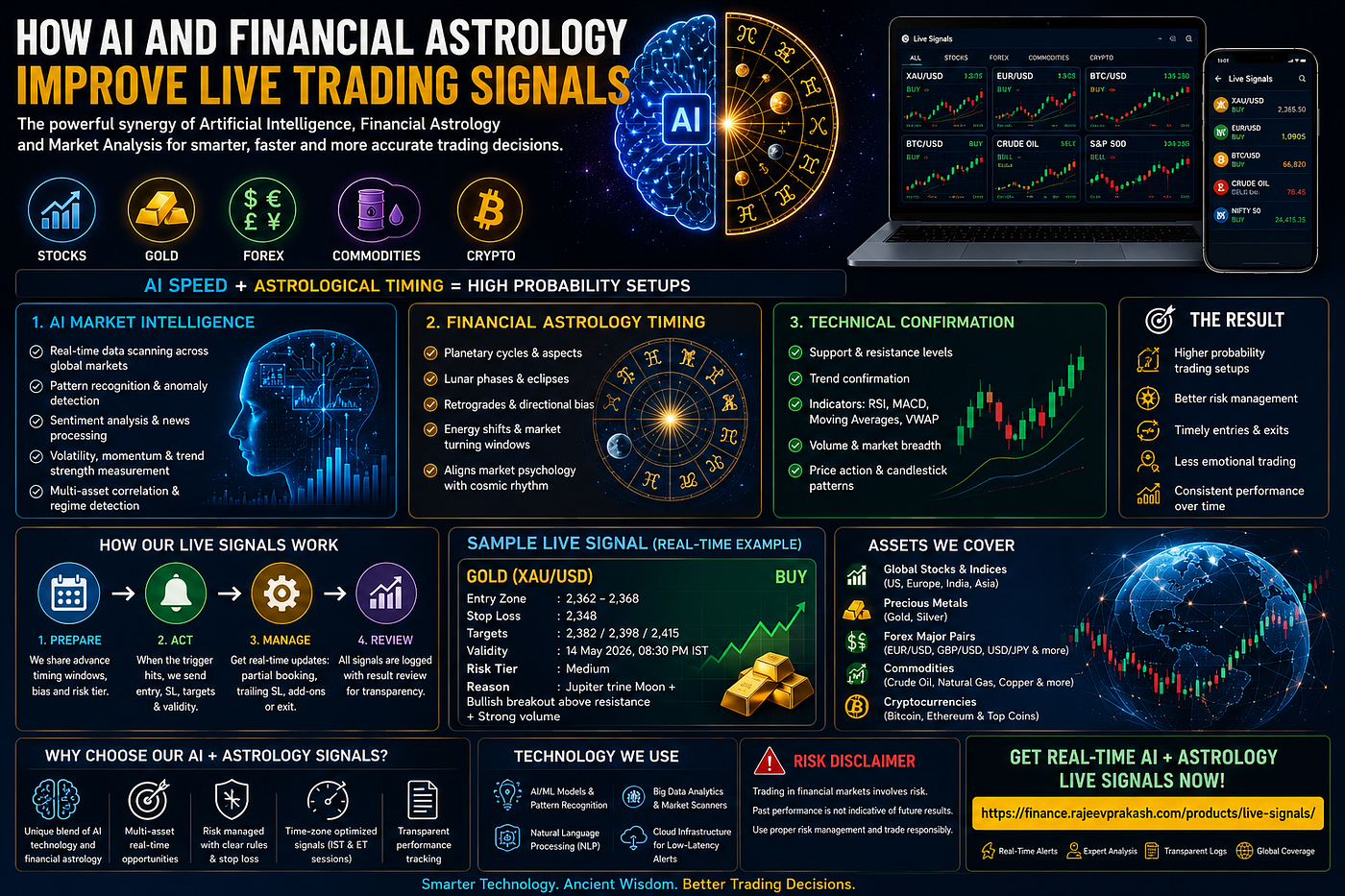
The Financial Astrology Terminal Live Signals service follows this layered approach by combining planetary timing with market structure. Its published workflow includes advance timing windows, an entry zone, stop-loss, targets, validity period, management updates and a transparent post-trade review.
The purpose is not to remove uncertainty. It is to help traders filter information, prepare for important market windows and execute risk-defined decisions more consistently.
What Are AI-Powered Live Trading Signals?
AI-powered live trading signals are data-driven alerts that identify possible trading opportunities based on predefined market conditions.
An AI system may analyse price direction, momentum, trading volume, volatility, correlation and changes in market breadth. It can monitor several assets continuously and identify when a market begins behaving differently from its recent pattern.
For example, a system may detect that an equity index has broken above resistance while trading volume and market breadth are improving. It may notice that gold is strengthening as the U.S. dollar weakens or that crude oil volatility has increased after a supply-related event.
The AI system does not need to place the trade automatically.
It can rank the setup, assign a confidence category and send the information to a trader or analyst for further review.
FINRA notes that AI tools can analyse and synthesise large sets of financial and market information. Financial firms also use AI for trading, portfolio management, surveillance, risk analysis and operational processes.
However, the usefulness of the signal depends on the quality of the data, the design of the model and the controls surrounding it.
A sophisticated algorithm cannot correct inaccurate prices, incomplete data or poorly defined risk rules.
What Financial Astrology Adds to the Signal
Artificial intelligence usually focuses on observable market behaviour.
Financial astrology adds a calendar of possible timing windows based on planetary movements, aspects, retrogrades, lunar cycles and eclipses.
Jupiter is traditionally associated with expansion, confidence and risk appetite. Saturn represents restriction, responsibility, debt and structural pressure.
Mars may correspond with urgency, conflict and short-term volatility. Mercury relates to data, communication and trading activity, while Venus is associated with money, valuation and investor preference.
Uranus symbolises disruption, innovation and sudden changes in market leadership.
These interpretations do not determine whether a market must rise or fall.
Instead, they suggest periods when a particular market theme may become more active.
A Jupiter-related window may coincide with expanding optimism. If price, breadth and volume also strengthen, the signal gains confirmation.
A Saturn-related period may suggest caution. If credit spreads widen, volatility increases and an index breaks below support, the combined evidence may justify reducing risk.
The Financial Astrology Terminal describes its methodology as a combination of ephemeris timing, price structure and risk protocols. It also states that its current platform includes AI-enhanced tools, alerts, watchlists and planetary overlays.
Why the Combination Is Stronger Than Either Method Alone
AI and financial astrology analyse markets from different perspectives.
AI studies measurable price and data relationships. Financial astrology contributes a predefined timing framework.
When these methods are used independently, both have limitations.
An AI model may recognise a technical breakout without understanding that a major economic event or timing window could increase the probability of a reversal.
An astrological model may identify an important planetary period without knowing whether actual buyers or sellers are entering the market.
The combined method can follow a simple process.
First, financial astrology identifies a potentially sensitive market window.
Second, AI monitors the relevant assets for changes in price structure, momentum, volume or volatility.
Third, the trading system requires technical confirmation before issuing an actionable signal.
Finally, risk controls define the entry, stop-loss, targets and signal-expiry time.
This prevents the platform from converting every planetary event into a trade.
It also prevents the AI model from acting on every small statistical movement without considering the wider timing context.
AI Helps Process Multi-Asset Market Data
One of AI’s most valuable functions is its ability to monitor several markets simultaneously.
Global indices, gold, silver, crude oil, forex and cryptocurrencies often react to the same macroeconomic development in different ways.
A rise in inflation expectations may strengthen commodities, weaken bonds and place pressure on growth stocks. A geopolitical event may support oil and gold while weakening transportation and consumer shares.
AI can compare these relationships in real time.
It may identify whether gold is rising together with the dollar or whether crude oil is increasing while airline stocks decline. It can measure whether Bitcoin is moving with technology shares or behaving as an independent asset.
The Financial Astrology Terminal tracks global equity indices, precious metals, copper, crude oil, natural gas, major forex markets and large-cap cryptocurrencies. Its published coverage includes markets in the United States, Europe and India.
This multi-asset view can reduce the temptation to force a trade in one familiar market.
The system can direct attention toward the asset displaying the clearest combination of timing, trend and risk-to-reward potential.
AI Can Improve Signal Filtering
A live signal platform should not alert users every time a technical indicator changes.
Too many alerts create noise and can encourage overtrading.
AI can improve signal filtering by ranking setups according to multiple conditions.
A bullish signal may require price to hold above an important support level, momentum to improve and market breadth to strengthen.
A bearish signal may require a breakdown below support, increasing volatility and weaker participation across the market.
The model may also reject a setup when the expected reward is too small relative to the stop-loss.
This filtering process is especially useful when several assets become active at the same time.
The system can prioritise the signal with the clearest structure rather than presenting every possible trade as equally important.
The Financial Astrology Terminal’s sample signal combines a Moon-Jupiter timing window with improving breadth and price holding above VWAP. This illustrates how planetary timing can be filtered through observable market confirmation before a trade is managed.
AI Can Detect Changing Market Regimes
A trading strategy that works in a trending market may fail during a range-bound period.
Similarly, a setup that performs well during low volatility may become dangerous when market swings expand.
AI can help classify the current market regime.
It may analyse volatility, trend strength, correlations and the behaviour of defensive and growth assets. It can then determine whether the environment appears risk-on, risk-off, trending, consolidating or unusually unstable.
This matters because the same astrological timing signal can produce different outcomes in different market regimes.
A Jupiter window during a strong bull market may support continuation. The same Jupiter window during an overextended speculative rally may coincide with a final surge followed by reversal.
A Mars-related period may produce an upside breakout in a strong commodity trend or a sharp sell-off in a weak equity market.
Regime detection gives the timing signal practical context.
Financial Astrology Can Improve Preparation
Many traders react only after a large market move has already occurred.
Financial astrology can help create advance awareness by identifying periods that deserve closer monitoring.
The trading platform can publish a timing window with an expected market bias and risk category before the technical trigger becomes active.
The trader then has time to review the instrument, understand the broader conditions and decide how much capital may be appropriate.
The Financial Astrology Terminal follows a four-stage workflow: Prepare, Act, Manage and Review. Timing windows and risk tiers are shared first, followed by the entry, stop-loss and targets when the setup triggers.
This preparation can reduce emotional execution.
Instead of entering because price suddenly begins moving, the trader already understands the possible setup and its invalidation point.
AI Can Support Faster Signal Delivery
A live signal loses value when it reaches the user after the market has already moved.
AI systems can monitor predefined conditions continuously and notify users when a trigger becomes active.
The alert may include the instrument, direction, entry range, stop-loss, targets, risk tier and validity window.
The Financial Astrology Terminal states that alerts are pushed through its app and web platform when the trigger occurs, while timing windows and directional bias are shared in advance.
Speed should not remove verification.
The system must ensure that the underlying data is current, the market is sufficiently liquid and the entry remains within the approved range.
A fast but inaccurate alert can cause more harm than a slower, carefully validated one.
Entry Zones Improve Execution
AI can help calculate practical entry zones by analysing recent volatility and support or resistance.
An exact entry price may be unrealistic in a fast-moving market. A defined range gives the trader more flexibility.
However, the system should not treat every price inside the range as automatically valid.
It may require price to stabilise, reject a lower level or close above a trigger.
The entry zone should also be connected with the stop-loss.
If the distance between entry and stop becomes too large, the model may recommend a smaller position or reject the signal entirely.
This is where AI can improve consistency.
It applies the same execution rules across markets rather than allowing emotional judgement to change from one trade to another.
Stop-Loss Placement and Invalidation
No live trading signal is complete without a stop-loss.
The stop defines where the original trade idea becomes invalid.
AI can help place the stop using volatility, recent swing levels, support, resistance and expected market noise.
The stop should not be so close that ordinary price movement removes the trader immediately. It should also not be so wide that the potential loss becomes excessive.
The Financial Astrology Terminal includes stop-losses, profit targets and validity windows with every published call. It also provides management updates for trailing, partial booking, additional entries or invalidation.
This risk-first structure is more important than any prediction.
Even a high-quality setup can fail because of unexpected news, liquidity or market conditions.
AI Can Improve Position Sizing
A signal may appear strong but still require a small position if volatility is high.
AI can compare the entry price with the stop-loss and calculate the potential loss per unit.
The position can then be adjusted according to the user’s approved risk limit.
For example, a trader may decide not to risk more than a small percentage of capital on one setup.
A volatile silver or cryptocurrency trade may therefore require a smaller position than a relatively stable equity-index trade.
AI can also detect when several open trades represent the same underlying risk.
Long gold, short equities and long volatility positions may all depend on a risk-off market view.
Treating them as separate trades can create hidden concentration.
An effective system should evaluate portfolio-level exposure, not only the risk of each signal individually.
Profit Targets and Dynamic Trade Management
Live signal performance depends heavily on what happens after the trade begins.
AI can monitor whether the market is moving as expected and help manage the position according to predefined rules.
When the first target is reached, the system may recommend booking part of the position and moving the remaining stop toward the entry price.
If momentum remains strong, the stop can trail behind new support or resistance levels.
If the market fails to continue during the signal’s validity window, the position may be reduced or closed.
The Financial Astrology Terminal’s published workflow includes partial booking, trailing, add-ons and invalidation alerts. Its sample signal recommends trailing to cost at the first target and exiting after the window or if the defined stop condition is reached.
These rules help prevent greed from replacing discipline.
AI Can Reduce Emotional Trading
Fear and greed remain major causes of poor trading decisions.
A trader may enter after a large move because of fear of missing out. They may refuse to close a losing position because they expect the market to reverse.
AI cannot remove emotion completely, but it can make the process more structured.
The signal already contains the entry, stop, target and expiry time.
The user does not need to invent a new rule while the market is moving rapidly.
Financial astrology can also reduce surprise by identifying the timing window in advance.
The combination encourages preparation rather than reaction.
However, users must still follow the signal correctly.
No technology can protect a trader who ignores the stop-loss, increases leverage without approval or enters after the recommended price has already passed.
Human Judgment Remains Essential
AI should assist human decision-making rather than replace it completely.
Market conditions can change in ways that historical data does not capture. A model may fail during an unusual geopolitical event, exchange disruption or sudden policy announcement.
Human analysts can assess whether the context has changed enough to invalidate the automated signal.
The Financial Astrology Terminal describes its research approach as human judgement amplified by its platform rather than a fully autonomous trading system.
This human-in-the-loop structure is important.
The AI can identify patterns and rank opportunities. The astrologer can interpret the timing cycle, while the market analyst checks whether technical and fundamental conditions support execution.
The final signal should reflect all three layers.
AI Risk Management and Model Governance
AI-based financial systems introduce their own risks.
Poor data quality, model drift, hidden bias and lack of explainability can reduce reliability.
FINRA states that firms using AI may need to update model-risk frameworks to address data integrity, privacy, explainability and the dynamic behaviour of machine-learning models.
NIST’s AI Risk Management Framework organises responsible AI around four functions: Govern, Map, Measure and Manage. It is designed to help organisations identify and control risks throughout the AI lifecycle.
IOSCO’s 2026 supervisory toolkit also reflects the increasing use of AI in capital markets and the need to address risks related to governance, data, models, third parties and human oversight.
For live signals, this means every model should have clear ownership, documented rules and continuous monitoring.
The system should record why the signal appeared and what data supported it.
Avoiding AI Washing and Unrealistic Claims
The growing popularity of artificial intelligence has encouraged some platforms to exaggerate what their systems can achieve.
FINRA warns investors about “AI washing,” where services overstate their AI capabilities or suggest that artificial intelligence can automatically predict market moves and optimise profits.
A responsible live signal platform should explain what AI actually does.
It may filter data, detect patterns, rank setups, monitor risk and automate alerts.
It should not claim that AI removes uncertainty or guarantees returns.
Financial astrology should be presented with the same responsibility.
Planetary timing identifies possible windows. It does not guarantee the direction or magnitude of the move.
Transparency creates more credibility than exaggerated claims.
Transparent Records Improve Accountability
AI makes it easier to maintain time-stamped records of every signal.
The system can preserve the original entry, stop, targets, timing window and management updates.
This prevents the service from changing the signal after the market has moved.
It also allows users to review losing calls as well as successful ones.
The Financial Astrology Terminal states that completed signals move into a transparent log and review process. It also highlights time-stamped publication and post-trade review as part of its accountability framework.
This record can help improve the model.
The research team can analyse which planetary windows were most useful, which markets responded best and whether certain technical filters reduced false signals.
Multi-Asset Benefits of AI and Financial Astrology
The combination can be applied across several markets.
For equities, AI can analyse breadth, volume and index leadership while financial astrology identifies sentiment windows.
For gold and silver, the system can combine planetary timing with the dollar, yields, momentum and physical-market conditions.
For forex, it can compare interest-rate expectations, trend structure and session-specific liquidity.
For crude oil and other commodities, it can monitor supply-sensitive price behaviour and volatility.
For cryptocurrencies, it can combine liquidity, momentum, institutional flows and innovation-related planetary cycles.
Different assets require different thresholds.
A model designed for the S&P 500 should not be applied unchanged to Bitcoin or natural gas.
AI makes it possible to maintain specialised models while delivering all signals through one platform.
Common Mistakes When Using AI Trading Signals
The first mistake is assuming that an AI signal cannot be wrong.
The second is entering after price has moved far beyond the recommended zone.
The third is using excessive leverage because the system reports high confidence.
The fourth is ignoring the stop-loss.
The fifth is treating several correlated signals as independent opportunities.
Another mistake is allowing the system to continue trading when market conditions have changed dramatically.
Users should also avoid believing that a complex model is automatically superior to a simple one.
The best signal is the one that is understandable, risk-defined and consistently reviewed.
The Responsible Use of AI and Financial Astrology
AI and financial astrology can improve live trading signals when they create a disciplined process.
Financial astrology identifies the timing window.
AI scans market data, filters setups and monitors changing conditions.
Technical analysis confirms the entry, while risk management controls the loss.
Human judgement reviews the wider environment and can reject a trade when the context appears unsuitable.
This layered method does not guarantee profit.
It reduces dependence on one indicator and makes the trading process easier to review.
The Financial Astrology Terminal clearly states that returns are not guaranteed and that outcomes depend on execution, position sizing and market conditions. It also notes that users remain responsible for their own decisions.
Final Thoughts
Understanding how AI and financial astrology improve live trading signals requires a realistic view of what each method can contribute.
Artificial intelligence can process large amounts of market data, identify unusual patterns, rank opportunities and deliver alerts quickly.
Financial astrology can provide advance timing windows linked with possible changes in sentiment, volatility and risk appetite.
Neither method is sufficient alone.
AI may identify a technical setup without understanding the broader timing context. Financial astrology may identify an important window without confirming that buyers or sellers are active.
The combined approach uses planetary timing to prepare, AI to scan and filter, technical analysis to confirm and risk rules to control exposure.
A useful signal contains an instrument, direction, entry zone, stop-loss, profit targets and a validity window.
Dynamic management can support partial profit booking, trailing stops and timely invalidation.
Transparent records allow users to review every result and help researchers improve the methodology.
Human oversight remains essential because no model understands every unusual market event.
The strongest benefit is not perfect prediction.
It is better preparation, faster analysis, greater consistency and clearer risk management across stocks, gold, forex, commodities and cryptocurrencies.
For AI-enhanced, time-stamped and risk-defined live trading signals powered by financial astrology and market structure, visit:
메타데이터
- post_id
- ed76df3cbeae
- slug
- how-ai-and-financial-astrology-improve-live-trading-signals-ed76df3cbeae
- url
- https://medium.com/@astroproton/how-ai-and-financial-astrology-improve-live-trading-signals-ed76df3cbeae
- canonical_url
- https://medium.com/@astroproton/how-ai-and-financial-astrology-improve-live-trading-signals-ed76df3cbeae
- author_url
- https://medium.com/@astroproton
- status
- ok
- fetched_at
- 2026-07-21 08:44:55