The National Human Rights Commission’s Vigilance: A Beacon of Hope Amidst Police Brutality…
In a democracy, law enforcement’s role is to safeguard the rights and dignity of citizens. However, when those entrusted with protection…
The National Human Rights Commission’s Vigilance: A Beacon of Hope Amidst Police Brutality Allegations in India
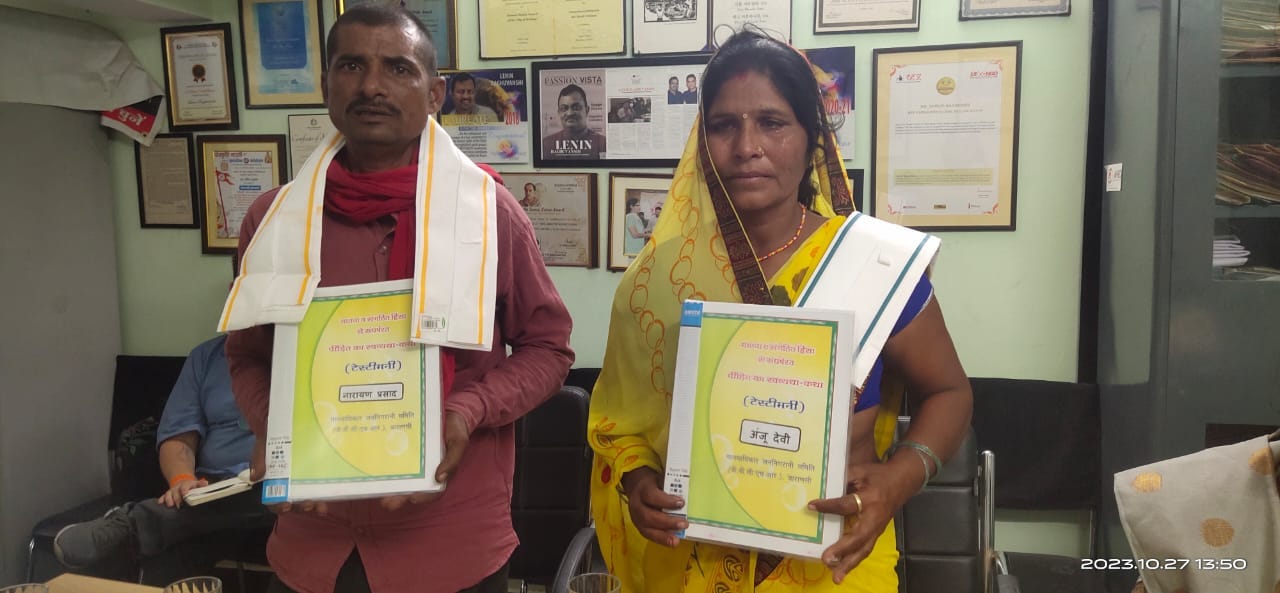
Parents received testimonies during an honor ceremony as part of testimonial therapy, a form of brief narrative therapy
In a democracy, law enforcement’s role is to safeguard the rights and dignity of citizens. However, when those entrusted with protection turn into oppressors, the consequences are devastating. The recent case of police brutality, reported by human rights defender Lenin Raghuvanshi in Kaushambi, Uttar Pradesh, underscores the urgent need for mechanisms like the National Human Rights Commission (NHRC) to intervene and provide oversight. The Commission’s prompt response in calling for a detailed investigation into the death of Vijay Soni is a testament to its commitment to upholding justice and human dignity, even in the most challenging circumstances.
Overview of the Case
On September 10, 2023, a disturbing incident unfolded that led to the tragic death of Vijay Soni. Allegedly abducted and brutally beaten by police officers, Vijay was killed under suspicious circumstances, framed as an encounter. His family, despite their desperate attempts to locate him, found no trace of his whereabouts until a chilling call revealed that Vijay had been shot and was at Swaroop Rani Hospital. The claim that Vijay’s death was the result of a police encounter, rather than custodial violence, raised serious concerns about extrajudicial killings and police excesses.


The photos capture the essence of honor ceremonies, serving as a part of brief narrative therapy within the framework of Testimonial Therapy. These ceremonies provide a platform for individuals to share their stories of resilience and healing, transforming personal narratives of trauma into empowering testimonials.

Additionally, newspaper clippings related to accidents and human rights violations offer further context, highlighting the real-world challenges faced by communities. These visuals not only document injustices but also serve as a reminder of the ongoing need for justice, advocacy, and human rights work.
The Broader Context of Police Brutality in India
The Vijay Soni case is not an isolated one in India. Cases of custodial violence, torture, and extrajudicial killings have been a persistent issue in India, reflecting deeper systemic problems within law enforcement. While India’s Constitution guarantees fundamental rights to life and personal liberty, the reality for many, especially those from marginalized communities, paints a starkly different picture. In recent years, police brutality has made headlines across the country, from major urban centers to rural villages, highlighting a pattern of abuse of power by law enforcement.
Custodial deaths, in particular, have become a grave concern. According to the National Crime Records Bureau (NCRB), India witnesses hundreds of custodial deaths every year, many of which are attributed to torture, ill-treatment, or negligence by police. These violations disproportionately affect the poor, Dalits, Adivasis, and religious minorities, reinforcing the systemic discrimination that permeates law enforcement practices.
NHRC’s Role: A Beacon of Hope in Dark Times
The NHRC has served as a critical watchdog in India, holding state and law enforcement agencies accountable for human rights violations. In the case of Vijay Soni, the Commission demonstrated its effectiveness by promptly directing the Superintendent of Police, Kaushambi, to submit comprehensive reports, including FIRs, postmortem details, and forensic findings. Such actions are crucial to ensuring that the truth is uncovered and that justice is served.
This intervention is in line with the NHRC’s broader mandate to investigate cases where the police use excessive force or act outside the bounds of law. Established in 1993 under the Protection of Human Rights Act, the NHRC has, over the years, played a pivotal role in examining custodial deaths, police encounters, and other forms of state violence. Its intervention in such cases ensures that abuses of power are not swept under the rug and that those responsible are held accountable.
Challenges Facing Human Rights in India
While the NHRC’s role is crucial, it operates within a challenging environment. Human rights defenders and civil society organizations in India have often faced significant hurdles when attempting to expose state-sponsored violence or police misconduct. In many cases, whistleblowers are threatened or harassed, and victims’ families are silenced through intimidation or coercion. The culture of impunity that surrounds many law enforcement agencies in India remains a significant barrier to achieving justice.
Moreover, the NHRC itself has faced criticism over the years for being slow in its investigations or for not being able to enforce its recommendations adequately. Although the Commission can recommend compensation, disciplinary action, or further investigations, its recommendations are not binding, which sometimes allows state authorities to sidestep accountability. Strengthening the NHRC’s powers and increasing its capacity to enforce its recommendations could help address some of these challenges.
Systemic Reform: The Need for Comprehensive Police Reform in India
The Vijay Soni case sheds light on a broader issue: the urgent need for comprehensive police reform in India. The country’s law enforcement agencies are often undertrained, understaffed, and overstressed, which leads to a culture where custodial violence and extra-judicial killings are normalized. Police officers, especially at the lower levels, frequently operate with limited oversight, and many lack adequate training in human rights, conflict resolution, and community engagement.
There have been numerous calls for police reform over the years. Commissions such as the National Police Commission and the Supreme Court of India have recommended reforms that include establishing independent police complaint authorities, separating law and order functions from investigative functions, and improving accountability measures within police forces. However, the implementation of these recommendations has been slow and inconsistent across states.
In a country as diverse and complex as India, policing must be sensitive to social and cultural differences. Many cases of police brutality stem from caste-based and religious discrimination, which is deeply ingrained in certain parts of the country. Reforms must therefore not only address procedural changes but also work towards transforming the culture within law enforcement agencies.
NHRC’s Role in Promoting Justice for Marginalized Communities
The NHRC’s intervention in the Vijay Soni case, while commendable, is part of its broader mission to protect marginalized and vulnerable communities. In India, individuals from Dalit, Adivasi, and Muslim communities are often the primary victims of police excesses. Many of these communities already face socio-economic hardships, and the added burden of state-sponsored violence only exacerbates their plight.
By ensuring transparency and accountability in cases like Vijay Soni’s, the NHRC acts as a safeguard for these marginalized groups, ensuring that their voices are heard and their grievances addressed. However, the Commission’s work is far from complete. For India to truly uphold the principles of justice and equality enshrined in its Constitution, there must be a concerted effort to empower human rights institutions and dismantle the structures of oppression that enable police brutality.
NHRC as a Guardian of Human Rights
The NHRC’s swift action in the Vijay Soni case is a beacon of hope in a country grappling with the challenges of police brutality and custodial violence. By holding public officials accountable, the NHRC ensures justice for victims and strengthens the rule of law in India. However, this case also highlights the pressing need for systemic reforms within India’s law enforcement agencies. While the NHRC can act as a check against abuses of power, true change will only come when the police system itself is reformed to prioritize human rights and the dignity of every individual.
As India continues its journey towards becoming a more just and inclusive society, institutions like the NHRC must be supported, strengthened, and empowered to carry out their mandate effectively. Only then can cases like Vijay Soni’s serve as a turning point in the fight against police brutality and the protection of human rights in India.
Links for details of case: https://pvchr.blogspot.com/2024/10/national-human-rights-commission-calls.html
메타데이터
- post_id
- ed7b30688bcb
- slug
- the-national-human-rights-commissions-vigilance-a-beacon-of-hope-amidst-police-brutality-ed7b30688bcb
- url
- https://medium.com/@shruti_25784/the-national-human-rights-commissions-vigilance-a-beacon-of-hope-amidst-police-brutality-ed7b30688bcb
- canonical_url
- https://medium.com/@shruti_25784/the-national-human-rights-commissions-vigilance-a-beacon-of-hope-amidst-police-brutality-ed7b30688bcb
- author_url
- https://medium.com/@shruti_25784
- status
- ok
- fetched_at
- 2026-06-20 20:29:01