Beijing 2022 and the Trains
There is no doubt that, this time ’round, the Olympics in Beijing have never been more controversial. And it’s not just the politics, but…
Beijing 2022 and the Trains
There is no doubt that, this time ’round, the Olympics in Beijing have never been more controversial. And it’s not just the politics, but the fact that there’s going to be a huge amount of artificial snow in use.
That’s “artificial” the undesired way. Yet another “artificial” element comes in the form of the rails, which are desired because, unlike a gearstick-shifting road monster, rail travellers have some very low carbon footprints. It’s also incredibly hard to find a car with even a 7th gear (on a select few) able to power the thing up to 350 km/h, a feat easily accomplished by a train.

They’re finally here (like it or loathe it): Beijing 2022
On the first full day of the Games, I decided to head to Qinghe Railway Station to ride the rails to and from Yanqing station, to get my two railway tickets printed (officially, as “expenses receipts”; in reality, as souvenirs). (They’re now digitised for posterity.)
Surprise: English-speaking ticket machines
When Beijing 2008 was reality, ticket machines could still offer rides an English interface, but for some reason, that option was taken away some years later. So it’s good to see, for 2022, the return of the English option on China Railways’ ticket machines.
Unlike 2008, today, ID is necessary for all travelling by rail, a requirement now part of China’s national security laws. However, the vast majority of machines struggle with passports, but those at Qinghe are equipped with passport readers, and the software has been programmed to take them.

Finally, the English interface on Chinese railway ticket machines is back!
Being one of the few expats in town granted a Chinese Green Card, these were a delight to use. I could easily get tickets, print itineraries, and pick up expense receipts (blue tickets) using just my Green Card. Passport holders could do the same on machines that supported them; it’s just a case of putting the data page of a machine-readable passport onto the reader.
Buying tickets was easy-ish. Of course, you could barge ahead and buy a ticket to major destinations for same-day departures on the same day by default, but there were also options to fine-tune them. This actually meant any machine could sell you tickets from any two points in Mainland China. You could further customise this with a specific date and time of departures, as well as your preferred class of travel.
After you picked your intended train, you were to present the identity document, then pay. Usually, the machine would spit out your itinerary (still mostly in Chinese). During the pandemic, you were also required to leave behind your email address or a mobile phone number. And that, in essence, was pretty much it.
Limited Edition Tickets
This was easily the showstopper of the day. These limited edition tickets — strictly speaking, limited edition expenses receipts, as well as equally limited edition itinerary slips — had everything to do with trains and the Games.

Remember, folks, these are TRAIN tickets, so of course there are TRAINS on them, right?…
The blue tickets had imagery of the new Fu Xing/Revival trains, athletes, and the old steam locomotives next to Badaling Tunnel on the Imperial Peking-Kalgan Railway, as well as a statue of the man behind that railway, Zhan Tianyou.
The white itinerary slips had what must resemble closest the unique Suzhou numerals, a numeral system China used before it joined most other countries in using Arabic numerals. (Language geeks: even today, three of these are still in use — those representing the numbers zero, ten, and thirty.) This railway line used these unique numerals to represent mileages and other “number crunching” data.
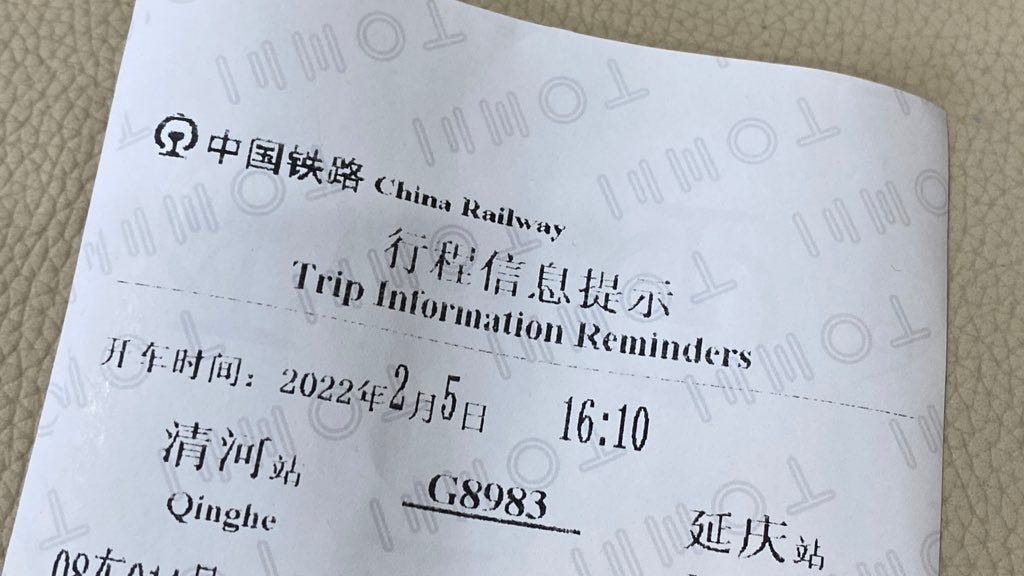
Achtung: This is not “Chinese Morse Code”!
The Exclusive Beijing 2022 “Snow” Blue Train
The Snow Express, a unique, customised version of the CR400BF-C trains on the Beijing-Zhangjiakou HSR, is unique in many ways. Car 8 features a TV studio, and the Business Class seats are Solo Suites.
Access to these trains is generally reserved for people having actual business with the Games — spectators, but far more likely to be athletes, staff, and media. It’s far more likely these trains will be available only to those in the Games Bubble, or known locally as the “closed loop”.
I know this because today, the departure board for that very train read Taizicheng, which is reserved for Winter Olympics personnel and has been temporarily cordoned off from the general public. Trains sold to non-Bubble people generally terminate at Chongli.

Welcome onboard (provided you qualify!)…
The Games Bubble
One unfortunate element of the Games is that, due to the current pandemic, those coming in from abroad, as well as others part of the Games circle, must stay in a Winter Games Bubble, locally known also as a “closed loop management system”.
Enforcement of this varies. At Qinghe station, Games Bubble personnel arrive at the station from the elevated drop-off access point, and enter the station headed straight for the platforms, behind a glass wall fully sealed off and separated from others. At Yanqing station, however, they can share the same platform and walk almost side by side next to the general public (although behind two levels of barriers). Onboard, certain carriages are reserved for Games personnel inside the Bubble.
Although case levels are low even inside the Bubble, I took the extra precaution of travelling today not just with an FFP2 face covering, but also with a face shield, something I removed outside and when doors on the train were open.
The First — No, Wait, Second — 350 km/h Olympics
Finally, if you thought this was the first 350 km/h Olympics, you’re actually in the wrong. The very same city, Beijing, hosted the 2008 Summer Olympics, and just a week before the opening ceremony, a 350 km/h line opened to nearby Tianjin, which also held some events.

Careful: This (312 km/h) is actually not “fast enough” for China!
Rolling stock, however, saw huge improvements. For 2008, we had what were basically — let’s be frank — imported trains from Germany and Japan. For 2022, though, I’m closer to agreeing that the trains on the rails are actually considerably more Chinese.
Still, this goes to show that there’s also a Green way to run the whole thing, and if in 2008, 350 km/h trains brought you between two cities (we had more, including Hong Kong, host other competitions back then), in 2022, these trains form pretty much the backbone of intercity travel for the Olympics.
However, what I think those of us ‘trapped’ in the Bubble will miss is quality, authentic Chinese food. 88+ Renminbi for a tuna sandwich? These tweets show that, even with management perfected as much as possible Games time, there’s still a lot more left desired.
(And by the way, the food onboard these trains aren’t always pitiful, either. I have my favourites on the menu!…)
메타데이터
- post_id
- ed98df3efd27
- slug
- beijing-2022-and-the-trains-ed98df3efd27
- url
- https://medium.com/@davidfengdf/beijing-2022-and-the-trains-ed98df3efd27
- canonical_url
- https://medium.com/@davidfengdf/beijing-2022-and-the-trains-ed98df3efd27
- author_url
- https://medium.com/@davidfengdf
- status
- ok
- fetched_at
- 2026-07-08 21:20:17