The Word Says Human. The Posture Says Look Again.
Street photography, public language, and the gap between the labels we display and the embodied lives we actually carry through the street
The Word Says Human. The Posture Says Look Again.
Street photography, public language, and the gap between the labels we display and the embodied lives we actually carry through the street
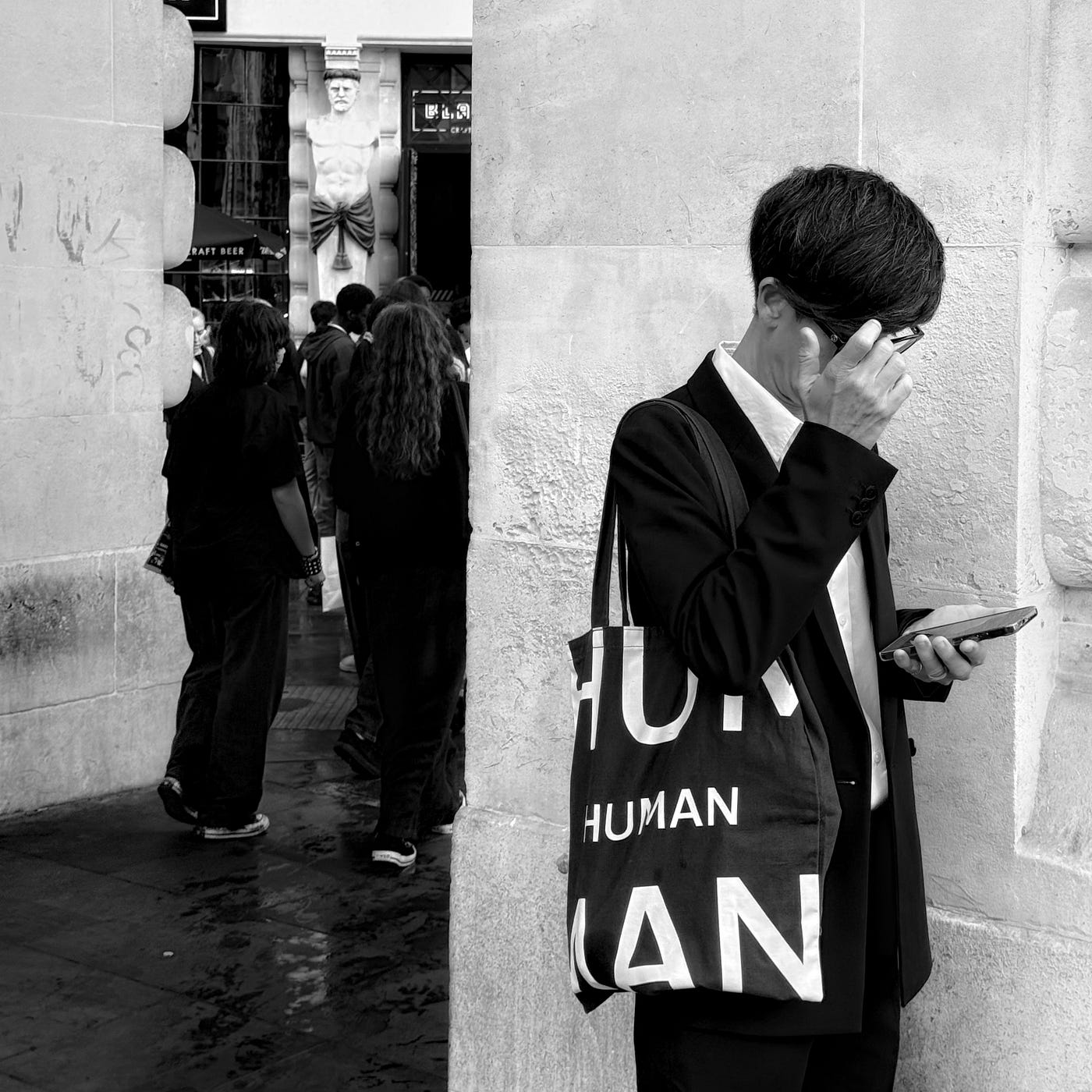
London, UK © 2026 Julien Valleton
The bag says HUMAN.
That should settle things.
It should be the clearest part of the frame. The most direct message. The easiest reading. A word large enough to organize the scene at first glance.
And yet the photograph does something more interesting than simply confirm it.
Because the word says human. The posture says: look again.
A person stands against a pale stone wall, half-withdrawn into a private gesture. One hand touches the face. The other holds a phone. The body is present, but not fully offered. Nearby, through the opening, a crowd moves past a sculpted figure whose body is exaggerated, monumental, almost theatrical. The composition splits the image into two regimes at once: the branded word and the lived body, the public sign and the private posture, the readable label and the more ambiguous human reality it fails to summarize.
That is what makes the image strong.
It does not merely show a person carrying a tote bag with a meaningful word printed on it. It shows the distance between language and embodiment. Between what can be declared in public and what must still be read through gesture, tension, angle, timing, and the quiet partiality of presence.
The bag says human. The photograph asks whether that word is ever enough.
Public language loves clarity
Words in public space are built for speed.
They are meant to land quickly. To brand, instruct, persuade, signal, simplify. They flatten complexity into something portable and immediately legible.
That is part of their function.
A sign says stop. A storefront says luxury. An ad says desire. A slogan says identity. A tote bag says something about values, irony, politics, taste, self-image, or affiliation.
The word HUMAN works like that at first.
It looks like a completed statement. A stable category. A universal term. Perhaps even a moral reassurance.
But the photograph undermines that simplicity.
Because the body carrying the word is not offering us “human” in the abstract. It is offering us one highly specific human moment: partial withdrawal, divided attention, self-touch, privacy in public, mild tension, maybe fatigue, maybe shielding, maybe nothing more dramatic than a brief pause. The point is not that we know exactly what the person feels. The point is that the body immediately exceeds the word.
Language summarizes. Posture complicates.
And that gap is where the image begins.
The first look reads the word. The second look reads the body.
This is why the frame works so well as a Second Look image.
The first look is captured by the large visible label. It feels like the photograph has handed us a theme.
Human. There it is. Clear enough.
But the second look notices that the actual human content of the image is elsewhere.
In the tilt of the head. In the hand touching the face. In the slight inwardness of the posture. In the way the body leans not toward declaration but toward partial concealment. In the phone, which suggests contemporary mediation without needing to become the whole point. In the fact that the person is both publicly visible and privately unavailable.
Now the word begins to feel insufficient.
Not false. Just insufficient.
That is one of the most valuable things street photography can teach: the labeled layer is rarely the deepest one. The body often tells a denser truth than the text nearby, because the body carries tension, timing, vulnerability, adaptation, and lived ambiguity in ways public language usually cannot.
The first look sees the printed idea. The second look encounters embodied life.
The body resists abstraction
This matters because modern life is full of abstractions about people.
Consumer. Citizen. User. Worker. Creator. Tourist. Follower. Customer. Audience. Human.
Each of these words does something useful. Each also leaves something out.
The body is harder to flatten.
A body in public space is never just a concept. It is always carrying more than the category can hold: mood, pressure, tiredness, self-protection, rhythm, social exposure, aging, awkwardness, style, hesitation, inner weather, distraction, care, the residue of the day.
That is why the photograph becomes so interesting the moment you stop reading the tote bag as the subject and start reading the body.
Now the image is no longer mainly about a word. It is about the inadequacy of the word.
Not because “human” is wrong, but because it is broad where life is specific. It is neat where presence is messy. It is public language trying to stabilize what embodied reality keeps making unstable.
Street photography thrives in that instability.
The crowd in the background matters too
The opening on the left side of the frame deepens the image.
Without it, the photograph might remain a quieter portrait of a person beside a wall with an ironic or meaningful tote bag. But the background crowd changes the logic. It reminds us that this is not a private scene. It is a public one. Human beings moving in flow, partially faceless, partially interchangeable at first reading, framed by architecture and watched over by a sculpted male figure that exaggerates bodily presence in a completely different register.
This contrast is subtle but powerful.
The statue is body as symbol. The crowd is body as movement. The main figure is body as signal.
And the tote bag sits inside all of that, trying to name something universal while the image keeps insisting on particulars.
That is one reason the frame feels intelligent. It does not oppose word and body in a simplistic way. It stages several forms of “human” at once:
the declared human, the monumental human, the crowd human, the embodied singular human.
The viewer is left to navigate between them.
The gesture of touching the face changes everything
If the person were standing upright, open, expressive, almost poster-like, the word on the bag might dominate. The image would become more graphic, more declarative, perhaps even more satirical.
But the self-touch gesture complicates the whole reading.
A hand to the face is one of those small bodily signs that immediately introduces interiority. It may indicate thought, discomfort, shielding, concentration, tiredness, momentary overwhelm, adjustment, or simply the tiny practical acts bodies perform all day in public without theatrical intention.
That is exactly why it matters.
Because it returns the image to lived human specificity.
The word says human in general. The gesture says this human, right now, under these conditions.
Street photography becomes more powerful whenever it catches that shift from abstraction to incarnation.
Modern identity often arrives as text plus device plus body
This is another reason the image feels contemporary.
The person carries: a public word, a phone, a bodily gesture.
That combination is almost a summary of modern urban presence.
We move through the city with labels attached to us or chosen by us, with devices in hand, with private psychological weather still visible in posture if someone is patient enough to notice it. We are at once branded, connected, distracted, exposed, and embodied.
The frame catches that without overstating it.
It does not scream a thesis. It lets the arrangement do the work.
The phone suggests mediation. The tote suggests language and identity. The gesture suggests embodied truth. The wall suggests public surface. The crowd suggests social life continuing around the scene.
That is enough.
The image asks what language misses
This may be the heart of the photograph.
What does the word human fail to tell us?
It does not tell us how the body is holding itself. It does not tell us the quality of this pause. It does not tell us whether the gesture is protective, tired, distracted, or simply passing. It does not tell us how public and private are colliding in this second. It does not tell us what it feels like to be a body in a city while still managing a self.
And that is where street photography enters.
Because the medium is unusually good at restoring what general language leaves out. It returns us to the specific arrangement of life in one unrepeatable moment. It says: yes, the word is there, but the body is here. Read both. Trust neither too quickly. Let the gap teach you something.
The second look is a humanizing tool
This is why the article matters beyond this one image.
The first look in modern life often stops at the label.
A role. A style. A slogan. A political sign. A brand. A category.
The second look asks what the body is carrying that the label does not contain.
That is not only a photographic discipline. It is an ethical one.
To look twice is to resist reduction. To let posture matter is to let embodied reality complicate abstraction. To notice the human being beyond the printed word is to recover a deeper form of attention.
That is exactly what this image offers.
A 15-minute exercise: photograph the gap between word and body
Try this on your next walk.
Look for words in public space: tote bags, T-shirts, ads, menus, signs, storefronts, slogans, branded surfaces, public instructions.
Do not photograph the word alone.
Wait for a body to complicate it.
A posture that contradicts the slogan. A gesture that deepens the phrase. A mood that exceeds the label. A human presence that makes the text feel thinner, stranger, sadder, funnier, or more revealing than it first seemed.
Make only six photographs.
One should let the word dominate at first glance. One should let the body take over on a second look. One should use a public phrase that becomes unstable in context. One should show a gap between identity language and embodied reality. One should use background figures or architecture to widen the reading. And one should answer this question: what did the word claim to explain that the body immediately made more complex?
When you review them later, ask:
Did I photograph text in the street? Or did I photograph the limit of text when confronted with a living body?
That is the exercise.
Why this matters beyond photography
Because modern life constantly invites us to mistake labels for understanding.
The label may be political. Commercial. Social. Personal. Moral. Psychological.
But human beings are always more than the clean word attached to them.
Street photography reminds us of that by returning us to embodiment. To posture, gesture, timing, and the ordinary complexity of being alive in public. It gives us back the ability to say: the word may be true at one level, but the body asks for a second reading.
That is a valuable skill now.
Not only for making images. For staying human among abstractions.
One question to walk with
Next time you see a word in public space trying to explain a person, an identity, or a value, carry this:
If the text offers the first reading, what is the body doing in this same moment that makes the human reality larger, stranger, or more specific than the word can hold?
That is often where the stronger photograph begins.
If this helped you see differently, keep going:
Follow me on Medium for the next article.
Or join **Street Photography Lab**, my newsletter where I turn books into weekly field missions for attention, perception, and clearer thinking in the age of AI.
메타데이터
- post_id
- eda46ac637ea
- slug
- the-word-says-human-the-posture-says-look-again-eda46ac637ea
- url
- https://medium.com/@Street_Photography_Lab/the-word-says-human-the-posture-says-look-again-eda46ac637ea
- canonical_url
- https://medium.com/@Street_Photography_Lab/the-word-says-human-the-posture-says-look-again-eda46ac637ea
- author_url
- https://medium.com/@Street_Photography_Lab
- status
- ok
- fetched_at
- 2026-08-10 21:46:50