Machine Learning for Edge Computing
What is Machine Learning?
Machine Learning for Edge Computing
What is Machine Learning?
Machine learning is a subfield of artificial intelligence, which is broadly defined as the capability of a machine to imitate intelligent human behavior.
What is Embedded Machine Learning?
Embedded machine learning refers to the integration of machine learning into embedded systems, such as IOT devices, mobile phones or any smart devices. These allows system to have more advanced and sophisticated capabilities such as image recognition, natural language processing, etc.
Embedded ML is also known as TinyML.

The difference between Traditional programming and Machine Learning
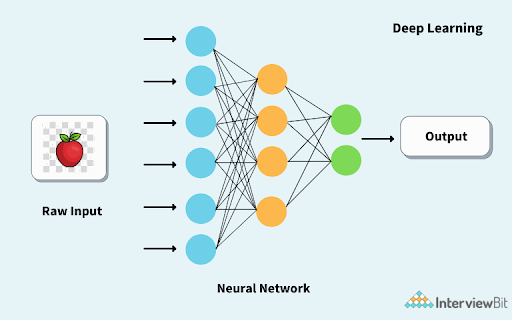
An example of Deep Learning
Types of Machine Learning:
- Supervised Machine Learning
- Unsupervised Machine Learning
- Reinforcement Machine Learning
- Semi-supervised Machine Learning
- Transfer Learning
Supervised Machine Learning
It is a type of machine learning where algorithm trains a labeled dataset, learning to map input data to specific outputs. The goal is to make predictions on new unseen data based on patterns learned from training set.
It is divided into two parts:
a) Regression and b) Classification
a) Regression
Regression is a statistical method used to model the relationship between a dependent (output) variable and one or more independent (input) variables. The goal of regression is to find the line of best fit (in linear regression) or a more complex function that predicts the dependent variable based on the values of the independent variables. Regression analysis is used in many fields, including finance, economics, and engineering, to make predictions, study relationships, and gain insights into a system or phenomenon.
b) Classification
Classification is a machine learning technique that involves assigning a categorical label to an input sample, based on a trained model. The goal of classification is to learn a mapping between input features and output labels, so that given a new, unseen sample, the model can predict its class label based on the inputs. Common applications of classification include image classification, sentiment analysis, and spam filtering.
Unsupervised Machine Learning
It is a type of machine learning where the algorithm trains on a unlabeled dataset, looking for patterns or structures in the data without any pre-existing labels. The goal is to discover hidden relationships in data.
Reinforcement Machine Learning
Reinforcement Machine Learning (RL) is a subfield of Artificial Intelligence and Machine Learning, that focuses on learning by trial-and-error, where an agent interacts with an environment to maximize a reward signal. The agent learns to make sequences of decisions based on the current state of the environment to reach a goal. In RL, an agent continuously takes actions, receives rewards, and updates its policy to improve its performance over time. Applications of RL include robotics, gaming, recommendation systems, and control systems.
Semi Supervised Machine Learning
Semi-supervised Machine Learning is a field of machine learning that combines the strengths of both supervised and unsupervised learning. In supervised learning, the model is trained on a labeled dataset, where the ground truth is provided for each sample. In unsupervised learning, the model is trained on an unlabeled dataset, where no ground truth is provided. In semi-supervised learning, the model is trained on a combination of labeled and unlabeled data. The goal of semi-supervised learning is to make use of the vast amount of unlabeled data available to improve the performance of the model compared to supervised learning with a limited amount of labeled data. Applications of semi-supervised learning include image classification, speech recognition, and natural language processing.
Transfer Machine Learning
Transfer learning is a method of training machine learning models where a model is trained on one task. This idea is to take advantage of knowledge gained from solving first task and apply it to second task. Training gets accurate and faster.
What are the use cases of Machine Learning?
Object Recognition, Natural Language Processing, Prediction, Speech and Sound Detection, etc;.
What is model in Machine Learning?
Machine learning model can be a mathematical representation of real word process. To generate a machine learning model user will need to provide training data to machine learning algorithm to learn from.

Model in Machine Learning
Training v/s Inference
Training: It is the process of Machine Learning algorithm builds a model of the system based on data we provide.
Inference: The process of running data through the model to make predictions.
What is Tensor?
A Tensor is a multi-dimensional array used in mathematical computations in a variety of fields, especially in machine learning. Tensors can represent scalars, vectors, matrices, and higher-dimensional arrays. In deep learning frameworks such as TensorFlow, PyTorch, etc., tensors are the basic building blocks for representing data and perform computations on them.

Tensor matrices
Challenges for Machine Learning
- Overfitting: When a model is too complex and captures the noise in the data instead of the underlying pattern.
- Underfitting: When a model is too simple and is unable to capture the complexity of the data.
- Data quality and quantity: Insufficient or biased data can negatively impact the performance of the model.
- Hyperparameter tuning: The process of selecting the optimal set of hyperparameters for a model can be challenging and time-consuming.
- Feature engineering: Transforming raw data into features that can be fed into a model is a critical step that can greatly impact the performance of the model.
- Model interpretability: Complex models may be difficult to interpret, making it hard to understand their decisions and reasoning.
- Computational resources: Training large models on large datasets requires significant computational resources, making it a challenge for some organizations.
Workflow for Machine Learning Projects
Decide the goal → Collect Dataset → Design a Model Architecture → Train the model → Convert the model → Run inference → Evaluate and troubleshoot
Tools: Edge Impulse

Edge Impulse Tool Flow
Edge Impulse is an IoT platform that allows developers to build and deploy machine learning models for edge devices, such as microcontrollers and single-board computers. The platform provides tools for data collection, preprocessing, feature extraction, and model training, allowing developers to quickly create and deploy ML models that run locally on edge devices.
메타데이터
- post_id
- eda627b7dcc5
- slug
- machine-learning-for-edge-computing-eda627b7dcc5
- url
- https://medium.com/@20it128/machine-learning-for-edge-computing-eda627b7dcc5
- canonical_url
- https://medium.com/@20it128/machine-learning-for-edge-computing-eda627b7dcc5
- author_url
- https://medium.com/@20it128
- status
- ok
- fetched_at
- 2026-07-26 04:29:58






