Jensen Huang and the Compute Layer Behind the AI Boom
Everyone talks about AI. But the modern AI revolution also depends on GPUs, data centers, and the infrastructure Jensen Huang helped build.
Jensen Huang and the Compute Layer Behind the AI Boom
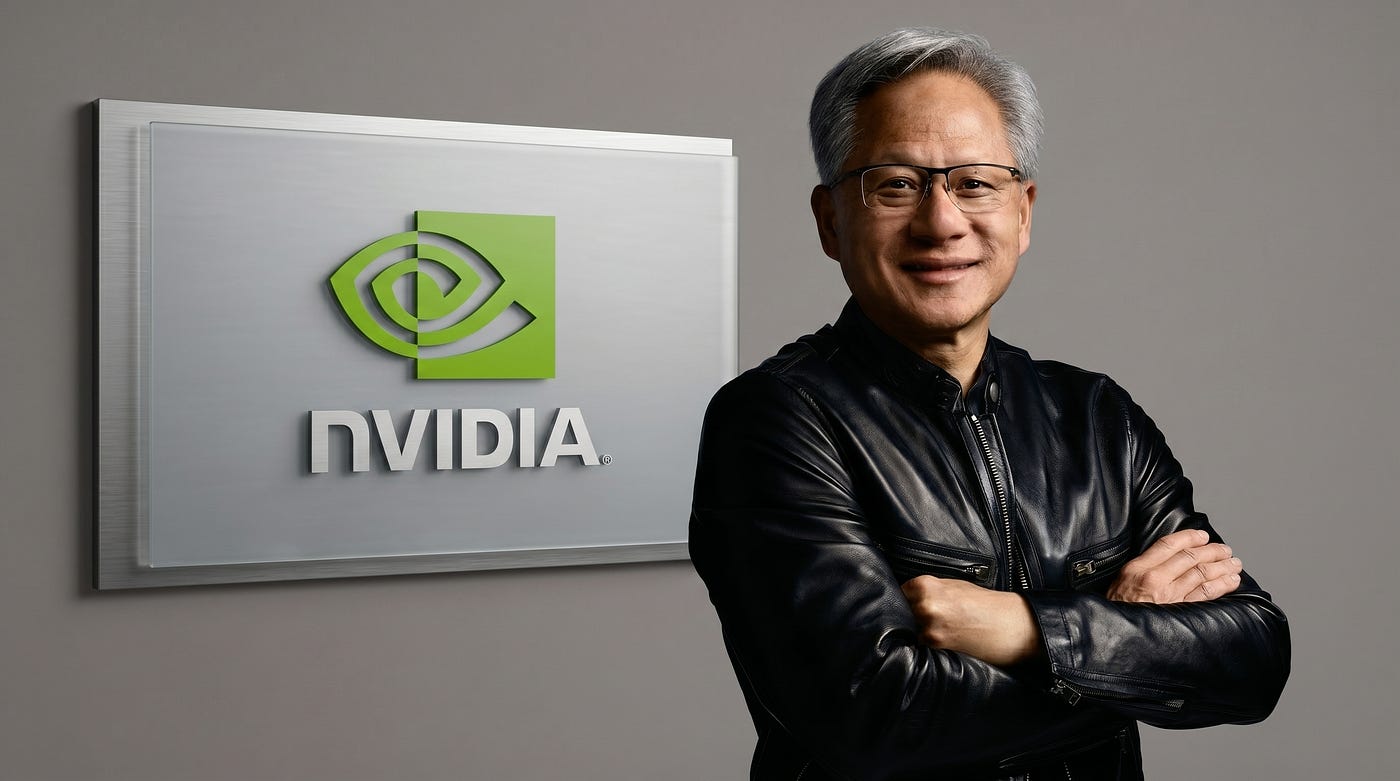
Jensen Huang helped position NVIDIA at the center of the AI infrastructure race.
The AI boom has a hardware story
When people talk about artificial intelligence, they usually talk about the visible tools.
Chatbots. Image generators. Coding assistants. AI search. Autonomous agents. Voice tools. Productivity apps.
That makes sense. These are the things people use.
But underneath all of that is a less visible layer: compute.
Modern AI depends on massive amounts of processing power. Training and running large models requires specialized chips, high-performance data centers, networking systems, software libraries, and developer tools.
This is where Jensen Huang’s story becomes important.
As the founder and CEO of NVIDIA, Huang helped turn a company once known mainly for gaming graphics into one of the most important infrastructure companies in the world.
The AI boom did not come from models alone.
It came from the hardware and software stack that made those models possible.
From graphics chips to AI infrastructure
NVIDIA was founded in 1993 with a focus on graphics.
At the time, that market looked very different from today. GPUs were mostly associated with gaming, 3D visuals, multimedia, design, and rendering. They helped computers process images faster and more efficiently.
But GPUs had a deeper advantage.
They were built for parallel processing.
While CPUs are designed for broad general-purpose work, GPUs are designed to handle many calculations at the same time. That made them ideal for graphics, but it also made them useful for other demanding workloads.
Scientific computing. Simulation. Machine learning. Data processing. Deep learning. Generative AI.
Jensen Huang’s strategic insight was that GPUs could become more than graphics hardware.
They could become a new computing platform.
CUDA changed the game
One of NVIDIA’s most important moves was CUDA.
CUDA allowed developers to use NVIDIA GPUs for general-purpose computing, not only graphics. That made GPUs much more useful for researchers, engineers, and AI developers.
This was not just a technical feature.
It was a platform strategy.
Hardware alone can be replaced. A developer ecosystem is harder to copy.
By building CUDA, NVIDIA gave developers a reason to build around its chips. Research labs, AI teams, cloud providers, and high-performance computing groups became part of a growing ecosystem.
That ecosystem became one of NVIDIA’s biggest advantages.
When AI demand exploded, NVIDIA already had more than chips. It had tools, libraries, software support, and developer trust.
That is why the company was ready when the market shifted.
The AI boom rewarded long-term preparation
Generative AI felt sudden to many people.
But NVIDIA’s rise was not sudden.
The company had spent years investing in GPUs, accelerated computing, data centers, CUDA, networking, AI software, and high-performance computing.
That is the real lesson of Jensen Huang’s career.
Many companies chase a trend once it becomes obvious. NVIDIA prepared for a future that was not obvious to everyone yet.
When large AI models started demanding enormous amounts of compute, NVIDIA was already positioned as the default infrastructure provider for much of the industry.
That does not mean NVIDIA has no competition.
AMD, Intel, cloud providers, startups, and custom AI chip teams are all trying to challenge NVIDIA’s lead. But NVIDIA’s strength is not only in individual chips. It is in the stack around them.
That stack is what makes the company so difficult to replace.
Why GPUs became essential for AI
AI training involves huge amounts of mathematical computation.
Large models process enormous datasets, adjust billions of parameters, and repeat calculations again and again. This is exactly the type of workload where GPUs perform well.
That is why GPUs became central to deep learning.
They allowed researchers to train models faster, experiment more, and scale systems in ways that would have been much harder with traditional computing alone.
As AI models grew, the demand for GPUs grew with them.
Cloud companies needed them. AI startups needed them. Research labs needed them. Enterprises needed them. Governments started paying attention too.
Jensen Huang became one of the most watched CEOs in technology because NVIDIA became central to the AI supply chain.
NVIDIA is not just a chip company anymore
One of the biggest mistakes people make is thinking of NVIDIA only as a GPU company.
Today, NVIDIA is closer to an AI infrastructure platform.
Its ecosystem touches data centers, gaming, robotics, autonomous vehicles, scientific computing, digital twins, professional visualization, healthcare research, and cloud AI systems.
That matters because AI is moving into many industries at once.
The future of AI will not be only about better chatbots. It will involve robotics, simulation, drug discovery, industrial design, automation, edge devices, and scientific research.
NVIDIA wants to power that future.
Jensen Huang often talks about AI factories: data centers built to transform data and energy into intelligence.
That phrase is more than marketing. It shows how NVIDIA wants the world to think about the next computing era.
The risks ahead
NVIDIA’s position is powerful, but not guaranteed.
The company faces serious competition. Cloud giants are building custom AI chips. AMD continues to push in GPUs. Startups are searching for specialized AI hardware opportunities. Governments are watching advanced chips more closely because AI infrastructure has become strategically important.
There are also supply chain risks.
Advanced chips depend on complex manufacturing, packaging, memory, and global semiconductor partnerships. Any weakness in the chain can affect availability and cost.
There is also the risk of market expectations.
When a company becomes central to a technology boom, investors and customers expect constant progress.
NVIDIA must keep proving that its platform is worth the premium.
Still, the company’s advantage is deep. Competitors can build chips, but copying an ecosystem is harder.
What Jensen Huang’s story teaches
Jensen Huang’s career offers a clear lesson for technology builders:
The future often rewards infrastructure before it rewards applications.
People see the apps first, but the infrastructure determines what those apps can do.
The AI tools we use today are built on chips, data centers, software libraries, developer platforms, and years of engineering.
Huang understood that specialized hardware could reshape software. He also understood that a platform is stronger than a product.
That is why NVIDIA became so important.
It did not only sell GPUs. It built the environment where GPUs became essential.
Final thoughts
Jensen Huang’s story is one of the defining business and technology stories of the AI era.
He helped turn NVIDIA from a graphics company into the compute engine behind modern artificial intelligence. His long-term bet on GPUs, CUDA, accelerated computing, and data center infrastructure positioned NVIDIA at the center of a global shift.
The most important takeaway is simple:
AI is not only software.
AI is infrastructure.
And Jensen Huang helped build the infrastructure layer that made the current AI boom possible.
Read the full Encyclotech profile here: Jensen Huang : The Man Behind NVIDIA’s AI Empire
Question for readers
Do you think NVIDIA can keep its AI infrastructure lead, or will custom AI chips from cloud companies change the market?
메타데이터
- post_id
- edb9116e2d75
- slug
- jensen-huang-and-the-compute-layer-behind-the-ai-boom-edb9116e2d75
- url
- https://medium.com/@Encyclotech.com/jensen-huang-and-the-compute-layer-behind-the-ai-boom-edb9116e2d75
- canonical_url
- https://medium.com/@Encyclotech.com/jensen-huang-and-the-compute-layer-behind-the-ai-boom-edb9116e2d75
- author_url
- https://medium.com/@Encyclotech.com
- status
- ok
- fetched_at
- 2026-06-09 15:37:30