Zero Tolerance: Building a Fortress of Code Quality Through CI/CD, Behavioral Testing, and Absolute…
In the software development lifecycle, there is a highly dangerous comfort zone for engineers: accepting the “Good Enough” principle.
Zero Tolerance: Building a Fortress of Code Quality Through CI/CD, Behavioral Testing, and Absolute Static Analysis
In the software development lifecycle, there is a highly dangerous comfort zone for engineers: accepting the “Good Enough” principle.
Usually, this compromise starts small. We lower the minimum Code Coverage threshold to 80%, ignore a few code smell warnings in a Pull Request (PR) due to looming deadlines, or skip performance testing with the classic excuse, “We’ll optimize it later when it’s in production.”
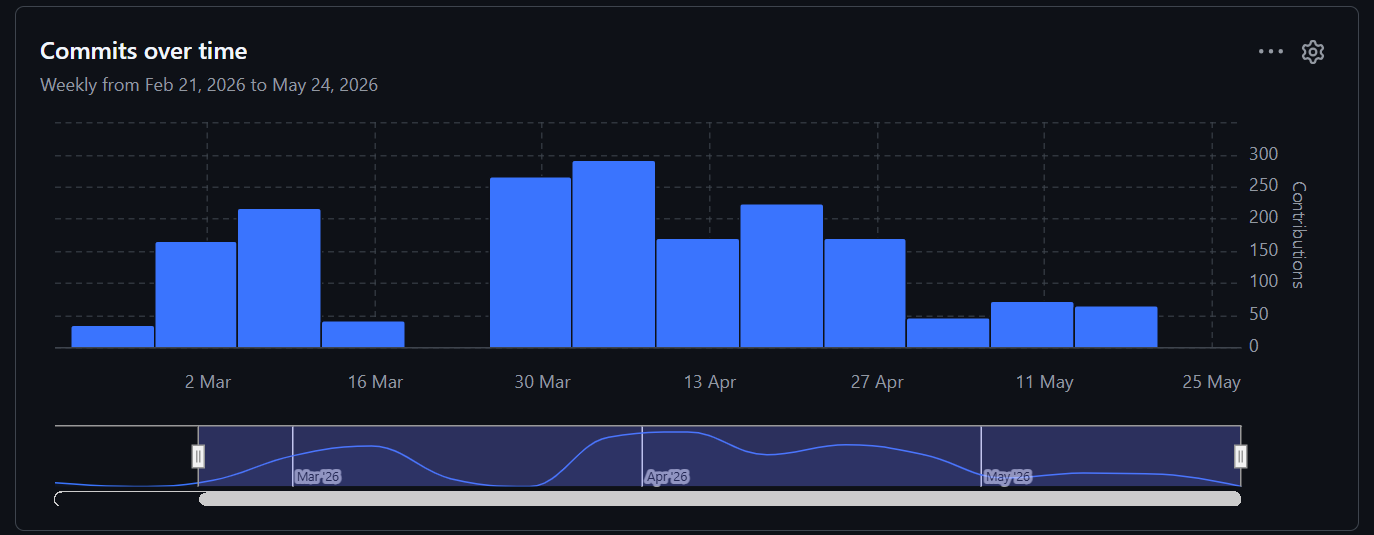
When we began building our new repository, excel-generator-benchmark-llm—a dedicated suite for evaluating Large Language Models (LLMs) against strict spreadsheet schemas—we made a radical decision. We rejected "Good Enough."
Instead of fixing quality issues retroactively, we architected a system where quality is non-negotiable from the very first line of code. This is the story of how our team integrated Behavioral Testing, Load Simulation, and ruthless static analysis to enforce a strict 100% Code Coverage and Zero Issues policy.

Me, myself, and I, when our CI/CD pipeline shows a PR with 99.9% coverage.
The CI/CD Guardrail: Engineering Discipline Beyond the Green Checkmark
Building an entirely new repository for LLM benchmarking is a high-risk endeavor. The logic is incredibly complex — involving prompt engineering, cross-format dataset ingestion, and JSON normalization that is highly prone to breaking. If the foundation of this benchmark is built on technical debt, the resulting AI model evaluations simply cannot be trusted.
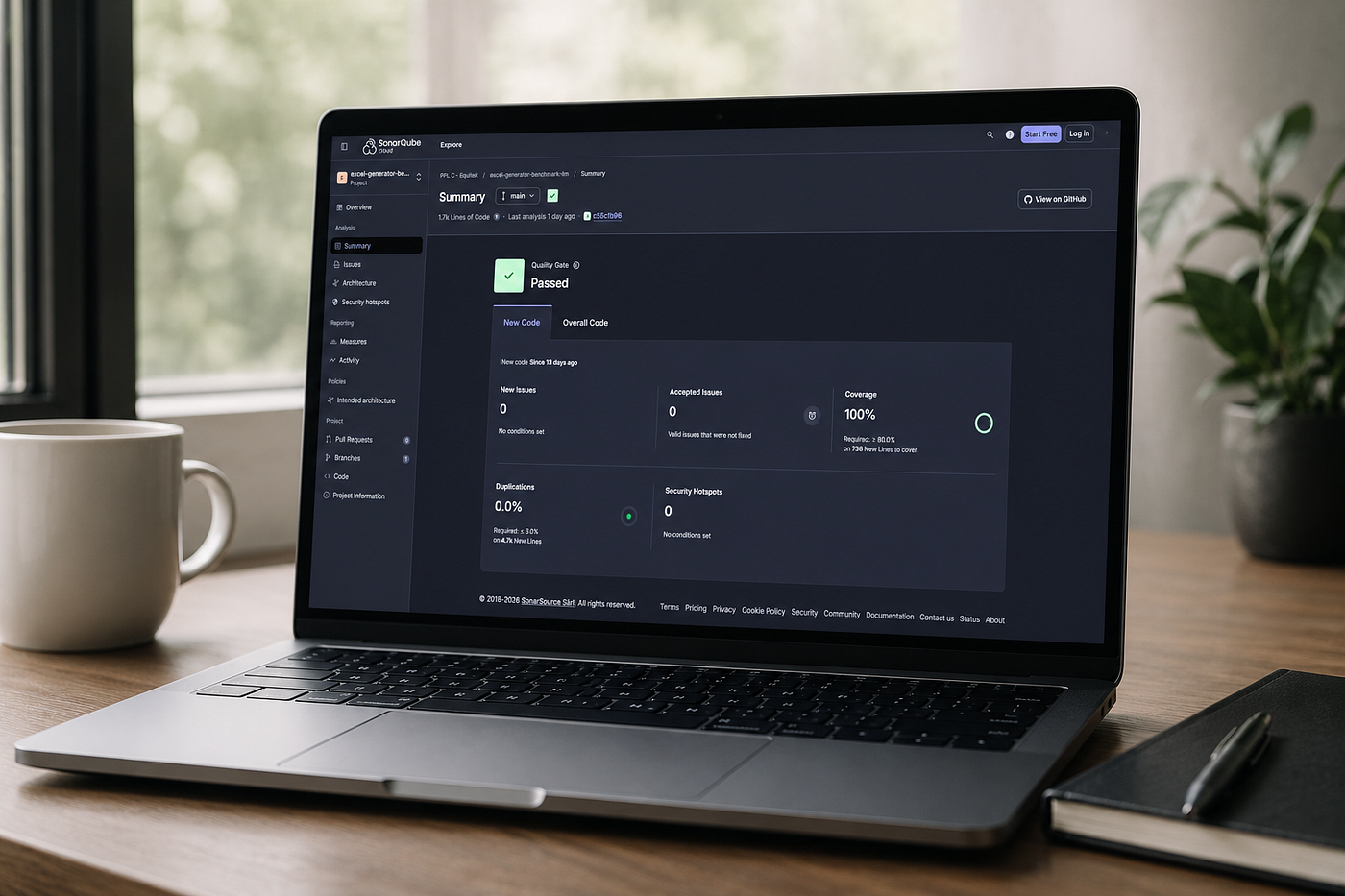
To prevent this, we integrated SonarCloud into our GitHub Actions pipeline. Officially, our system’s Quality Gate is configured to pass if code coverage hits the industry standard of 80%.
But for me, 80% was not good enough. I established a personal, non-negotiable engineering standard: 100% Code Coverage and Zero Issues.

The Gold Standard: An uncompromisingly clean bill of health on our main branch.
Even if SonarCloud flashes a green “Passed” at 85% coverage with a few minor code smells, I flat-out refuse to click the merge button. Every time I open a Pull Request, I treat the SonarCloud scanner not just as a tool, but as a mirror of my own engineering discipline. If it detects an untested logic branch (e.g., a missed EmptyDataError scenario) or a minor code smell, I force myself to halt. The code must be fixed, refactored, and re-tested locally until the dashboard shows absolute zero for issues and absolute 100% for coverage before it is allowed to touch the main branch.
Behavioral Analysis: When Unit Tests Lie to You
While SonarCloud guarantees our code is immaculately clean in the benchmark repository, static analysis only proves that the code works in isolation. As we learned while developing the backend for our core application, having high coverage numbers means nothing if the system's behavior doesn't align with reality in the field.
To bridge this “Desynchronization Gap,” we turned to Behavior-Driven Development (BDD) using Behave. BDD interacts with a genuinely running server and database, transforming business specifications into living, executable documentation.
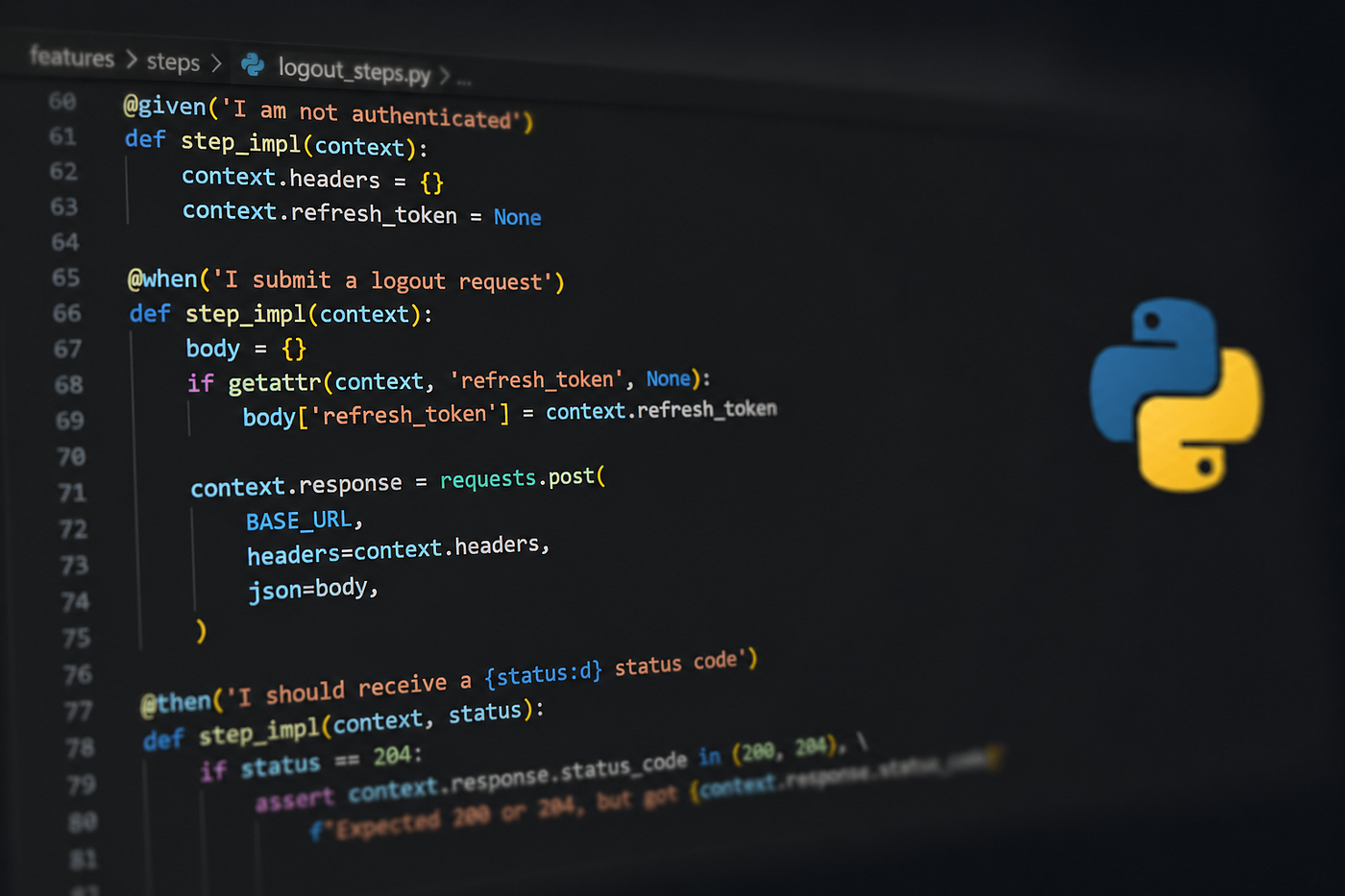
In a previous sprint, our unit tests for the Logout feature passed with flying colors. However, our Behave scenario — which mimics a real user session interaction — failed spectacularly, returning a 401 Unauthorized error.
Well, that BDD test successfully uncovered a highly critical environment parity defect: our Django Shell was creating users in the default auth_user table, while our API was already configured to look for users in a custom auth_users table. Standard unit tests are notoriously blind to infrastructure-level issues like this!
By rewriting the Given steps in Behave to utilize the correct custom model registry, we successfully synchronized the database. The script ran flawlessly end-to-end, validating that our logout endpoint actually destroys sessions securely.
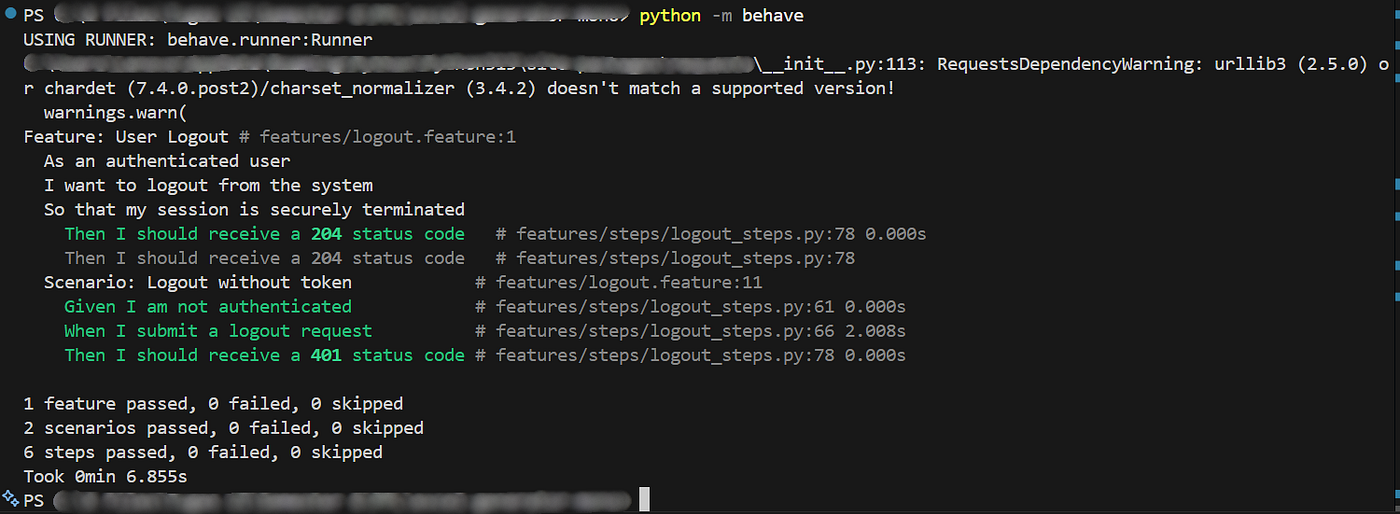
After synchronizing the database models, all 2 scenarios and 6 steps passed end-to-end.
Performance and Security: Testing at the Speed of Light and Deflecting Attacks
Software quality isn’t just judged by what it can do, but by how well it withstands pressure. To ensure the endpoints in our main application possess high-level resilience, we rely on k6 for Load and Security Testing.
In one architectural validation, we needed to test the computational efficiency of our backend’s validation layer without exhausting our third-party API quota (since our registration endpoint triggers real email dispatches). The strategy? We bombarded the system with massively malformed registration payloads. This forced the Django REST Framework (DRF) serializer to work overtime validating the data and rejecting it before it ever touched the external service.
The result? Our system handled 333 iterations with a p(95) latency response time of 5.52ms — shattering our 800ms threshold.
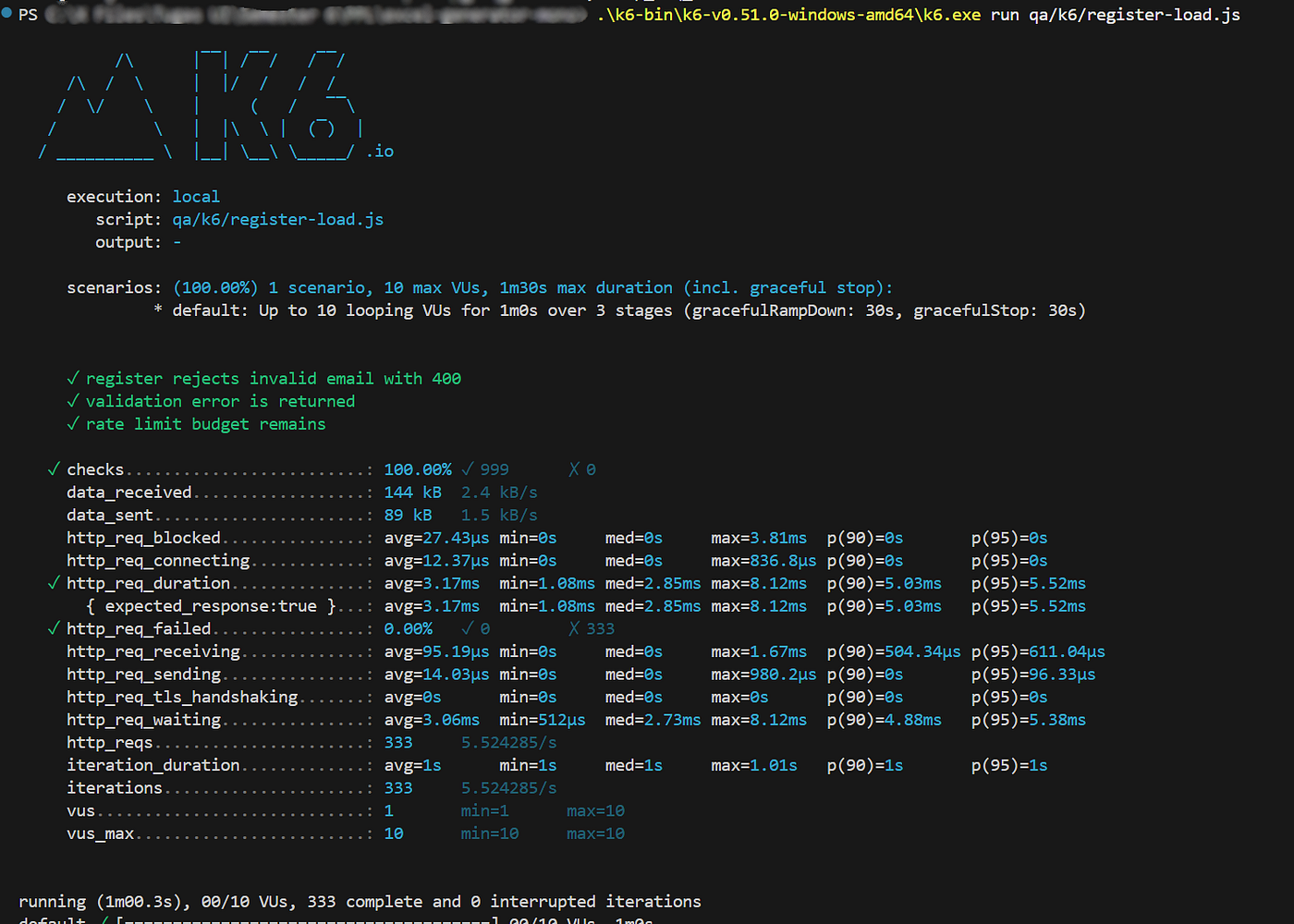
K6 results demonstrating a 100% check pass rate and a p(95) latency of 5.52ms, significantly outperforming our 800ms threshold.
Furthermore, security configuration without verification is just a guess. We configured a rate-limit threshold of 60 requests per minute. To prove it works, we instructed k6 to simulate a “Burst Attack.” The script ruthlessly fired 65 requests. The first 60 requests returned a 400 Bad Request. However, precisely on the 61st beat, the backend flawlessly shifted its status to HTTP 429 Too Many Requests. This empirical proof guarantees that our interface protection system actively and automatically repels abusers.
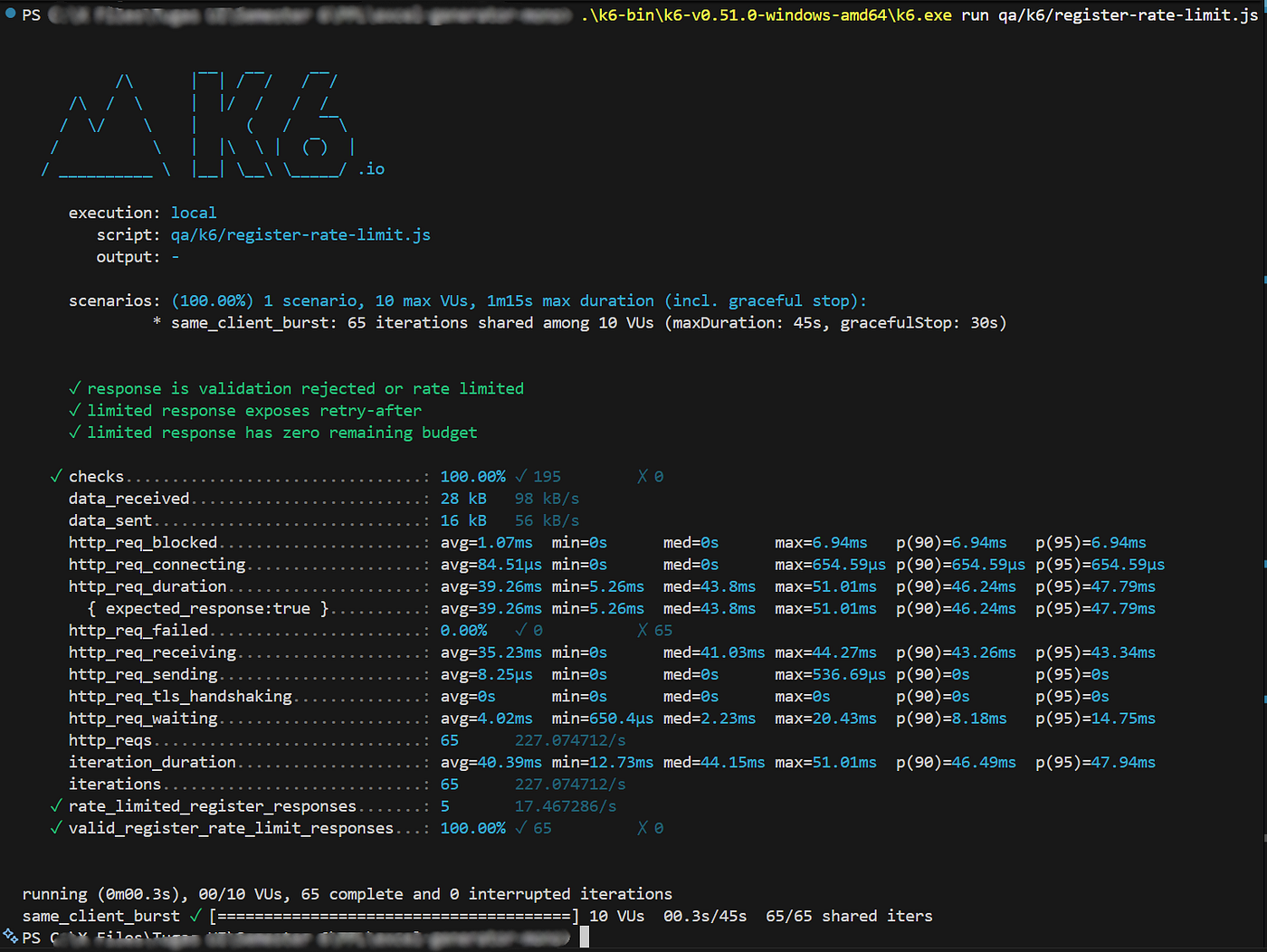
The terminal shows that the rate limit responsed 5 times, exactly after the 60th iteration.
Conclusion: Engineering Trust
The transition from a “writing tests for green checkmarks” mentality to a “building a fortress” mentality has been a turning point for our team. The benefits of this discipline are now backed by empirical data:
- Maintainability: Our CI/CD pipeline in the benchmark repository rejects compromises, locking in quality with 100% coverage and 0 issues via SonarCloud.
- Reliability: Proven performance capable of handling concurrent traffic with a 5.52ms latency.
- Security: Middleware that is mathematically proven to block DDoS attacks exactly at the 61st attempt.
- Behavior: BDD scenarios that successfully catch database misconfigurations before they become disasters in production.
In the high-stakes world of software development, quality isn’t just about the absence of bugs, quality is about the presence of mathematical and behavioral proof.

The inner peace of a software engineer after the program has passed QA.
메타데이터
- post_id
- edc08f6e0967
- slug
- zero-tolerance-building-a-fortress-of-code-quality-through-ci-cd-behavioral-testing-and-absolute-edc08f6e0967
- url
- https://medium.com/@belvaghaniabhinaya2020/zero-tolerance-building-a-fortress-of-code-quality-through-ci-cd-behavioral-testing-and-absolute-edc08f6e0967
- canonical_url
- https://medium.com/@belvaghaniabhinaya2020/zero-tolerance-building-a-fortress-of-code-quality-through-ci-cd-behavioral-testing-and-absolute-edc08f6e0967
- author_url
- https://medium.com/@belvaghaniabhinaya2020
- status
- ok
- fetched_at
- 2026-06-21 09:28:28